
America’s Affordability Crisis

Republicans cannot afford to let 2026 pass without pursuing an offensive legislative playbook for our nation’s future.
Politicos keep talking about an affordability crisis, and they’re not wrong; there clearly is one. But the price pressures everyone is obsessing about sit atop something deeper. The truth is that the affordability crisis is the result of choices, policy decisions made over decades, that reshaped the country in ways that no longer reward responsible behavior. The crisis is not primarily about inflation or deregulation or unemployment, or any other economic metric. It is about a generation of young Americans waking up and realizing that the path they were told to take no longer leads where they were told it would.
We have built a country in which a young person can do well in school, take on debt to get a degree, work full-time, delay gratification, even postpone marriage, and still fail to secure a middle-class life. That kind of change doesn’t just happen. It’s a reflection of how the country has been governed for decades, and the truth beneath all the charts and numbers being thrown around today is that the affordability crisis is a governing crisis: a failure to use power to deliver outcomes that make ordinary life better.
Our country isn’t just dealing with mere financial problems; the way it is governed is becoming unaffordable. And because Republicans claim to be the party of order, family, and competent government, the failure to deliver outcomes lands on them with a special force. They cannot afford to continue confusing restraint with virtue. The decision to refrain from using power is not moderation; it is surrender. And nowhere has that surrender been more obvious than in the refusal to fight for economic outcomes that would materially change the lives of young families.
Over the last year, there have been many examples of where the Republican governing coalition has failed to help the president use the power of his mandate from the American people. Red states are declining to redistrict. Congress is refusing to impeach judges and codify executive orders. The Senate is slow-walking the confirmations of Trump appointees and refusing to meaningfully use strategic procedural maneuvers, even as they obstruct the president as he attempts to use his recess appointment power. Republicans-in-Name-Only have thrown sand in the gears of federal reductions-in-force and the president’s impoundment authority, which would have allowed the administration to discipline Washington’s insubordinate bureaucracy.
The consequence of these actions is a widening gap between political promises and material outcomes—the kind of thing that young voters notice.
Unless the American right decides to grow a spine, there’s a risk that it will have accomplished very little at the end of President Trump’s second term because it will have allowed so many of his actions to expire when a new administration arrives. This, despite having a majority in both chambers and a national mandate from the American people.
Some will respond that Republicans are addressing affordability, and point to the One Big Beautiful Bill, the National Defense Authorization Act (NDAA), or a possible American Care Act (ACA) subsidies bill. The first is a package of legislation that only modifies mandatory spending; the NDAA has passed every year for the last 64 years and does not reflect the administration’s goals set out in its new National Security Strategy. The last item extends the health care provisions provided to us by Obama-era Democrats. Together, these provide weak evidence of a governing coalition eager to assist the president in reshaping the country.

Republicans cannot afford to let 2026 pass without pursuing an offensive legislative playbook for our nation’s future. This is crucial, because as Democrats openly prepare to end the filibuster the next time they have unified power, voters are entitled to ask a simple question: If Republicans had the same 50-vote threshold, what exactly would they do with it?
Today, the answer is not promising. As a result, Republicans in Congress cannot afford to enter a campaign cycle acting as if they intend to remake the country, only to be governing as if they are perpetually bracing for the next news cycle. The American people, especially younger voters, can tell when a party is fighting to win and when it is just buying time—and time is the one resource many young Americans believe our country no longer has.
An inability to produce transformational change that improves the lives of American families is pushing young Americans to look beyond traditional political actors. It is not because they crave upheaval, but because they no longer see a meaningful difference between the parties, which promise transformation yet behave like reluctant caretakers of a system collapsing under its own weight.
Many thinkers have taken the time to lay out how our country has arrived at this point: the Uniparty, trade deals that hollowed out towns, financialization that turned life into a series of transactions, cheap money that inflated everything but wages, and institutions that shed their purposes as quickly as they shed their standards. All of that matters. But the point is simpler than most analysts admit: the Republican Party has lost its courage.
For example, entry-level jobs have been harder to secure as foreign labor flows into the workforce. In fiscal year 2024, nearly 400,000 H-1B visa applications for foreign workers were approved, more than double the number in 2000. H1-B visas have become notorious as a tool abused by corporations to save money as they replace American workers with cheaper immigrant labor imported from abroad.
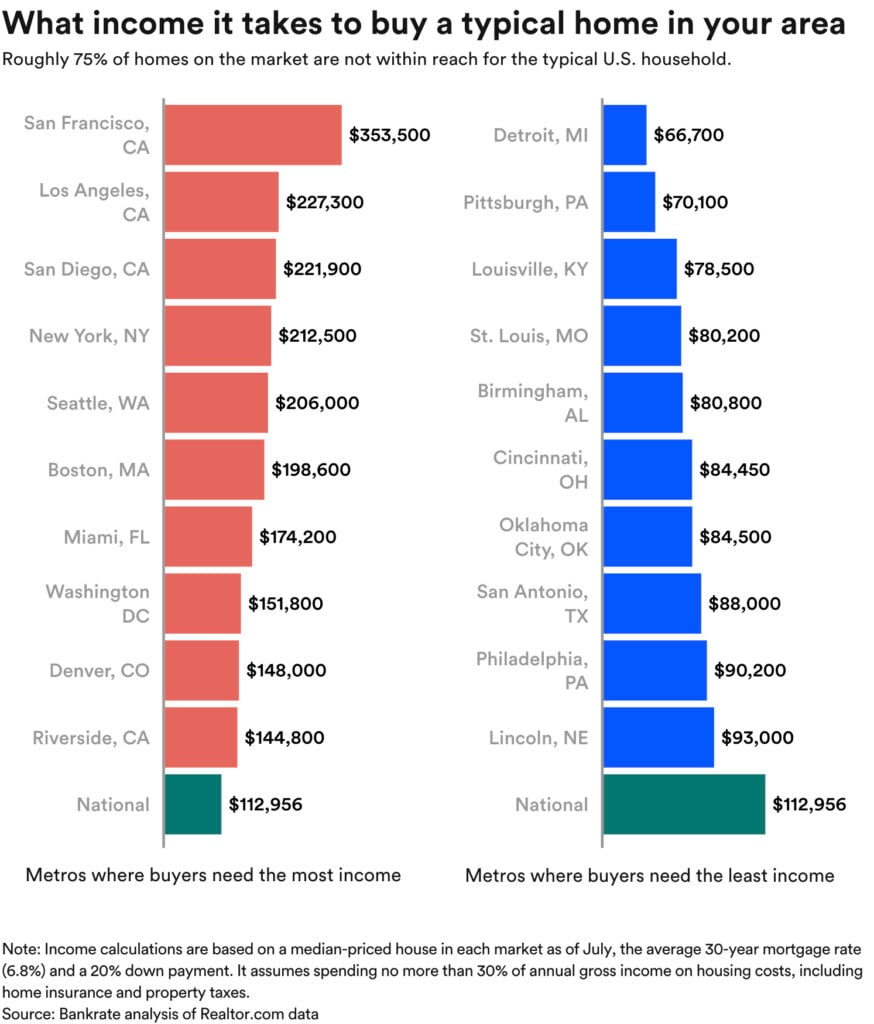
At the same time, according to a recent analysis by the personal finance publisher Bankrate.com, more than 75 percent of single-family homes for sale are now out of reach for a median-income household, and the typical American household needs to make at least $33,000 more annually to be able to afford a median-price home.
On top of that, the overall foreign-born population (including legal immigrants) now accounts for around 15 percent of the total population, and these trends show that labor markets and housing markets have been reshaped in ways that tighten entry-level opportunities and compress affordability, not by accident, but by policy choices directly related to an immigration system that puts American families last.
The economic problems caused by mass immigration and globalist economic policy aren’t new or a secret to those who have been paying attention. Individuals like Pat Buchanan warned us about these same issues in the 1990s, but few listened. Others labeled the conversation as extremist and took the debate out of the mainstream for fear of having the right labeled racist or xenophobic. And after decades of tolerating these kinds of problems, during which they have only grown worse, the affordability crisis can no longer be solved with a few tweaks here and there in the law. Solving our problems today requires a governing class willing to confront a multitude of existential civilizational questions.
The formative years of today’s young Americans were defined by cultural instability, foreign intervention, economic crisis, and swift government action to tackle the problems confronting their parents’ and grandparents’ generations. Because of this, they have learned an unmistakable lesson: when powerful interests are threatened, government acts. But when you and your family are in need, best of luck: “Work harder, loser!”
Imagine a young American named John. He’s 24 years old, has a steady job, a good head on his shoulders, and did what he was told he should do growing up. Yet, he’s only just scraping by. Rent devours half his paycheck. His car insurance spiked for reasons no one bothers to explain. He has no real savings to speak of and piles of student loan debt. When he’s not working, he’s glued to a phone he knows is making him miserable, where he finds himself swiping on dating apps, streaming shows on Netflix that really aren’t all that interesting, and trying to resist ads pushing pornography and online gambling. When he scrolls through X or Instagram, he sees only the most carefully curated lives of his peers, who somehow always appear richer, healthier, and happier than he is.
You could pick almost any young American today and find a life story like John’s. He’s come to realize this is the reality for most of his peers at this point. His frustration is not confusion about how the system works. It is that the system no longer works the way it was promised it would.
And it’s no wonder that at the end of each month, John looks at what’s left in his checking account and wonders how his parents at his age managed to get married, have kids, buy a home, and have hope for the future, when he can barely even stay ahead of his bills.
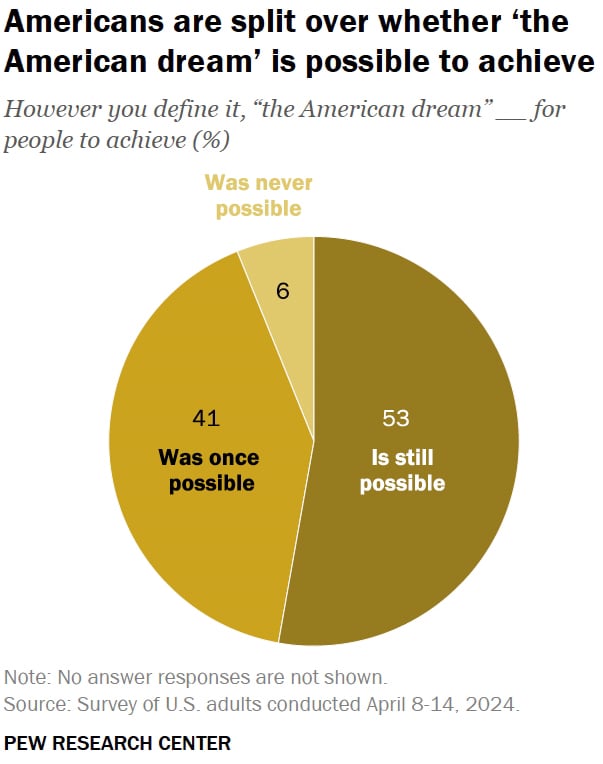
These circumstances are common enough that a generation has begun to suspect that the “American Dream” their parents described no longer exists for them. Certainly, if nothing changes, it won’t exist for their children. The message is unmistakable: Our current mode of governing is unaffordable for those who will live longest with its consequences. For that reason, it should be of little surprise that more and more people are beginning to conclude that those they elect to represent them are perfectly content to manage decline rather than reverse it. To make matters worse, the institutions that are supposed to anchor young Americans in adult life—schools, work, church, and civic associations—have become ornate shells of themselves, beautiful in branding but thin on substance.
Polling reflects this sentiment. A 2025 Harvard Youth Poll shows that more than 40 percent of Americans aged 18–29 are either struggling or just getting by financially, and one in four already expects to be worse off than their parents. Pew Research reports that barely four in ten adults under 50 still believe the American Dream is achievable. And a Wall Street Journal/NORC survey found that fewer than 30 percent of Americans now think hard work leads to a decent life. These numbers don’t just reflect anxiety about economics; they’re a referendum on whether the regime can still deliver.
When leaders provide stability and opportunity, people return trust. When leaders fail to live up to those obligations, or pretend to have met them when everyone can see they haven’t, that trust doesn’t erode gently. It vanishes. This is what is quietly unnerving many today. When civic society and government no longer produce solutions that meet basic needs like housing, wages, stability, and security, people don’t have the patience to sit through another congressional hearing or wait for the next white paper from a think tank. They start asking who, if anyone, is actually capable of leading them.
And, increasingly, young Americans are asking that question of both parties. To be clear, it is not because the president has failed to act, but because much of his own party has refused to match his urgency. It is the natural consequence of winning a trifecta during the 2024 election and not delivering with it. It becomes impossible to ignore the gap that exists between what members of Congress, in particular, say they are going to do when they win and what they actually deliver while in office.
Tragically, the habits of those running for office explain why this frustration keeps compounding. Historically, campaigns have directed most of their attention toward the anxieties and comforts of older voters: promising minor adjustments to Social Security, caps on prescription drug prices, tax cuts, and every imaginable assurance to those who already own homes and hold sizable assets. What’s missing is a serious attempt to invest in the generations that will inherit the country. Young Americans are noticing.
To preserve, let alone increase, the 47 percent share of 18-to-29-year-olds who voted for President Trump in 2024, Republican politicos must cease behaving as if governing is something closer to managing a brand than running a country. Boomers and Gen Xers should stop responding to the concerns of younger generations with the same canned reassurances of the past, that “inflation is cooling,” “gas and eggs are cheaper,” “unemployment is low,” or “GDP is up.”
As if pointing to a chart—GDP, unemployment, inflation, or whatever passes as the metric of the week—somehow makes a starter home accessible, resolves the fact that rent eats half a young person’s salary, or deports the millions of illegal aliens and foreigners who compete for entry-level jobs and whose presence drives up the prices of basic goods and services, or solves the fact that young people can’t accumulate savings no matter how many hours they put into overtime. To be clear, the issue isn’t entirely one of citing statistics. It’s the political habit of people waving them around in place of results, and nowhere is that disconnect clearer than the way Boomers and Gen Xers hide behind the GDP.
Measuring the nation’s success by its GDP alone is like judging a football team by offensive yardage, even if it only kicks field goals and never scores touchdowns—if the high numbers don’t actually benefit the team, who cares?
GDP is only one illustration of the problem, but it’s an important one, because of what it tells us when the nation is experiencing obvious cultural and economic strife. GDP goes up when landlords hike rents; rises when families get divorced and both parents need to work; increases when autoimmune diseases become significantly more common and medical costs skyrocket; improves when waves of illegal immigrants enter the country and begin consuming goods and services; maintains when public schools are exposing children to pornography and sexual predators; and it even goes up when the basic costs of forming a family rise to punishing levels. A country can register “growth” on paper while its foundations erode in plain sight. The macro indicators that past generations were told indicated national prosperity are incomplete. Making them go up doesn’t fix anything. They describe an economy on paper, not the country people actually live in.
Those honored with the task of governing must have the courage to finally face something that has been avoided for far too long. America can no longer point to GDP as proof of its vitality. GDP flatters decay, the way so many of our celebrated metrics now do. To those who just can’t let go, it’s time to hang up the cleats and pick a new career.
If America intends to remain the greatest nation in the world, rather than a has-been, it must stop mistaking consumerism for strength and begin examining the nature of the lives its citizens are living. A country is not held together by quarterly earnings. It holds because mothers and fathers believe they can raise children in peace; because young adults see marriage as something attainable rather than aspirational; because church pews are full; because a young man in his hometown can imagine a future there rather than hitting the road. Without those basic conditions, everything else is decoration.
Our country needs a different scorecard. GDP was only ever a proxy, and a poor one, for national well-being. A better scorecard would track the most important parts of American life rather than the velocity of American consumption. Additionally, it needs a different elite to read that scorecard: leaders who treat marriage, child-rearing, church attendance, stable neighborhoods, and livable wages as the real measures of national health. There is only one question that really matters: Can Americans begin and live out the kinds of lives a functioning nation depends on? If that answer is “no,” then the direction of the market charts is meaningless.
Imagine if our leaders in Washington had to publish, every quarter, the marriage rate next to the unemployment rate. Imagine if homeownership among young families were treated with the same urgency as inflation. Imagine if the number of children born into stable households mattered more than whether consumer spending ticked up a fraction of a point. It would reorder everyone’s priorities overnight.
The time is quickly approaching when America will no longer be shaped by those who recite statistics or endlessly celebrate metrics like the GDP. The choice is simple: keep celebrating the metrics of yesterday as custodians of a dying regime, or produce for the families of tomorrow. If we choose the latter, then the future will belong to leaders who decide to grade the nation by what matters: whether Americans can form families, own homes, attend church every Sunday, and plant roots in safe communities with work available to them. Those who anchor our country to these standards will write its next chapter.
President Trump’s ascent to the presidency, beginning in 2015, was the first sign of the times. He wasn’t elected by political hobbyists looking for entertainment; he was elected by millions of ordinary Americans, many of them young, who had concluded that those serving in elected positions were incapable of changing anything that mattered to them. Trump’s ascendency was a condemnation of the institutional actors who had become custodians of decay.
The same impulse appears to be on the rise on the other end of the ideological spectrum. Look at New York, where Mayor-Elect Zohran Mamdani gained ground among young voters who feel just as dismissed by the status quo. They aren’t turning to him because of some newfound love for socialism; they’re turning to him because he treats their material and spiritual concerns as real and worth solving. In a political environment addicted to the chain-smoking habits of marketing campaigns that deliver little more than retweets and press releases, that feels like fresh air.
Sam Francis and Pat Buchanan were both prescient, spending many years warning that a regime exhausting its own legitimacy will not choose its successors. It will not be replaced by polite custodians of existing norms, but by leaders who promise outcomes rather than continuity and are believed precisely because they acknowledge how and why the previous custodians failed to deliver.
A regime survives only as long as it delivers results. To summarize Machiavelli: a ruler keeps his authority only so long as he provides security and stability. Aristotle says the same, but more gently, arguing that a regime remains legitimate only so long as it serves the common good. When a regime stops meeting these basic obligations—whether through neglect, incompetence, or exhaustion—people do what they have always done. They begin to look elsewhere. People turn toward anyone who seems capable of restoring order or offering a future that feels plausible. History is consistent on this point: when a system falters for too long, it is not the caretakers of the old order who rise to replace it. It is the figures who speak to the vacuum the old order created.
This is what sits underneath the national debate, whether some want to admit it or not. What looks like financial hardship from a distance is something else up close: a generation tallying the promises made to them against the realities they now face. Their frustration isn’t just an inability to see their dollars go as far as their parents’ did; it’s a verdict on a system that no longer holds up its end of the bargain.
While America is not out of hope, it is certainly out of excuses. The Washington political class cannot keep hiding behind charts and talking points while the spiritual and material well-being of the American people continues to decline due to poor governance. Eventually, a large enough coalition of Americans will stop looking for answers from the people content to manage decay. They will turn to those who speak plainly about what has gone wrong and, just as in 2016, they will offer an opportunity to someone new, even if the solutions that newcomer offers lie outside the boundaries the current elite deems “respectable.”
When that moment comes, the old guard won’t get to select its successors. It will simply wake up one morning and find out who has taken its place.
https://chroniclesmagazine.org/view/americas-affordability-crisis