
Bernie Goetz, the Marginal Character Who Moved the Center
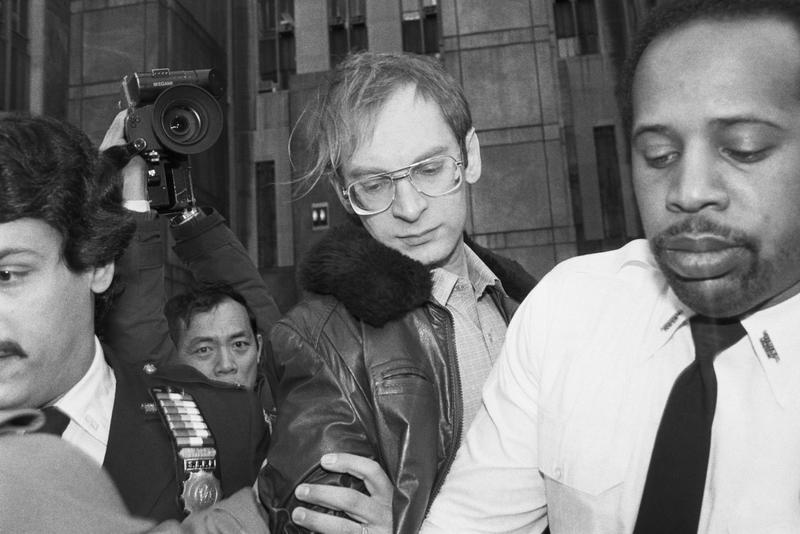
Elliot Williams
Five Bullets: The Story of Bernie Goetz, New York’s Explosive ‘80s, and the Subway Vigilante Trial that Divided the Nation
New York: Penguin Press, 2026
“Wheel of Fortune, Sally Ride
Heavy metal suicide
Foreign debts, homeless vets
AIDS, crack, Bernie Goetz
Hypodermics on the shores
China’s under martial law
Rock and Roller cola wars
I can’t take it anymore”
—Billy Joel
I remember becoming aware of the Bernie Goetz case in elementary school. My teacher taught reading by using an age-appropriate newspaper-like publication that covered current events. That paper contained a bowdlerized version of the then ongoing controversy surrounding Goetz, who’d shot and wounded four black teenagers in a subway car on December 22, 1984. The race of the teenagers was downplayed, but I remember the paper claiming those who were shot were aggressive “youths” carrying “sharpened screwdrivers.”
The Goetz story was a nationwide sensation because the shooting took place at the critical social intersection of race and crime—runaway crime. Media saturated New York City was awash with crime in 1984 and the central drivers of the crime wave were sub-Saharan black male teenagers and young adults. This fact was universal knowledge by 1984. In his book Radical Son: A Generational Odyssey (1996), the late David Horwitz, who had worked for the Black Panthers, perfectly expressed how gathered individual experiences made black criminality become universally known in the mid-1980s, writing that:
…it occurred to me that the word “bad,” used by the [Black] Panthers as a term of praise, was something more than merely a colorful slang for “good,” as I had assumed. It also meant bad – as having the balls to do what is truly evil. Like murder.
Horowitz was also alarmed by the deportment of several mourners at a funeral, writing:
…[one] was wearing pinstripes, a white carnation in the buttonhole, a fedora tilted in Bogart fashion. He looked as though he had stepped out of a gangster film. I had seen [this sub-Saharan] before, but this time the image registered differently. I don’t know whether it was seeing him with the others, or just the accumulation of incidents over recent months, but I had a sudden intuition: This is not style; this is real.
Goetz became a representative of rising white frustration with post-“civil rights” black behavior.
Elliot Williams, a Jamaican who grew up in New York City and works for CNN as a legal analyst, has written a book about the Goetz affair. He starts the narrative with the blackout of July 13, 1977. This loss of electrical power shouldn’t have been remarkable. There was a blackout in 1965 which had caused New Yorkers to react with good cheer and cooperation. The 1965 blackout was even used as a gag in the TV show Green Acres, but writes Williams:
… 1965 this was not. For the next twenty-four hours, arson, looting, and violent crimes tore through the entire city. The predominantly black and Hispanic neighborhoods of the South Bronx, East Harlem in Manhattan, and Bedford-Stuyvesant and Bushwick in Brooklyn were among the most devastated. Some 1,037 fires, 50 of them serious, were the most seen in a single day in New York history. Rioters smashed through the steel door and windows at a Pontiac showroom in the Bronx, speeding off with fifty new cars … [the looting was widespread] … All told, 473 shops in the Bronx and 700 in Brooklyn were attacked, and the rioting led to a billion dollars of damage. Time’s next cover story, echoing the words of Mayor Abraham Beame, dubbed the event a “night of terror.” (pp. 4-5)
Between 1965 and 1977, New York City’s civic society had slipped downwards. White liberals running the city in the early 1970s had tolerated a steady increase in crime. Meanwhile, the Son of Sam—a serial killer who turned out to be a Jew—was still at large, and the city needed a financial bailout from the federal government. The bailout didn’t cover the shortfall, however. The transit police force was cut by 25%. This meant the police didn’t bother to deal with the small crimes. Smash-and-grabs, burglaries, and muggings became a daily inconvenience. There was a sense that matters were out of control. Whites were fleeing the city.
White flight left sub-Saharan blacks the only residents in large areas of the city, such as South Bronx. By the late 1970s, this region had become a hyper-ghetto of worthless properties which were often burned down by their respective owners to get the insurance money. While the South Bronx turned into an Africanized post-colonial dystopia, the subway system also declined. Graffiti covered the cars, whose lights ominously flickered. The tracks were ill-maintained, so subway trains deliberately moved slowly. Subway rides were uncomfortable affairs where sub-Saharan blacks hassled other riders, often demanding money. The sense of lawlessness was compounded by the fact that many of the young black men in the subway cars had not paid to get on the subway in the first place, they simply jumped the turnstile. The move Death Wish (1974) accurately reflected New York City’s problems.
A decade after Death Wish was released, there was a boom in video games and game consoles abounded in any business where people might loiter. Each game console required quarters to be played, and they were inserted into a slot and stored in an internal bin. The games could hold a significant number of coins, so they became targets for enterprising thieves who only needed a screwdriver to get the money. Four such thieves were Barry Allen, Darrell Cabey, Troy Canty, and James Ramseur, all sub-Saharan blacks from the South Bronx.
Allen, then 19, had already fathered a child. He was also addicted to drugs, aggressively stealing, and had already done prison time for assault and theft. At the end of 1984 he was facing more prison time due to violating the terms of his probation. Canty had demonstrated a pattern of psychiatric and behavioral issues in school and had beaten up a teacher. He also had a string of arrests for theft. He also used marijuana and cocaine. Ramseur had also been arrested multiple times for burglary, larceny, and robbery. He had four pending warrants for not appearing in court. Cabey was awaiting trial for armed robbery. As 1984 drew to a close, they got on New York’s subway on a quest to steal quarters from video game consoles.
The subways were the place where New Yorkers intermingled. On a subway, high earning bankers rode alongside mentally ill homeless men. The four sub-Saharan blacks entered a subway car and began behaving erratically and loudly. Only three were carrying a screwdriver, none were sharpened, and none carrying a screwdriver brandished a screwdriver. In the subway car was Bernie Goetz.
Goetz was the son of a north-German Lutheran immigrant and a Jewish mother who had converted to Christianity. He was an engineer who ran a home business repairing electrical equipment. Although Goetz was not among the super-rich, he was not underprivileged. Growing up, he attended a boarding school in Switzerland and had helped his father develop properties in Florida. Goetz had also been injured in a mugging several years prior.
In response to his mugging, Goetz applied for a permit to carry a gun in New York City, but he was ensnared by what the late Sam Francis called anarcho-tyranny, whereby the police cannot stop criminals, but can ruthlessly apply the law against the law abiding. Permit or not, Goetz was armed. He’d gotten several firearms in Florida. He frequently carried firearms and had brandished the weapon at people he thought were muggers in two separate incidents.
The four sub-Saharans surrounded Goetz and demanded five dollars. They had already committed crimes by sneaking on a bus and jumping the turnstile to get on the subway. They were on their way to commit more crimes. They were from a demographic that, by 1984, was universally known to cause crime. Muggings typically start with the offender asking for something. In aggressively asking Goetz for money, they were violating Law 19 of Robert Greene’s 48 Laws of Power: Know who you’re dealing with—do not offend the wrong person. They were in effect, seeking to rob an armed man who knew how to shoot, knew the signs of being mugged since he’d experienced a mugging, and had two prior experiences of pulling his weapon.
Goetz pulled out his firearm and shot. Accounts differ as to the exact specifics of the shooting. Most of the witnesses on the subway car said the five shots rang out quickly. In his later videotaped confession, Goetz claimed to have said, “You don’t look so bad, here’s another,” before firing a second bullet into Cabey. The two bullets fired into Cabey caused him to be paralyzed and brain injured. The confusion over the exact specifics of the shooting is not unusual. Most eyewitness reports of shootings are a blur of confused recollections.
During the shooting, someone pulled the emergency brake on the subway. The conductor of the stopped subway, which was filled with panicked riders, went to the scene and calmly asked Goetz if he was a cop. Goetz replied that he was not and then left the subway car, traveled through the subway tunnel to the next station, and then left the subway station for the streets, passing police cruisers speeding to the scene. He then rented an automobile and took off to Vermont, where he buried his disassembled gun in a snowbank.
For the next few days, Goetz kicked around New England, returned to his apartment on December 30, 1984, and admitted everything to his neighbor, Myra Freidman, a writer. Freidman would go on to testify at Goetz’s later trial. He returned to New England and on New Year’s Eve, 1984, turned himself into the Concord, New Hampshire Police Department.
The NYPD were already on to Goetz; they’d received a very specific tip indicating Goetz was the likely shooter after a police composite had been distributed through the media. Additionally, Goetz’s apartment was near the location of the shooting. While Goetz was in New England, detectives swung by his apartment and left a note asking him to make contact. Meanwhile, the New York Post, which had recently been purchased by Rupert Murdoch, had extensively covered the story. The story went national and support for the shooter was high.
Massad Ayoob, a cop’s cop and gun and self-defense expert, advises that a member of the public who shoots a criminal (a just self-defense shooter) should follow a five-point strategy after firing his weapon. After immediately surrendering to law enforcement, the just self-defense shooter should establish “the active dynamic.” Meaning the just self-defense shooter gets on the police record the fact that the person who got shot was attempting to rob, murder, etc. This puts the just self-defense shooter in the system as a victim and how one enters the system matters. The just self-defense shooter must then cooperate with police, point out evidence and witnesses on the scene, and then cease talking until represented by a lawyer.
Goetz did none of this. Not only did he confess everything to the police while being videotaped without a lawyer, he also fled. As Ayoob points out, flight equals guilt. Ayoob also reminds his readership that a few seconds of shooting can lead to years of legal trouble. That’s what happened to Goetz. His trial did not take place until 1987. He was found not guilty on all counts except a minor gun violation. He was sentenced on October 19, 1987—a date that came to be called Black Monday due to a stock market crash that dominated the news cycle. Goetz was sentenced to six months in prison, but the legal technicalities continued. Goetz had to be sentenced a second time in 1989 since the judge should have sentenced him to a year under the law. He eventually served eight and a half months, and his time was extended for two weeks over his refusal to return a razor because he feared re-using razors would spread AIDS.
As for the sub-Saharan blacks, Darrell Cabey never fully recovered and won a $43 million-dollar lawsuit against Goetz. Troy Canty seems to have successfully moved on, although he did rack up a “string of petty offenses” including stealing a home pregnancy test from a department store in 1990. He eventually left New York City and went to work as a mechanic. Barry Allen went on to continuously commit serious crimes, and he died in prison in 2021. James Ramseur was also involved in serious criminal activity, and he died in a hotel in the Brox on December 22, 2011. In the hotel room’s toilet was an empty pill bottle with its label scratched off.
In 2018, Barry Allen gave an interview and expressed his continued bafflement of Goetz’s actions. This is more a demonstration of Allen’s inability to see another person’s point of view than anything else. By 1984, crime had been out of control for two decades and it was universally known that young black men were fueling the disorder. Lack of empathy is a common trait among habitual criminals.
The Goetz shooting became a magnet upon which concerns around crime gravitated, however, the concerns did not arrange in a way that refuted the color blind “civil rights” order in 1984. Goetz’s supporters were a colorblind multi-racial group. His most visible allies were from the Guardian Angels, a group founded by Chris Silwa in 1979. The Guardian Angels wear red berets and special jackets. In 1984 they “patrolled” the subways attempting to suppress crime. Throughout Goetz’s legal affairs, Guardian Angels, often sub-Saharan blacks or “Latinos” with much sub-Sharan ancestry supported him in various ways including reenacting the actions of the four blacks on the subway for the jury.
Goetz also became the center-point of the activism of the increasingly political National Rifle Association (NRA). Prior to Goetz’s subway shooting, gun control was favored by most conservatives. As California’s governor, Ronald Reagan had enacted gun control after a group of armed sub-Saharan militants took over a courthouse and held a judge hostage. The NRA saw the issue from precisely the opposite view, holding that an armed citizenry would cut down crime because the “good guys” would be armed thereby changing a would-be criminal’s calculations as to commit a crime or not. One of the NRA’s most prominent spokesman for increased carry to deter crime was Roy Innis, a former Black Panther who had a proven record as a Black Nationalist.
This colorblind support for Goetz allowed for a political position to materialize that successfully won elections and solved problems until Obama’s weepy second term—the tough-on-crime social liberal. New York’s mayor during the shooting and its hectic aftermath was Ed Koch, who called himself a “liberal with sanity.” Koch was not reelected in 1989, and David Dinkins, a sub-Saharan black, won. The city continued to decline. Dinkins was replaced by Rudy Giuliani who enacted the broken glass theory of crime control.
This theory holds that broken glass and other signs of decay indicate that an area is uncared for and that it permits crime. It also posits that the same people who commit the small crimes—like turnstile jumping—commit the big crimes. This was the case with the four sub-Saharans shot by Goetz. Giuliani’s police also used data visualization techniques to determine when and where crimes like purse snatching were occurring and surged forces there, catching many criminals. Giuliani also got homeless and mentally ill people out of the city by bussing them to Philadelphia and other places—it led to a minor outcry—but New York’s political elite were happy feeling safe so the bussing trick didn’t become a national scandal. Giuliani was aided at the federal level by tough-on-crime social liberals such as Bill Clinton. Williams skips over this in the book, although he points out that crime in New York City is down today compared to the 1980s.
The multi-racial, civic nationalists used the Goetz case to shore up and turn around a collapsing system for several decades. It was, according to law-and-order people like Chris Silwa, merely a problem of criminals of any race. However, the Goetz shooting had racial overtones throughout it and as attitudes have hardened these overtones have increased in importance.
The most prominent black voice campaigning against Goetz was Al Sharpton. Then he was a 305 lbs. preacher who dressed in a track suit. Williams writes:
Sharpton was deliberate in explaining that two things could be true at the same time: Goetz’s victims may not have been blameless, but nothing entitled Goetz to try to kill them and get away with it. “People feel we’re for the boys…[w]e’re not. If they did a crime, they should pay for it. They should go to jail, but so should [Goetz].” He was more blunt with the same sentiment when interviewed for this book. “The precedent to me was more important than the individuals involved,” he said. “A kid might have been rowdy on a train and said something threatening. And therefore you got the right to blow their brains out?” (p. 248)
Essentially, Sharpton argues that there can be no just self-defense shooter because such a shooter cannot justly or truly recognize a person as suspicious or a threat. This is the legal theory which got the just self-defense shooters of Ahmaud Arbery in prison for life. On the face of it, Sharpton’s argument has merit, however as with all things related to “civil rights,” it ignores much of the data.
Segregation appeared in the North as soon as public transportation by train became possible. It arose because sub-Saharan blacks have a known and consistent pattern of ill behavior in public spaces. Furthermore, by 1984, it was universally known that sub-Saharan blacks were fueling the crime epidemic.
Blacks are indeed dangerous, and many black professionals have a close relative in prison for serious offenses. There is real sympathy for crime in the black community. In addition to his moralizing against Goetz, Sharpton was engaging in a metapolitical campaign to narrow the definition of suspicious, pre-crime behavior. The four “youths” shot by Goetz were criminals on their way to commit a crime, at a minimum Goetz was right to be suspicious. Sharpton, however, was encouraging the whole society to rely on legalisms rather than the healthy instinct of self-preservation.
Additionally, Sharpton successfully carried out a political act. Sub-Saharan black crime gives blacks political power. Crime allows blacks to occupy extremely valuable real estate, and their occupation of this territory gives them representatives in Congress and state legislatures. This criminality also makes Maryland, Illinois, Michigan, and other states hostage to the black ghettos in Baltimore, Chicago, Detroit, and other cities.
Goetz’s views reflected the opposite extreme. In 1980, at a meeting of his building’s tenement association, Goetz pointed out that “spics and niggers” were causing most of the crime. His remarks shocked the audience, and he was removed from the association’s board of directors. However, he was correctly pointing out that sub-Sharan blacks from the Spanish West Indies (“spics”) and the descendants of the African slaves brought to America (“Niggers”) were the main drivers of crime.
Williams presents the case that Goetz had the views of a modern-day white advocate, although at its core, Goetz has a darker vision. Williams writes:
Goetz’s comment from his civil trial that society would have been better off if Cabey’s mother had had an abortion, and a comment he made on NBC that “Society is better off without certain people…. Whether one believes that they should be killed or – locked up, or used in forced labor, is just a matter of one’s political point of view,” and it is clear that Goetz isn’t just all in on self-defense. He sounds like an evangelist for eugenics. (p. 290)
Goetz also became an evangelist for vegetarianism and rescued injured squirrels. He was a marginal character, indeed. His unaccommodating personality is filled with quirks. He is exactly the sort of marginal person who carried out an extreme act indicating a shift at the center of the bell curve. Other, more socially mainstream people, built upon the groundswell of support for Goetz and turned around New York City.
https://counter-currents.com/2026/02/bernie-goetz-the-marginal-character-who-moved-the-center