
Bibi’s Big Lie and Why Pluto Didn’t Bark in Tehran

Well, it bears repeating. Again. The Iranians never had a nuke, had no near-term prospect of weaponizing their enriched uranium stockpiles, were not hell-bent on blowing up the world and were not two weeks from anything other than still another wolf-crying episode from the one actual “crazy” leader in the middle east. That would be Bibi Netanyahu. Hands down.
But those truths did not stop the Donald from blatant lying and fear-mongering yet again today. And to even go so far as to imply that he has the mullahs by the short hairs.
Trump: “Iran, they are not going to have a nuclear weapon. They are not going to blow up the world. They are crazy. And therefore, they are not happy.
The truth is, however, the Donald surely does not have anyone who is crazy up against any kind of negotiating wall. They Iranians are never going to give up their nukes because by the lights of his own DNI (Director of National Intelligence), Tulsi Gabbard, they don’t have anything to give up—including even scribbled plans on how to make a homemade nuke:
“The IC [U.S. Intelligence Community] continues to assess that Iran is not building a nuclear weapon and Supreme Leader Khamenei has not authorized the nuclear weapons program that he suspended in 2003.”
The only thing that has been terminated, therefore, is the Supreme Leader who ixnayed the whole nuke scare story 23 years ago! Indeed the result of Israel’s sweeping assassination attack on the entire leadership of the Iranian regime on February 28th was to simply ensconce the remaining hard line leaders more completely in power.
In any event, what is actually getting nuked is the world economy, as illustrated by the graphs for aluminum, nitrogen fertilizer and #2 diesel fuel below. And this is just the beginning of the mayhem yet to follow.
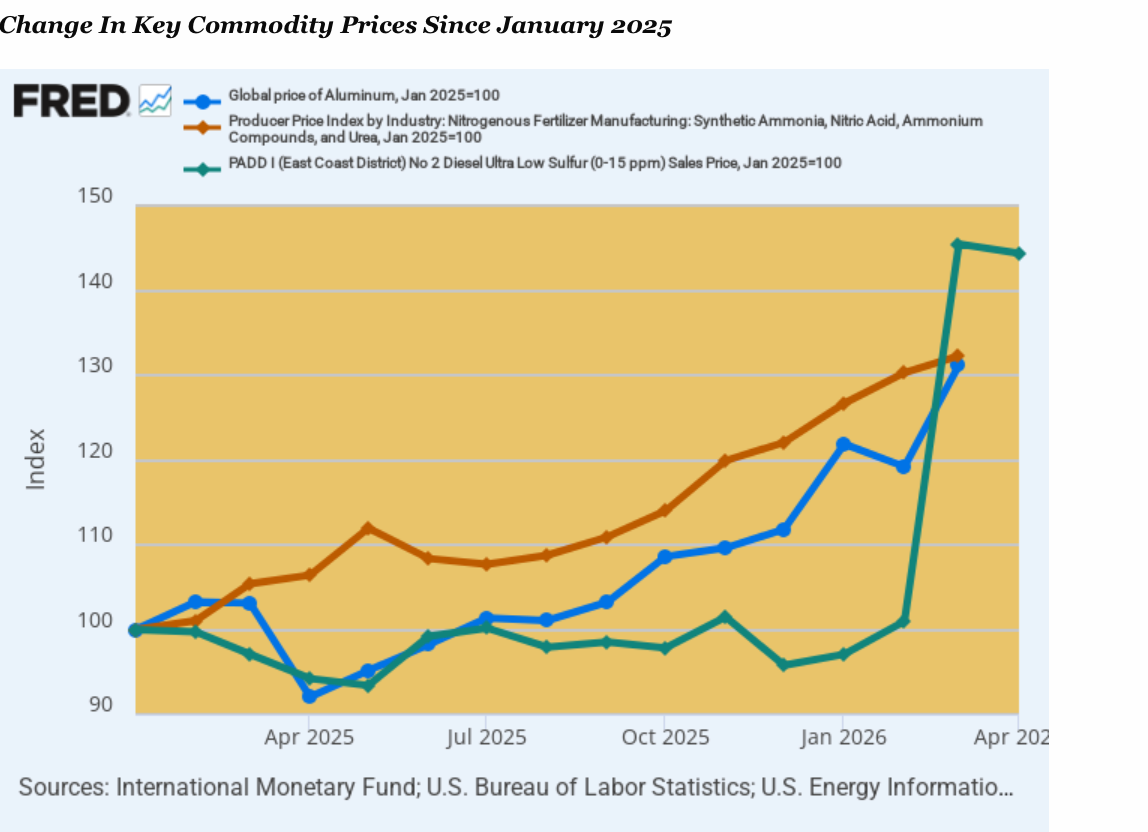
Meanwhile, the Big Lie about Iran’s nuke becomes more and more preposterous with every passing day. Still, the true history needs be told because Washington’s War Machine has been turned loose on the basis of a narrative about the Iranian bomb that doesn’t have a leg to stand on.
So we start with what might be called the curious incident of the dog that didn’t bark in the night, which, of course, remains one of Sherlock Holmes’s most famous deductions: The absence of expected action was itself the clue. So apply that logic to Iran’s so-called mad dash to get a nuke, and the silence is deafening.
That is to say, if the mullahs in Tehran were the “mad men”caricatured by Bibi Netanyahu and lip-synced by the Donald, and were single-mindedly obsessed with acquiring a nuclear weapon at any cost, indifferent to sanctions, inspections, or international legitimacy—then one thing is abundantly clear: To wit, the most rational, lowest-tech, and fastest route to a nuke lay not in the labyrinth of uranium enrichment they actually pursued, but in the plutonium path that had already been demonstrated and proven by North Korea.
Call it the “Pluto Route” based on a small, natural-uranium-fueled, graphite-moderated plutonium reactor paired with a simple reprocessing plant. This is the route North Korea choose purely to attain a “deterrence” bomb.
This path was far simpler, far less expensive, far less demanding scientifically and engineering-wise than the 90%+ highly enriched uranium (HEU) route that Iran has allegedly been pursuing. The former required no isotope separation, no thousands of precision centrifuges, no gigawatts of electricity—just natural state domestic uranium, basic chemical engineering, and a straightforward path to weapons-grade plutonium, not 90%+ highly enriched uranium (HEU).
Two structural realities make the plutonium route objectively far easier for a bomb-only proliferator. First, acquiring the fissile material itself is far less demanding. A small, dedicated 5 to 30 megawatt (MW) graphite reactor operating on natural uranium (0.7 % U-235) produces plutonium-239 as a byproduct when fuel is irradiated at low burn-up.
No enrichment infrastructure is required; the reactor and a basic PUREX-style reprocessing line suffice. In contrast, the highly enriched uranium (HEU, >90 % U-235) route demands cascades of thousands of high-speed centrifuges, exotic materials, vacuum systems, and massive electrical power—precisely the industrial-scale apparatus Iran built at Natanz and Fordow.
Second, once the bomb-grade material is in hand, machining and fabricating the bomb core clearly favors plutonium. A plutonium implosion device can function with as little as 4–6 kg of weapons-grade metal; the core is smaller, the explosive lenses are more compact, and the overall package lighter and easier to miniaturize for missile delivery.
An HEU-based implosion weapon typically requires 15–25 kg or more of HEU. In turn, this demands a larger, heavier “physics package”, more exacting spherical machining tolerances on a bigger metallic pit (core), and greater challenges in achieving uniform compression in fractions of a second when the bomb is detonated by the outer ring of explosive material.
Thus, the engineering burden for a deliverable HEU implosion device is demonstrably far higher. That is to say, a regime fixated solely on the bomb would have barked for Pluto(nium) and followed the path already pioneered by North Korea, as amplified below.
In Tehran, of course, Pluto never barked. Accordingly, since North Korea’s plutonium program is the textbook case of how to get a bomb efficiently, its history is worthy of amplification.
North Korea’s ambitions date to the 1950s, when Soviet assistance supplied basic training and the IRT-2000 research reactor at Yongbyon. By the late 1970s, Pyongyang had begun indigenous design work on a small-scale dedicated production reactor.
Construction of the 5 MW gas-cooled, graphite-moderated reactor—modeled on early British Magnox designs—began around 1984, alongside a radiochemical reprocessing laboratory. The reactor achieved criticality in 1986, and was fueled entirely with domestically fabricated natural uranium. No enrichment was ever needed.
The design deliberately permitted short irradiation cycles to maximize nearly pure Pu-239 while minimizing Pu-240 contamination. Spent fuel was transferred to the adjacent reprocessing facility, where a straightforward chemical separation process extracted weapons-usable plutonium metal.
By 1990 the reprocessing line had been hot-tested, and small quantities of plutonium were being separated. U.S. intelligence later estimated that between 1986 and 1994 the 5 MW reactor produced enough material for one or two crude devices.
The entire fuel cycle—uranium mining at Pyongsan, milling, fuel fabrication, irradiation, and reprocessing—was kept indigenous and low-profile.
Still, North Korea did joined the Nuclear Non-Proliferation Treaty in 1985, and under International pressure agreed to the 1994 Agreed Framework, which froze the 5 MW reactor (and larger planned projects) in exchange for light-water reactors and heavy fuel oil promised by the Clinton Administration.
Pyongyang largely complied on the surface until the framework collapsed in late 2002 because the Washington never supplied the promised fuel oil and light water reactors. In January 2003, therefore, North Korea withdrew from the NPT, restarted the 5 MW plutonium reactor and resumed operations at the reprocessing plant. By mid-2005 officials privately informed U.S. visitors that they had finished extracting plutonium and now possessed weapons-usable material.
On 9 October 2006 came the first underground test—an implosion-type plutonium device yielding a very small 0.5–1 kiloton explosion, widely assessed as at best only a partial success, owing to imperfect high-explosive lenses rather than material failure.
A higher-yield plutonium test followed in May 2009.The timeline is telling: Serious weapons-oriented infrastructure began in the early-to-mid 1980s. Plutonium production was under way by the early 1990s. After an eight-year freeze, the program restarted in 2003 and delivered a testable device by 2006—roughly 20–25 years from dedicated construction to first detonation, with the final sprint requiring still another three years once reprocessing resumed.
In this context, a single small reactor could yield roughly 6 kg of weapons-grade plutonium annually—enough for one bomb per year. Thus, the plutonium process was chosen precisely because it was the path of least resistance. No exotic vacuum technology, no cascade engineering, no power-hungry centrifuges. Just a reactor, a reprocessing line, and single-minded focus.
For a regime that wanted only the bomb, this was the rational choice. Iran, by contrast, built its program around the very infrastructure a bomb-only proliferator would have avoided: That is, a large light-water power reactor at Bushehr, which demanded low-enriched uranium fuel and therefore require a full-scale industrial enrichment apparatus.
Iran’s very different nuclear story, therefore, begins in the 1970s under the Shah, who signed contracts for 23 reactors and full fuel-cycle facilities. Construction of the Bushehr nuclear power plant started in 1975 with two 1,300 MW pressurized light-water reactors supplied by West Germany’s Kraftwerk Union.
The project was 80–90 percent complete when the 1979 Islamic Revolution halted everything. Iraqi bombing during the 1980–1988 war further damaged the site. After the war, Siemens refused to resume work under U.S. sanctions pressure.
In 1995 Russia’s Atomstroyexport agreed to complete a single VVER-1000 (1,000 MW) reactor fitted into the existing German containment. Fuel loading began in 2010 and the reactor reached criticality in 2011. It was grid-connected in September 2011 and formally commissioned in 2013.
Bushehr remains Iran’s only operating commercial nuclear power plant, supplying a modest fraction of national electricity.The critical constraint is that light-water reactors like Bushehr require low-enriched uranium (typically 3–5 % U-235). Natural uranium as used in North Korea’s bomb-purposed reactor cannot sustain a chain reaction in light water—so enrichment is thus mandatory.
In short, Iran embarked in the uranium enrichment path not as some kind of sinister route to a bomb, but because its civilian power facilities forced it down the centrifuge path. There wasn’t anything sinister or untoward about it—and most especially because Washington actually forced it.
That is to say, by the time Iran’s Bushehr civilian power plant was commissioned, it had already been subjected to every kind of sanction and embargo known to man. While the Shah’s original plan for massive nuclear power generation had been based on out-sourcing the enrichment process to France, Washington sanctions had long since foreclosed that route and had made domestic enrichment a necessity if the Bushehr plant was to be operated.
That is to say, the fact that Iran was forced into building large scale enrichment facilities was another case of the Washington neocons and Bibi’s Fifth Column on the banks of the Potomac scoring an own goal.
In any event, the Natanz pilot fuel-enrichment plant (revealed in 2002) and the Fordow facility (revealed in 2009) were publicly justified as necessary to supply Bushehr and any future reactors. Thousands of centrifuges were installed in cascades, consuming enormous electricity and requiring precision manufacturing.
Even today Iran’s enrichment program is calibrated to produce LEU (low enriched uranium) for power reactors while retaining the latent capacity to surge to weapons-grade levels. This is the opposite of a bomb-only strategy: Enrichment is the hard, detectable, power-intensive step that North Korea largely skipped.
Moreover, Iran’s brief flirtation with plutonium via the Arak heavy-water research reactor (IR-40) was marginal by comparison. Arak was never optimized for low-burn-up weapons-grade plutonium production, and under the 2015 JCPOA it was redesigned with international assistance to minimize plutonium output. No reprocessing plant was ever constructed similar to the North Korean set-up and the reactor core at Arak with filled with cement under IAEA supervision.
Throughout this HEU-centric journey, therefore, the U.S. Intelligence Community has delivered a remarkably consistent assessment: Iran was not building a nuclear weapon. Full stop.
The 2007 National Intelligence Estimate (NIE) judged with high confidence that Tehran halted its structured nuclear-weapons program in fall 2003. Subsequent assessments—through 2010, 2011, and into the 2020s—reaffirmed that no decision had been made to restart weaponization.
The IC repeatedly noted that Iran was keeping open the option by advancing enrichment and other dual-use capabilities, but Supreme Leader Khamenei had not authorized resumption of the Amad Plan-style (pre-2003) warhead work. Nevertheless, even pre-2003 weaponization studies had focused exclusively on implosion designs using HEU, not plutonium.
Furthermore, even after the Donald recklessly shit-canned the JCPOA in May 2018, causing the Iranians to expand their enriched-uranium stockpile to much higher levels, the core judgment of the 17-US intelligence agencies held: Namely, that Iran had no active bomb program.
That consistency had actually been extended into Trump’s second term, as per Tulsi Gabbard’s above quoted March 2025 testimony before the Senate Select Intelligence Committee.
While she noted an erosion of the decades-long taboo on public discussion of nuclear weapons and the unprecedented size of Iran’s enriched-uranium stockpile, the bottom line remained unchanged: No weaponization decision had been made and there was no restart of the structured program halted in 2003.
Even after the 2025 U.S.-Israeli strikes that damaged Iranian nuclear infrastructure, subsequent assessments reiterated that Iran had made no efforts to rebuild enrichment capability after the Donald’s B-2 bunker buster strikes in June 2025. The regime appeared intact but largely degraded, but the intelligence community detected no move toward active bomb construction.
By choosing the HEU route required by its civilian light-water reactor at Bushehr, Iran not only lengthened the material-acquisition timeline but also raised the downstream engineering, machining, and fabrication challenges for any eventual weapon.
That’s because a plutonium implosion device, as North Korea demonstrated, allows a smaller, lighter, more missile-compatible “physics package” once the material is available. So by committing to the HEU route meant either accepting a bulkier, heavier warhead or investing additional R&D to optimize compression and reflection for a larger HEU mass.
Machining a bigger metallic HEU pit to the exact spherical tolerances demanded by symmetric implosion is more demanding in terms of precision tooling, contamination control, and handling. The explosive assembly must still achieve microsecond simultaneity, but now across a much larger volume.
In short, even at the bomb construction and assembly phase, North Korea’s plutonium path cleared the material hurdle with minimal technology; Iran’s HEU path compounded it. A true bomb-obsessed regime would have avoided this self-imposed escalation.The absence of a Yongbyon-style plutonium program in Iran is therefore the dog that did not bark
A “mad man” leadership indifferent to global opinion and focused solely on the fastest possible bomb would have copied North Korea’s 1980s blueprint decades ago: One small graphite reactor, one reprocessing line, domestic natural uranium, and a single-minded sprint to plutonium.
Iran instead invested in Bushehr and the enrichment infrastructure it demands—an approach that makes sense only if the regime wanted both a civilian nuclear power program and the latent option of a future bomb, or if it sought the political and economic benefits of a dual-use program under international scrutiny. The multi-decade North Korean timeline—from 1980s construction to 2006 test—proves the plutonium route is viable even for an isolated state.
Iran’s civilian reactor basis at Bushehr locked it into a slower, more visible, and technically more demanding enrichment path. The consistent intelligence-community judgment since the 2007 NIE through Gabbard’s 2025 testimony—that weaponization remains suspended and no bomb is under construction—reinforces the point. In Tehran, Pluto never barked. The silence suggests the regime’s ambitions, whatever they may have been, have never been those of a North Korean-style bomb-only proliferator.
Moreover, it was also a path that never got them even close to the rudimentary but difficult steps of fabricating the components, machining the parts, assembling the engineered clockwork and testing even a small scale device—to say nothing of a life size bomb that could have sustained the immense heat and pounding percussion of re-entry when launched from an ICBM.
In short, the entire “weeks” or “months” to a bomb was Bibi’s Big Lie of the 21st century to date.
Soon or latter every previous POTUS figured that out including Sleepy Joe, Obama and Dubya Bush. But Netanyahu outlasted them all, and finally got an Oval Office occupant dumb enough to believe the lie and act upon it with what is sure to be devastating implications for the entire world.
https://davidstockman.substack.com/p/bibis-big-lie-and-why-pluto-didnt-d8b