
Biotech and Pesticide Corporations Are ‘Winning’ Under Trump’s Second Administration
Donald Trump created yet another fracture in the already delicate Make America Healthy Again movement by declaring production of glyphosate-based herbicides as “central to American economic and national security”.
On February 18, 2026, President Trump issued an Executive Order (EO) titled “Promoting the National Defense by Ensuring an Adequate Supply of Elemental Phosphorus and Glyphosate-Based Herbicides.” The order invokes the Defense Production Act (DPA) and states that the production of glyphosate-based herbicides is essential to US national security.
The EO is the latest in a series of actions by the Trump administration that benefit the pesticide industry and the biotech companies producing genetically engineered (GE) food products.
The Make America Healthy Again (MAHA) movement—launched in part by Health and Human Services Secretary Robert F. Kennedy Jr.’s 2024 presidential campaign—has shown divided reactions to Trump’s EO. Some view it as a betrayal of the movement’s goals, while others remain optimistic that the administration may still accomplish health-focused reforms.
The Executive Order notes that phosphorus is an important component for “defense supply chains” and is “crucial to military readiness and national defense.” It states:
“It is a key input in smoke, illumination, and incendiary devices and is a critical component for manufacturing the semiconductors that are central to numerous defense technologies, such as radar, solar cells, sensors, and optoelectronics.”
Beyond military applications, the EO also outlines the current need for phosphorus as a precursor to the production of glyphosate-based herbicides, which “play a critical role in maintaining America’s agricultural advantage” by allegedly allowing farmers to “efficiently and cost-effectively produce food and livestock feed.”
The order describes glyphosate-based herbicides as “the most widely used crop protection tools in United States agriculture” and “a cornerstone of this Nation’s agricultural productivity and rural economy.” It claims they allow farmers and ranchers to maintain high yields and low costs while keeping “healthy, affordable food options” accessible to American families.
The order claims that without access to glyphosate-based herbicides the agricultural productivity of the US would be jeopardized, leading to increased pressure on the domestic food system. “Ensuring an adequate supply of elemental phosphorus and glyphosate-based herbicides is thus crucial to the national security and defense, including food-supply security, which is essential to protecting the health and safety of Americans,” the order says.
It specifically instructs US Secretary of Agriculture Brooke Rollins to use the authority under the DPA to “ensure a continued and adequate supply of elemental phosphorus and glyphosate-based herbicides.”
The Defense Production Act, first enacted in 1950 in response to the Korean War, gives the president the ability to require businesses to accept and prioritize contracts for materials deemed necessary for national defense. The law has been invoked 50 times since 1950, including during the COVID-19 panic when Trump used it to require 3M, General Electric, and Medtronic to increase their production of N95 respirators.
Critics within MAHA have noted that the order explicitly states that “the Secretary shall ensure that any order, rule, or regulation issued under this section does not place the corporate viability of any domestic producer of elemental phosphorus or glyphosate-based herbicides at risk.” This would mean any action taken by the government cannot come at the expense of any producer’s financial bottom line.
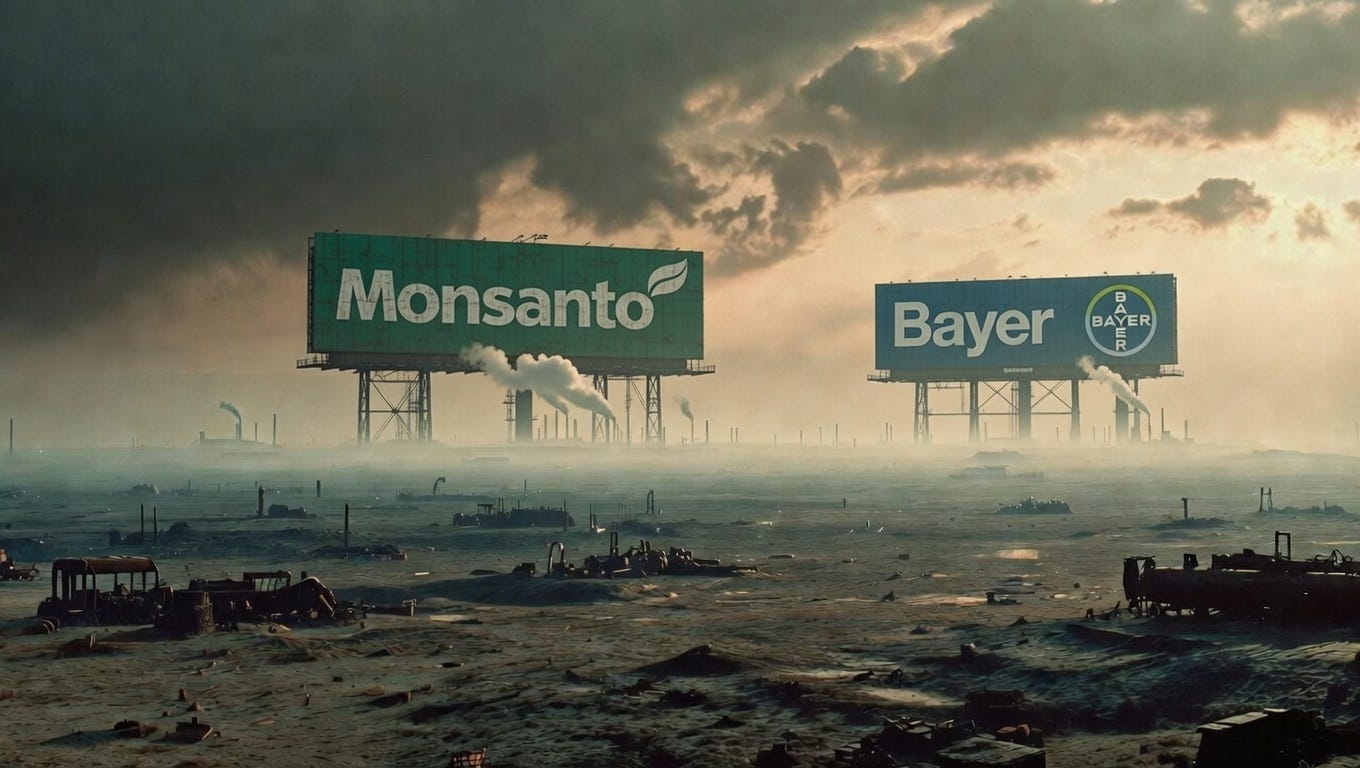
Currently, the only producer of glyphosate-based herbicides is Bayer, the German corporation who purchased Monsanto in 2018. Monsanto has produced the world’s most popular glyphosate-based herbicide Roundup since the mid-1970s. In 1996, the company also introduced so-called “Roundup Ready” genetically engineered seeds, designed to withstand glyphosate application.
The Executive Order even includes an “Immunity” provision that protects producers of glyphosate from liability under section 707 of the Defense Production Act, titled “Liability for compliance with invalid regulations; discrimination against orders or contracts affected by priorities or allocations.” That section contains a provisions titled “Protection from liability for compliance with invalid rules” which notes that “no person shall be held liable for damages or penalties for any act or failure to act that results directly or indirectly from complying with a rule, regulation, or order issued under the Act”.
In relation to the order on glyphosate, this appears to indicate that Bayer/Monsanto cannot be held liable for damages resulting from their compliance with the order. While Section 707 primarily protects against contractual disputes relating to breach of contract, there is concern among MAHA advocates that the order will shield glyphosate producers from legal and financial risks relating to the increased production of glyphosate-based herbicides.
Political commentator Lauren Lee—who supported Kennedy’s MAHA efforts yet now questions its future relevance—stated:
“The MAHA movement has lost all leverage. Just days after MAHA leaders called for Trump to hold pesticide corporations accountable ‘if Republicans want to win the midterms’, Trump came out in favor of glyphosate immunity. If that doesn’t show you the absolute failure of MAHA’s long-term political strategy, I don’t know what does.”
Lee believes some MAHA activists are more interested in being close to political power than standing by their principles, saying, “People want to go to soirées. They want to be ‘in the room’. So leadership compromised key MAHA issues and gave the leverage of independence away completely.”
Robert F. Kennedy Jr. Defends Glyphosate Executive Order
The day after the EO’s release, HHS Secretary Kennedy released a statement to the media making it clear he was in support of the measure:
“Donald Trump’s Executive Order puts America first where it matters most — our defense readiness and our food supply. We must safeguard America’s national security first, because all of our priorities depend on it. When hostile actors control critical inputs, they weaken our security. By expanding domestic production, we close that gap and protect American families.”
Lauren Lee and other MAHA supporters are split over whether they should continue to back Kennedy’s efforts or if he has abandoned the principles he helped promote. Speaking with The Last American Vagabond on the current state of the movement, Lee stated:
“Do I trust Bobby? I don’t trust the government, period. I understand the emotional reaction people have about our Health Secretary because of how much investment went into his independent campaign; and how hard we pushed for the Trump coalition. But for me, it’s all about what’s happening now. Anything else is a sunk cost fallacy. The question we have to ask ourselves now is, are we moving forward or backwards?”
“I think we should hold government appointees accountable for their decisions regardless if we voted for them or not. To me that’s just common sense. I’d like to see promises kept.”
As the backlash from the MAHA movement increased on social media, Kennedy was pressured to make a longer statement, which he did on February 23:
“Pesticides and herbicides are toxic by design, engineered to kill living organisms. When we apply them across millions of acres and allow them into our food system, we put Americans at risk. Chemical manufacturers have paid tens of billions of dollars to settle cancer claims linked to their products, and many agricultural communities report elevated cancer rates and chronic disease.”
However, Kennedy stated that US agricultural system depends on these toxic pesticides and herbicides.
“The U.S. represents 4% of the world’s population, yet we use roughly 25% of its pesticides,” he continued. “If these inputs disappeared overnight, crop yields would fall, food prices would surge, and America would experience a massive loss of farms even beyond what we are witnessing today. The consequences would be disastrous.”
Kennedy also defended Trump, stating that the president “did not build our current system—he inherited it.” Kennedy correctly noted that for the last few decades politicians have written farm policy, “directed research dollars, structured subsidies and crop insurance, and shaped commodity markets to reward monocultures and maximum yield.” Kennedy said these decisions “locked farmers into chemical dependence and prioritized short-term output over long-term soil vitality and human health.”
He claimed the Trump administration is now “changing course” without destabilizing the food supply. Towards this end, Kennedy said he will work with USDA Secretary Rollins to accelerate the “transition to regenerative agriculture by expanding farming systems that rebuild soil, increase biodiversity, improve water retention, and reduce reliance on synthetic chemicals, including pre-harvest desiccation.”
Kennedy said that American farmers are putting these ideas to the test and that the federal government will “act with urgency to expand their reach and accelerate adoption nationwide.”
While Kennedy’s mention of regenerative farming is notable and reminiscent of his own shuttered presidential campaign, the claim that the Trump administration is supporting this transition belies the actions taken by Trump during his first term as president, as well as his first year back in the White House.
Robert F. Kennedy Jr. Defends Trump’s Glyphosate Executive Order
In his latest appearance on Joe Rogan’s show @SecKennedy @RobertKennedyJr once again acknowledges the harm caused by glyphosate and makes excuses for Trump’s EO. In the full clip he also admits that the solutions… pic.twitter.com/ZN7vlvunka
— Derrick Broze (@DBrozeLiveFree) February 28, 2026
Trump’s History of Working with Pesticide and Biotech Corporations
During his first term, Trump continued the trend of nominating industry insiders, namely from chemical companies like DOW and Monsanto. As I reported in March 2018, Trump nominated Peter C. Wright to be the assistant administrator for the US Environmental Protection Agency’s Office of Land and Emergency Management (OLEM). Since 1999, Wright worked at The Dow Chemical Company where he served as managing counsel for environmental health and safety and principal counsel for all significant mergers and acquisitions. Wright also worked as an Environmental Attorney for Monsanto from 1989 to 1996.
While the revolving-door relationship between industry and government didn’t start under Trump, he absolutely continued the practice. As far back as the Reagan administration, the US presidency has been bending to the will of biotechnology giants like Monsanto, Dow, and Syngenta.
Former President George H.W. Bush appointed Monsanto attorney Clarence Thomas to the Supreme Court. Former President George W. Bush was also friendly to the pharmaceutical and biotech industry, appointing individuals like Donald Rumsfeld, a former president of Searle Pharmaceuticals, to Secretary of Defense. The younger Bush also appointed Linda J. Fisher, a Monsanto representative from 1995 to 2000, to second-in-command at the EPA.
One of the most well known examples of the incestuous relationship between chemical companies and the US government was Michael Taylor, a former lawyer for Monsanto. Taylor worked in the US Food and Drug administration during the Nixon and Reagan administrations before serving as a lawyer for Monsanto. In 1991, President George H.W. Bush appointed Taylor as the FDA’s Deputy Commissioner for Policy. Taylor was also reappointed to the FDA by the Obama administration.
During Trump’s first term as president he also ended investigations into pesticide manufacturers and their products. In June 2018, I noted that a coalition of conservation and public health groups filed suit against the Trump administrationand the EPA. The groups accused the federal government of forgoing an assessment of a pesticide known to have harmful health effects, as well as suspending training for pesticide handlers.
The Center for Biological Diversity, Center for Environmental Health and Californians for Pesticide Reform filed suit against EPA head Scott Pruitt, accusing him of failing to protect endangered wildlife and the environment by abandoning a safety assessment of the pesticide malathion.
One year later, Trump issued an Executive Order which made it easier for GE foods to enter the American food supply. Trump’s executive order was said to “streamline” regulations for GE and Genetically Modified Organisms (GMOs) in the United States. In his executive order, Trump called on federal agencies to fix what he called a “regulatory maze” related to the farming and selling of GMO products.
The executive order stated:
“Biotechnology can help the Nation meet its food production needs, raise the productivity of the American farmer, improve crop and animal characteristics, increase the nutritional value of crop and animal products, and enhance food safety. In order to realize these potential benefits, however, the United States must employ a science-based regulatory system that evaluates products based on human health and safety and potential benefits and risks to the environment. Such a system must both foster public confidence in biotechnology and avoid undue regulatory burdens.”
The order instructed the Secretary of Agriculture and other officials to “develop an action plan to facilitate engagement with consumers in order to build public confidence in, and acceptance of, the use of safe biotechnology in agriculture and the food system” [emphasis added].
The executive order also laid out plans for the Trump administration to work with other nations in developing GMO policies. Section 8 of the order directed the Secretary of Agriculture and the Secretary of State to develop, within 180 days, an international communications and outreach strategy to facilitate engagement abroad with policymakers, consumers, industry, and other stakeholders.
Greg Jaffe, biotechnology director at the Center for Science in the Public Interest, told the Associated Press at the time that the impact of the order would depend on how the federal government responded.
“There needs to be an assurance of safety for those products,” Jaffe said.
By increasing the presence of GE seeds and foods in the US food supply, Trump was also increasing the spraying of chemicals like glyphosate-based herbicides. Bayer/Monsanto’s “Roundup Ready” crops are genetically engineered to thrive in the face of heavy spraying, while traditional seeds and crops cannot survive the influx of the toxic chemical.
Cozy Relationship Continues Under Trump 2.0
Under Trump’s second term, the cozy relationship between government officials and industry insiders has not abated.
Several key USDA officials nominated or appointed under Secretary Rollins have direct links to biotech and pesticides firms. A few examples include:
- Scott Hutchins, Undersecretary for Research, Education, and Economics, who spent more than 30 years at Dow AgroSciences developing pesticides and hybrid seeds.
- Dudley Hoskins, Undersecretary for Marketing and Regulatory Programs, who previously managed regulatory policy for Responsible Industry for a Sound Environment (RISE), a division of CropLife America, the primary trade association for the pesticide industry.
- Peter Laudemann, Senior Policy Advisor for Trade and Foreign Agricultural Affairs, who was formerly the political affairs manager at Corteva Agriscience.
Additionally, as noted by US Right to Know, the second Trump administration includes “potent Bayer connections” via Chief of Staff Susie Wiles and US Attorney General Pam Bondi. Both Bondi and Wiles previously worked as lobbyists for Brian Ballard prior to joining the Trump admin. USRTK reported:
“Wiles, one of Trump’s most powerful advisors in Washington, worked for Ballard Partners as a lobbyist and then partner for a decade until 2022. From 2016 to 2022, she also worked as a senior advisor to Trump’s presidential campaigns.
Ballard raised more than $50 million for Trump’s 2024 campaign, and served on the 2024 inaugural and transition finance committees; he is widely seen as one of the most influential people in D.C. in who does not hold an official government title.
Ballard’s firm Ballard Partners became the highest-earning lobbying firm in D.C. in 2025, setting a record for the most lucrative year for any lobbying firm in US history. The firm registered to lobby for Bayer in December 2024. The firm also now lobbies for the American Chemistry Council, a trade group that includes Bayer among its corporate members.
Both Ballard and his partner, Daniel McFaul, who served on Trump’s 2016-2017 presidential transition team, are registered to lobby for both Bayer and the American Chemistry Council. The two organizations have paid Ballard Partners a combined half million dollars since Trump was elected the second time, according to federal lobby disclosures.”
Meanwhile, the Trump administration is currently being sued by several environmental groups following an EPA orderfrom the Trump administration that granted unconditional new use registration for the controversial herbicide Dicamba. The group includes the National Family Farm Coalition, Center for Food Safety, Center for Biological Diversity and Pesticide Action & Agroecology Network.
“EPA’s re-registration of dicamba flies in the face of a decade of damning evidence, real-world farming know-how and sound science, and, oh-by-the-way, the law,” George Kimbrell, legal director of the Center for Food Safety, told Courthouse News. “In reality, the Trump administration has once again betrayed farmers and poisoned the environment to pad corporate pesticide profits.”
While Dicamba has been used as a pesticide since the 1960s, it wasn’t until 2016 that it was approved for use over GE dicamba-resistant soybean created by Monsanto. Since that time, concerns over the damage caused by Dicamba have increased among farmers. The plaintiffs in the lawsuit alleged that the herbicide has damaged millions of acres of farmland because the chemicals spread beyond the intended crops because of wind drift.
In short, anyone who believed Donald Trump was going to uphold the MAHA agenda and change the policy of working with the pesticide and biotech industry has been proven incorrect. Much like the AI and Big Tech firms that are “winning” under Trump 2.0, Big Ag is likely to see record profits as the American people continue to suffer.
https://tlavagabond.substack.com/p/biotech-and-pesticide-corporations