
Brain-Computer Interface (BCI) Companies: Mental Privacy is Doomed
And the first amendment won’t protect us from ourselves.
For years, the public was told that brain-computer interfaces were about compassion. The sales pitch was simple and emotionally powerful: helping a paralyzed person communicate again, allowing someone with ALS to type with their thoughts, restoring movement after a catastrophic injury. Few people would object to that. It is difficult to look a suffering patient in the eye and argue against technology that might give them some measure of independence back.
But that is not where this is going.
And increasingly, the companies involved are not even pretending otherwise.
What we are witnessing is the rapid normalization of direct human-machine integration at a speed that should alarm every sane person paying attention. Not cautious development. Not slow, heavily regulated medical adoption. Not decades of careful ethical consideration. Instead, this technology is being pushed forward with the manic urgency of a Silicon Valley app launch. The rationale behind it all is revealing.
There simply are not enough paralyzed patients in the world to justify the scale of the investment pouring into brain-computer interface companies. Investors are not throwing billions into this sector because they are humanitarians. Venture capital is not a charity. The real target market is everybody else.
- Gaming.
- Consumer electronics.
- Augmented reality.
- Mood tracking.
- Productivity optimization.
- Advertising.
- Military applications.
- Cognitive enhancement.
- Surveillance.
The paralysis market is the moral doorway through which the rest of this agenda enters.[1][2]
Once you understand that, the current frenzy begins to make sense.
Consider the landscape now emerging. Companies such as Neuralink, Synchron, Precision Neuroscience, Blackrock Neurotech, and Kernel are all racing to wire human cognition directly into digital systems.[3][4][5] Synchron alone has announced partnerships and integrations involving Apple and NVIDIA, while positioning itself as a leader in minimally invasive neural implants.[6][7] Meta has developed Brain2Qwerty, an AI brain-computer interface (BCI) capable of translating neural activity into text as users type on a keyboard.
And we are supposed to believe this will stop at helping quadriplegics move a cursor?
Please…
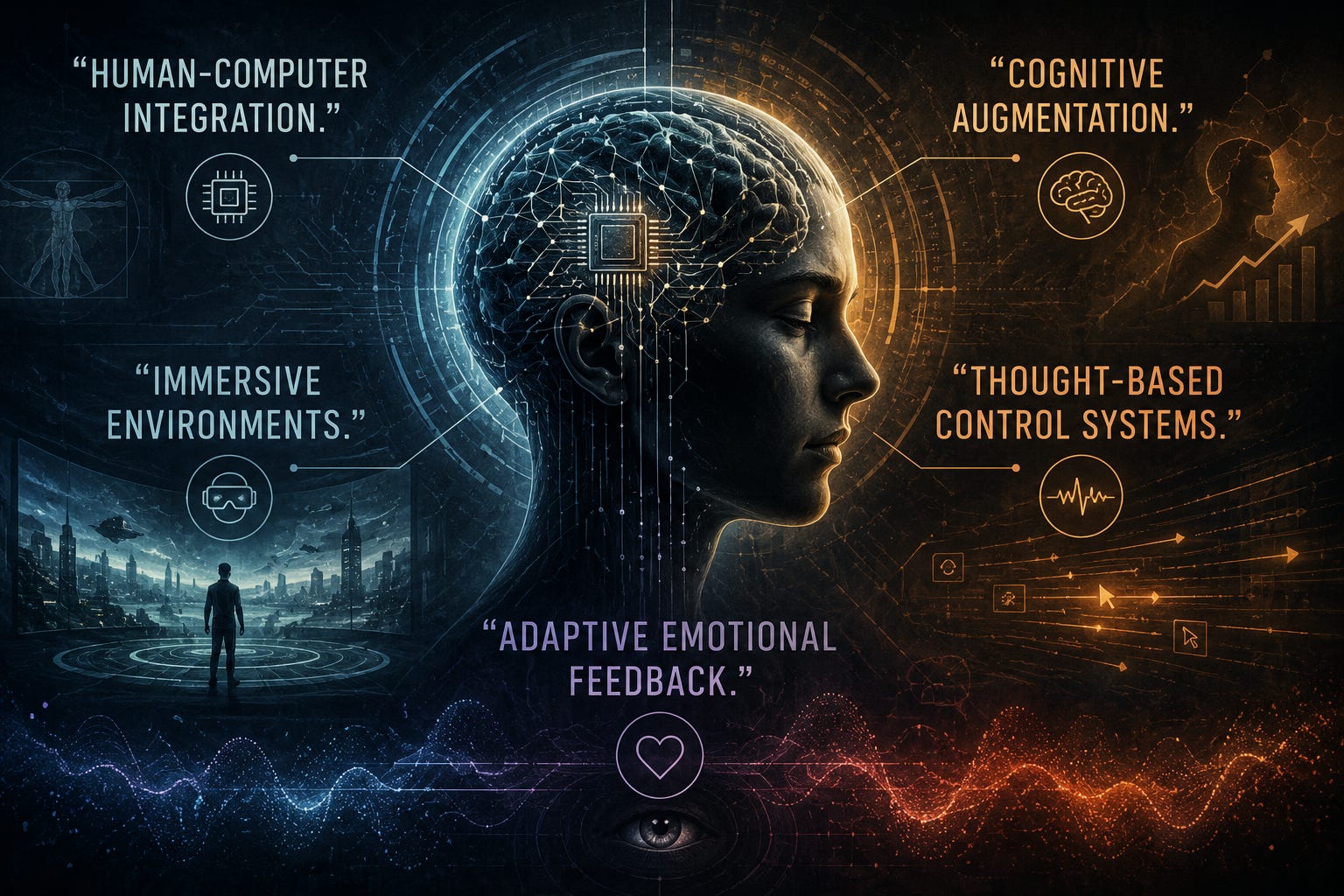
The language used by these companies tells the story. “Human-computer integration.” “Cognitive augmentation.” “Immersive environments.” “Thought-based control systems.” “Adaptive emotional feedback.” In plain English, they are building systems designed not merely to observe human behavior, but to interface directly with cognition itself.[8][9]
This is not simply another medical device category.
This is the potential end of mental privacy.
Once a technology exists that can reliably decode intent, emotional state, preference, impulse, or attention in real time, every institution on earth will want access to it. Governments will want it. Militaries will want it. Intelligence agencies will want it. Advertisers will want it. Employers will want it. Social media companies will want it. Insurance companies will absolutely want it.
And history tells us the same thing over and over: if something can be weaponized economically, politically, or socially, eventually it will be.
The truly astonishing part is how casually this is all being normalized.
Headlines describe brain implants the way technology blogs once described smartphones or gaming consoles. Investors talk about “scaling.” Market analysts discuss “consumer adoption pathways.” Journalists marvel at people controlling video games with their thoughts, as though humanity has collectively learned nothing from the last twenty years of technological overreach.[10][11]
We already live inside an attention-harvesting ecosystem that has profoundly damaged children, destabilized public discourse, amplified addiction, fueled anxiety and depression, distorted politics, and created unprecedented mechanisms for censorship and behavioral manipulation.
And now these same industries are moving upstream, toward the brain itself.
What could possibly go wrong?
Even the current non-invasive systems should concern people. Companies are already marketing EEG-enabled devices for focus optimization, emotional adaptation, workplace productivity, meditation tracking, and gaming immersion.[12][13] Universities are openly discussing systems capable of decoding internal speech from brain activity.[14]
Think carefully about that trajectory.
Today, it is helping a stroke victim communicate.
Tomorrow, neural enhancement will be linked to software capable of determining attention, emotional response, ideological engagement, fatigue, impulse control, stress levels, and cognitive performance in schools, workplaces, military systems, airports, vehicles, and digital platforms.
And eventually, inevitably, someone will propose that refusal to participate represents a safety risk. That mandates are necessary for the well-being of society: for safety, for well-being, for longevity, for compliance.
We have seen this movie before.
Every major technological intrusion into personal liberty arrives wrapped in convenience, safety, compassion, or progress. Surveillance becomes “security.” Censorship becomes “harm reduction.” Tracking becomes “public health.” Behavioral manipulation becomes “user engagement.” Now, direct neural integration is being sold as accessibility and entertainment.
The gaming angle alone should terrify people.
The fact that companies are racing to connect brains directly to immersive digital environments before we even understand the long-term neurological, psychological, developmental, or societal consequences is sheer madness.[15][16] We are talking about systems specifically designed to blur the boundary between biological cognition and engineered virtual environments, deployed into populations already suffering epidemics of screen addiction, anxiety, loneliness, attention fragmentation, and social isolation.
Children can barely escape smartphones and algorithmic feeds now.
What happens when immersive systems no longer require hands, keyboards, or even speech?
What happens when digital environments become emotionally responsive in real time to neural feedback?
What happens when AI systems learn to optimize not just your behavior, but your neurological reward pathways directly?
And perhaps most importantly: who owns the data?
Because make no mistake, neural data will become the most valuable commodity on earth. More intimate than your browser history. More revealing than your DNA. More predictive than your purchasing patterns. A direct map of attention, preference, impulse, and emotion.
Once collected, it will not remain private.
It never does.
Supporters insist safeguards will emerge. Regulations will protect users. Ethical frameworks will evolve. But this is the same fantasy we heard during the rise of social media, mass surveillance, smartphone tracking, facial recognition, and artificial intelligence. The technology always outruns the oversight. The money always outruns the ethics. And once infrastructure is embedded into society, reversing course becomes nearly impossible.
The frightening thing is not that brain-computer interfaces are being developed.
Some of the medical applications are genuinely remarkable.
The frightening thing is that humanity is sprinting toward mass adoption before we have even begun to grapple seriously with the implications.
We are watching the construction of systems capable of penetrating the last truly private domain humans possess: the interior space of the mind itself.
And we are racing towards this future, so someone can play a video game faster.
That may be the most absurd part of all.
https://www.malone.news/p/brain-computer-interface-bci-companies