
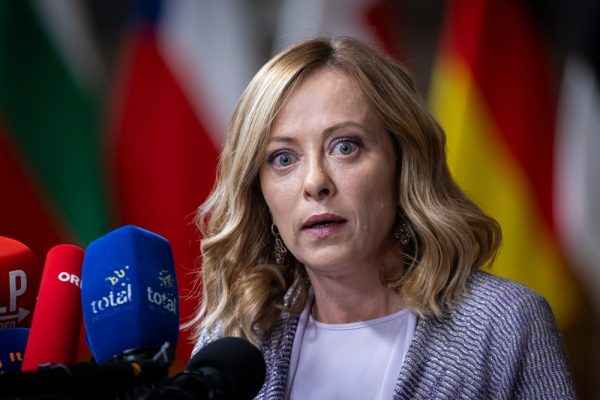
Business as Usual — Giorgia Meloni Turns Out to be a Standard Globalist ‘Conservative’
Rome in winter is free of the frenetic chaos of the tourist season—which starts around Palm Sunday and ends in late October—to reveal the Eternal City’s intimate side. Without those ubiquitous foreign multitudes, Rome looks and feels like a normal city inhabited by real people. It can be chilly by local standards, temperature hovering around 60 at noon, but the skies are mostly blue and the pranzo can be enjoyed outdoors on many days.
It is especially pleasing to be able to sit on a bench along the walls of the Sistine Chapel and savor Michelangelo’s masterpieces without being constantly urged by the guards to keep moving. At the Galleria Borghese the customary two-hour limit on visits is still in force, but it is not applied with undue diligence. The restaurants revert to the locals’ stringent standards of service and food quality, which even the better ones often find hard to maintain in season. Right now, in short, the greatest city on Earth is very pleasing just by being itself.
For an aficionado of politics who remembers well the turbulent Berlusconi era, which ended with il Cavaliere’s death almost three years ago, the surprising news is that there is nothing dramatic to report. Italy is enjoying a period of stability unprecedented in its post-World War II history. Giorgia Meloni’s coalition government, formed after the September 2022 elections, is already the third longest-serving in the history of the Republic. It may prove to be the first to complete its full term, with the next general election due in December 2027.
This is in marked contrast to political crises experienced in other European countries, most notably France. A confederalist rather than federalist—but by no means a certified Euroskeptic like her coalition partner Matteo Salvini, the Lega leader—Meloni has shed her populist image of yore in favor of respectability abroad and fiscal discipline at home.
With Italy’s GDP growing steadily and employment at historic highs, she is heading a government which is increasingly identified with her personally rather than with her party, the Fratelli d’Italia (Italian Brothers). That seems conventional enough: Italians tend to vote for strong leaders, as Berlusconi’s career has shown, rather than their parties. (The phenomenon acquired an absurdist twist 10 days ago, when it was discovered that the face of one of two recently restored angels in a historic church in Rome bore an “astonishing” similarity to Meloni’s own countenance.)
In foreign affairs Meloni is notably friendlier to Donald Trump than the dominant political elite in Brussels, Berlin, and Paris. In an extensive interview on Jan. 31 she said that the Europeans should stop complaining that the Americans want to reduce their presence and influence in Europe, while at the same time trying to continue delegating their responsibilities as sovereign nations to the United States.
Meloni sees a paradox in the fact that “precisely those who continually argue about relations with the United States, and who tear their clothes over the presence of U.S. security officers during events like the Olympics, simultaneously ask the United States to continue to handle our defense.“ This brings only confusion to Europe itself, Meloni said, which “for a long time has given up on addressing its own security, even going so far as to believe that there was no external danger from which it needed to defend itself.“ But that danger does exist, she concluded, as evidenced in Ukraine.
Such platitudes, coupled with Meloni’s simultaneous assurances that Italy will continue supporting Ukraine in concert with its allies, reveal her as a conventional Atlanticist who is still unwilling to take seriously a spate of warnings from Washington that the Trump administration has a problem with Europe—a fundamental problem which goes way beyond defense burden-sharing.
Meloni claims to be a conservative Roman Catholic who believes in defending “God, Fatherland, Family,” but she acts as if she were oblivious to the substance of criticism of the EU contained in Trump’s National Security Strategy revealed two months ago. That document (as our readers may recall) warns that Europe is facing the “stark prospect of civilizational erasure,” that the European Union is eroding political liberty and sovereignty of its member states, and that the possibility of “certain NATO countries” becoming majority non-European brings into question the very future of NATO.
This is a serious omission for the leader of a major European country. It brings to mind my misgivings about Meloni expressed at the time of her election victory, specifically that in the final days of the campaign she gave assurances to Italy’s Western partners that she would provide continuity on three key policy issues: Atlanticism, anti-Russianism, and fiscal restraint. Her government may yet proceed with some anit-woke measures in the social and cultural sphere, I opined, for as long as its fundamental geostrategic anchorage stays set:
Meloni is making a strategic mistake, however, if she imagines that making compromises on national interests in foreign affairs will buy her the right to proceed with a permanent conservative social and cultural agenda at home, including serious immigration control.
Two and a half years later it appears that I was wrong in assuming Meloni was making a Faustian pact with Brussels and Washington to pursue a conservative domestic agenda. It now seems evident that all along she has lacked the necessary conviction and stamina for such a dual-track strategy. Her failure is particularly striking when it comes to immigration control, arguably the most important challenge facing Italy and a key issue in her election campaign.
Before the 2022 election Meloni repeatedly promised, but subsequently never enacted, a naval blockade to halt illegal immigration. She has pursued measures to limit the arrival of migrants and increase deportations which proved palliative and ineffective. A fund of paltry five million euros (less than $6 million) was created to reduce the overcrowding on Lampedusa, Italy’s southernmost island, some 70 miles from the Tunisian coast. The maximum detention period for illegal migrants was increased from 120 to 135 days, a notably meaningless “success.”
Predictably, Meloni’s 2023 plan to send migrants arriving in Italy to Albania for fast-track processing has been obstructed by domestic courts and by the European Court of Human Rights. Unlike Prime Minister Viktor Orban in Hungary, Meloni has accepted the EU Pact on Migration and Asylum (effective June 2026) which makes it mandatory for member states either to accept relocations of asylum seekers or to provide financial contributions for their upkeep.
During Meloni’s tenure thus far, the number of foreign-born residents in Italy has grown from 5 to 5.6 million. Under pressure from the main employers’ group, Confindustria, she has agreed to issue 497,000 additional work permits to foreign workers between 2026 and 2028. Proportionate to the population, this is the equivalent of the U.S. federal government pledging to issue three million new green cards to foreign citizens over the next two years. Obviously tailored to fall just short of the politically problematic figure of half a million, the plan—coupled with the ongoing illegal influx—will push the number of resident foreigners above 10 percent for the first time in Italy’s history.
Meloni’s betrayal of her election promises has helped her political ambition by plea sing millions of stability-seeking Italians who did not vote for her in 2022. To many of them, the migrant crisis is still not an existential issue that impacts them directly, as it has become in France, Germany, or Britain. The turning point is bound to come, however, when the migrants start taking over neighborhoods near their homes or when they become ubiquitous in the narrow streets of provincial towns and villages. For the time being, however, these voters are happy to support a former firebrand who has mellowed into an eminently mainstream politician.
Her pro-family rhetoric notwithstanding, Meloni has done little to alleviate Italy’s challenge of collapsing demography. The population of Italy has contracted by close to four percent, from over 61 to under 59 million, over the past decade. It has the lowest birthrate in the EU and a rapidly aging population. Its 370,000 live births in 2024 marked the lowest number since 1861, when the newly united Italy had 26 million inhabitants. At the same time emigration is on the rise: “The numbers of Italians leaving their country and of foreigners moving in have soared to the highest in a decade,” official data showed in June 2025. This is a national emergency which demands a resolute national plan of action; but for now, there is none.
On balance, the current state of Italy’s political and social scene is reflected in the fact that notoriously globalist media outlets, including The Financial Times and The Economist, are lavishing praise on Meloni. While lauding her “political effectiveness” and “good management skills,” they seem willing to dismiss with a knowing smile Meloni’s occasional missives which appeal to her old conservative base.
For Italy to recover in the medium term, and to survive as a national community in the long run, Giorgia Meloni’s view of stability needs to be challenged. The 2026 winter of Italian content, for all its transient allure, may bode ill for the country’s future.
For Italy to recover in the medium term, and to survive as a national community in the long run, Giorgia Meloni’s brand of stability needs to be challenged. The 2026 winter of Italian content, for all its transient allure, bodes ill for the country’s future.
https://chroniclesmagazine.org/web/the-winter-of-italian-content-is-deceptive