
China and the End of Dollar Rule
Multipolar money rises.
China enters the global ledger like a dream that refuses daylight. Ink turns tidal. Numbers begin to breathe. Xi lifts the yuan from the abstraction of accountants and sets it loose in the bloodstream of the planet: a currency that wants circulation, friction, and the metallic taste of distance. Traders in Singapore, ministers in Riyadh, bankers in São Paulo feel the tremor before language catches up. America senses the disturbance the way an old cathedral senses cracks traveling through stone. Empires recognize approaching weather long before the first thunder speaks.
Financial power grows from furnaces, fiber-optic nerves, and laboratories where engineers rehearse the future. China studies its own mass and discovers density. Steel, data, ships, rare earths: the elements chant together. Strength calls for expression; expression demands a currency equal to the scale of production. Multipolarity glows here as an atmospheric shift: the sky that once carried a single sun now gathers several burning centers, each insisting on gravitational rights.
The dollar still floats everywhere: in oil contracts, sovereign vaults, and the muscle memory of global trade. Yet something spectral passes through it. Reserve managers move fractions across spreadsheets with the care of surgeons redirecting blood flow. Sanctions gallop across continents like iron doors slamming shut. Every closure teaches the same lesson: dependence sharpens risk into doctrine. Even treaty partners listen. Especially treaty partners listen. Multipolarity expands through these micro-decisions, through cautious reallocations that accumulate until an entire architecture begins to tilt.
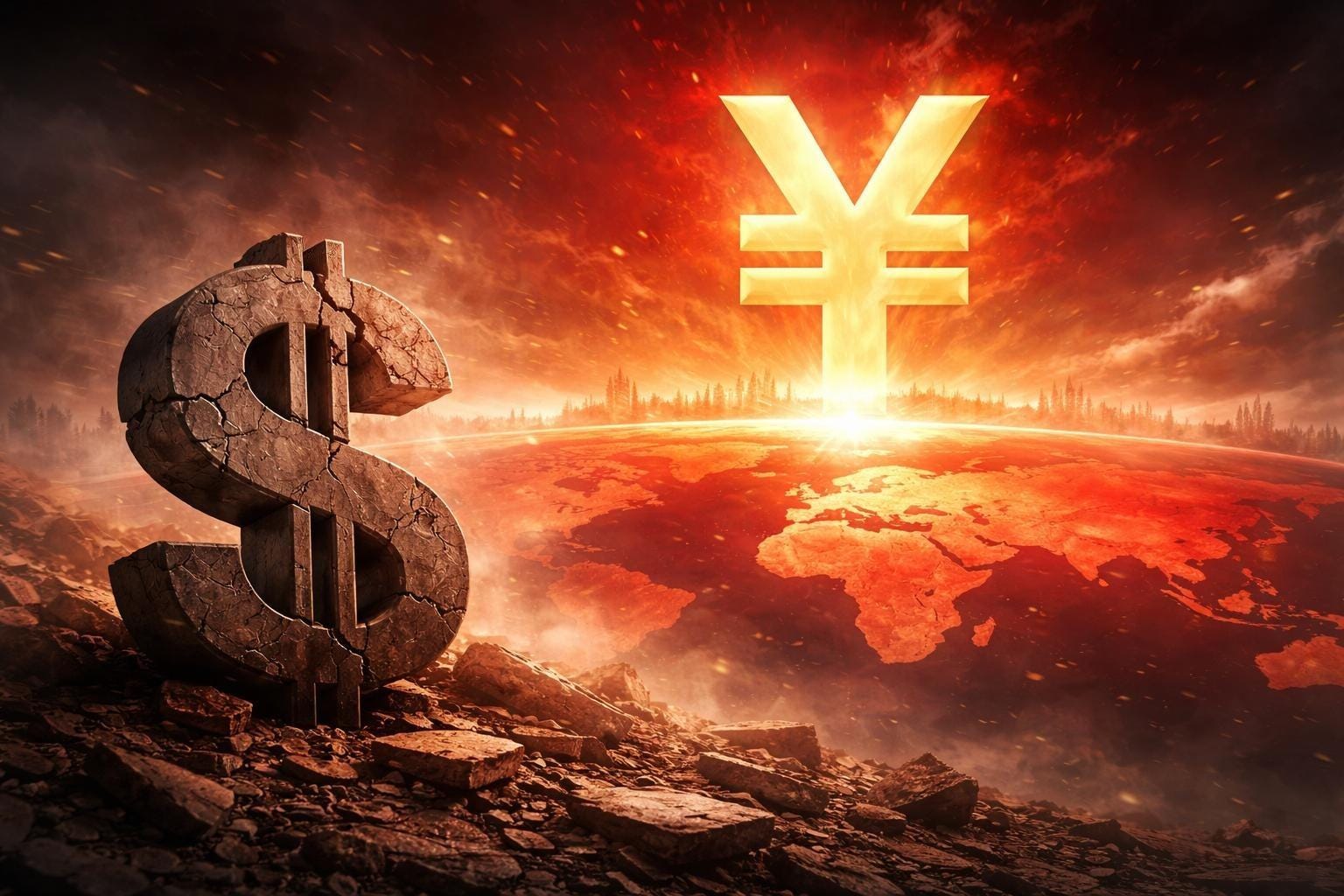
Commerce rehearses escape routes. Bilateral settlements appear. Clearinghouses proliferate. Digital corridors flash into existence. The threat of expulsion from SWIFT hangs in policy rooms like a blade suspended by a filament. For generations, the dollar advanced beside fleets and air wings, finance braided tightly with projection of force. Picture the choreography changing: the yuan rising through trade winds while the dollar descends into a more contested altitude. Orders rarely shatter; they liquefy, seep, and reassemble around fresh magnets of confidence.
Beijing speaks with longer temporal lungs, aligning monetary ambition with planning cycles that stretch beyond electoral imagination. Xi’s words carry the texture of inevitability, almost geological. Momentum gathers in silence first. Across the ocean, the United States radiates power outward while internal frequencies flicker: polarization, fiscal strain, and the theater of democratic combustion. Markets worship continuity; once continuity appears fragile, capital develops wanderlust. Strategists redraw their atlases. Diplomacy acquires new geometry. The question of the dollar transforms into the central riddle humming beneath world politics.
Ease dissolves in such an hour. Should the monetary pillar of American predominance erode further, the republic still wields vast military force, a thunderhead accumulated across decades. Yet the century leans towards dispersion, towards a constellation rather than a crown. Currencies gather symbolic voltage. Trade routes mutate into civilizational signatures. Authority migrates across several capitals at once. Multipolarity ceases to function as theory and becomes atmosphere inhaled by markets and exhaled by states, until the planet itself feels organized less like a unipolar empire and more like a field of rival stars, each radiating its own law of value.
https://www.eurosiberia.net/p/china-and-the-end-of-dollar-rule