
Christmas Peace of 1914 – Satanists Hold Us Hostage
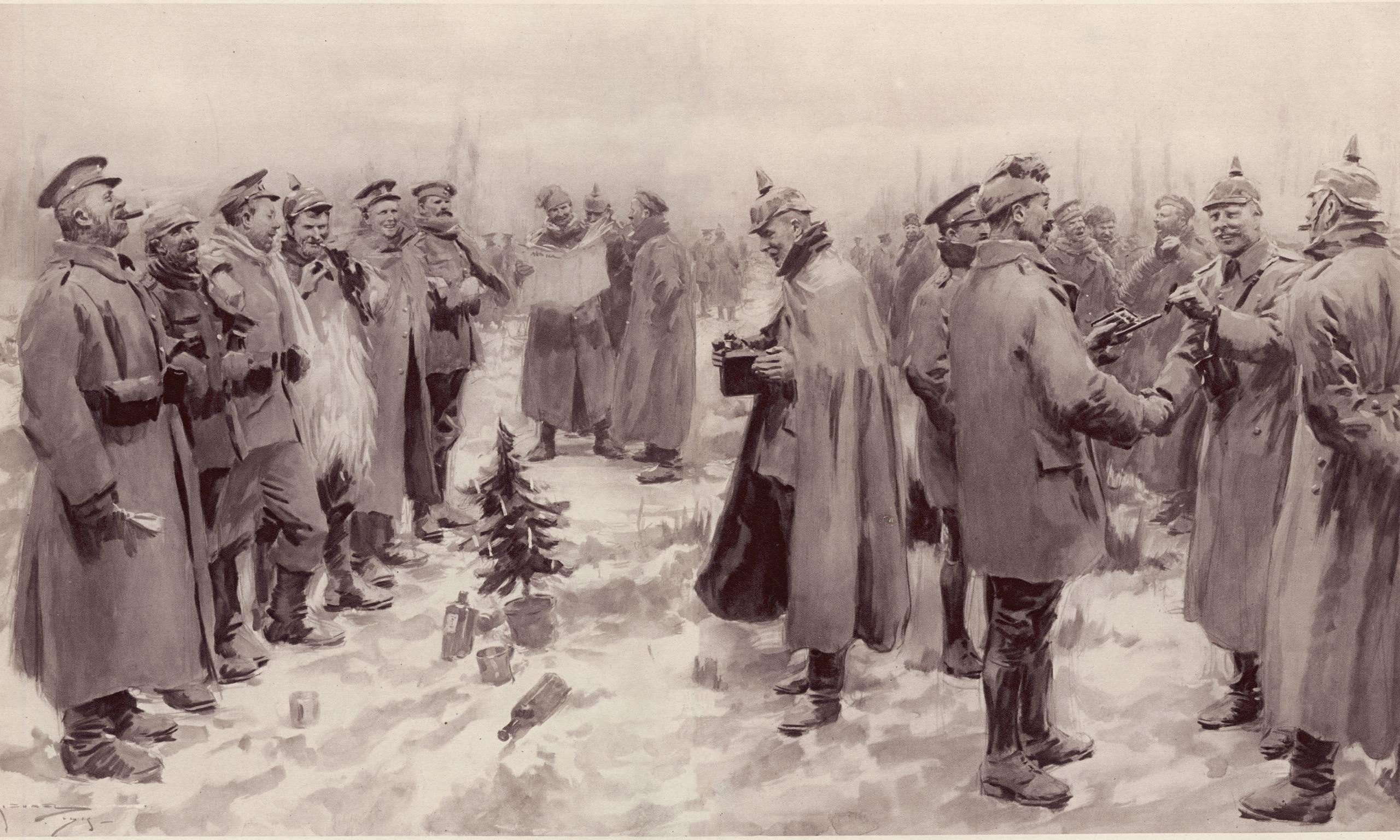
At Christmas 1914, British and German soldiers fraternized and refused to kill each other. Christmas reminded them that they had more in common with Jesus Christ and the gospel of love than with the cabalistic (Satanist) bankers who had engineered this war to kill them.
Brian wrote: “You post this every year at Christmas. I never tire of it. Shout it from the rooftops! It clearly shows that people generally don’t want to go to war with each other if they pause for a moment and think for themselves.”
Just like Smedley Butler when he stopped blindly following orders. When you travel, you realize that people are more alike than different. They love their children, their culture, their traditions, and, like us, they seek peace. And finally, this story is thought-provoking, writes Henry Makow .
Why would Christian nations take up arms against other Christian nations? The answer is that war is caused by globalist bankers for their own ends, not by media narratives. We hope that complicated alliances and meaningless treaties don’t drag us into other conflicts like the war in Ukraine.
May all the men who paused for peace rest in peace. And may all the leaders who yearn for war get what they deserve.
“The total number of military and civilian casualties in World War I exceeded 37 million: over 16 million killed and 20 million wounded, making it one of the deadliest conflicts in human history.” – Wikipedia
The governments of the Western nations, whether monarchical or republican, had fallen into the hands of a plutocracy, internationally powerful and influential. I venture to say that it was this semi-occult power which…thrust the masses of the American people into the cauldron of the First World War. —Major General J.F.C. Fuller (1878-1966) Decisive Battles of the USA, 1776-1918, (1942) p.396
from December 25, 2019
By Kieran Dunn
It’s a story worth retelling . Few realize that just over a century ago, the Christian nations of the world were at war.
Catholic, Protestant, Orthodox, and Coptic Christians had taken up arms against each other. They had cast aside the teachings of Jesus, which said to “love your enemy,” and were now embroiled in a disastrous war.
By Christmas, it was clear that this “short war” would not be over quickly, as politicians had promised. Pope Benedict XV had proposed a Christmas truce, but this was rejected by both sides as “impossible.”
Alfred Anderson of the British Expeditionary Force was only 18 years old and was at the front on Christmas Eve 1914 when the unthinkable happened. German and British soldiers began singing Christmas carols as they crouched in their respective trenches. A truce was quickly declared between the warring sides, and men who had been enemies just hours earlier began greeting each other and exchanging gifts.
In other areas along the front, German troops placed small trees on the parapets of their trenches, decorated them with burning candles, and began singing Christmas carols. Soon, many British troops along the front in this area joined in the singing. British and French troops saw Germans putting up signs reading: “YOU NO FIGHT; WE NO FIGHT.”
Some British units improvised banners reading “MERRY CHRISTMAS” and waited for a response. Soon, German, French, and British troops, unlike the warring governments, reached a spontaneous ceasefire, and the soldiers left their trenches.
All along the front line, men who just hours earlier had tried to kill each other met in ‘no man’s land’ to shake hands, share rations, chocolate cake, cognac, postcards, newspapers and tobacco, and (more solemnly) bury their dead.
Kurt Zehmisch, another BEF witness, wrote in his diary: “The English retrieved a football from the trenches, and soon a lively game broke out. How wonderful, yet also strange, that Christmas, the festival of love, managed to bring mortal enemies together as friends for a while.”
This informal truce, which also included some French and Belgian troops, was largely over by New Year’s Day. German and British soldiers reluctantly parted, in the words of Private Percy Jones of the Westminster Brigade, “with much shaking of hands and mutual goodwill.”
On January 1, 1915, The London Times published a letter from a major in the medical corps reporting that the British had played a match against the Germans in his sector and lost 3-2. The men had exchanged gifts and buttons. Soldiers who had been barbers gave free haircuts. A German juggler gave an impromptu performance in the middle of “no man’s land.”
German and Allied commanders tried to conceal the improvised ceasefire. French generals couldn’t understand why their soldiers ignored orders and participated in the forbidden Christmas truce. To the great consternation of field commanders on both sides, some troops were reluctant to resume fighting. In several areas, men were ordered to resume hostilities under penalty of court-martial.
In Germany, the ceasefire was largely ignored, and the High Command quietly replaced most of the front line units that had participated in the ceasefire. Although caught off guard and embarrassed by the spontaneous armistice, the Allied commanders ensured that the 1914 Christmas Truce would not be repeated and allowed their troops to engage the enemy during the following Christmas holidays.
The Christmas Truce of 1914 shows how the common faith in a Redeemer born in Bethlehem, shared by enemies, can transform even the bitterest enemies into friends.
When the British heard the Germans sing a song about a little baby born in a stable, they sang along to ‘Silent Night’.
It’s amazing how a song about a tiny newborn baby could make enemies lay down their weapons and embrace as friends.
When those on both sides of the trenches realized that the Christ they knew was also the Christ their opponents knew, what other response was possible than to make peace between brothers?
That’s why this story is worth telling every Christmas. Christ came to bring peace and forgiveness of sins to a troubled world. Knowing Christ continues to bring freedom and peace to all who encounter Him.
The Christmas Truce of 1914 is a beautiful testament to the words spoken by an angel on that first Christmas Day so long ago: “Peace on earth, good will toward all men.” Merry Christmas to everyone!
CB wrote:
My father was a U.S. Army veteran of World War II in the Pacific. He fought in the Battle of Leyte Gulf and Okinawa. He didn’t believe the government’s propaganda about “Why We Fight.” It’s not widely known, but army morale was low when the battle for Okinawa began; and I remember a U.S. Army unit collapsing on Okinawa.
He said morale on Okinawa was crumbling because the men were tired of fighting and dying. A morale officer quietly went around surveying the troops. One of the questions asked was: Are you prepared to see this war through to the end? My father replied, “No!” The officer was surprised and insisted, “Why not?” He said he didn’t care who won the war because he had lost his health, his mind, and his youth. My father said the officer was visibly upset by his answer, and what was even more disturbing was that he was hearing the same thing from men across the line! When I went to the World War II exhibit at the U.S. National Archives in 1995, I saw a combat report that, coincidentally, confirmed what my father had told me.
After reading Dave Grossman’s book, “On Killing: The Psychological Cost of Learning to Kill in War and Society ,” it immediately became clear to me that most men on the front lines don’t want to kill other men. A member of my church told me he’d fought in the Battle of the Bulge. He spent many days in a foxhole and eventually suffered frostbite. He emphatically stated that he had decided he wouldn’t kill another human being. He would rather be captured or killed. He had no intention of firing his weapon. I wonder how many other men believed the same thing (Private Eddie Slovak is a good example of a man refusing to fight and a bad example of how not to be captured).
Do I consider these men cowards, lazy, or unpatriotic? NO! As many veterans say, you have to be there (on the front lines, surrounded by death) to understand what this does to a person’s psyche. My father said of his experiences on Okinawa that it’s shocking to see what one person can do to another. There’s a line in the movie “Grand Torino” that fits this. Clint Eastwood’s character, Walt Kowalski, is a Korean War veteran. He tells Father Janovich, “What haunts a man are the things he shouldn’t have done.” I can absolutely confirm that my father suffered from PTSD until his death. He saw death as the only way a man could live in peace. How sad.
A few years ago, Dr. Thomas Weber examined war diaries and historical documents to reconstruct the Christmas Truce of 1914.
He found evidence that many soldiers attempted to negotiate armistices repeatedly in 1915 and 1916, but by then divisional commanders on both sides had received orders to use snipers to shoot any soldier who emerged unarmed from the trenches.
It was actually the singing of Christmas carols familiar to both sides that prompted the soldiers to approach each other without weapons. During modern battles, soldiers were driven by adrenaline and brutality, which, between fights in the trenches, turned into remorse. The respite from the sheer inhumanity of what they were doing likely prevented many of them from losing their humanity forever. The sad fact is that most of those who participated in the 1914 Armistice did not survive the war.
Dr. Weber also mentioned that the French soldiers did not participate in the first armistice, only the British and Germans.
Another person who opposed the armistice, along with the divisional commanders and the French, was Corporal Hitler, a courier to the regimental headquarters at the front. At least, that’s what one of Hitler’s brigade comrades, Heinrich Lugauer, wrote in his war diary. Weber quoted him: “When everyone was talking about fraternization with the English during Christmas 1914, Hitler proved to be a fervent opponent. He said: ‘Something like that shouldn’t even be discussed in wartime.'”
At Christmas 1914, British and German soldiers fraternized and refused to kill each other.
Christmas reminded them that they had more in common with Jesus Christ and the gospel of love than with the cabalistic (Satanist) bankers who had engineered this war to kill them.
https://www.frontnieuws.com/kerstvrede-van-1914-satanisten-houden-ons-gegijzeld