
Claiming Victory, Whilst Admitting Defeat: There is No Easy Way to Open Hormuz
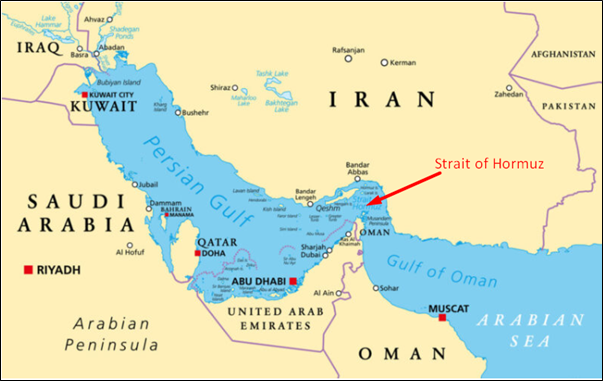
Bloomberg: “It is arguably Iran that has secured the most significant strategic victory … There is every sign that Tehran’s ability to control the Strait is increasing”
The defeats which the West keeps on having “[are] above all … intellectual”. And “not being able to understand what they are seeing – means that it’s impossible to respond effectively to it”. So Aurelien has argued. But “the problem goes beyond the fighting on the battlefield, to seeing and understanding the nature of asymmetric wars and their economic and political dimensions”.
“This is particularly the case for Iran, where … Washington appears to be incapable of understanding that the ‘other side’ does have a strategy with economic and political components — and is implementing it”.
“[In line with the western obsession with trivia], all the media concentration recently has been on the movement of US troops to the region and their possible uses, as though that, in itself, was going to decide something. Yet in fact, the real issue is the development and deployment by the Iranians of a new concept of warfare, based on missiles, drones and defensive preparations, and the inability of the West, with its platform-centric mentality, to understand and process these developments [i.e., fully assimilate the strategy behind asymmetrical warfare]”.
Iran’s security concept and model was planned more than 20 years ago. The trigger for the move to an asymmetric paradigm came from the US’ utter destruction of Iraq’s centralised military command in 2003, as a result of a 3-week massive air assault on Baghdad.
The issue for Iran that arose in its wake was how the country might build a deterrent military structure when it did not have (and could not have) anything resembling peer air capability. And when too, the US could look down upon the extent of Iran’s military infrastructure from its high-resolution satellite cameras.
Well, the first answer simply was to have as little of its military structure out in the open to be observed from above. Its components had to be buried — and buried deeply (beyond the reach of most bombs). The second answer was that deeply buried missiles could indeed, in effect, become Iran’s ‘air force’ — i.e. a substitute for a conventional air force. Iran thus has been constructing and stockpiling missiles for more than twenty years. The third response was to divide Iran’s military infrastructure into autonomous provincial commands — to decentralise command centres, with each having separate stockpiled munitions, separate missile silos, and where appropriate, their own naval forces and militia.
In short, Iran’s military machine — in the event of a decapitation strike — was designed to operate as an automated, decentralised retaliation machine that cannot be easily stopped or controlled.
When unable to understand what is before our very eyes, the easiest thing is to reach for that which one knows — a build-up of troops — and to continue doing what hasn’t worked in the past.
In an earlier incarnation, a younger Trump — desperate to be admired as a star in the world of Manhattan real estate — took New York Attorney Roy Cohen to be his personal mentor. “The latter notably was also the lawyer for the city’s five big crime families — who had, with connections such as these, earned for himself the reputation as someone not to be messed with”, Israeli military commentator, Alon Ben David relates:
“In most cases, all Trump needed to do was to introduce Cohen to the other side of the deal, so that the latter would agree to his terms. Sometimes Trump was also forced … to drag the other side to court, where Cohen would bare his teeth to the judges and win. But that was always Trump’s bottom line: win. Not to make the pie bigger, not a win-win for both sides, but a victory for him alone — and preferably with the other side’s surrender”.
Time moves on, and today, as Ben David writes, the US military juggernaut serves as Trump’s ‘Roy Cohen’. He presents the American military might for display to the Iranians in the expectation that they readily will capitulate; else he, Trump, will let go of the leash. Trump complained to Witkoff after the armada of US naval vessels had been assembled off the Persian coast that he was ‘puzzled and confused’ as to why the Iranians had not already capitulated on sighting the collective naval power assembled.
“[The cause for Trump’s puzzlement is that] this time he faces an opponent different from any he has ever known. These are not Manhattan real estate moguls or Atlantic City mobsters, they are Persians, members of a 3,000-year-old culture, and they have different concepts of time and what victory is”.
Trump doesn’t now know what to do: he is confused and at a loss as to how to extricate himself from this predicament. He has threatened Iran, but they don’t capitulate. And as might be expected, Netanyahu, fearing that Washington might enter into negotiations with Iran before Iran’s military capabilities have been completely dismantled, “is pressuring the Trump administration to carry out a short, high-intensity operation that could include ground forces”, Israeli commentator Ben Caspit writes in Ma’ariv.
Whilst Trump is sending mixed messages about the prospects for talks with the Islamic Republic, Israeli officials believe he is considering three options: First to escalate the war by attacking Iran’s energy infrastructure on Kharg Island and at its South Pars gas field, with a second option being a ground operation to eliminate Iran’s highly enriched uranium stockpile.
A third option being considered would be to negotiate an agreement with Iran — but such a prospect would be seen by Israeli leadership circles as a “clear Iranian victory, opening the path for the Iranian Republic to survive”, Caspit writes. “Israel is focused on weakening the regime to the point where it cannot recover — thus it hopes, maybe encouraging future mass protests. This argument is also being used to convince Washington to continue the war”, Caspit emphasises.
A fourth option could be that Trump just declares victory and walks away.
What, realistically, might Trump hope to accomplish if he expands the war?
First, both Israeli and US military officials now consider that toppling the Iranian State is nigh impossible to achieve through airstrikes alone. It has never worked in the past.
Secondly, statements of faith by the US Administration in say the ultimate military seizure of the Strait of Hormuz should be seen more as battle-cries and descriptions of fantasies which reveal a deeper problem — that of strategic lacunae —
“They are not deduced from the facts of the situation, nor do there have to be actual processes capable of making them happen. The truth is what we want it to be; the truth is what makes us comfortable, we prefer the myth to the reality”.
The fact is that there is no easy way to reopen the Strait. Any negotiated reopening would, at a minimum, require substantive concessions to Iran, including explicit recognition of Iranian sovereignty over the waterway.
An attempt to agree a ceasefire to open Hormuz would require it to be applicable across all fronts: it would require Israel to cease operations in Lebanon, for AnsarAllah to similarly halt attacks on Israel, for Iraq to halt its attacks — and for Israel to halt its attacks in Occupied Palestine.
Thirdly, Trump claims that that ‘regime change’ has already occurred because he had not heard the names of the new Iranian leaders before — “These are different people than anyone has ever heard of before, and frankly they’ve been more reasonable. So, we’ve had total regime change beyond what anyone thought possible”. Trump doesn’t know who the ‘new’ third layer of Iran’s leadership are, but nonetheless presumes that they will be more flexible in negotiating with the US. (What is the basis for this ‘faith statement’? No facts needed?)
Fourth, any attempt to open Hormuz by direct military assault would be fraught with the risk of sustaining substantial US casualties: Hormuz is home ground to the Iranians and constitutes a prospective battle for which they have been preparing over many years. The geography of Hormuz alone — narrow waterways, proximity to Iran’s coastline, and dense Iranian defence systems — pose obvious and severe risks. From where would the troops stage? How would they be supplied? How would they be exfiltrated?
Even were US forces to seize Kharg, or one, or all of the three islands adjacent to the UAE coastline, Iran could still attack unauthorised tankers transiting the waterway using surface or submersible drones or missiles launched from mainland Iran.
And even if successful, US military positions on the islands would not solve the core problem — Iran would still have the ability to impose costs (missile strikes and casualties) from afar, and would use this leverage to impose further escalatory steps.
Fifth, as with the suggestion of controlling Iran’s enriched uranium, there is no way to ensure that the reported 430 kg of 60% enriched uranium that Iran has is out of Iranian hands other than seizing it; an agreement on Iran relinquishing it is unlikely, as is seizing it in an impossibly complex military operation —
According to the Washington Post, when Trump requested a plan to seize the enriched uranium from Iran, the US military briefed him on a complex operation involving airlifting excavation equipment, building a runway inside Iran for cargo planes to extract the material, all with the deployment of hundreds of troops.
A US Special Forces military operation to seize this uranium would require meticulous detailing of the site (or sites) where it is held, as well as requiring well-founded staging and ex-filtration plans. Does the US know if this uranium is still in one consignment, or has it been separated?
There is no indication that the US has done the ‘thinking through’ for such an operation — suggesting that this aspect might be lined up as a deception exercise: Mount a small operation close to Isfahan, pretend to have seized the uranium, and skedaddle away quickly before Iranian forces kill American troops.
And finally, regarding the destruction of Iran’s missile capabilities, there is simply no way to achieve this. Iran’s magazines and production facilities are dispersed across the extent of the country and buried deeply. Maybe to lie would be Trump’s best option to produce a ‘win’ on this issue.
Iran has launched the extensive machinery of its ‘Mosaic’ system of long-term, pre-planned military actions. This is the point — Iran’s strategic counterattack was not conceived to lead to any negotiated compromise, but rather to create the circumstance by which Iran can escape the western-imposed ‘cage’ of endless sanctions, blockades, isolation and siege.
The uncomfortable reality for the US and its allies is that every available counter-military or diplomatic response to Iran’s strategic counterattack carries significant downsides.
The war is Trump’s and the US’ to lose. Trump now realises the war is lost — it may be lost, but it is not over. It may last for some time.
After a month of war, “it is arguably Iran that has secured the most significant strategic victory”, notes Bloomberg — with its ever “tightening grip over traffic through the Strait of Hormuz”:
“There is every sign that Tehran’s ability to control the Strait is increasing … The near-total closure of Hormuz since [early March] … has proved an exceptionally effective asymmetric weapon in Iran’s fight against two of the world’s most powerful military forces”.
https://conflictsforum.substack.com/p/claiming-victory-whilst-admitting