
Designer Babies: Silicon Valley’s Gift or a Temptation to Play God?
Christ and Humanity or Lucifer and Transhumanism? That is the Question.
Is it a dream for the rich, or a dystopian nightmare for us all? Tech entrepreneurs, venture capitalists, and cutting-edge medical labs are teaming up to offer parents a choice which used to be confined to science fiction B-Movies: the ability to design their children before they are even born. Predictably, this is a far bigger ‘thing’ at present in the USA than in Britain, but it’s coming for us all.
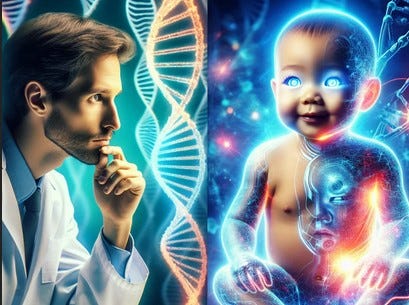
Through advanced IVF combined with polygenic embryo screening, scientists create multiple embryos, sequence their DNA, and select the one with the best predicted traits – lower risk of disease, higher chances of intelligence, greater height, even longer life.
Companies like Orchid Health, Nucleus Genomics, Genomic Prediction, and Herasight, backed by some of the Valley’s biggest names, are making this real. For tens of thousands of dollars, the promise is a healthier, smarter, “optimized” next generation.
Kian Sadeghi, the 25-year-old founder and CEO at Nucleus Genomics, appeared recently on CBS Mornings. He explained how, for $30,000, his company allows parents to select a baby with qualities they desire – from height to weight to intelligence. He calls it “genetic optimization.
Sadeghi started the company in 2021, inspired by a cousin who died of a rare genetic illness. Backed by investors and prominent tech entrepreneurs like Peter Thiel and Alexis Ohanian, Sadeghi says his company has helped thousands of families. This is big business already.
Nucleus offers a program called IVF+, which includes full DNA scans of both parents and up to 20 embryos conceived through in vitro fertilization. The company screens embryos for more than 2,000 traits and conditions, including eye and eye color, intelligence – even acne. It estimates genetic predisposition to medical conditions such as depression, autism and bipolar disorder.
The process is alarming some medical experts, who point to the ethical dilemmas surrounding these reproductive technologies. An article published in the MIT Technology Review last October argued the race to create the “perfect baby” is actually creating an “ethical mess.”
The American College of Medical Genetics and Genomics warns that the practice of genetic screenings and use of polygenic risk scores for embryo selection has “moved too fast with too little evidence.”
The ethical concerns multiply beyond the individual family. This technology is expensive, which gives rise to widespread criticism from a liberal perspective – only the elite can afford to ‘perfect’ their children.
It risks creating a two-tier society: the genetically “upgraded” and everyone else. It devalues those living with disabilities and it commodifies human life, turning the miracle of procreation into another consumer transaction. It brings back a process effectively outlawed since opinions formed by World War Two effectively outlawed it: Eugenics.
Despite all the concerns, it is easy to see the attractions. Who among us, watching a child struggle with a hereditary illness, would not leap at the chance to spare future generations that pain? Parents naturally want to give their sons and daughters every advantage; we always have done.
But now, in addition to the old possibilities – a decent neighborhood, the best schooling, braces – the wealthy have new choices for their offspring: strong bodies, sharp minds, beautiful faces, resilience against cancer or heart disease. Why leave something as precious as our offspring to chance when technology offers control?
Because, as Christians who hold fast to the God who “knit us together in our mother’s womb” (Psalm 139:13), we must pause and examine this with clear eyes and humble hearts. The technology is not neutral. It raises questions that strike at the core of what it means to be human, made in the image of God, and entrusted with life as a sacred gift rather than a customizable product.
Consider first how these “designer babies” come into being. In vitro fertilization is used to create not one embryos, but a dozen or more. Advanced genetic sequencing then ranks them by polygenic scores: predictions for everything from Alzheimer’s risk to IQ potential. The “top” embryo is chosen for implantation. The rest? They are discarded, frozen indefinitely, or sometimes donated for research that destroys them.
The use of that word ‘embryo’ is the crux of the problem. Or, rather, an attempt to gloss over the key problem: A dozen ‘embryos’ sounds completely neutral, the unwanted ones can just be flushed away. But they are not ‘embryos’, each one is a human soul, a living baby with all its potential, its looks, character and humanity already decided.
A supposedly Christian nation has to understand that life begins at conception, the moment when the unique spark of a new human soul is created. Which makes this process nothing less than selective mass abortion.
Then there is the spiritual temptation: the lure to play God. Scripture warns us repeatedly against the pride that leads us to usurp divine prerogatives. In Genesis, humanity’s first sin was grasping for knowledge which belonged to the Creator alone. The fate of the Tower of Babel reminds us of what happens when we seek to build our own heaven on earth.
The Bible calls children a heritage from the Lord (Psalm 127:3), not projects to optimize. When we reject the child God gives us in favor of the one we engineer, we declare that His wisdom is insufficient. We trade trust in divine Providence for the illusion of personal control.
Acceptance of this technology also sells the pass for transhumanism, the global elite quest to move from Homo Sapiens to Homo Deus. If the wealthy can ‘improve’ their children through screening and embryonic choice, then what is the moral problem with merging humans with robots and AI implants? Once they start choosing human genetics, why shouldn’t they change them? Why stop at Man, when they can create Superman? The best word is ‘Luciferarian’.
The prospect of healthier, happier, more successful children is a very tempting vision for prospective parents standing on their little mountains of uncommon wealth. But the cost is astronomically high – not the $30,000 charge by companies like Nucleus, but the creation and killing of nineteen siblings and the mainstreaming of the idea that humans have the right to play God. “Get thee hence, Satan”.
https://nickgriffin544956.substack.com/p/designer-babies-silicon-valleys-gift