
Doomsday: The Suicide Pact No One Voted For
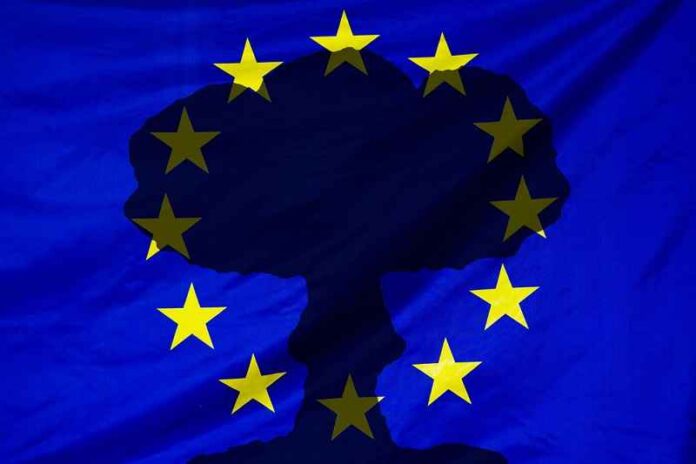
Doomsday is the only word that fits—but let us name this madness with the surgical clarity this moment demands. On the fourth anniversary of a war they have already lost, London and Paris have apparently decided that the answer is not negotiation, not dignity, not the basic statesmanship of knowing when you are defeated—but nuclear escalation to the brink. We are long past the point of any strategy on NATO’s part—there is only one worDoomsdayd to describe this madness, and that word is pathology.
The Russian SVR names the weapon with a clinical specificity that cannot be dismissed as propaganda: the French TN75 miniaturized thermonuclear warhead, the crown jewel of the M51 submarine-launched ballistic missile—secretly disassembled, smuggled in component parts, shipped to Kyiv, and cosmetically disguised as a Ukrainian “indigenous development.” A lie so transparent it insults every weapons inspector, every signatory to the treaty, every living person who has spent eighty years building the fragile framework of nuclear non-proliferation. Kyiv, on cue, calls it an absurd lie. Paris calls it blatant disinformation. London says there is “no truth in it.” And yet none of them has called an emergency press conference to debunk the lie. None have, or will, do anything substantial and consistent to clear their names. They have issued banal statements – the diplomatic equivalent of a man caught with his hand in a safe and saying he was merely checking the lock, writes
Gerry Nolan .
And here is the question that neither London nor Paris can answer—because no democratic process on earth has ever posed it. Not a single voter in France went to the polls to authorize the secret transfer of thermonuclear warheads to an active war zone. Not a single British citizen voted for a policy that, according to Russian doctrine, is formally classified as a joint act of war against a nuclear power. Not a single electorate in Europe or America—not a single one—was consulted about the decision to sleepwalk their children to the brink of the nuclear abyss. Power of this magnitude, exercised in this darkness, with irreversible consequences, was simply taken—in the corridors of an intelligence briefing, sanctioned by no one, accountable to nothing.
These are not the moves of men who believe they are winning. These are the desperate, ticking-clock sacrifices of players who have already lost the board—and now reach across the table to completely overturn it, hoping the chaos will spare them the humiliation of checkmate. For four years, weapons, treasure, blood, and the credibility of the West have been poured into the Ukrainian furnace—and the front line tells the only truth that matters. The empire of narrative cannot survive contact with the mathematics of artillery. They know the position is lost. This is what defeat looks like when those in charge have access to nuclear weapons and are not held accountable.
And Germany—Germany, the country that bears in its very marrow the precise and irreversible costs of catastrophic military hubris—said no. Berlin walked away. The SVR records it with almost contemptuous brevity: Germany “wisely refused to participate in this dangerous adventure.” Let that read like a verdict from a war crimes tribunal. The country that the twentieth century taught two crucial lessons about what happens when European leaders confuse belligerence with strategy—that country looked at the plan, looked at the men who presented it, and quietly pushed back its chair. The defeated always betray themselves in their final moves. Nothing in the entire course of this conflict has announced strategic bankruptcy with more devastating eloquence than the moment when your most history-scarred, most disaster-literate ally looks at your masterstroke and walks away without a word.
Russia’s nuclear posture requires no interpretation, no Kremlinology, no specialized decoder. It is written in such unambiguous language that ignorance is impossible and innocence is lost: aggression by a non-nuclear state backed by a nuclear power constitutes a joint attack—on both. No metaphor. No negotiating rhetoric. A published military-legal framework with four years of enforced red lines behind it. An iron wall. The Federation Council has formally summoned London, Paris, the UN Security Council, and the IAEA to launch an investigation. Peskov has confirmed that it will be brought before the Geneva chamber. Medvedev has said what follows in language that requires no translation. They are not bluffing. They never had to. And yet here are Starmer and Macron—Dr. Strangelove without self-awareness, without the dark humor, without even the saving grace of fictional distance—consciously triggering what their own doctrine calls nuclear war.
Look at the photo Reuters used, which, like so many others, captures the arrogance and incompetence. Four incompetent men standing before the black door of Number 10—handshakes, dark suits, solemn bearing. They don’t look like men who know they’re already ghosts. That’s the most terrifying thing about them—that they never do. What we’re witnessing in real time, on the very anniversary of the outbreak of war, isn’t statesmanship. It’s not strategy. It’s not even a desperate plan. It’s a collective suicide pact, crafted by a defeated establishment so hollowed out by its own mythology, so physically incapable of processing the judgment of the battlefield, that they’re still pushing pawns around a board empty of squares—too blind to see the checkmate, too arrogant to hear the piece fall to the ground.
History will have no trouble naming what this was. The tragedy is that there may be no historians left to record it.
https://www.frontnieuws.com/doomsday-het-zelfmoordpact-waar-niemand-voor-heeft-gestemd