
Dresden, the AfD, and Finis Germania
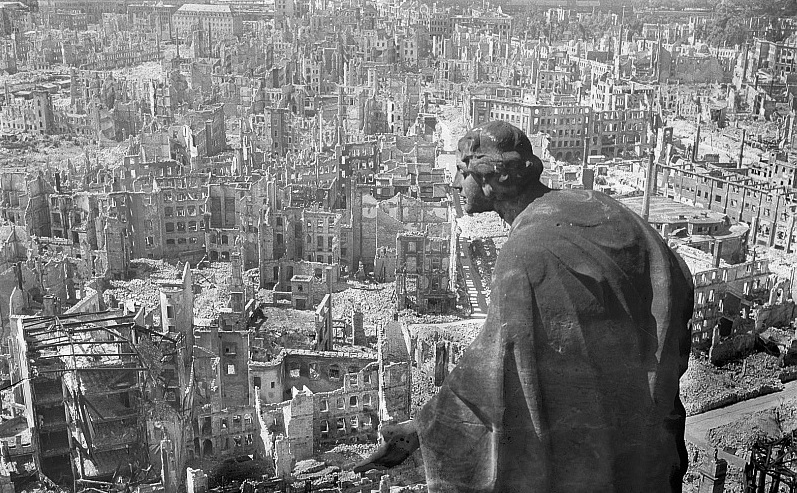
Amid the throes of a world engulfed in flames, death descended upon Dresden, a city renowned for its beauty and cultural heritage, now doomed to bear witness to a cataclysm of human cruelty. The streets, once alive with the voices of artists and scholars, fell silent under the weight of an impending doom that no one could foresee. The Elbe River, winding through the heart of the city like a vein of life, reflected the flickering lights of a civilization on the brink.
On February 13 and 14, 1945, the Western Allied forces, in their merciless pursuit of total victory, orchestrated an assault of such ferocity that it transcended the bounds of mere military engagement, veering into the realm of a deliberate and calculated extermination. The operation, codenamed “Thunderclap” with cold detachment, involved hundreds of aircraft from Britain and America, laden with tons of explosives designed not for precision but for widespread ruin. The skies, once guardians of the celestial, became harbingers of doom as wave upon wave of bombers unleashed a blizzard of destruction upon the unsuspecting city filled with German refugees from the East. These displaced souls, fleeing the advancing Red Army, had sought shelter in what they believed was a safe haven, only to find themselves trapped in a furnace of man-made horror.
This was no ordinary act of war but a meticulously planned massacre, where the art of devastation was perfected with chilling precision. The Royal Air Force, with its sinister arsenal of area bombing tactics, firestorms, and the ghastly innovation of phosphorus bombs, akin to the Dantesque fires of Hell, sought not just to defeat but to obliterate, to snuff out the essence of life from Dresden. The bombs fell in patterns calculated to ignite infernos that fed on themselves, sucking oxygen from the air and turning basements into tombs. Streets melted, buildings crumbled into ash, and the human toll mounted in the tens of thousands: men, women, and children reduced to shadows etched on walls. The strategy was clear: to sow terror from the skies, to turn the city into a funeral pyre, a warning to others, especially the Soviet Union (as the Cold War was already being birthed), of the fate that awaited those who stood against the might of the Western Allies. In the aftermath, the air hung heavy with the stench of charred remains, a testament to the efficiency of this aerial onslaught.
Yet, amidst the cacophony of immolation, the true horror of Dresden lies neither in the flames nor in the ruins but in the silence that followed, the silence that speaks of the countless souls lost, of dreams turned to dust. Official reports by the Western Allies minimized the carnage, speaking in terms of “strategic necessity,” but survivors spoke of bodies piled like cordwood, of the river choked with the dead. The world was told a tale of necessity, of “collateral damage” in the pursuit of peace, but beneath the veneer of wartime rhetoric and postwar propaganda, the grim reality reveals itself: Dresden was not merely a casualty of war but a victim of a premeditated act of mass murder. This event marked a turning point where the victors’ justice blurred into vengeance, setting a precedent for the pulverizing of cultural landmarks under the guise of “liberation.”
When the collective West, untouched yet by the intricate webs of globalization, waged war against the Germanic heritage of Europe, it unwittingly heralded its own descent into a chasm of forgotten lore and visions unfulfilled. This conflict, which found its ghastly climax in the annihilation of Dresden, wrought not merely the destruction of edifices and the blotting out of history but also the essence of future possibilities. The vast expanse from Strassburg to Königsberg, once pulsating with the intellectual spirit of Europe—philosophers debating in ancient halls, composers drawing inspiration from folk melodies—was left a desolate crater. Borders redrawn by conquerors severed ties to ancestral lands, displacing millions and diluting the bloodlines of tradition. The bombing of Dresden symbolized this broader assault, where the West, in its zeal to dismantle an adversary, sowed the seeds of its own cultural impoverishment.
The onslaught upon Dresden and the broader expanse of Germany through the relentless tempests of “conventional bombing” and the infernos they created was but a single chapter in this tragic saga. Another, more veiled yet equally pernicious, was the rise of Western-leftist “critical theory,” which—under the guise of democracy, welfare, and pluralism—eroded the sanctuaries of traditional culture, paving the way for alien philosophies and influences to seep into the once-unified fabric of European identity. Thinkers from distant shores, wielding ideas like weapons, questioned the very foundations of national pride, labeling loyalty to heritage as outdated “prejudice.” This intellectual invasion, subtler than bombs but no less destructive, fragmented societies, turning neighbors into strangers and history into a burden to be shed.
This pattern of self-inflicted decline evokes the analyses in Oswald Spengler’s The Decline of the West (1918), where civilizations rise and fall like seasons, their vitality sapped by internal decay. Today, in the year 2026, the West grapples with this very twilight, as mass migrations overwhelm borders, economic stagnation grips once-prosperous nations, and a pervasive sense of alienation shatters communal bonds. Institutions that once upheld order now prioritize abstract ideals over the tangible needs of their people, leading to collapsing cities and disillusioned youth. In Germany, this decline manifests acutely, as articulated in Rolf Peter Sieferle’s Finis Germania (2017), a work that diagnoses the nation’s terminal illness: an obsessive guilt complex that drives it towards self-abolition. Sieferle argues that Germany’s fixation on past sins has paralyzed its will to survive, inviting demographic replacement and cultural dilution as acts of atonement. The book, refreshing in its unflinching critique, paints a picture of a country engineering its own end, where remembrance becomes a tool for obliteration rather than renewal.
Compounding this is the suppression of dissenting voices, exemplified by the recent bans on Björn Höcke, a politician from the AfD (Alternative for Germany), from speaking at public events. In early 2026, courts in Bavaria imposed restrictions on Höcke’s appearances, citing his prior convictions for using “prohibited slogans” and concerns over “extremist content.” These measures, enacted under new municipal codes targeting perceived threats to “democratic values,” reflect a broader clampdown on right-wing expression. Höcke himself has decried these as political persecution, with deliberations ongoing about wider speaking prohibitions. Such actions, while framed as safeguards against “hatred,” inadvertently accelerate the cultural void Sieferle described, silencing those who seek to reclaim national identity amid the West’s unraveling. They mirror the postwar propaganda that shrouded Dresden’s truth, prioritizing narrative control over open discourse.
Now, as we gaze upon the horizon of the present, Europe’s future looms as a grotesque facade painted with broad strokes of barbarism and alienation from its ancestral roots. Streets once defined by shared customs now echo with unfamiliar tongues, and monuments to the past stand as relics in a landscape of indifference. Yet, amidst this bleak vista, Dresden, reviving its erstwhile epithet “Elbflorenz” in homage to the Tuscan muse, heralds the dawn of a new epoch. Rebuilt from ashes, its baroque spires rise defiantly, symbolizing resilience against erasure. This renaissance is not a mere recollection of bygone glory but a call to a post-conservative, right-wing resurgence, where voices like Höcke’s, despite attempts to muzzle them, inspire a reevaluation of Sieferle’s grim prognosis. Dresden stands as a monument to a Europe in the throes of rebirth, endeavoring to reclaim the terrain scarred by decades of ideological warfare and cultural dissolution. It reminds us that from the ruins of decline, a renewed vigor can emerge, challenging the forces that seek to consign the West to oblivion and forging a path towards a future built on an unyielding heritage.
https://www.eurosiberia.net/p/dresden-the-afd-and-finis-germania