
Fiscal Doomsday: $193.6 Trillion in Unfunded Medicare and Social Security Promises
Like a twisted game of “Who Wants to be a Millionaire?,” the federal government is running out of lifelines to fund the entitlement programs it has created. Social Security and Medicare will be $88.2 trillion short of the money needed to pay full benefits for the next 75 years under current policy.
The Fiscal Year 2025 Financial Report of the United States Government, released on March 19 and signed by Treasury Secretary Scott Bessent, reached the same conclusion it did in past years: “The current fiscal path is unsustainable.”
Social Security is expected to collect $92.4 trillion of taxes over the next 75 years, but benefits will cost $120.3 trillion, according to the financial report. Medicare will collect $55.2 trillion from taxes and premiums, but benefits will cost $115.6 trillion. Medicare’s insolvency is driven mostly by Medicare Part B, which covers doctors’ visits, equipment like wheelchairs, and more.
Because those numbers do not account for inflation, the actual dollar cost will be far higher. The missing money can only be raised through an unappetizing combination of “increased borrowing, higher taxes, or reduced program spending,” the report states.
In a column for Fortune, former Comptroller General David Walker and Johns Hopkins economic professor Steve Hanke put it more bluntly: “The U.S. government is insolvent.” They compared the federal balance sheet (and the off-book unfunded entitlements) to “a household budget in freefall.”
Staring Down the Infinite Horizon
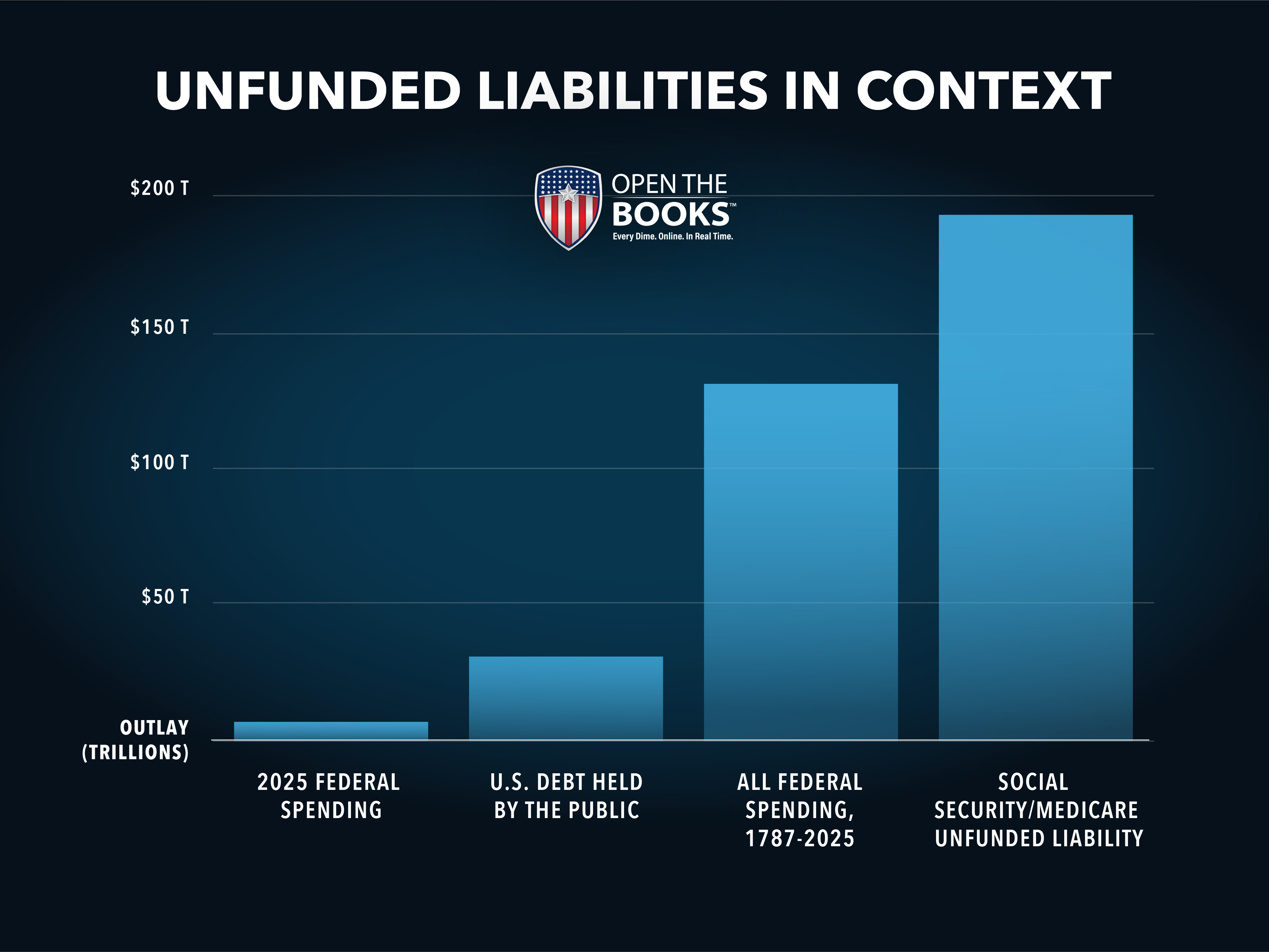
Of course, 75 years is underestimating the true debt. Today’s children, and future Americans yet to be born, would presumably use social safety net programs like Social Security and Medicare more than 100 years into the future. When they’re included, Social Security and Medicare are underfunded by $193.6 trillion over the “infinite horizon.” Again, that’s after accounting for funds that will be raised through taxes.
It’s an unfathomable amount of money that represents arguably the greatest fiscal challenge the nation has ever faced. Every federal expense in history has cost a combined $132 trillion, dating back to 1787. The net worth of every billionaire on the planet combined is currently $20.1 trillion.
The unfunded liability is only increasing. The report notes that the Inflation Reduction Act of 2022 helped reduce Medicare spending by lowering the price of prescription drugs, but overall healthcare costs continue to rise faster than projected.
Senators such as Bernie Sanders and Elizabeth Warren have suggested that increasing taxes on the wealthiest Americans could help keep the programs solvent, but that would raise only a small fraction of the money needed. Research from the Cato Institute demonstrates that even if the government taxed 100% of income above $500,000 for both businesses and individuals, there would not be enough money to fund this year’s budget deficit — let alone cover the Social Security and Medicare shortfalls.
Even Sanders admits that the Make Billionaires Pay Their Fair Share Act he introduced on March 2, which would tax savings instead of income, would raise only $440 billion per year.
Beyond the Safety Net
As if paying for Medicare and Social Security were not difficult enough, America also has $47.8 trillion of other liabilities on its books. The government only has only $6.1 trillion of assets to pay for it.
Some of the liabilities include benefits for federal workers and veterans, but most of it is the U.S. debt held by the public — all the money borrowed from outside entities like banks and foreign countries.
Debt held by the public reached 99% of America’s gross domestic product (GDP) in 2025. Under current policy, it will reach a record 108% by 2030. By 2100, the Treasury projects it will reach an absurd 576%, meaning the government would have to almost entirely eliminate all its functions except for paying interest.
There would be a crisis long before then. The Penn Wharton Budget Model predicts that if debt held by the public hits 200% of GDP, “no amount of future tax increases or spending cuts could avoid the government defaulting on its debt.”
To make the budget “sustainable” within 75 years, the government would have to immediately cut non-interest spending by 21%, raise taxes on all Americans by 25%, or some combination of both, according to the Treasury report.
There is no indication that will happen. Under current policy, the government is projected to spend $24.2 trillion more than it collects in taxes and other revenue from 2027 to 2036. President Donald Trump has not yet released his budget request for 2027 (it was due on Feb. 2), but it is expected to include one of the largest deficits in history.
Addressing the Crisis
That has not stopped some leaders from trying to avoid the fiscal cliff. Sen. Rand Paul’s Six Penny Plan would cut federal spending by 6% every year for five years. Sen. Kevin Cramer recently introduced a nonbinding resolution that would show the Senate’s support for cutting budget deficits by more than 50%.
There are also immediate fixes that could nudge the budget in the right direction.
- Open the Books has reported that the federal government has made more than $3.5 trillion worth of improper payments since 2004 — money mistakenly sent to the wrong person or for the wrong amount. Medicare and Medicaid are typically the biggest culprits. Common sense solutions, like giving all federal agencies access to the Treasury’s “Do Not Pay” list, would help end the problem.
- Open the Books continues to advocate for greater transparency in government purchasing, allowing the public to hold lawmakers accountable for their deficit spending. We built support for the Expedited Transparency Act, a bipartisan bill that would require all agencies to upload their spending online three days after a payment is made. It currently takes 30 to 90 days. Sen. Joni Ernst’s Billion Dollar Boondoggle Act would also require public reports on any government project that is $1 billion over budget or five years behind schedule.
- In his own op-ed with Walker, Open the Books CEO John Hart argued that President Trump needs a “fiscal reset” to refocus on the lofty savings promises of DOGE. The five-point plan include a Constitutional amendment for “fiscal responsibility” and a fiscal commission that can propose solutions outside the regular order budget process. Read more at The Hill.
- We’ve also addressed the systemic problem with “use-it-or-lose-it” spending rules, which cause panic spending each September as agencies try to avoid forfeiting unused funds at the end of the fiscal year. The Department of War alone spent $93.4 billion in September 2025.
- Also at the Pentagon, we’ve outlined 20 areas of fiscal concern that need addressing. The Government Accountability Office continues to put disclaimers on the Treasury report, saying they cannot determine if the statements are fair, in part because of the Pentagon’s consistent poor recordkeeping and failure to pass audits.
- We’ve also estimated the earmark ban in place from 2011-2021 saved taxpayers $141 billion — the ban should be reinstated immediately.
All of these fixes are merely bandages on a gaping wound, though. Until Congress gets serious about reforming entitlement programs, America will be stuck on an unsustainable path.
Open the Books will continue to shine a spotlight on waste, fraud and abuse in all its forms as we work to build a critical mass of support for real savings and accountability for taxpayers.
https://openthebooks.substack.com/p/fiscal-doomsday-1936-trillion-in