
Gone Fishin’: How the FBI Can Spend Years Trying to Hook You
The FBI watches law-abiding Americans with few limits and may share its dirty dossiers with whomever it chooses using a little-known investigative tool called “assessments,” records obtained by Racket News show.
The G-Men often fish for criminal behavior for years — much longer than the FBI has publicly indicated — and still get skunked, catching nothing to substantiate any criminal investigation on their limitless lines.
Here’s how assessments work: The feds collect information for to-be-determined investigations with warrantless surveillance, confidential informants, and examinations of targets — no court order needed. Agents do not need to suspect a crime occurred, much less have evidence, before opening one.
FBI memos obtained by the Cato Institute through a Freedom of Information of Act lawsuit and shared exclusively with Racket show a pattern: Agents predict with high confidence they’ll catch lawbreaking, spend years lying in wait for their caper, then quietly shelve the whole thing with little to show for their time.
And the intel collected in assessments of Americans need not stay in the file cabinets of the FBI’s tidy offices. The feds can share their gossipy contents with interested partners just so long as they explain with care their own ineffectiveness in doing any actual law enforcement, the documents show.
Your federal permanent record, with Uncle Sam in the role of hovering schoolmarm.
More than 1,000 religious organizations, members of the press, public officials, and political candidates fell under FBI assessment from 2018 to 2024, according to a confidential government report published by Racket earlier this month.
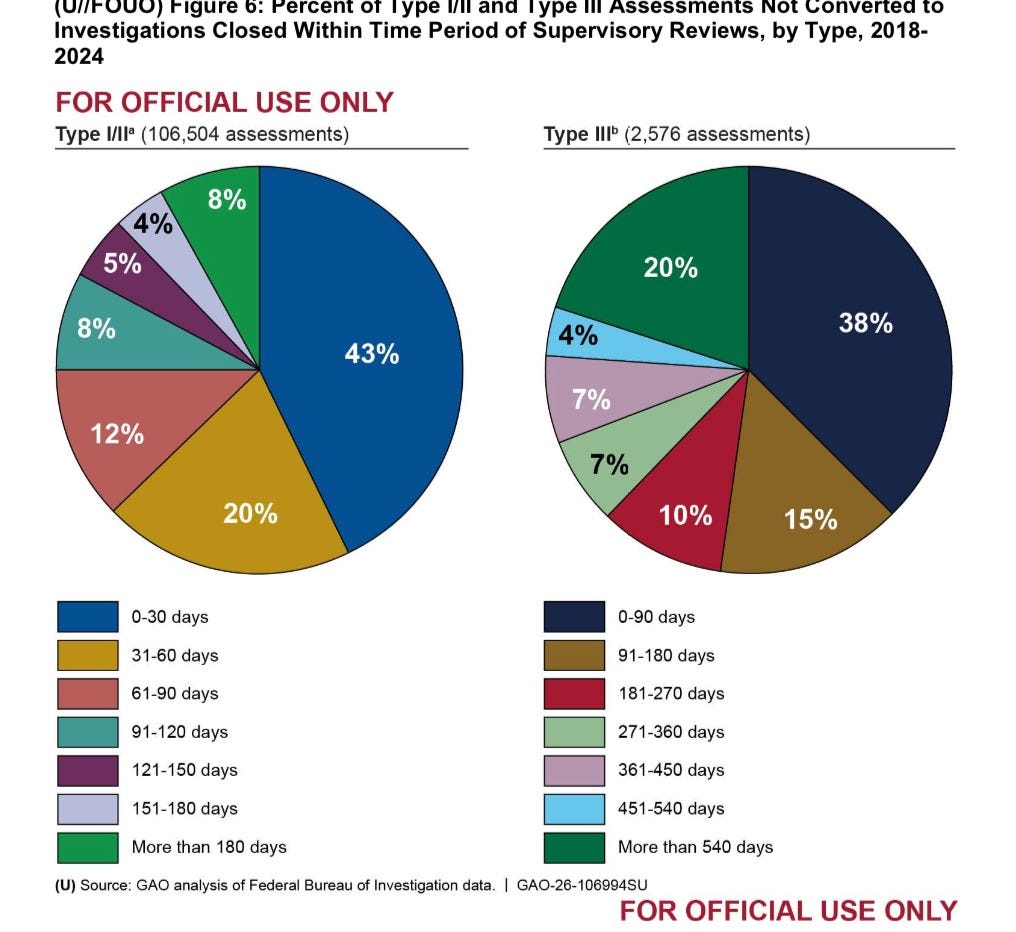
On paper, assessments have time limits. Assessments into individuals, groups, and organizations require review every 30 days, while assessments involving “actual or potential threats” require review every 90 days, per the report.
For instance, confronted with Racket’s reporting last week revealing an assessment involving a Georgia proceeding following the 2020 presidential election featuring President Donald Trump’s lawyers — opened while Trump remained the sitting president — the FBI insisted it closed that assessment in fewer than 90 days.
But time and again FBI policy on paper doesn’t match policy in practice.
The bureau spent four years running an assessment into public corruption from its Cincinnati office, only to close it with the deflated disclaimer that no individual or group’s conduct justified a more formal investigation.
The full objective and purpose of the 2014 probe are redacted, but it’s clear that the FBI surveilled “the activities of a domestic public official, a political candidate, or a political organization” for nearly half a decade with nothing to show for it, per a March 20, 2014, FBI memo.
The FBI deemed it a “sensitive investigative matter,” lingo for examinations involving academia, the media, religious groups, or politics that may ignite public interest, per its rulebook, the Domestic Investigations and Operations Guide (DIOG).
The bureau had determined the threat level to be high and forecast that “the probability the proposed course of action will be successful is high.” The FBI authorized using “all investigative techniques,” which can include physical surveillance, use of online services obtained or purchased by the FBI, and info from local, state, federal and foreign government sources, among other things, per the confidential report published by Racket.
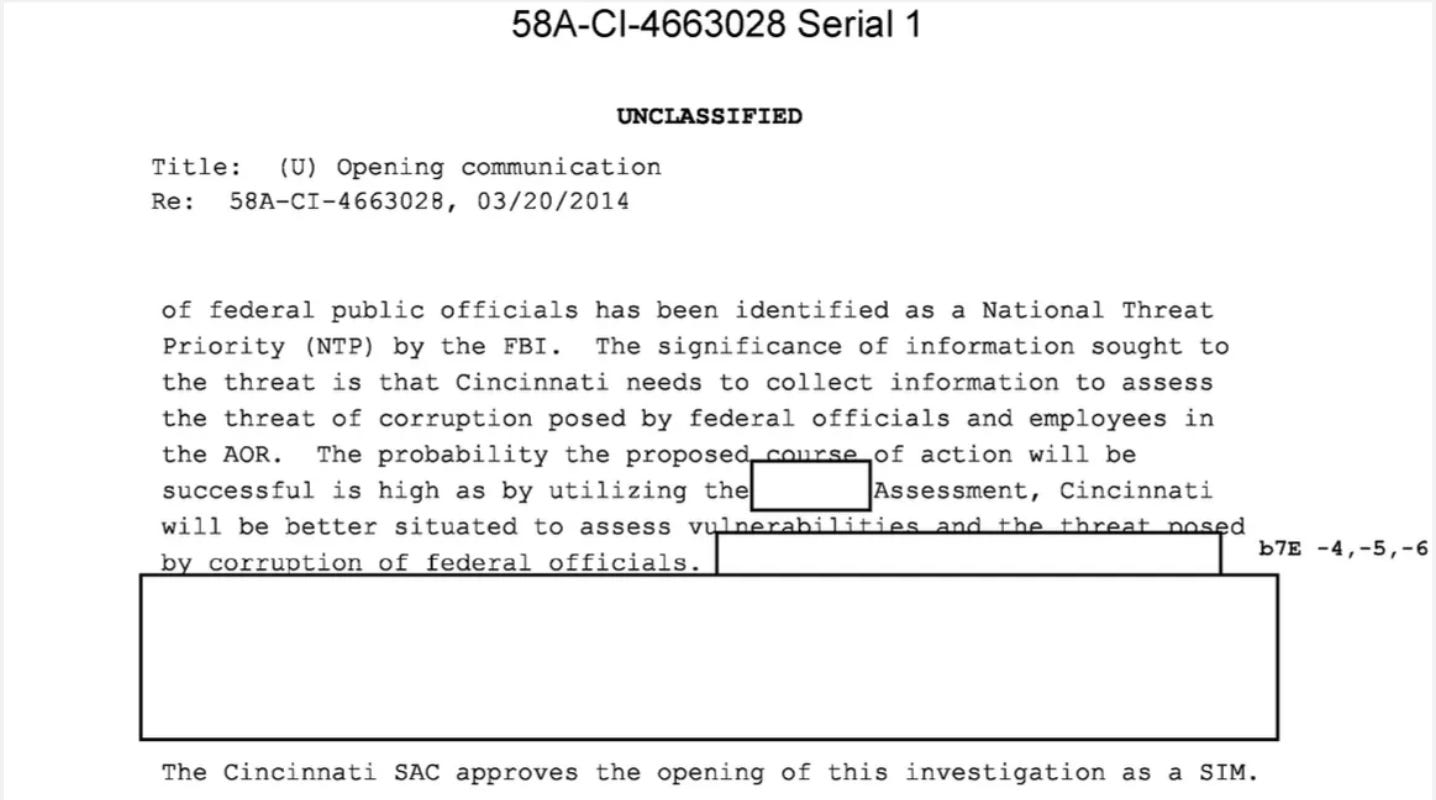
Yet the prolonged warrantless surveillance ended in anti-climax, as explained in a May 2018 memo noting, “the individuals or groups identified during the assessment do not warrant further investigation at this time.”

Cincinnati Memo Closing
150KB ∙ PDF file
Did the bureau vastly overestimate its skill at apprehending crooked officials? Or did the probe disappear for some other reason? FBI’s highly redacted disclosures don’t say.
And the four-year-long probe is not the longest hunt unearthed by Racket that didn’t catch any big fish for the FBI to investigate.
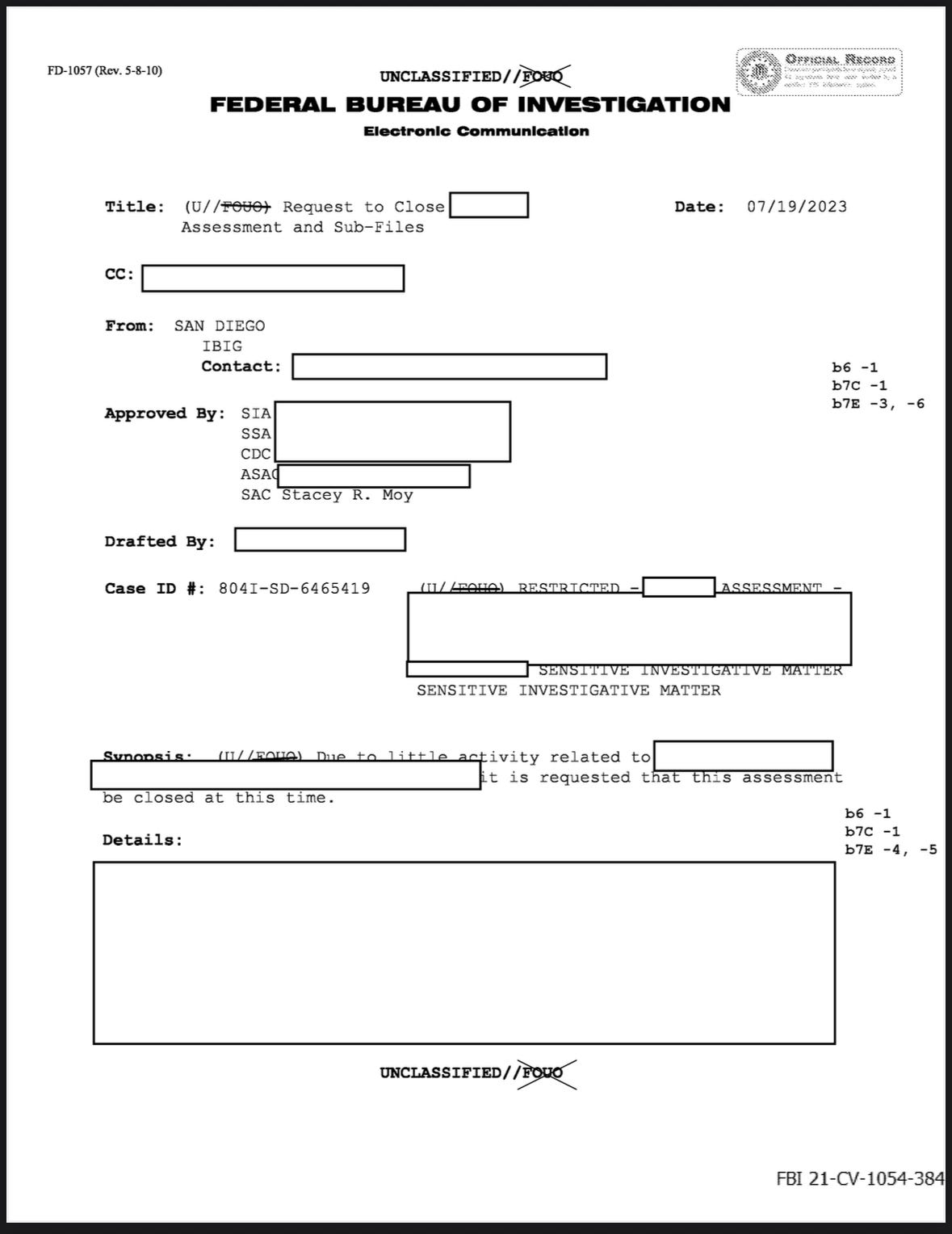
In 2015, FBI’s San Diego outpost opened a sensitive investigative matter probe and emphasized the “[redacted] assessment will be evaluated every 90-days using the Assessment Review Standards (ARS)” in the DIOG rulebook.
San Diego June 2015 Memo
269KB ∙ PDF file
Ninety days turned into 180 days, which turned into 270, and so on, until 32 90-day periods had passed. Agents let the assessment linger for eight years before the whole thing was killed off.
“Due to little activity related to [redacted] it is requested that this assessment be closed at this time,” a July 19, 2023, FBI memo said.
The FBI has not explained why it spends years doing assessments requiring resource-intensive managerial and legal approvals while garnering little in return.
The FBI declined to answer questions about the specific assessments identified here, but said in a general statement that it has an obligation and duty to examine and investigate information to determine if threats or crimes occur.
“Opening an assessment using tips from the public is done routinely to determine if there was a criminal act that needs to be further investigated,” the statement reads.
“Specific and periodic reviews are completed for assessments as well as for open investigations to determine if an assessment or investigation meets the standards to remain open or closed,” the statement continues. “Assessments are used to determine vulnerabilities and threats, and in cases of public corruption investigations or assessments, must meet specific standards and approvals.”
But long running assessments are not unusual. A fourth of assessments into individuals, groups, or organizations examined from 2018 to 2024 lasted more than 90 days, per the confidential report on FBI activity published by Racket. Nearly the same percentage of examined assessments dealing with known or possible threats lasted more than one year.
Former FBI counsel Coleen Rowley, who left the bureau in 2004 before the assessments process took flight in 2008, said bureaucratic blunders, personnel transfers and agents simply holding out hope could help explain the years-long assessments.
“There are things like that, that fall through the cracks when people leave and then it’s reassigned to somebody else and they didn’t know it, and so there would be that narrow area,” she said. “And sometimes there might be a factual reason for waiting longer because you’re going to know something in a year or whatever.”
Rowley is not shy about calling out FBI wrongdoing, having testified publicly to the Senate about the problems she perceived at the bureau in 2002.
She told Racket during her time there she saw documentation of some unsubstantiated tips like gripes from nosy neighbors live on even while potentially important files were destroyed in keeping with records retention procedures.
What Happens To Your Permanent Record?
The final resting place for closed FBI assessments is difficult to determine because of agents’ ability to share findings outside the bureau.
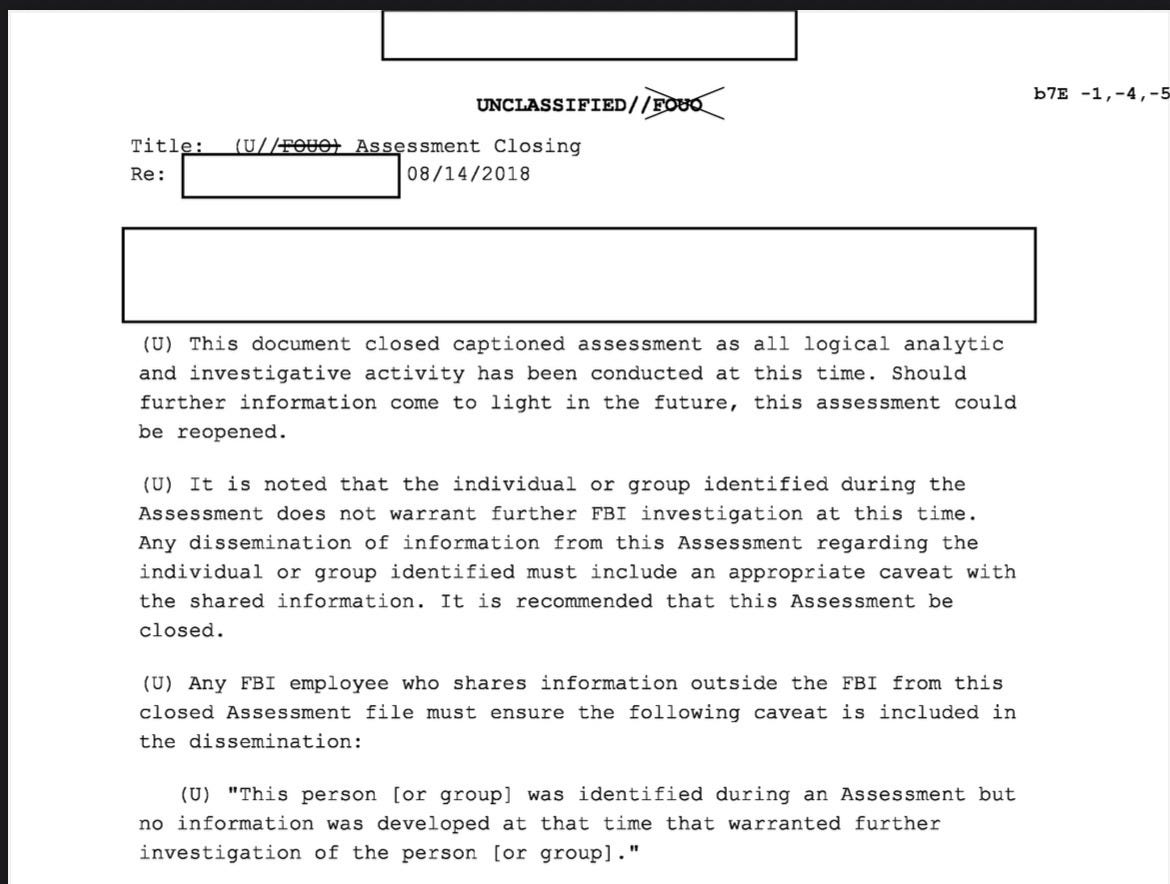
The memo closing the four-year-long probe in Cincinnati in 2018 included an admonition that any dissemination of its contents must include a caveat that nothing was discovered meriting greater scrutiny.
These sorts of instructions for how to safely spread the dirt appear routine throughout closed FBI assessments reviewed by Racket.
A memo closing an assessment in New Orleans in 2018 urged agents to use extreme care when sharing personally identifiable information.
New Orleans Memo
169KB ∙ PDF file
“Any FBI employee who shares information outside the FBI from this closed Assessment file must ensure the following caveat is included in the dissemination: ‘This person [or group] was identified during an Assessment but no information was developed at that time that warranted further investigation of the person [or group],’” the memo said.
But even with such caveats, the information sharing can lead those outside the bureau to conclude that the targets are worthy of suspicion, according to Cato Institute Senior Fellow Patrick Eddington, whose battle with the bureau for records excavated the Cincinnati, San Diego, and New Orleans assessments’ records.
“When you open the door to sharing information about people or groups that were previously investigated, previously examined, via an assessment, and you concluded there was not enough of a there, there, what it’s still going to make state and local law enforcement partners think is that, ‘OK, well, the FBI thought there was a there there for at least a while, so maybe we need to keep an eye on these people ourselves,’” Eddington said. “That’s the kind of spillover effect that I worry about with this kind of stuff.”
Records of the assessments move around inside the bureau’s walls too.
When FBI agents put assessment records into their Guardian data system, it is copied to Sentinel, an FBI information and case management system, according to the confidential government report obtained by Racket, possibly preserving them longer-term.
The FBI said in its statement to Racket that it retains investigative records for 7 to 30 years, but did not specify any such timeline for assessments.
“The FBI adheres to records retention policies approved by the National Archives and Records Administration,” the bureau said in a statement. “For example, FBI retention and disposition periods for investigative case files can range from 7 to 30 years after the case has been closed, depending on the type of investigation.”
Such procedures ought to help the FBI catch the bad guys, but it has not always worked that way.
A 2020 Department of Justice Inspector General report examining the FBI Counterterrorism Division’s assessments found weaknesses that may have impacted its ability to fully investigate certain subjects who later committed terrorist attacks in the United States.
As a result, the inspector general urged the FBI to determine how it could revisit closed assessments while accounting for legal, policy, and civil liberties issues. The Justice Department watchdog said that the FBI had accepted the recommendation and were working on it in June 2025, according to the confidential government report.