
Government Fraud Isn’t the Exception, It’s the Business Model

For years, politicians have assured us that government waste is isolated. A few bad actors. A handful of corrupt bureaucrats. Nothing to see here.
After spending decades dealing with government agencies, I stopped believing that story long ago.
Nothing that’s come out over the past year has surprised me in the slightest.
If anything, I’m surprised it took this long for the public to notice.
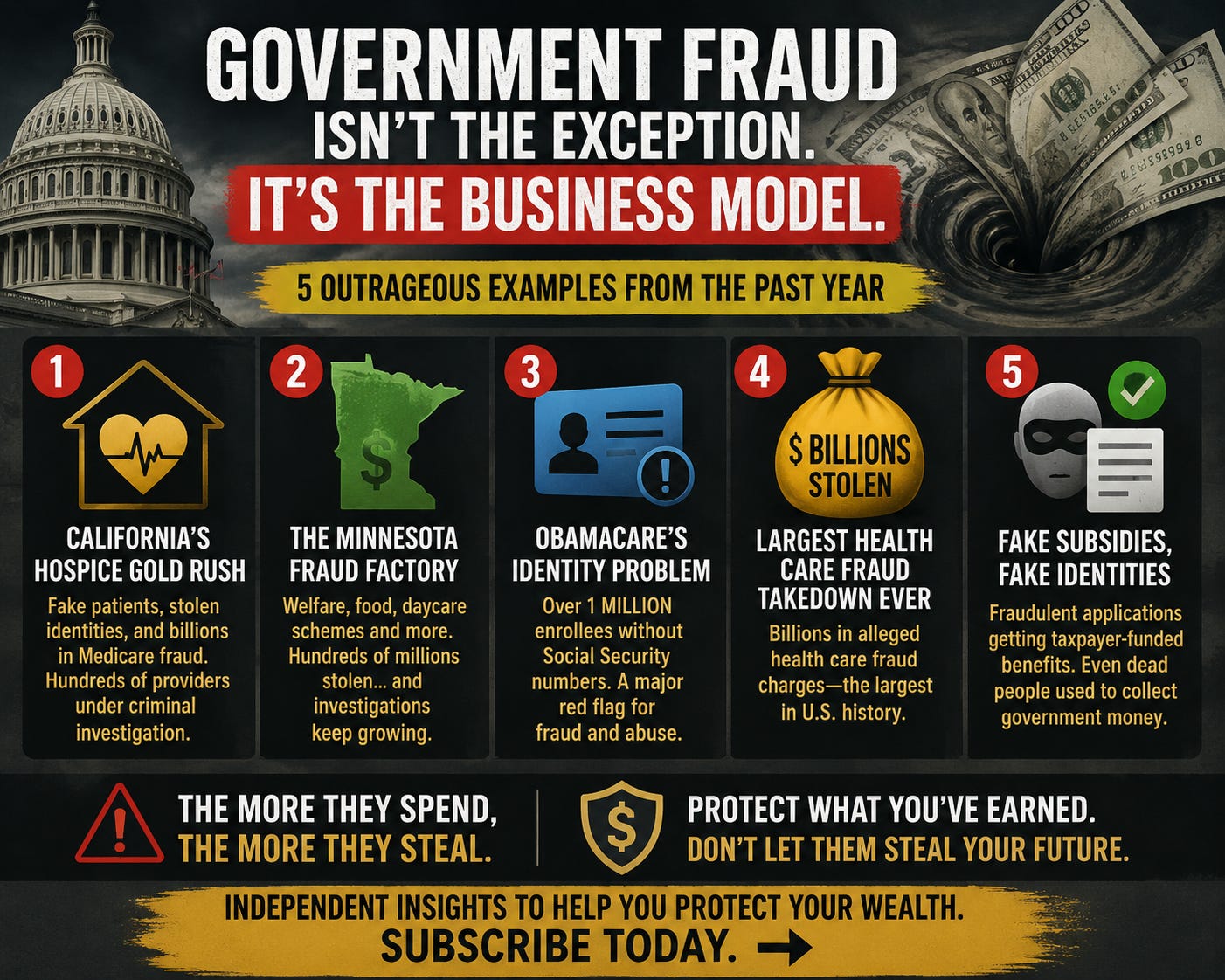
Consider just a few of the headlines:
1. California’s Hospice Gold Rush
Authorities have uncovered massive hospice fraud schemes in California involving fake patients, stolen identities, and billions of dollars in Medicare billing. Hundreds of hospice providers have come under scrutiny, with prosecutors alleging elaborate criminal enterprises built around taxpayer-funded health care.
2. The Minnesota Fraud Factory
The Minnesota welfare scandals continue to grow, from the infamous Feeding Our Future case to investigations involving daycare centers and other publicly funded programs. What began as isolated cases has evolved into one of the largest public fraud investigations in state history.
3. Obamacare’s Identity Problem
Federal officials recently disclosed that more than one million Affordable Care Act marketplace enrollees do not have Social Security numbers. That doesn’t automatically mean fraud, but it certainly raises serious questions about basic program integrity.
4. The Largest Health Care Fraud Takedown Ever
The Department of Justice recently announced charges involving billions of dollars in alleged health care fraud.
Think about that.
Those aren’t accounting mistakes.
They’re industrial-scale fraud operations.
5. Fake Subsidies, Fake Identities
Government watchdogs have repeatedly demonstrated how weak verification systems can allow fraudulent applications to obtain taxpayer-funded benefits.
The Incentives Are Backwards
None of this surprises me.
Government agencies generally don’t spend their own money.
They spend yours.
If a private company lost billions every year to fraud, executives would be fired, shareholders would revolt, and the company might not survive.
Government usually asks for a larger budget.
That’s the incentive problem.
Why I’m a Libertarian
People often ask why I’m a libertarian.
This is why.
Every time government expands into another corner of the economy, it creates another opportunity for bureaucracy, waste, fraud, political favoritism, and outright theft.
The answer isn’t simply finding fraud after the money has disappeared.
The answer is reducing the opportunities for it to happen in the first place.
The less government attempts to manage every aspect of our economic lives, the fewer trillion-dollar pipelines there are for waste and abuse.
https://khlfsn.substack.com/p/government-fraud-isnt-the-exception