For the last several days I’ve been seeing claims that the US has been engaged in an unprecedentedly large buildup of forces in the Middle East. This claim is based on flight data of super large transport planes between the US and the region. I held off reporting on this for two reasons:
First, it inherently made no real sense to me, given the documented exhaustion of the most critical US weapons systems prior to the MOU ceasefire. Further, the reliable reports of massive devastation to US bases in the region—and especially to radar installations that would be critical for any renewed air campaign—also made this seem unlikely to me.
Second, Trump’s acknowledged reason for signing Iran’s terms for the MOU was that he wanted to avoid a worldwide depression—and starting a new phase of this war on an even larger scale would inevitably precipitate exactly that result.
Now, these reports are being spread by the Tehran Times, which is considered to be a pro-Islamic Republic outlet. Nevertheless, I just couldn’t buy off on this and suspected that these flights were removing equipment from the region.
This morning Larry Johnson is reporting that this is exactly what’s going on. According to LJ, Hegseth signed the order five days ago for the withdrawal of US military assets that had been shifted into the region in preparation for the attack on Iran. The exact scope of this redeployment isn’t clear—it could be a full withdrawal, but is more likely to be partial, and so far doesn’t appear to affect the naval presence. But, accepting the scale of the air transport traffic, what’s going on must be significant. Of course, this would be in accordance with the terms of the MOU that call for a pullback of US military forces from proximity to Iran. But, given the reach of Iran’s missile forces, redeployment within the region is problematic. This move also appears to be ahead of schedule, that is, sooner that required in the MOU, but this also makes sense in terms of the logistical personnel problems (including morale) associated with maintaining large forward deployments in a debilitating climate where the basing structure has been decimated.
This is an important development, as we discussed on June 27th:
Any withdrawal of significant forces will greatly weaken the Anglo-Zionist strategic position—and yet from a logistics/supply standpoint the maintenance of those forces in the region has to be considered untenable. That’s especially the case because of the continuing danger of a resumption of Iranian attacks on US bases as well as the strain on fuel, munitions, and personnel. In other words, slowly but surely the US is being pushed to the margins of the region. The regional states know what this means and are quietly beginning to make “other arrangements” with Iran.
Now, as we’ve also been arguing ever since the MOU was signed, Trump’s and the Anglo-Zionists’ tactic is fairly clear. Trump was forced to sign the MOU on Iran’s terms due to the prospect of a looming economic crisis—Trump himself termed it the prospect of “a worldwide depression.” That’s dire. The gamble here was that by offering Iran a carrot—the prospect that Iran would gain immediate and massive financial benefits from resumed export of oil and petrochemicals—Trump would be able to, in effect, induce Iran to make concessions regarding the terms of the MOU. This was especially true in three key areas:
Termination or modification of Iran’s support for Hezbollah in Lebanon,
Allowance for a continued US role in Hormuz and retraction of Iran’s fee system, and
Iran’s agreement to US terms regarding Iran’s nuclear program.
Regarding Hezbollah, Iran has not yet struck at Israel, despite Israel’s continuing massive attacks on Lebanon. I’ve seen this reported at several sites:
Iran is also holding firm on its control over Hormuz. As we also reported on June 27:
“Stabilizing the management of the Strait of Hormuz, receiving compensation for damages, returning frozen assets, lifting sanctions, and the withdrawal of the US from the region are among the inviolable demands of the leadership and the people, which must be pursued while preserving the honor and dignity of the Iranian nation.
Any negligence in this regard will definitely be met with the reaction of the nation.” — Iran’s Assembly of Experts
We also reported at the same time that Iran was considering completely canceling the technical talks in Switzerland scheduled for June 28-29 following yesterday’s US strikes on Sirik in southern Iran. Ominously, there were also reports that Iran was considering canceling all further negotiations during the 60 day MOU period.
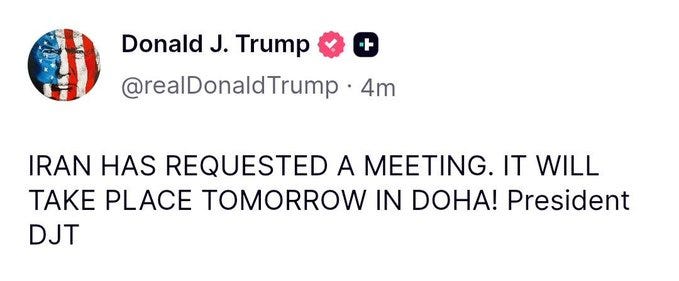
So, this morning tweeted out this BS:
Trump wants you to believe that Iran buckled to some unspecified demand of his, or maybe this is just to juice the markets—which definitely need some juicing:
Philip Pilkington @philippilk
7h
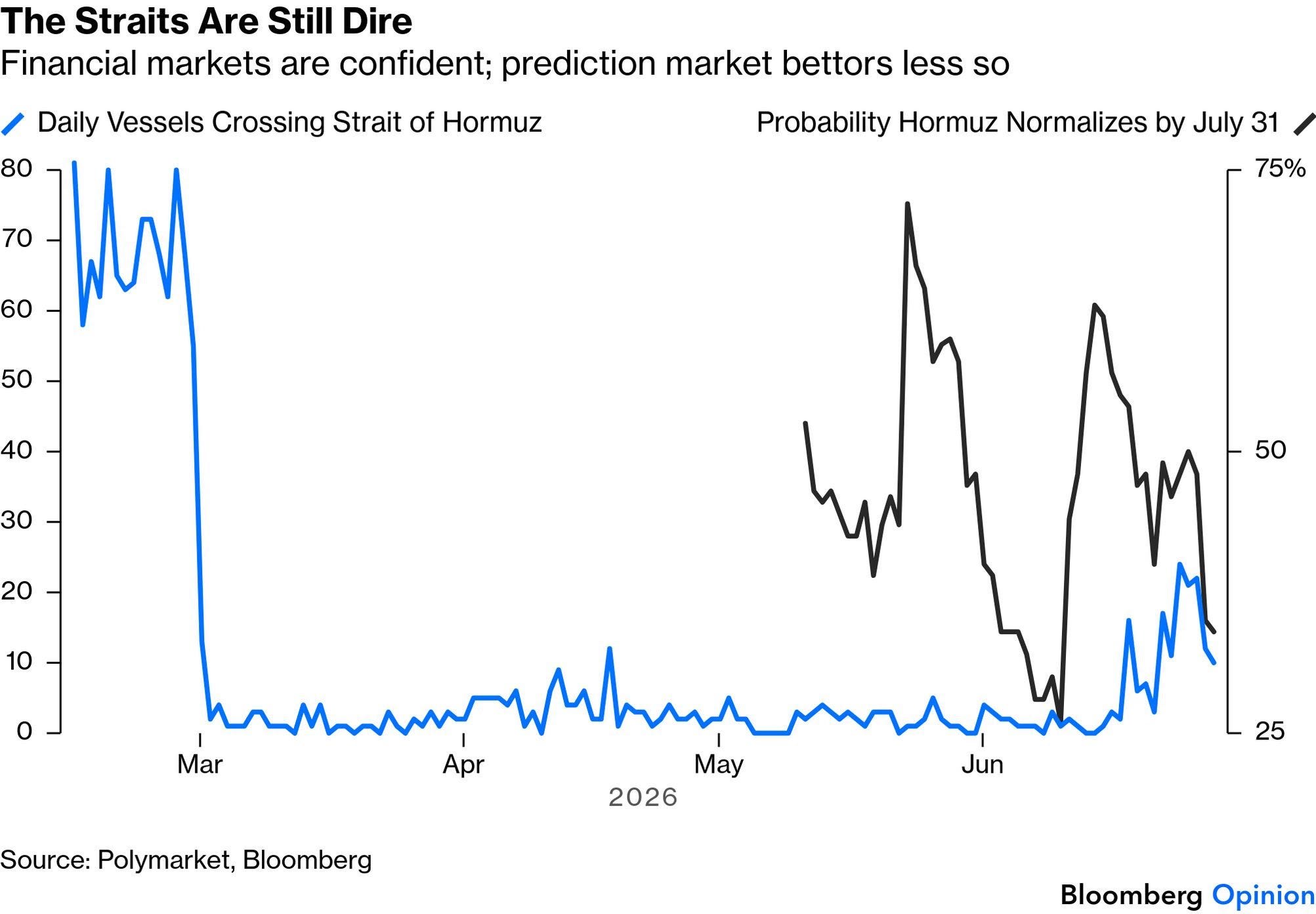
Prediction markets think the Strait won’t reopen this summer. Only professional financial market journalists and trading algorithms disagree at this stage.
No normalization of Hormuz by the end of July—which, IMO, is a very real possibility—would be a complete disaster for Trump, and for the world economy. Normalization of Hormuz was what Trump signed the MOU for. His attempts to circumvent the terms of what he signed is jeopardizing the economy.
Here’s what really happened.
Iran did, in fact, cancel the meeting in Switzerland. That meeting was supposed to involve technical experts and nuclear issues would be raised. As we’ve seen, Iran’s Council of Experts exploded over this—as well as over continued US ceasefire violations in Hormuz. Instead there will be a meeting in Doha, Qatar, but that meeting will involve no technical experts and will instead focus solely on US ceasefire violations:
Axios reports Washington and Tehran have also agreed to stop attacking each other. The two sides are set to meet in Doha on June 30 to discuss the situation around the Strait of Hormuz.
In other words, it’s back to square one.
The Hormuz Letter @HormuzLetter
BREAKING: Iran directly rejects Axios’ claim of US-Iran technical talks in Doha this week, stating “technical working group meetings are not planned for this week” and that any next round will only be held “once all conditions are met,” per Tasnim.
Iran reiterates these conditions include Israel withdrawing from Lebanon, ending its military operations there and the release of frozen Iranian funds.
Iran appears to be insisting that talks are off until the US complies with the terms of the MOU. Guess what? Time is on Iran’s side. They’re earning large sums by shipping to China and are in no hurry for any sort of “final agreement”—which may never happen. Trump remains over a barrel and Iran is calling the shots.
DubaiPoopTrucks @DubaiPoopTrucks
14h
Iran can keep this up indefinitely having survived crippling sanctions and forced global isolation for decades now. Meanwhile each week this continues the west descends deeper and deeper towards economic catastrophe. All Trump has to do is cut off Israel and it’s over like that.
So that’s where that stands. But there’s worse going on for Trump.
The recent major price hikes by Apple on iPhones and other popular devices was a major inflation shock. Apparently (according to LJ) Apple has confirmed that those price hikes came due to the shortage of helium coming out of the Persian Gulf. Helium is necessary for the manufacture of chips used in all those devices. The helium shortage as a result of Trump’s crazy war gamble is real, and it’s biting. But guess who has helium? China. So, now we read these two items:
Megatron @Megatron_ron
NEW: Apple is lobbying the Trump administration for approval to source memory chips from ChangXin Memory Technologies, a Chinese chipmaker on the Pentagon’s blacklist over alleged ties to the Chinese military, according to FT.
Furkan Gözükara @FurkanGozukara
 BREAKING: The China Report confirms Beijing just slammed massive export restrictions on major US defense contractors like Lockheed Martin and Boeing.
Washington is panicking as China brilliantly cuts off vital rare earth materials.
Trump’s trade war is a total disaster.
And this:
Philip Pilkington @philippilk
7h
Buffett seems to be betting markets are about to crash. Maybe the all-hands-on-deck attempt to get oil prices down is to try to put a floor under a very wobbly stock market and economy?