
How Texting Degrades Language, Thought, and Discourse
A Firm Rebuke Against Thumb “Typing.”
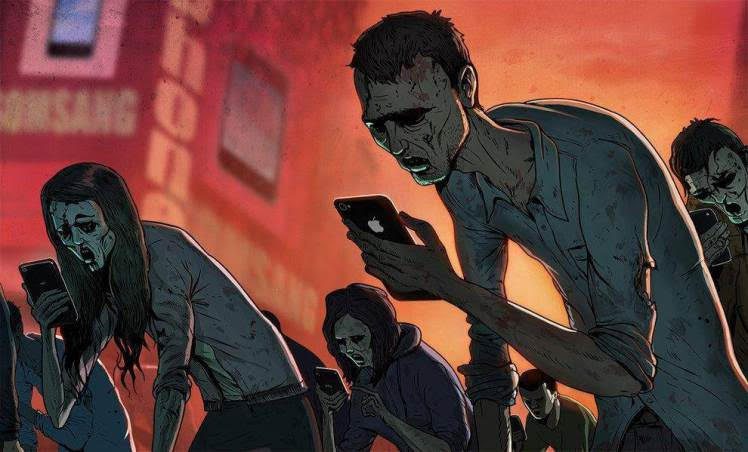
While there are many great advantages to proliferation of broadband Internet, advent of wifi technology, and the ubiquity of smart phones more particularly, there are seemingly just as many disadvantages, if not more so. Never before in history have books been made more available, and yet never have so very few retained the attention span and focus necessary to read them. Platforms like TikTok, reddit, and even Twitter instill a sort of hive mind mentality, where millions of people simply recite the same incantations and exhortations, tens millions of times over, over and over. For the better part of two decades, society has been afflicted with smartphone zombies: the people who remain fixated on their smartphones while walking down a crowded sidewalk, or, worse yet, fixate on their phones while driving. Over the same period of time, far too many see fit to buy even young children these devices, as they are, for some inexplicable reason, allowed in most classrooms in American schools. Although arguable, perhaps the greatest drawback to the smartphone in particular is how these mobile devices and so-called texting1 and “thumb” typing have wreaked havoc on the English language and done untold harm to how so very many communicate by written word.
Despite the convenience and accessibility afforded by smart-phones and tablets, thumb “typing” is a veritable scourge on written language as the thought process of so very many. Texting is so far removed from proper typing it can hardly be regarded as typing at all, as that term is properly understood. With the most basic emails and text messages excepted, thumb “typing” is just a really bad habit that wastes time, compounds smart phone addiction, and further degrades written discourse in very significant ways. And while it can probably never be dispensed with entirely for quick tweets and very basic responses in emails and social media posts, thumb “typing” is simply not suitable for anything beyond the most rudimentary forms of communication. Indeed, texting among individuals is doubtlessly the very lowest form of communication known in modern times. Texting, of course, is perfectly suitable for the most basic ideas and questions, such as confirming a time and place to meet, or notifying a loved of a late departure from work, an appointment, or a gathering with friends. All too often, however, people use this method of communication to convey (or rather poorly attempt to convey) complex ideas about relationships, personal matters, and other weighty issues for which texting is simply not suitable. Women in particular are known to text for hours on matters far better suited to simply picking up the phone and speaking, or even writing a thoughtful, contemplative email. Whether single, in a relationship, or married, men with a sensible (and correct) aversion to texting are all too familiar with the requirement to engage in text messaging far more than is sensible or reasonable. These same considerations of course inform the serious limitations on platforms like Twitter, reddit, and various message boards in which a majority of users “type” on mobile devices.
Many of the drawbacks of thumb “typing” pertain to the inefficiencies that are built into its mechanics. Instead of proper typing on a dedicated keyboard, ostensibly while viewing a composition and related materials on a large screen, texting limits the user to two thumbs, all while looking at a small screen on a phone or tablet. This makes thumb “typing” much more labor intensive. It requires far more time and effort to type a five-sentence paragraph via texting than it would for anyone with even marginal typing abilities on a dedicated keyboard. This defining feature of texting by mobile device degrades the very capacity to communicate textually, and does so in significant ways. Indeed, communicating complex ideas through larger bodies of text becomes wildly inefficient if not impossible. To the extent that habitual mobile use is addictive, this in turn deters people from typing written texts by email or other means. The quality of discourse suffers accordingly, and does so in spectacular fashion.
These significant limitations of texting degrade discourse in many different ways. As these mechanical and structural inefficiencies that render writing more than a few sentences wildly inefficient, texting remains most inconducive to expressing anything other than the most basic thought. This explains, at least in part, why so many blurt out the same canned exhortations millions of times over in text messages and social media. It also explains why the NPC phenomenon has become so prevalent in recent times. Rather than writing even two sentences expressing intense sexual desire for a particular actress or model, let alone expressing such thought in a unique or interesting way, it is much easier to simply type “would,” or worse yet continue to spam that long since stale meme that has already been seen millions of times over, and sadly will continue to be posted and seen many millions of times more. Rather that typing even a basic sentence such as “I never thought she was all that attractive,” it is much easier to peck with one’s thumbs three simple letters: “M-I-D,” MID!
In many important ways, these limitations of texting and the social media platforms that are designed to be used with mobile devices in mind create a similar effect to that of Newspeak in 1984. Newspeak sought to restrict thought by drastically reducing the number of words in what was the English vocabulary as well as dismantle complex syntax and grammar. Instead of describing something as “excellent,” “satisfying,” or “superb,” outer party members would simply blurt out “double plus good.” Admittedly, texting and addiction to social media does constrict vocabulary in far less drastic ways that Orwell’s imagined Newspeak, but it still constricts vocabulary, usage, and even syntax in very important ways. As indicated earlier, the inefficiencies built into thumb-typing deter use of “big words,” while they also encourage use of short cuts more generally, in order to compose and send a text message or post with some minimal efficiency. This same reward and deterrence encourages users to resort to cut corners in other ways. It is far more labor intensive and aggravating to “hammer out” a full paragraph via texting than shooting off a quick phrase or even a word. In this way, a constellation of platforms and venues combined with a new way of typing that renders all but the most basic written thought inefficient deters, constricts, and degrades complex thought in the written word. The result is an acute exacerbation of the dumbing down of the populace that began with the advent of radio, moving pictures, and later television.
Discourse, to the extent it can called discourse at all in these contexts, is degraded in other ways as well. The constrictive propensity of texting that renders it utterly inconducive to typing all but the most basic, terse sentences also compound propensity for miscommunication and misunderstanding. Because the inefficiencies bound up in texting discourage anything other than the most basic text possible, those writing text messages, emails, and the like on a mobile device—i.e.,by texting—consistently cut corners to compensate for these inefficiencies. As a result, text messages, emails, and other posts by thumb “typing” are often written even more hastily, and invariably omit qualifying language or composition of more complex messages or posts that better convey a writer’s thoughts and feelings. When compounded with the absence of tone of voice, body language, and other cues, such text messages beget misunderstanding and miscommunication on a constant, seemingly unremittent basis. The fluid and informal nature of email, which can be typed and sent nearly instantaneously, presents similar problems, but they are much more acute with texting.
This is compounded by how texting and “thumb typing” multiplies, by some order of magnitude, the propensity for typographical errors, rendering them an inevitability. Autocorrect software often worsens this, rather than helps. Recently autocorrect changed a tweet of mine from “coveted” to covered. Another time it entered “I’m” rather than “in” for the phrase “In many important ways. . ..” Autocorrect failure is so pervasive and so common that a wide variety of memes have been created offering much needed comic relief on how frustrating such failures can be. This problem is in turn exacerbated by the very limitations whereby someone attempts to type with two thumbs on a mobile virtual keyboard. The size of the virtual keyboard and other mechanical limitations to so-called thumb “typing” beget and compound typographical errors on a scale and magnitude that simply does not exist on a standard, conventional keyboard. Some who type with speed but less than ideal accuracy already struggle with typographical errors from typing on a dedicated, standard keyboard. The propensity for such errors explodes exponentially with so-called thumb “typing.”
This problem is made all the worse by a certain propensity, mostly (but not always) exhibited by a smug sort of shitlib, whereby they will invariably suggest that such a typographical error—obviously induced by these limitations in thumb typing—somehow impugns the intelligence, education, or spelling abilities of the person who wrote the tweet, tweet reply, message board post, or whatever the case may be. This is often done when the same basic word (that even a child knows how to spell) is correctly spelled, or rather typed, in other areas of that same tweet, text, or post. Given how well known and not even just common but ubiquitous such problems are, one would think the novelty of exaggerating the significance of such typographical errors obviously induced by thumb “typing” would wear off. The phenomenon is not that interesting or surprising. Indeed, the problem was foreseen by The Simpsons decades ago in the “Eat up Martha” gag. And yet various insufferable sorts, usually but always of a leftist persuasion, will invariably focus a response on something so trivial.
Given these and other drawbacks, why do so many continue to text? Why do so many continue with this mad charade of thumb-typing? Quite obviously, smart phones in particular have an addictive property. Many of the social media platforms are designed to be addictive through various mechanisms providing dopamine rewards. I myself am not immune; indeed, most are not. The ability to browse the Internet and even send quick tweets or responses away from a desktop also presents many obvious advantages and conveniences.
Because of these advantages and conveniences, many often store memes and other important items on a mobile phone as a first resort. Since I undertook to make this publication a success, I have also set forth a concerted effort to develop a following on Twitter. In addition to other strategies not relevant to mobile use, both campaigns require some basic methodology in using and retaining memes and other graphic images. For better or for worse, statistical analyses routinely show that tweets and tweet replies receive substantial more engagement when images are attached. They also seem conducive to playing to what the algorithm boosts, provided the image is not subject to AI scan technology which deboosts certain disfavored images. Memes of course are a cultural phenomenon, and have been indispensable in promulgating messages opposed to leftist orthodoxy.
How does this relate to texting? While I do create some memes of my own, both for promotional purposes and to simply convey important messages succinctly, or simply have in order to boost engagement, a collection of memes and other graphic images have been acquired for this purpose. The vast majority of these memes and other graphics are found and downloaded during perusal on a mobile device, a smartphone most particularly. As a brief aside, this effort soon required organizing memes by theme. A meme tool kit “of hate and intolerance” has been organized according to many different folders, including anti-transgender, failures of mainstream conservatism, lolberts (i.e. anti-libertarian), anti-boomer, race, WWII (and the Anglosphere being on the wrong fucking side!), the Jewish Question, feline supremacy, reactions to stupid and obnoxious people, women behaving poorly, and so on and so forth. This meme collection, as stated, has been largely acquired and organized on a smart phone.
In the interest of fostering and developing a following on Twitter, this means that a tweet on a trending matter or reply to a large, influential account requires having this meme library organized and readily available at a moment’s notice. As stated, this is on a mobile device. Very often this can be achieved by a very short message, sometimes even simply an emoji and attachment of a meme. Other times, however, a tweet should include several sentences, and this is where the very perils of so-called thumb “typing” come in to play. One solution is to write a tweet or reply on a computer, then save as draft, before attaching a meme from my smart phone device. The most important memes and memes created by yours truly are of course also available on my desktop computer, but new memes are constantly being added. This means that the most up-to-date and current meme library is stored on my smartphone.
In relation to email correspondence, often emails that require a response are received and read while away from my desktop, very often when not at home. Some matters are of such a nature that a short response by thumb “typing” is acceptable, but very often email correspondence requires a more substantive reply that simply cannot be reasonably responded to via texting. The sort of message required in a reply is too long, and the inevitability of typographical errors from thumb “typing” is just too much of a hassle to bother with. One strategy is to write a short confirming receipt that also indicates one is on a mobile and that a reply will be forthcoming. It is even beneficial to create a prefabricated message indicating as much, which can be edited and tailored for each email received. A sample reply might read as follows:
Hello, I am writing to confirm receipt of this email. I am currently on my mobile phone. Please allow me time to get to my desktop, when I will reply in earnest.
There are other considerations at play. Especially when not at home, posting any message, text, or email is obviously not possible on a desk-top. For simple, short basic texts, responding on a mobile device via thumb “typing” is simply more efficient. And yet complacency and laziness always tempt one to try and respond via texting when typing on a dedicated keyboard is more efficient and makes it much easier to write more complex messages and to do so without the myriad of egregious typographical and other errors induced by the mad folly that is thumb “typing” on a mobile device.
Because of the advantages and conveniences set forth above, thumb “typing” will not be going anytime soon. To state the obvious, it is here to stay. But that does not mean people need to resort to texting to the extent so many do. I myself have made a conscious decision to at least try and limit thumb-typing to those most basic messages and posts where it makes sense. Most everyone doubtlessly falls short in practice, but these drawbacks invariably reinforce this conclusion: namely, that texting really is the lowest form of communication and should be limited to the most basic, short messages. Raising awareness of both the evils and shortcomings of thumb “typing” and the platforms built around it are critical to dissuading overuse of what is indeed the lowest form of written communication. It is one of many necessary and sensible measures that can elevate discourse just a bit in this age of such unspeakable vulgarity and jarring stupidity.
https://theravenscall.substack.com/p/how-texting-degrades-language-thought