
Identitarian Reflections on Heavy Metal
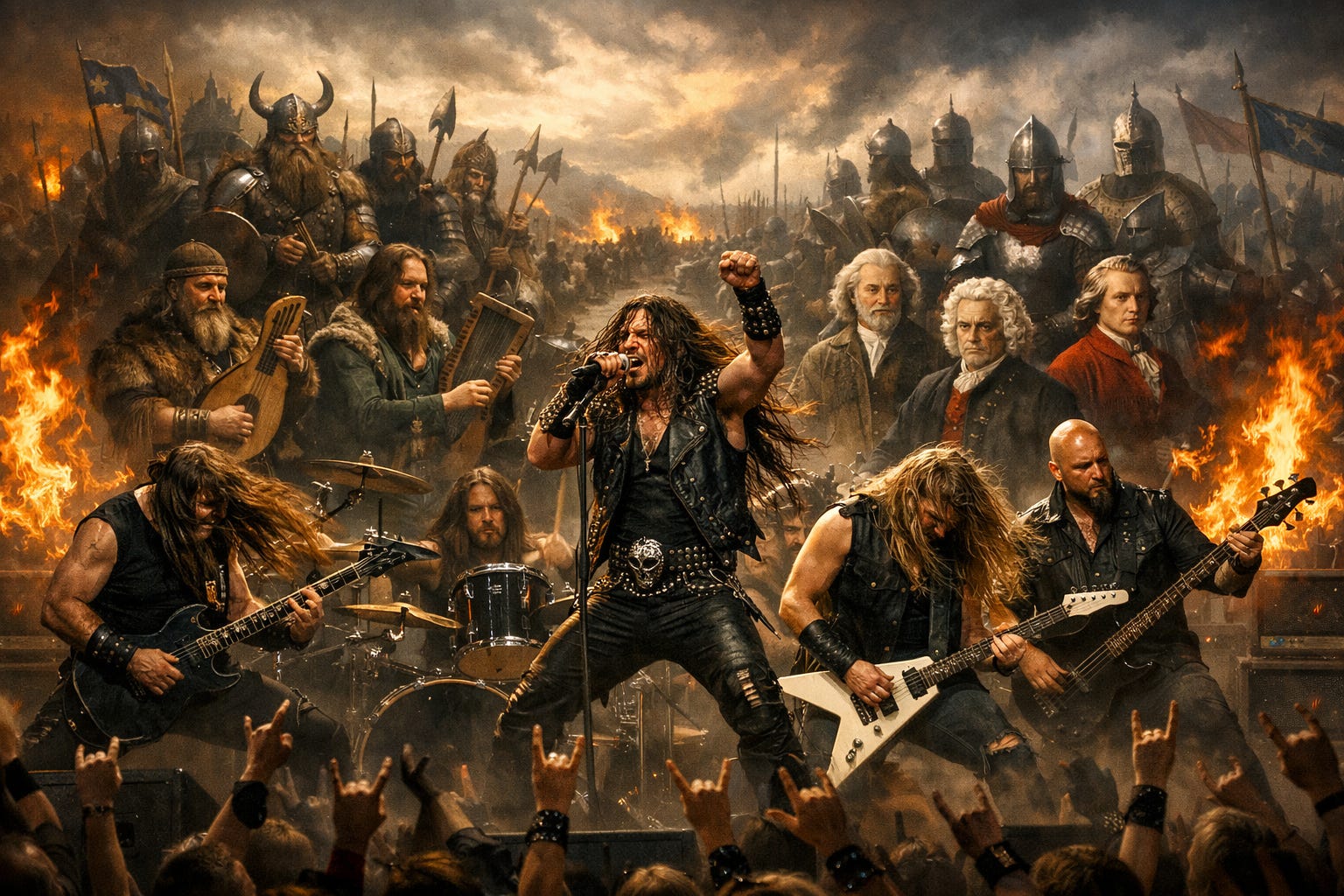
Heavy metal was forged in the rebellious fires of rock ‘n’ roll. As fast as lightning and as deep as thunder, it is characterised by pounding drums, powerful riffs, and vocals capable of stirring the gods or summoning the demons from the underworld. Sometimes loud and fast, sometimes slow and stirring, it is an intense form of the creative and artistic powers of the European soul, and an organic, modern continuation of older traditions, such as the epic poetry of Greek rhapsodes, the rhymes of Scandinavian bards, or the fervour of Romantic classical composers.
The Fusion of Rebellion and Tradition
Standing apart from the nihilistic attitudes of punk, as well as the dazed “”peace and love” pacifism of the hippies, heavy metal rebelled against the status quo in its own way. Rather than indulging in self-pity or endlessly complaining about real or imagined social injustices, it brought forth a different kind of rebel — one of manliness and self-assertion.
The heavy metal rebel may be an individual who stands out from the crowd, but he is not a rootless figure. He rejects the stale, mediocre values of his time and dares to tread upon paths forbidden by “polite” society. Unlike the leftist types of punks and similar subcultures, who wallow in their own misery while dreaming of a utopian, egalitarian future that will deliver them from perceived oppression and inequality, the metal rebel harkens back to the archetypes of heroes and warriors of old. He rejects both the culture of victimhood and the stiffness of the modern bourgeoisie. He is a free spirit, yet he approaches matters of courage, honour, nobility, and integrity without cynicism, mockery, or irony, for he is deeply impressed by myths and the heroic and tragic acts of the ancient days. Hence, he often turns to the past for inspiration in his revolt against the wrongdoings of the present system. He looks for heroes in the pages of the past, knowing full well that those pages are often smeared with blood and full of savagery, but also rich in myths, values, and traditions.
Heavy metal can be dismissive not only toward the whining of stoned pacifists or the victimhood of punk, but also toward overly hedonistic, repetitive themes of endless pleasure seeking. While men of metal know how to have a good time and are quite keen to sing praise to various alcoholic beverages or pretty girls, they are chiefly fascinated by deeper things and mythic figures that emerge out of the depths of the past.
Therefore, instead of an endless stream of sex, drugs, and rock ’n’ roll, pressing the play button on our audio devices throws us into a world of bloody battles, forgotten legends, mighty kings, beautiful queens, noble knights, warriors, berserkers, wrathful barbarians, and even wizards and dragons. Whereas there are many artists with diverse lyrics, one of the chief traits of heavy metal is that it can take us on a journey to a place where reality becomes interwoven with imagination, and history with myth. Visions of beauty and horror, struggle and joy, bitter wars and noble quests unfold before us almost like magic once the music takes over.
When heavy metal first descended upon the Western world, it shocked “respectable” society just like other styles and subcultures that emerged from the rock revolution. Growing subgenres, which sprang like boughs from the mighty oak of metal, continued to unsettle the “upright” citizens by disregarding established social norms. For ordinary, white, Christian, middle-class folks, whether conservative or more liberal, heavy metal often seemed hostile to traditions, morals, and family values. This resulted at times in modern “witch hunts” that, regardless of the beliefs of the Inquisition, can somewhat remind us of contemporary cancel culture.
On the other hand, many bands tried to achieve the highest possible shock value through “satanic” aesthetics, and later, with morbid and gruesome album covers depicting dismembered bodies or rotting corpses. Still, most bands would wear inverted crosses and sing about the devil only as a form of provocation. It was all part of a rebellion against a society that seemed old and sclerotic to the youth of steel and thunder, who wanted to break free from the grayness of everyday life and the worn-out patterns of expected behaviour.
Common morality and civilisational values are crucial for a strong community. Nevertheless, regardless of the satanic imagery and provocative style, heavy metal did not truly seek its own expressions outside the confines of Western civilisation, nor did it embrace leftist progressivism. Whatever the personal political beliefs of individual musicians may be, most bands engage in themes that are actually very identitarian and conservative beneath the surface.
Today, within the broader metal scene, both artists and enjoyers hold a myriad of political opinions and views — left and right, liberal and conservative, cosmopolitan and nationalist — but one could argue that the ethos of heavy metal is deeply rooted in history, myth, tradition, and even ethnocultural identity. The aesthetics, the lyrics, and the spirit of metal itself are heavily imbued with the rich cultural repository of European civilisation and the authentic traditions of our forefathers.
In a sense, it does not really matter if some artists espouse conventional liberal views, whether honestly or simply to kowtow to political correctness, especially if they use Germanic or Scandinavian imagery, such as runes, which can quickly earn them the label of white nationalism. What matters is the work of art itself and the feelings it arouses.
There are plenty of bands that take their topics seriously, but even those that treat their art only as a form of entertainment or as a way to explore interesting motifs and subjects are still drawn to traditional themes and the old ways. They still choose to sing about Viking raids or lone warriors seeking revenge rather than about the glamour of modern life, drugs, or endless partying. This spirit is passed on to the listener, who can then be inspired by the music itself, without concerning himself too much with the personal beliefs of musicians. Therefore, an enjoyer of the genre may become interested in his culture and roots, and may be motivated by the message of brotherhood, courage, loyalty, and even patriotism, since the protagonists of metal lyrics will often act in very tribal ways.
From the Nietzschean Blond Beast to the Vennerian Rebel
Heavy metal may have come across as antagonistic to the social conventions of its heyday, but unlike the counterculture of the 1960s or the anarcho-leftist strands of punk rock, its rejection of established values is more Nietzschean than progressive. Rather than succumbing to the ideas that crept out of the belly of the Frankfurt School, metal instinctively turns to the bygone eras such as Antiquity and the Middle Ages, as well as to the domain of myths and legends, including traditional tales and modern fantasy inspired by the medieval period, not in search of a return but of alternative attitudes with which it can confront the future.
The heavy metal hero is not a rootless, genderless creature fighting for minorities, but a masculine blond beast conquering himself and his surroundings, while simultaneously honouring his ancestors with his deeds. When Nietzsche posed the question of the revaluation of all values, he often turned to Antiquity. In a similar manner, heavy metal turns to the distant past when exploring issues of moral virtue and the nature of good and evil.
In heavy metal, individualism is tempered by a sense of brotherhood, of belonging to a community and knowing one’s past. The rebellious aspect of the genre is something more than just a simple middle finger to society, as was typical for early punk, or a refusal of social norms for the sake of hedonistic self-gratification. The renowned European patriot and herald of identitarianism, Dominique Venner, defined the rebel as someone who is “his own norm through fidelity to a superior norm.” For him, the rebel “holds himself in the face of nothingness,” always keeps his youth, and would “put the world against himself rather than grovel before it.”1
On a deeper level, heavy metal rebellion discards the rigid norms of an increasingly liberal, consumerist society of sameness, while yearning for a return of masculine principles and values, which are mocked and ridiculed in the current era of materialism and cold rationalism. C. S. Lewis once remarked: “We laugh at honour and are shocked to find traitors in our midst.”2 Similarly, the modern skalds of metal will often reflect upon those virtues that formed the basis of societies in which honour was above gold and where traitors were punished instead of rewarded.
In the spirit of Venner, heavy metal develops its own norms, but looks for guidance in the rich cultural heritage of the Western world. It keeps its youth by seeking that which makes us truly feel alive. It also encourages self-improvement and the pursuit of excellence, which is often realised within this particular subculture by mastering one’s aptitudes and talents for instrumental or poetic skills, but it can also be understood above all as an aristocratic approach that spurns mediocrity.
The ethos of metal motivates us to be active, to strive toward the will to power, and to be the master of oneself – to take on challenges, have an adventure, and act with confidence and integrity. However pleasing it may be to immerse oneself in the mighty riffs and lyrical tales of glory and heroism, we should not only be passive audiophiles but active participants in the struggles of life by engaging with the world around us, from visiting concerts and having a drink with the lads, to being physically active, exploring nature, wandering the woods, hiking in the mountains, and learning about our history and culture. Most importantly, we should always stand for what we believe in. Metal music can motivate and inspire us in such endeavours, as it offers a meaningful alternative to the emptiness of commercialised culture and generic entertainment. As the guitarist of U.S. epic heavy metal band Visigoth once explained:
“I think what makes heavy metal so timeless and endearing to fans over multiple generations now since its very earliest beginnings, is the genre has always called forth a primal response that every metal fan feels when listening to their favourite bands. The most basic fundamental sounds that heavy metal universally across all genres expresses is more powerful and driving that other styles of music and quite often invokes a sense of being called to something greater and more powerful than everyday existence especially in the genres of epic styles of heavy metal…”3
The Traditional Understanding of Masculinity
Numerous bands sing of the glory of battle and conquest, but the archetypal protagonist who fights for his honour and the honour of his clan — or seeks righteous vengeance — is by no means always a mindless brute, even when he is capable of severe brutality. Metal follows the traditional ideal of manliness, which has nothing in common with the liberal stereotypes that paint masculinity as “sexist” and “toxic” behaviour, consisting of cartoonish violence, endless one-night stands, and passionate outbursts only with regard to sports.
Defying the false dichotomy between a scholar and a tough guy, the genre deeply engages with literature, particularly with history and fantasy works, thus restoring its rightful place among manly endeavours. Real men should be well-read, and we should remember that fantasy authors such as Tolkien or Robert E. Howard were not mere bookworms. The former fought in the trenches of the Somme, and the latter trained in boxing and bodybuilding. Furthermore, metal does not merely romanticise battles but examines the anxiety before combat, the clash between fear and duty, the sufferings of ordinary soldiers, and the horrors of war as well. Consider, for example, “The Trooper” by Iron Maiden or “Fate of the Fighting Man” by Wolfchant, a German epic pagan metal band:
»We get so close, near enough to fight
When a Russian gets me in his sights
He pulls the trigger and I feel the blow
A burst of rounds take my horse belowAnd as I lay there gazing at the sky
My body’s numb and my throat is dry
And as I lay forgotten and alone
Without a tear, I draw my parting groan..«(Iron Maiden, “The Trooper”)
»Hold my hand because my heart is full of pain
Look in my eyes, am I a warrior or just a man?
This is the fate, of the fighting men
To live or to die, only for honour
This is the curse, of the brave men
To be one of many thousands«(Wolfchant — “Fate of the Fighting Man”)
Conventional Morality and Political Correctness
Metal also revolts against the modern world by attacking its conventional morality. Numerous artists try to rip off the bandage of decorum and politeness from the skin of modern civilisation to reveal the harsh, violent truth about human existence. Therefore, some death, black, or thrash metal bands will adopt the grisly and morbid aesthetics of deadly violence and destruction. Lyrical themes revolve around death, murder, senseless slaughters, sinister prospects of apocalyptic wars, mass destruction, and the general brutality of the human animal. This is thrown in the face of polite society and is often directed at Christianity, which was until recently held as the main arbiter of morality. However, some bands with conspicuously anti-Christian imagery may actually include Christian members, as is the case with Tom Araya from Slayer, who is Roman Catholic. Incidentally, Slayer also has a song titled “Silent Scream” that reflects the horrors of abortion:
»Electric, circus, wild,
Deep in the infants mind.
Silent Scream
Bury the unwanted child.
Beaten and torn
Sacrifice the unborn.
Shattered, adolescent
Bearer of no name.Restrained, insane games
Suffer the children condemned.Scattered, remnants of life,
Murder a time to die.«(Slayer, “Silent Scream”)
Nonetheless, if some bands provoke Christianity purely for shock value, others are truly hostile to the Church, and this hostility became a principal trait within some subgenres. Yet, in their attempt to expose perceived duplicities within Christianity, some of these bands could themselves be accused of hypocrisy, as many artists who vehemently attack the Christian religion do not dare to criticise the ongoing Islamisation of the West, or simply do not care about it. They rather stay within the safe boundaries of political correctness by only criticising the diminishing power of the Church, instead of risking being cancelled by denouncing the ongoing demographic and cultural invasion of Europe by another religion, much more despotic and foreign to us today than Christianity. But there are exceptions. Among them are the U.S. thrashers Exodus with the song Children of a Worthless God, which is quite direct, albeit from a more libertarian and generally anti-extremist perspective:
»Follow us blindly or die like a dog
Blood mixed with sand for this holy war
Your savior’s a killer, you die for Allah
You are all children of a worthless godSmite the perverts and the obstinate
Praising the death of the free
United States of Islam
That’s what you would like it to be
Violate the unbelievers
Praising crimes against man
Human rights mean nothing
Doctrine of death a scourge upon man«(Exodus — “Children of a Worthless God”)
Exodus has quite a few songs lambasting the Church as well, but at least they are consistent. There are other bands that tackle the question of Islamic terrorism as well, from Slayer’s “Jihad” to Sabaton’s “In the Name of God.”
From Inverted Crosses to Thor’s Hammers
The rejection of Christianity within the genre can come from different places that vaguely correspond to either liberal or identitarian criticisms of the Christian faith. One such tendency stems from a place of individualism, progressive atheism, and even nihilism. Its basic premise is that Christian teachings are simply untrue, and that this religion has become a mechanism of oppression and discrimination, imprisoning individuals within false narratives and beliefs.
Another tendency, corresponding to some degree with the critique of Christianity found in some right-wing circles, may partially agree, yet sees it not only as a tool for the subjugation of the individual and his free will, but essentially as a foreign oppression of an entire people. This premise considers Christianity to be an alien religion occupying the European soul and mind, which has imposed its own outlandish values onto the native culture and has destroyed or altered large parts of it in the process.
Those artists who took the second route outgrew their adolescent flirting with satanism and found a more meaningful way to rebel against the established Christian norms by rediscovering their native roots. They ventured into the pre-Christian past of their peoples and began to express themselves within the framework of paganism and early European traditions, many of which had in fact survived beneath the Christian veil. In other words, instead of inverted crosses, no crosses at all. Diabolic pentagrams were replaced by Thor’s hammers or Perun’s axes, and the Devil was dethroned by the olden gods.
Still, metal, in all its branches, is a vast cultural phenomenon, and cannot be considered entirely hostile to Christianity. Some heavy and power metal acts have taken a different path, drawing inspiration from historical themes such as the Crusades or the Holy wars of Christian knights against foreign invaders. Bands such as Saxon or HammerFall sing about the courage and boldness of the Templars and Crusaders, while Sabaton, whose lyrics admittedly sometimes sound like Wikipedia entries on history, has multiple songs about renowned historical triumphs of Christendom. Just as some bands are drawn to the harsh world of Norsemen, dark forests, wide seas, and heathen spirituality, so others prefer the medieval imagery of mighty castles and warriors of Christ. Some artists may even combine both elements of our layered civilisational and cultural legacy, thus reflecting the broad and complex historical background of our continent.
»Crusader, crusader, please take me with you
The battle lies far to the east
Crusader, crusader, don’t leave me alone
I want to ride out on your quest
I’m waiting, I’m waiting, to stand by your side
To fight with you over the sea
They’re calling, they’re calling, I have to be there
The holy land has to be free
Fight the good fight, believe what is right
Crusader, the Lord of the Realm
Fight the good fight with all your might
Crusader, the Lord of the Realm
We’re marching, we’re marching, to a land far from home
No one can say who’ll return
For Christendom’s sake, we’ll take our revenge
On the pagans from out of the east
We Christians are coming, with swords held on high
United by faith and the cause
The Saracen heathen will soon taste our steel
Our standards will rise ‘cross the land«(Saxon — “Crusader”)
Ethnocultural Rootedness: A Chief Trait of Metal
The monumental landscape of metal stretches from the stormy seas where drakkars sail to the shadowy forests of the ancient tribes, from the icy valleys of eternal winter to the high peaks of formidable mountains towering above the clouds. It reaches from ominous fortresses wrapped in mist, standing on lone hills, to majestic white castles. It spans the dusty old roads upon which warbands march, the motorways above which the roaring sounds of iron horses crack the sky, and extends from the halls of the gods to the hellish caverns of the nether regions. The sound of steel has its own archetypes, metaphors, concepts, tales, and realms. It envisions its own geography, inspired chiefly by the northern regions of our civilisational homeland. Music itself varies far and wide.
While black metal can conjure up atmospheric and mysterious melodies or command brutal assaults on our eardrums, death metal often invokes powerful yet somewhat melancholic and even fatalistic feelings. At the same time, the dynamic spirit of our people runs through power metal tracks like blood through our veins, and folk metal gives the genre a local flair by incorporating traditional instruments and native elements.
The genre is strongly rooted in its cultural and natural surroundings, and this instinctive rootedness was illustratively expressed by Quorthon of Swedish black and viking metal pioneers Bathory in an interview, where he discussed how he wanted to replace the satanic aesthetics with something that was completely detached from Christianity:
“The pre-christian Scandinavian Viking and Vendel era seemed perfect for lyrics and arrangements. Had Bathory been a japanese act, we might as well have picked up the Samurai culture. Had we been an Italian act, it could easily have been the Roman empire era. Now, we happened to be a Swedish act and the Viking and Vendel era seemed exciting in terms of writing music and lyrics.”4
This type of rootedness and a bond with blood and soil comes almost naturally to many artists and is an integral part of the subculture. Joris Boghtdrincker, the lead singer of the Dutch folk metal group Heidevolk, expressed similar attitudes. When discussing their primary sources of inspiration, he cited folklore, history, and the outdoors. Although they also deal with pagan themes, their name does not actually mean “heathen folk”; rather, it comes from heath, a type of terrain typical of their country. Therefore, Heidevolk actually combines the elements of folk and land – the natural environment of their home and the native population. Apart from Germanic mythology, a lot of their songs are about local historical events and personal experiences in the world of nature. As Boghtdrincker emphasised, “It needs to be authentic. It needs to be real. It needs to be tied to local history.”5
Another band that followed their compatriot Quorthon’s lead, but went even deeper into the Old Norse lore, Scandinavian mythology, and history, are the Swedish death metal giants Amon Amarth. While their name comes from Tolkien, meaning Mount Doom in the Elvish language Sindarin, their lyrical and musical skills throw us into the harsh era of the grim Vikings, outcasts, berserkers, adventurers, gods, and monsters of the old North. Even though they do not appear to be heathen or religious themselves, they seem profoundly fascinated by the Norse sagas, the myths of the Poetic and Prose Eddas, the philosophy behind Hávamál, and the mindset, undertakings, and history of their ancestors. The lyrical themes blend with at times fast and aggressive, and at times slow, sorrow-laden melodies that perfectly capture the cold, northern air, the often ruthless world of the Viking age, and the honour-bound ethos of the northern heathen warriors.
»This life it is not for everyone
The grind of travel can wear you down
Our grave may be waiting around the bend
But we’ll keep fighting to whatever end«(Amon Amarth – “Heidrun”)
The powerful yet sombre style of Amon Amarth evokes images of men hardened by the environment and fate that could easily be compared to the great American writer Jack London’s description of Wolf Larsen, a stern Swedish captain and a larger-than-life antagonist in his work The Sea-Wolf:
“This loneliness is bad enough in itself, but, to make it worse, he is oppressed by the primal melancholy of the race. Knowing him, I review the old Scandinavian myths with clearer understanding. The white-skinned, fair-haired savages who created that terrible pantheon were of the same fibre as he. The frivolity of the laughter-loving Latins is no part of him. When he laughs it is from a humour that is nothing else than ferocious. But he laughs rarely; he is too often sad. And it is a sadness as deep-reaching as the roots of the race. It is the race heritage, the sadness which has made the race sober-minded, clean-lived and fanatically moral…”6
Amon Amarth’s countrymen, Grand Magus, who hail from the camp of heavy rather than death metal, are another band that mostly focus on pagan and medieval matters. Their poetic undertakings are heavily influenced by contemplations on the power of nature and the lore of Nordic and Germanic myths and legends. Their latest album from 2024, titled Sunraven, is a conceptual album dedicated to the epic of Beowulf. As their vocalist, JB Christoffersson, plainly puts it: “I think Norse mythology is cool, I think Vikings are cool. Am I supposed to be ashamed of this and dress it up in fancy metaphors?” For him, Beowulf is a timeless legend that contains “a lot of the fundamental aspects of human life. It deals with life and death and love and hate and victory and defeat, all the basic things that every human in different ways has to deal with.”
It was already pointed out that heavy metal is a genre that is very much free from the modern clutches of cynicism. Christoffersson made a similar case in his definition of the genre, as he emphasised that for him metal is “about not getting caught up in life’s tedious goings-on, or trying too hard to be a sarcastic smartarse.” Instead, he pointed out, “it’s for releasing powerful, basic emotions.” Furthermore, regarding the band’s attraction to myths, he explained:
“For centuries, the Vikings and their worldview have fascinated people of all ages across the world—just like Greek mythology, Chinese legends, or Arthurian tales. All cultures have their own warrior lore: tales of bravery and heroes overcoming formidable threats. These myths have been a constant throughout mankind’s history.”7
American heavy metal outfit Visigoth exhibited a similar fascination by choosing their name after a Germanic tribe that first sacked Rome, stating that it evokes “the heavy metal warrior spirit very concisely.”8 Beyond this, Visigoth is chiefly inspired by epic fantasy — from Highlander to Conan the Barbarian — through which it echoes broader mythological themes and the traditional heroic creed.
Out in the Wilderness: The Rootedness of Black Metal
Rootedness in one’s ethnocultural soil is prevalent within black metal as well. Northern wilderness covered in snow, mysterious woodlands, and the darkness of the long nights are often mirrored in pagan and black metal’s imagery, sounds and lyrics. Black metal shuns the modern world with its concrete hives and consumerist landscape, and instead navigates the depths of primeval human nature, the mysteries of the ages gone, and the natural world. Without romanticising nature, it contemplates its secrets, often emphasising its darker side and the brutal realities of its eternal laws.
Varg Vikernes, most famous for his project Burzum, once posited black metal as “an expression and (for fans) appreciation of the despair most men feel from living in a world that is not built for them”, adding that “Black metal has woken up many good anti-Jewish Pagan Europeans and has thus led them on the right course.”9 The church burnings, which he was involved in, may have been denounced by some artists but were simultaneously approved within the Norwegian black metal community as a manifestation of the desire to purge the land of what was seen as traces of “semitic roots”, as Gaahl, former frontman of Gorgoroth, puts it in the documentary Metal: Headbanger’s Ball from 2005, mentioning Islam and Judaism in the same breath.10
Being the most “extreme” metal genre both in music and attitudes, black metal ventures more frequently beyond the fences of political correctness. Whereas some bands attack Christianity but do not risk criticising the followers of Muhammad, quite a few black metal artists would extend their assaults to mosque-goers as well. The Norwegian act Taake, for instance, was blacklisted by a number of promoters and organisers because of its song Orkan, meaning Hurricane. Directed at both Christianity and Islam, the lyrics include the following line: “To hell with Muhammad and Muslims, Unforgivable customs”, while declaring that Norway will awaken soon. More than a decade later, Hoest, the band’s vocalist and founder, would still defend his decision of daring to criticise the Mohammedan faith:
“Freedom of speech allows me to voice my opinion and I will never be silenced, even if constant attempts at re-installing enforcing blasphemy laws should succeed. Infidels are to be subjugated, humiliated and killed with impunity, as well as spend eternity being tortured in Hell. The least I could to was to say something similar back. I still don’t understand how this is supposed to be considered extreme, compared to my other lyrics…”11
Originally named Thule, Taake described itself as “True Norwegian black metal”, and one of the band’s aims, in the words of Hoest, is to awaken the national pride and cultural nostalgia among Norwegian listeners. The name itself is an old spelling of the word tåke, which means fog in Norwegian, thus reflecting the band’s rootedness in both natural surroundings and the cultural legacy of Norway.
Reflecting the genre’s proximity to the great outdoors and its disdain for consumerist, rootless societies, the now-defunct English band Wodensthrone gave the following definition of the genre, which is also worth considering:
“Black Metal has always been an artistic mode that shuns the crowded cityscape, seeking refuge in the natural world, and we embrace this both lyrically and visually. Our impulse is to transport the listener back to a time when man relied on the land for all his needs, before that moral and spiritual connection was replaced by the hollow pursuit for materialism, before technology presented us with a means to make our lives comfortable at the expense of tearing up the earth for profit.”12
The ethos of black metal combines one’s individualism with one’s roots: it is as much about freedom, personal autonomy, and independent thoughts as it is about origins, surroundings, and heritage. However, the kind of individualism we find in black metal is far removed from the modern, liberal conception of the term. It’s not about relinquishing all rules only to gratify one’s individual lust and lowest instincts, but about setting one’s own rules on the quest for true meaning, growth, and self-overcoming, which calls to mind Nietzsche’s ideal of the Overman. Social norms are disregarded when they stand in the way of doing what one thinks is right. In conclusion, black metal dives deep into one’s primordial soul and explores motifs of spiritual quests, rootedness, self-expression, and one’s passions and yearnings.
https://www.arktosjournal.com/p/identitarian-reflections-on-heavy