
‘I’m Fine Losing My Freedom’
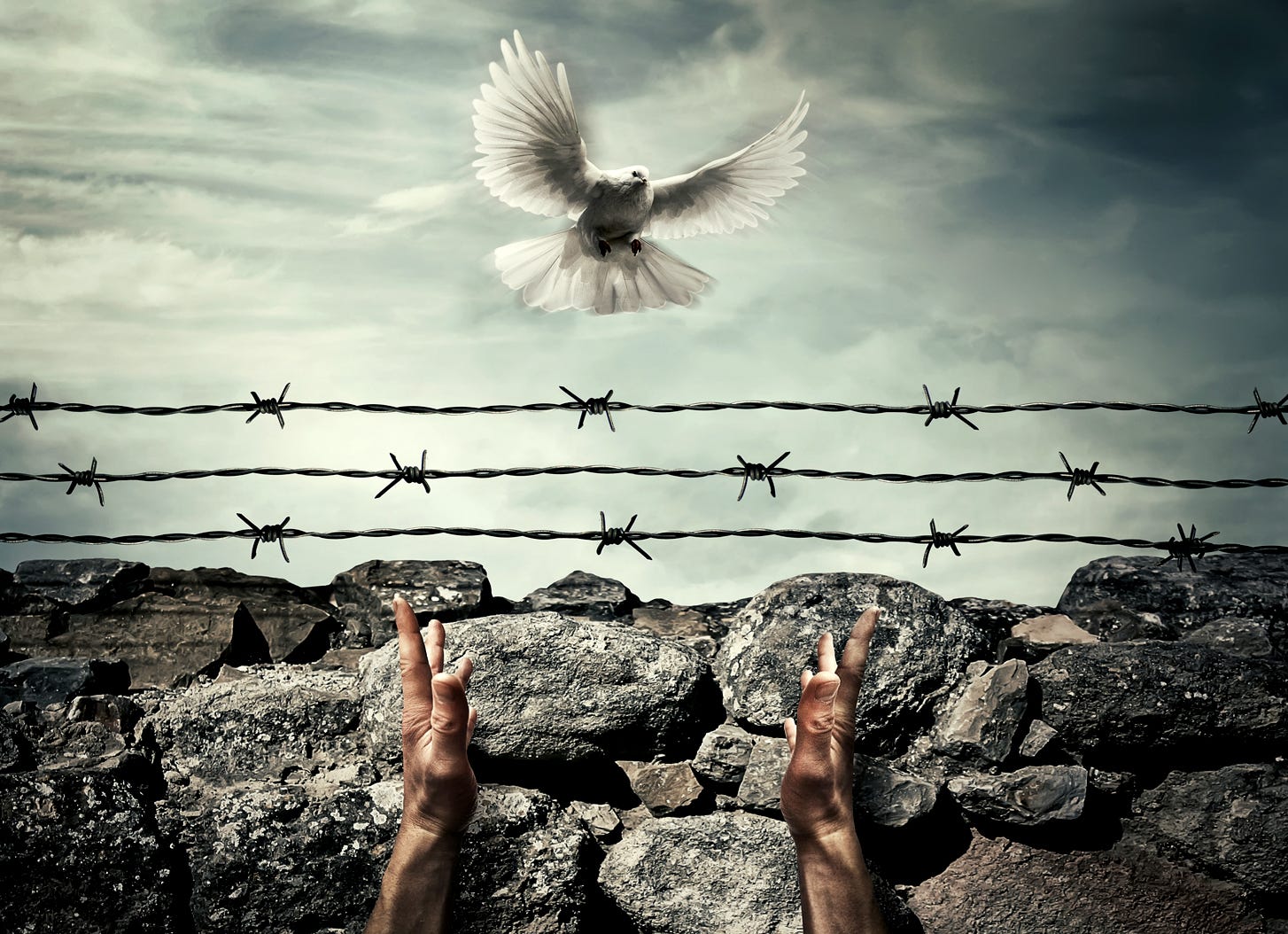
This one really threw me for a loop, though I can’t say I’m entirely surprised. I was chatting with a sheep (sorry, I just can’t give up the word) the other day, and when I posed the obvious question—“Don’t you want to preserve your freedoms as an individual in a free country?”—she replied, “No, not really. I want to do what’s necessary for the collective; I don’t care about my individual rights.”
Wowzer!
My first thought was that she didn’t know what she was talking about. The second thought was that she knew full well and meant every word. The third was that the Covid vaccine had turned her brain to mush, transforming her into a zombie for the state.
All three possibilities could be valid—and all three are extremely dangerous. The first one, that she doesn’t grasp the implications, is probably the least troubling. Maybe it’s just a matter of education: teaching her what such a life would truly entail, why she likely wouldn’t be okay with it, and what she’s missing out on.
She’ll know soon enough, you might say. Well, maybe not—which brings us to the second thought: that she does know what she’s talking about and genuinely means it. I believe today’s technology, social systems, and supply chains are robust enough to sustain a globalist-controlled world while still providing sufficient creature comforts. People could endure it all, waking up each morning to their bowl of crickets and thinking, “Hey, things aren’t so bad! It’s all for the good of the collective, right?”
We often envision North Korea, with its starving population, brutal labour camps, constant surveillance, public executions, and total suppression of dissent. Or worse—like the dismal horrors of Orwell’s society under the thumb of Big Brother in his dystopian novel 1984. But there’s no guarantee that’s how it would play out. It might be more like Klaus Schwab’s declaration: “You’ll own nothing, and you’ll be happy.” Until, of course, it becomes necessary to start eliminating a few “useless eaters” to keep the chosen ones owning nothing but remaining content (and, of course, those at the top own it all!). Who knows—maybe the attitude from the movie Soylent Green would prevail: a serene walk toward the ecstasy of ending your life for the good of the community. Aren’t we already seeing echoes of that with assisted suicide programs in countries that endorse them?
Of course, that’s for the sheep. Us shrews won’t be happy—even if the state provides us with endless pickleball. But I’m not talking about us shrews right now . . . I’m talking about the masses who might, like my friend, claim they don’t really care about losing their individual freedoms. Did this she-sheep really mean it? I do believe her comment was a combination of Thought One and Thought Two (maybe even Thought Three—but I’ll get to that in a minute).
She also proclaimed to be a socialist, but it sounded a bit more like communism to me, where there is a central state of control, all production is nationalized, and all control sits in one place. Socialism, or more accurately democratic socialism, is not quite that stringent—it’s a broader system that often allows for some private property and emphasizes democratic reforms rather than full state ownership or revolutionary upheaval. When you are talking about wanting a central authority to make decisions for the good of the whole, it seems a bit more Marxist to me—“From each according to his ability, to each according to his needs.” Commie words.
I don’t think communism has ever worked. For instance, the Soviet Union crumbled in 1991 amid rampant corruption, economic stagnation, and elite power grabs; Maoist China devolved into the Cultural Revolution’s chaos before pivoting to state capitalism; and Cambodia under the Khmer Rouge saw mass genocide and societal collapse due to tyrannical leadership. People start to lose it psychologically, even intellectually and physically, when they are oppressed to the degree they are in these cultures. And I don’t think there has been a historical example of communist systems where it did not eventually collapse due to corruption at the top. Even if the social and economic system does not collapse, the restrictions on the community become extremely oppressive, including total restrictions on living any sort of decent life, imprisonment, death, and a complete destruction of the human spirit.
Communism’s track record is a graveyard of shattered dreams: regimes like the Soviet Union, where leaders hoarded luxuries while citizens queued for bread; Castro’s Cuba, riddled with nepotism and economic failure that drove mass exodus; and Venezuela under Chávez and Maduro, where elite corruption turned oil riches into hyperinflation and famine. In every case, the iron fist of control crushes the human soul, breeding despair, intellectual atrophy, and physical decay, not to mention the utter destruction of any meaningful artistic expression—turning vibrant societies into wastelands of broken spirits and enforced misery.
For that matter, I personally do not have much of a different opinion of democratic socialism. But that’s another story.
Going back to my original topic, I do find it quite perplexing that anyone who lives in a free country would be so cavalier they would say they didn’t care about basic freedoms such as free speech, freedom of assembly, the right to privacy, and freedom of religion, among many others! I confronted her with these things she would lose, and she stuck with her original statement, pointing out that most likely things would not get as bad as I was describing (although historically it has happened EVERY time, with no exceptions.)
She believed that those in charge would never let it get so bad, and even if our speech was restricted, it would be for the best. People should not be allowed to say whatever they want, blah blah blah. Again, her entire argument was based on the benevolence of those in charge. Why in the world would she think leaders who actually had total control, would always do what was best for the people they ruled? Again, this has historically never happened. She certainly is not pleased with what she believes to be Trump’s intentions to be a freedom-destroying dictator. So, what’s that about?
So now I come to Thought Three—the vaccine implemented mush brain. Could the Covid vaccine actually cause physiological damage to the brain, the psyche, and the personality? Some researchers and doctors have raised alarms about potential neurological effects from these vaccines, particularly mRNA types. Dr. Peter McCullough, a cardiologist and outspoken critic, has discussed “vaccine-induced brain fog” and cognitive impairments linked to spike protein inflammation crossing the blood-brain barrier. Neurologist Dr. Russell Blaylock has written about possible long-term neuroinflammatory damage leading to altered behaviour and reduced empathy. Dr. Stephanie Seneff, a senior research scientist at MIT, has theorized that the vaccines could contribute to prion-like diseases or neurodegenerative issues, potentially affecting personality and decision-making. While these ideas remain controversial and not universally accepted, they stem from reports of side effects like headaches, fatigue, and rare cases of Guillain-Barré syndrome, fueling speculation about subtler psychological shifts.
I have seen other evidence of this in other situations such as general empathy, compassion, ability to be flexible (like people used to be), critical thinking skills, emotional resilience, and openness to diverse viewpoints. I find this a difficult pill to swallow primarily because what I am talking about here is so specific (“I don’t care if I am free. I hate Trump with a passion. I am pro-vax and anyone who is not should be hung.”) I can’t see how any drug, or mechanism, could be this precise in its changing of the personality.
Yet the specificity of these shifts is what haunts me most—it’s not just vague fog, but laser-focused ideological entrenchment, like a scripted rewrite of the soul. How could a jab create such pinpoint alterations, turning flexible minds into rigid echo chambers of compliance? It’s as if the needle doesn’t just pierce the arm, but reprograms the very core of free will, leaving behind zombies who parrot the agenda with eerie precision.
In the end, whether it’s ignorance, willful surrender, or some sinister alchemy in the veins, this sheep’s casual dismissal of liberty chills me to the bone. It’s a stark reminder that the real battle isn’t just against tyrants—it’s against the apathy that lets them thrive. Wake up, fellow humans, before we’re all grazing in the same fenced pasture, munching on illusions while the gate clangs shut forever.