
Imperium and Destiny
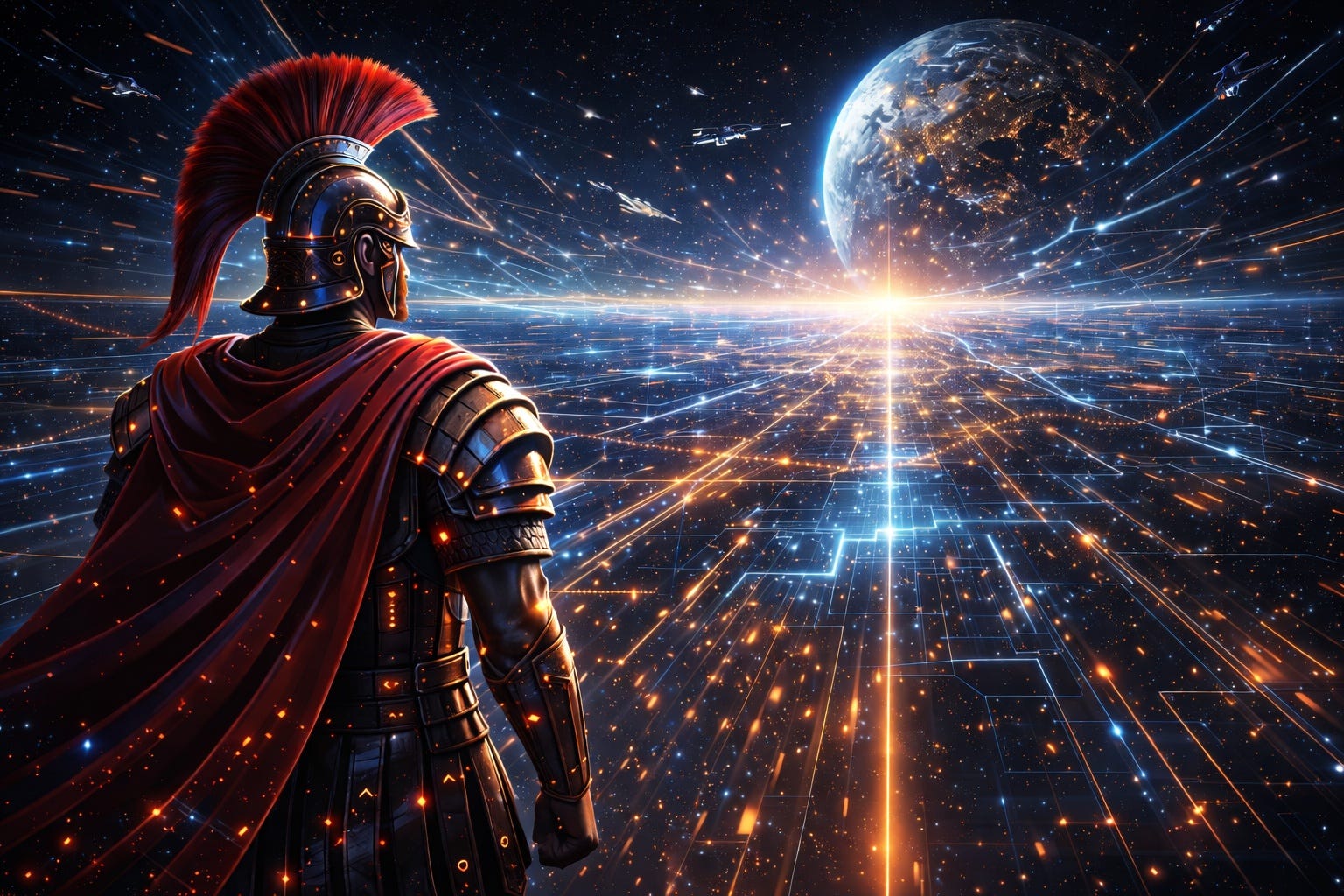
Today it is not a matter of conserving the present or returning to a recent past that has failed, but rather of regaining possession of our most archaic roots, which is to say those most suited to the victorious life.
— Guillaume Faye
Guillaume Faye (1949-2019), the great French philosopher of destiny, magnitude, and civilizational resurgence, saw further than the administrators and technocrats who mistook temporary stability for historical permanence. His imagination moved along tectonic lines rather than electoral cycles. Decades ago, he described a future in which Europe would either rediscover its heroic scale or dissolve into managerial triviality. Today the atmosphere itself seems charged with his foresight. Archeofuturism steps out of abstraction and enters the terrain of armies, laboratories, orbital networks, demographic strategy, artificial intelligence, energy corridors, and continental logistics.
The age of weightless ideology yields to the age of embodied power. Across the landmass of Eurasia, ancient cultures awaken with renewed coherence. Orthodox Russia speaks once again in the register of sacred history and imperial time, presenting itself as a katechonic force that restrains chaos through hierarchy and tradition. Confucian China advances with methodical discipline, merging algorithmic governance with a civilizational memory measured in millennia. Hindu India gathers momentum through spiritual inheritance, scientific ambition, and strategic autonomy, shaping a pole whose vitality and space program (named after Hindu gods) radiates across our solar system. The illusion of a single organizing center for mankind fades; the multipolar dawn spreads with the inevitability of sunrise.
Within this transforming horizon, Europe faces the question that determines centuries: will it act as a subject or drift as an object? Faye answered with Promethean clarity. Europe must seize its own flame. A European empire, immense in economic force and decisive in military power, could arise as a unified strategic organism—politically centralized, civilizationally plural—gathering Europe’s historic peoples into a single continental will. Such a structure would reflect the autarky of great spaces, a continental metabolism capable of sustaining itself through internal strength rather than external permission. Strategic industries, food security, technological ecosystems, and organs of defense would align towards durability. Cultural confidence would replace apologetic hesitation. Demographic renewal would appear as a civilizational project rather than a statistical concern. Through convergence with Russia, geography itself gestures towards destiny: Eurosiberia, a continuous sphere stretching from the Atlantic facade to the Pacific theater, abundant in resources, scientific talent, transport arteries, and strategic depth. Here space becomes power; scale becomes freedom.
The Belgian thinker and strategist Jean Thiriart (1922-1992), long before the current century gathered momentum, articulated a parallel intuition with granite firmness. He envisioned a united European empire extending from Dublin to Vladivostok, a geopolitical organism capable of standing upright among giants. His thought carried the Roman sense of imperium adapted to the technological era: disciplined, sovereign, and continental. Thiriart grasped that small states orbit larger gravitational centers; only a great political body commands its own trajectory. In the emerging multipolar order, such an empire could form a decisive pole, balancing the energies of Asia while engaging them through reciprocity rather than subordination. Thiriart supplied the geopolitical skeleton; Faye infused it with mythic electricity. Together they outline a Europe restored to historical agency, neither a museum nor a marketplace, rather a strategic civilization conscious of its mission.
The geopolitical field already shifts with visible acceleration. The vanished Soviet specter gave way to new vectors of pressure flowing from the global South, currents that Atlanticist strategy attempted to manage through financial leverage, security umbrellas, and narrative dominance. That edifice is weakening as civilizational actors are accumulating confidence. Eurasian integration advances through high-speed rail networks, energy pipelines that redraw dependency maps, quantum communication systems, Arctic routes, and financial mechanisms that bypass earlier chokepoints. Defense planners across the continent increasingly contemplate unified command structures supported by credible nuclear deterrence. What once stirred unease inside the Pentagon now reads as a structural probability: a Eurocentric Eurasian power grounded in heritage, realism, and strategic patience.
Such a formation would pursue equilibrium through strength rather than expansion through restlessness. An imperial state could coordinate diplomacy, currency frameworks, industrial policy, cyber defense, and expeditionary capability while cultivating bilateral partnerships across the civilizational spectrum. Multipolarity here reveals its mature matrix. Distinct worlds rise into clarity with Europe rediscovering its Faustian drive towards the infinite horizon. Each pole in the new multipolar world guards its inheritance, develops its technological expression, and engages others through negotiated respect. Archeofuturism thus becomes the overarching structure of the century: high technology guided by ancestral memory, planetary reach anchored in primordial identity, and innovation fused with continuity.
Faye understood that the magnitude of will shapes the magnitude of history. Eurosiberia symbolizes precisely that will: a cvilization-state capable of guarding its sphere, projecting stability along its frontiers, and contributing to a concert of civilizations whose plurality generates balance rather than fragmentation. Strength deters opportunistic intrusion; clarity invites structured cooperation. Trade flows gain resilience through diversified corridors. Scientific exchange accelerates through sovereign research clusters. Cultural production regains confidence once it springs from rooted worlds rather than a deracinated fashion. The very scale of such a power would discourage colonizing impulses from rival blocs while encouraging pragmatic agreements grounded in mutual advantage.
Thiriart’s imperial intuition enriches this picture further. He perceived the empire as a stabilizing organism, a framework within which diverse peoples participate in a shared strategic destiny. Empire in this sense transcends mere conquest; it organizes space, secures routes, standardizes defense, and generates long temporal horizons for development. Within a multipolar environment, a European empire would function as both a shield and a bridge: a shield against external coercion and a bridge towards cooperative equilibrium among the great civilizations. Rome once structured a world through roads and law; a future Europe could structure its environment through infrastructure, digital sovereignty, aerospace capacity, and maritime reach.
Across the wider planet, parallel awakenings reinforce this trajectory. Moscow speaks in the language of vertical authority and metaphysical statehood. Beijing refines a synthesis of meritocratic governance and technological statecraft. New Delhi channels civilizational depth into entrepreneurial expansion and strategic independence. Each center contributes to a planetary equilibrium in which difference generates harmony rather than conflict. The emerging order resembles a cathedral composed of distinct arches, each bearing weight, each enhancing the stability of the whole.
Archeofuturism therefore exits the realm of prophecy and enters lived experience. Hypersonic craft traverse skies once ruled by slower dreams. Data constellations orbit above ancient pilgrimage routes. Megacities rise near temples older than recorded history. The youth across continents inherits both microchips and myth. Time itself seems to fold, allowing archaic symbols to guide futuristic societies. Europe, should it embrace the path traced by Faye and anticipated by Thiriart, could join this renaissance as a conscious pole rather than a hesitant spectator.
The strategic blueprint appears with crystalline sharpness. A proud Eurosiberia, grounded in sovereignty and animated by imperial scale, would cast security across its territories while inviting dialogue among equals. Military readiness would coexist with diplomatic finesse. Economic gravity would attract partnerships across Africa, Latin America, and the Indo-Pacific. Currency autonomy would reinforce political independence. Cultural self-knowledge would nourish creative resurgence in art, literature, architecture, and philosophy.
The future these thinkers discerned approaches visibility with each passing year. Maps reorganize. Alliances recalibrate. Civilizations remember themselves. Archeofuturism ceases to signify daring speculation; it names the structure of the world coming into form. Europe stands before a threshold. Should it step forward with the confidence worthy of its history, it may yet emerge as one of the decisive poles of the multipolar age: vast, sovereign, technologically radiant, faithful to its ethnos and ethos, and oriented towards its identitarian destiny.