
Israel’s Doctrine of Succession
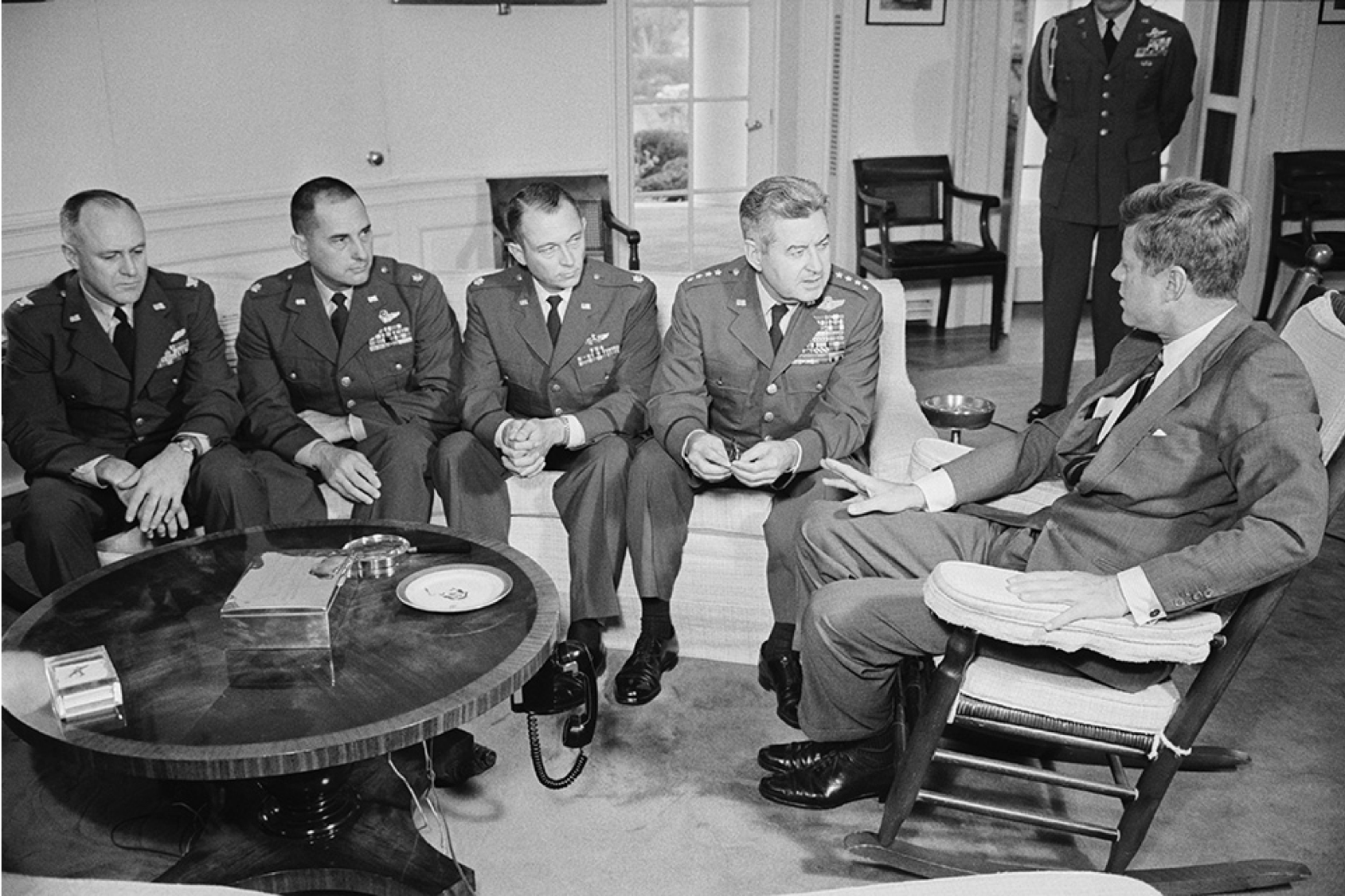
How Likud’s lineage penetrated the U.S. presidency — from JFK to Charlie Kirk.
“Give me a place to stand and I can move the world. Fellow leaders of the world, let us see if we can take our stand here in this place, in this time, to move the world toward peace.”
— President John F. Kennedy, addressing the UN General Assembly
Every American president who forced peace onto Israel’s strategic agenda paid a severe price — political, physical, or historical.
Because nothing threatens the doctrine more than peace.
George H.W. Bush froze $10 billion in loan guarantees and dragged Israel to the Madrid Peace Conference. AIPAC declared him an “enemy.” Donors revolted. An attempted assassination followed within a year. (Kuwait, April 1993).
“One lonely guy vs. a thousand lobbyists.” — George H.W. Bush
Jimmy Carter forged the only real Arab–Israeli peace. Washington excommunicated him for it.
John F. Kennedy confronted nuclear deception, insisted on Dimona inspections, defended Palestinian return, and challenged covert operations on U.S. soil.
JFK became the existential threat.
But there is one exception:
Dwight D. Eisenhower.
And the reason he survived is the reason everything that followed became possible.
In 1956, during the Suez Crisis, Eisenhower stood against Britain, France, and Israel on behalf of Egypt — and crushed them so decisively that the old empires never rose again. It was the moment Israel understood who now decided its strategic fate.
America had become the new imperial center.
And from that moment forward, the doctrine shifted.
What Israel could not achieve through force or old alliances, it would pursue through something far more durable:
penetration, proximity, political engineering, and narrative control.
Which leads to the question that frames this entire series — the question the archives answer but history books avoid:
How did one small state acquire enough influence to bend the world’s superpower — its presidents, its intelligence agencies, its media system — across seven decades?
The Architecture Behind the Question
This investigation does not rely on speculation, rumor, or retrospective mythology.
It follows the documented circuitry — the actual channels through which influence, intelligence, and political pressure flowed from the 1940s to 2026.
And the truth is simple:
The doctrine did not begin in Washington.
It arrived there.
It was born in the militant underground of Mandatory Palestine — Irgun and Lehi — movements whose operatives later became:
- prime ministers (Menachem Begin, Yitzhak Shamir)
- intelligence chiefs (Rafi Eitan and the MALAM generation)
- nuclear strategists (Shimon Peres’s Dimona network)
- diaspora political architects (from Abe Feinberg to Mathilde Krim)
It matured through Angleton’s Israeli channel inside CIA counterintelligence, the NUMEC uranium diversion, the Pollard espionage case, and the covert diplomatic pipelines that shaped U.S. Middle East policy from LBJ to Biden.
It expanded into evangelical institutions, media ecosystems, donor networks, and eventually into the White House itself, where foreign-aligned priorities could bypass formal policy and enter through personal relationships.
This isn’t theory.
This is infrastructure.
Which is why the map below exists — not as speculation, but as a synthesis of official archives, declassified liaison files, nuclear investigations, espionage cases, and documented political channels.
The Network Behind the Crisis
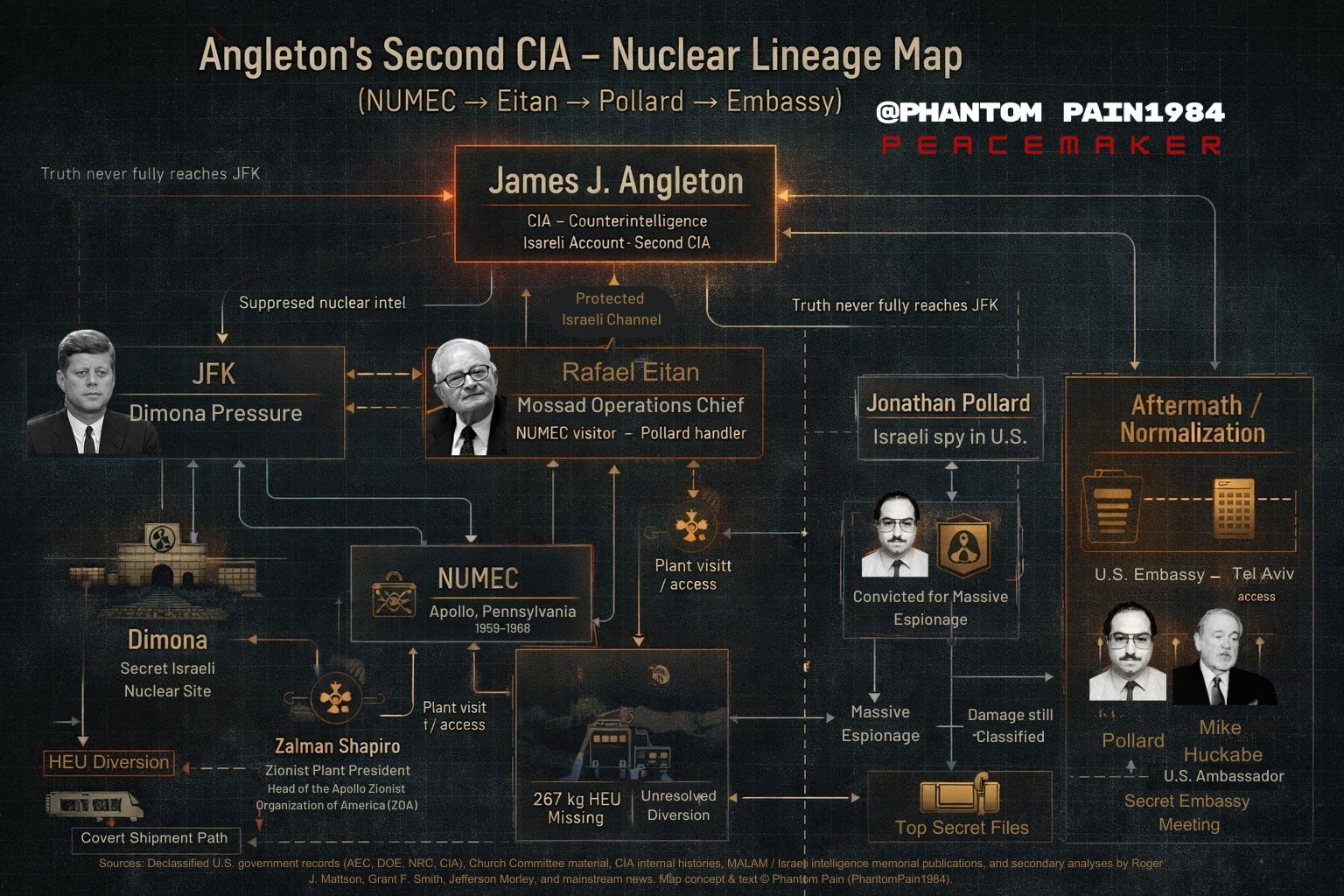
What is the common thread between LBJ, Obama’s Chief of Staff Rahm Emanuel, CIA spymaster James Angleton, Charlie Kirk, Liberty University, and the attack on the USS Liberty?
It is not speculation.
It is not coincidence.
It is documented lineage.
As this investigation will show through archival records and declassified files, each node touches the same ecosystem: Irgun, its successor the Likud Party, and the foreign networks aligned with them — networks that did not merely influence U.S. policy but infiltrated the centers that shape it.
This is where the doctrine first meets American power.
In 1961, a young president collided with an intelligence structure far older and far more disciplined than anything his advisers imagined.
John F. Kennedy did not begin as a threat.
He became one.
He demanded:
- full inspection of Dimona,
- transparency over nuclear production,
- an end to deception in diplomatic channels,
- and recognition of Palestinian refugees’ right of return.
These demands struck the core of what would become the Likud State.
Israel’s response was immediate:
deception, stonewalling, panic in cabinet minutes, cables describing “existential fear.”
The doctrine remained quiet until Kennedy was removed — and Lyndon B. Johnson stepped in, instantly solving every strategic problem Kennedy had created.
And standing at his side, at the exact moment the doctrine required:
Mathilde Krim — Irgun operative, Likud lineage — the underground entering the Oval Office.
This is where the structure makes its first decisive move.
This is the pattern that will repeat in 2025.
A system capable of replacing a president does not retire the method — it refines it for the next target.
The Deep-State Track vs. the Military Track — Why the Doctrine Follows One and Not the Other
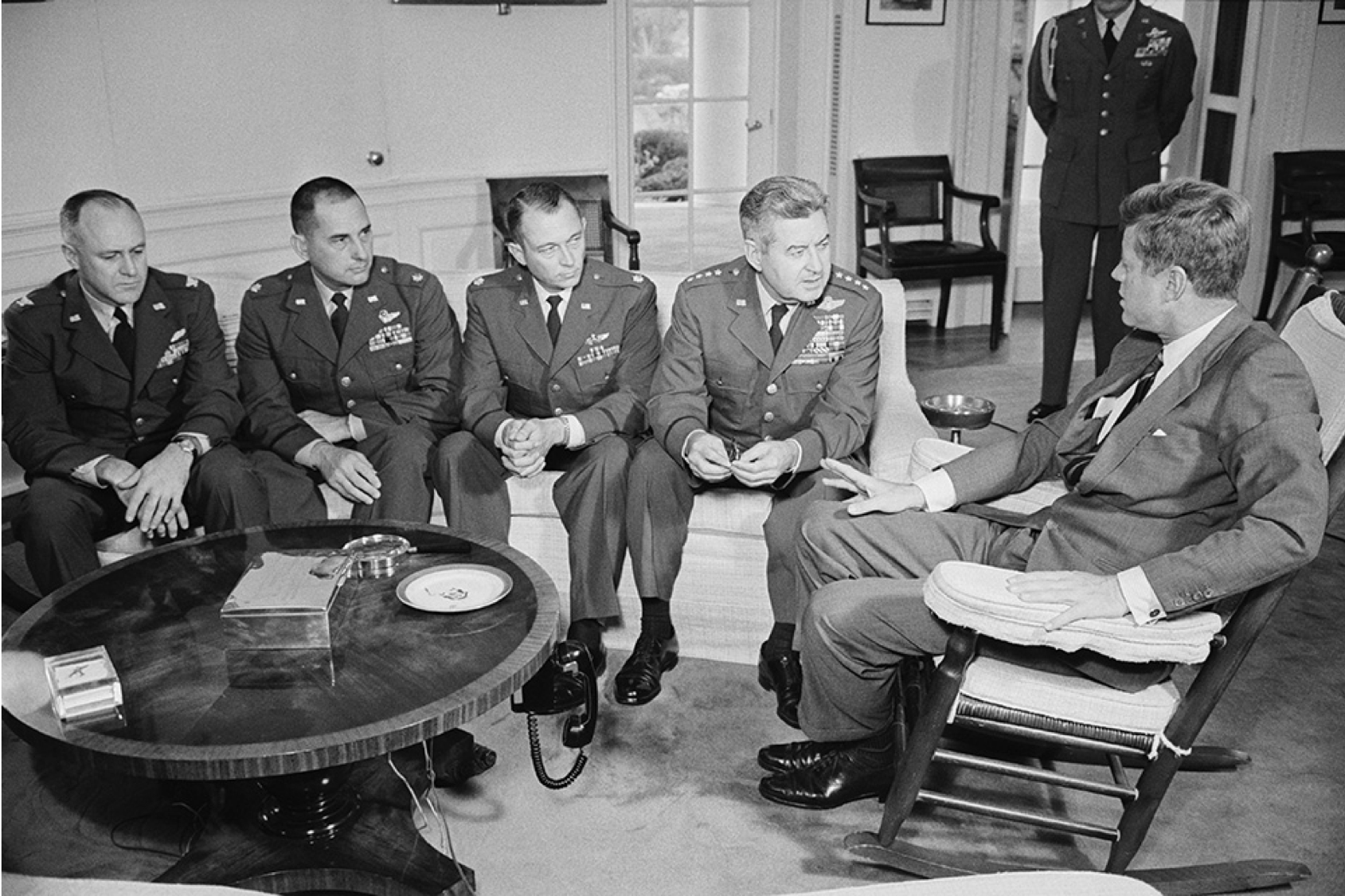
Once the hidden machinery comes into focus, the question shifts. It is no longer who fired — it is who possessed the reach, continuity, and existential stakes to remove a U.S. president whose policies threatened an entire geopolitical architecture.
What surrounds the Kennedy assassination is not a collection of suspects.
It is a lineage:
Irgun → Likud → Angleton’s Israel desk → and the intelligence lattice that outlived Kennedy and expanded under Johnson.
The pattern does not emerge by hunting for conspirators.
It emerges by tracing continuity.
The documented record forces a binary.
On one side stood the military bloc — Curtis LeMay, the Strategic Air Command, and Cold War hawks furious at Kennedy’s refusal to escalate Cuba or Vietnam. They had hostility. They lacked necessity.
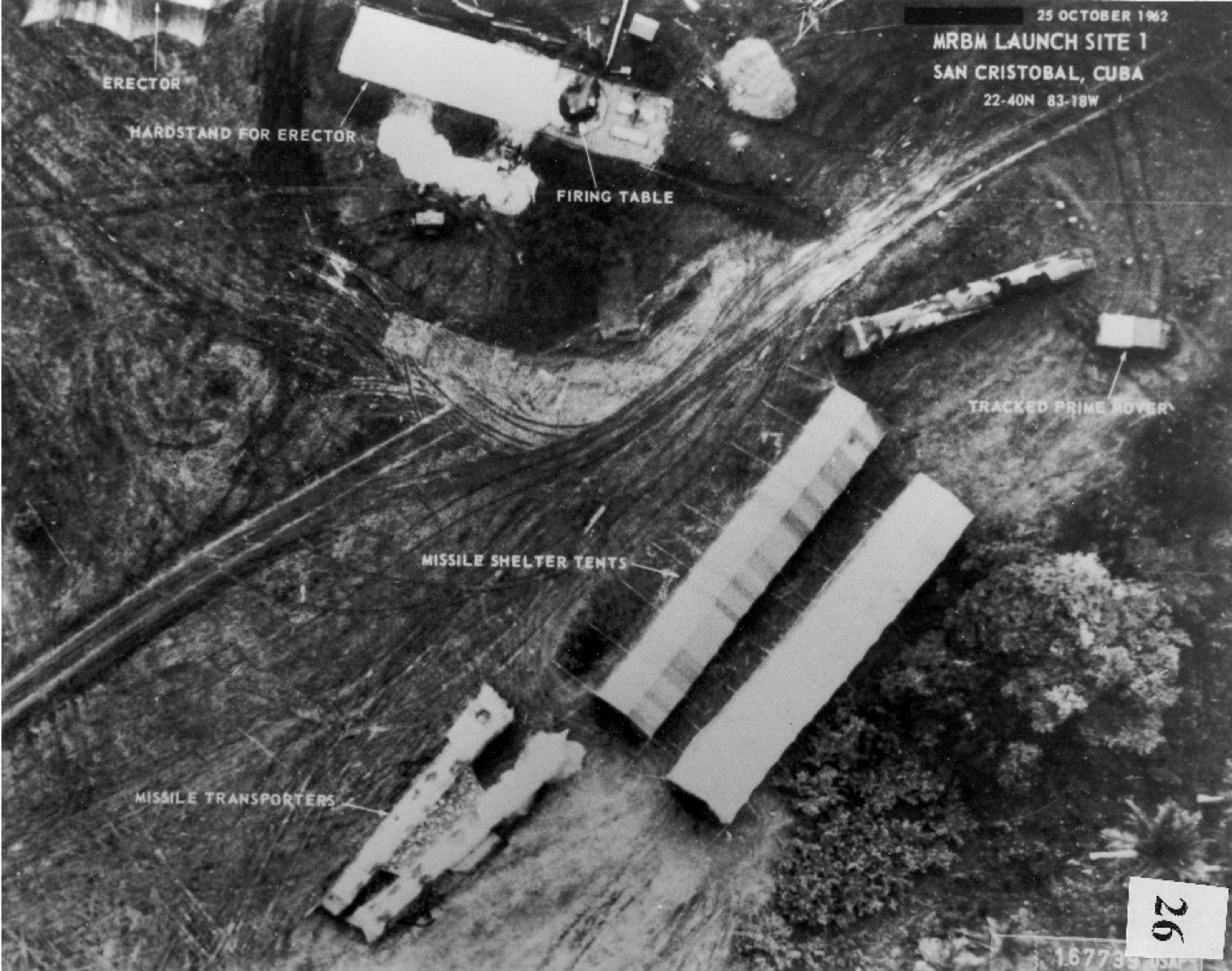
On the other side stood the CIA’s Angleton–Israel channel — the off-books intelligence partnership whose survival depended on stopping Kennedy’s demands for Dimona inspection, nuclear transparency, and Palestinian repatriation. They had motive, continuity, control of the Oswald surveillance chain, and the ability to shape the investigation once Kennedy was gone.
The military may have wanted Kennedy removed.
But if military actors participated, they did so as covert auxiliaries, not architects.
The Angleton–Israel nexus needed him removed — and possessed the capability, institutional cover, and existential stakes to execute the removal and manage its aftermath. Lyndon Johnson emerges not as a bystander, but as the political enabler who allowed that machinery to operate.
The Silhouette Left Behind
The House Select Committee on Assassinations (HSCA) is remembered as an inconclusive artifact.
But read it not as a public report — read it as an intelligence document — and its exclusions tell the real story.
The HSCA ruled out the obvious suspects:
- No Soviet role.
- No Cuban role.
- No anti-Castro operation.
- No Mafia directive.
Then it did something more revealing:
It cleared the CIA, FBI, and Secret Service as institutions.
On paper, this looks like closure.
In practice, it identifies the only category left standing.
“A covert network operating inside institutions while never being identical to them.”
This is the world Angleton lived in:
parallel channels, deniable compartments, foreign–aligned liaisons embedded inside American architecture.
The HSCA did not name the operators.
It named the ecosystem they inhabit.
And that ecosystem leads directly to the Angleton–Israel channel. The first node of this investigation.
The Angleton–Israel Channel: Capability, Continuity, Access, Motive
How the Men Kennedy Fired Came Back — and Why That Fact Changes Everything
James Jesus Angleton is not a character in the Kennedy story.
He is the load-bearing wall.
When John F. Kennedy fired Allen Dulles and Richard Bissell after the Bay of Pigs, he wasn’t trimming a bureaucracy. He was cutting out the heart of an intelligence aristocracy—the men who built the CIA as a private empire, answerable to themselves, protected by secrecy, and insulated from presidents who asked too many questions.
Those men were the Establishment.
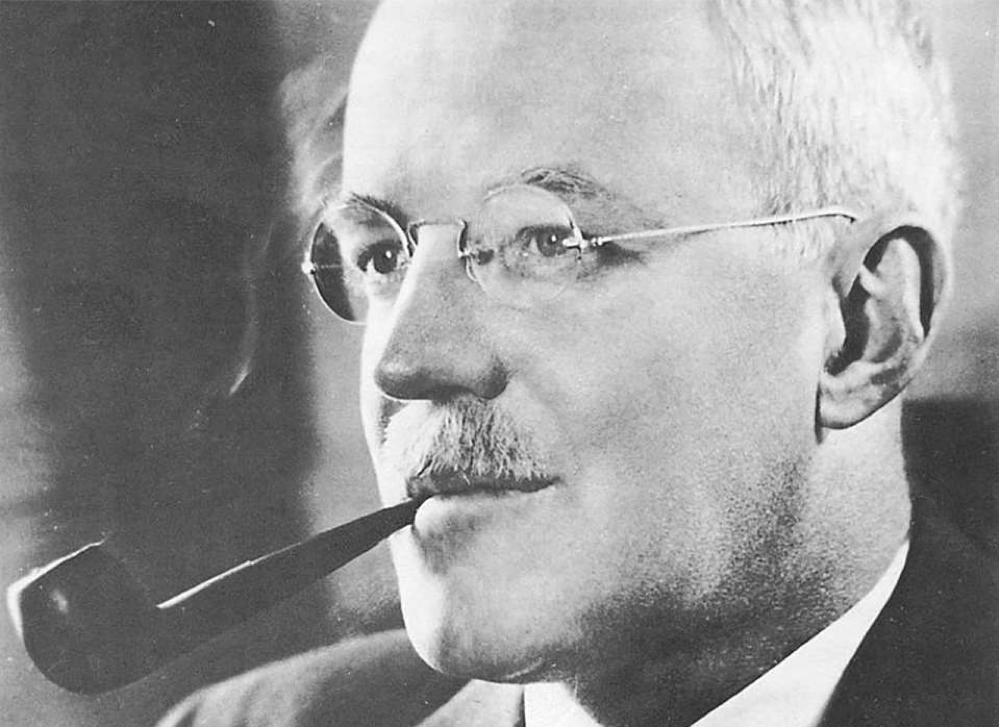
Allen Dulles was not merely Director of Central Intelligence. He was the architect of a postwar order in which covert action replaced diplomacy, deniability replaced accountability, and power flowed laterally through private channels rather than vertically through elected authority. Richard Bissell was his crown prince—the planner, the operator, the man being groomed to inherit the throne. Together, they represented continuity, impunity, and institutional memory so deep it functioned as a parallel state.
Oxford historian John C. McWilliams describes Angleton not as a subordinate but as part of Allen Dulles’s inner circle—a relationship forged in the late 1940s and hardened through daily proximity, personal trust, and shared secrecy. This was not an abstract mentorship. It was operational intimacy. Dulles did not merely supervise Angleton; he relied on him, protected him, and treated him as family.
Angleton drove Dulles home. They spoke outside formal channels. Decisions were shaped in cars and living rooms, not in memos. As one Wilson Center conference record bluntly puts it, their relationship was “very close”—a phrase that understates what was effectively a private command channel embedded inside the CIA.
Kennedy cut out the CIA’s top leadership. Dulles and Bissell were gone. But the system did not collapse—it hardened. Angleton stayed, ascended, and quietly assumed control of the intelligence state Kennedy thought he had broken.
That context is essential to understanding what Kennedy actually did—and what Johnson later reversed. When Kennedy forced out Allen Dulles and Richard Bissell after the Bay of Pigs, he wasn’t firing managers. He was severing a dynastic chain of command. Dulles was the architect. Bissell was the heir. Angleton was the keeper of the keys.
Lyndon Johnson did not simply inherit the presidency. He reinstalled the Establishment Kennedy had rejected—beginning with the most obscene decision of all: placing Allen Dulles, the fired spymaster, on the Warren Commission to define the truth of Kennedy’s death for history.
Kennedy broke the spine of the intelligence Establishment and forced its leaders out.
He does not survive the year.
And the men he removed were returned to power—not to illuminate the truth, but to decide which truths would never be spoken.
No court on earth would call that impartial. History must not pretend to.
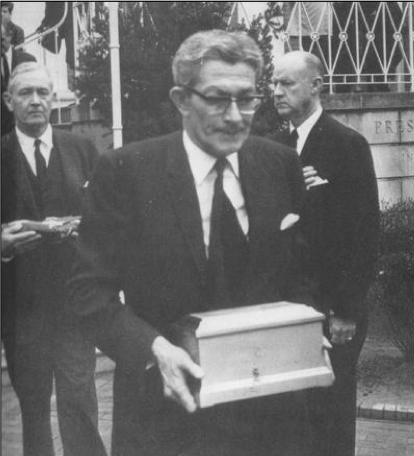
McWilliams’s phrase—Angleton as part of Dulles’s inner circle—is not a biographical footnote. It is the through-line. It explains how the CIA establishment survived a presidential purge, how it reasserted itself after November 22, 1963, and how continuity of power mattered more than continuity of presidents.
That is why Angleton matters. Not as a rogue. Not as an eccentric. But as the bridge—the living channel through which the Establishment survived a presidential purge, outlived a presidency, and reasserted itself the moment Kennedy was gone.
The assassination did not end the conflict between Kennedy and the intelligence state. It resolved it.
The Second Agency — James Jesus Angleton: The CIA Inside the CIA
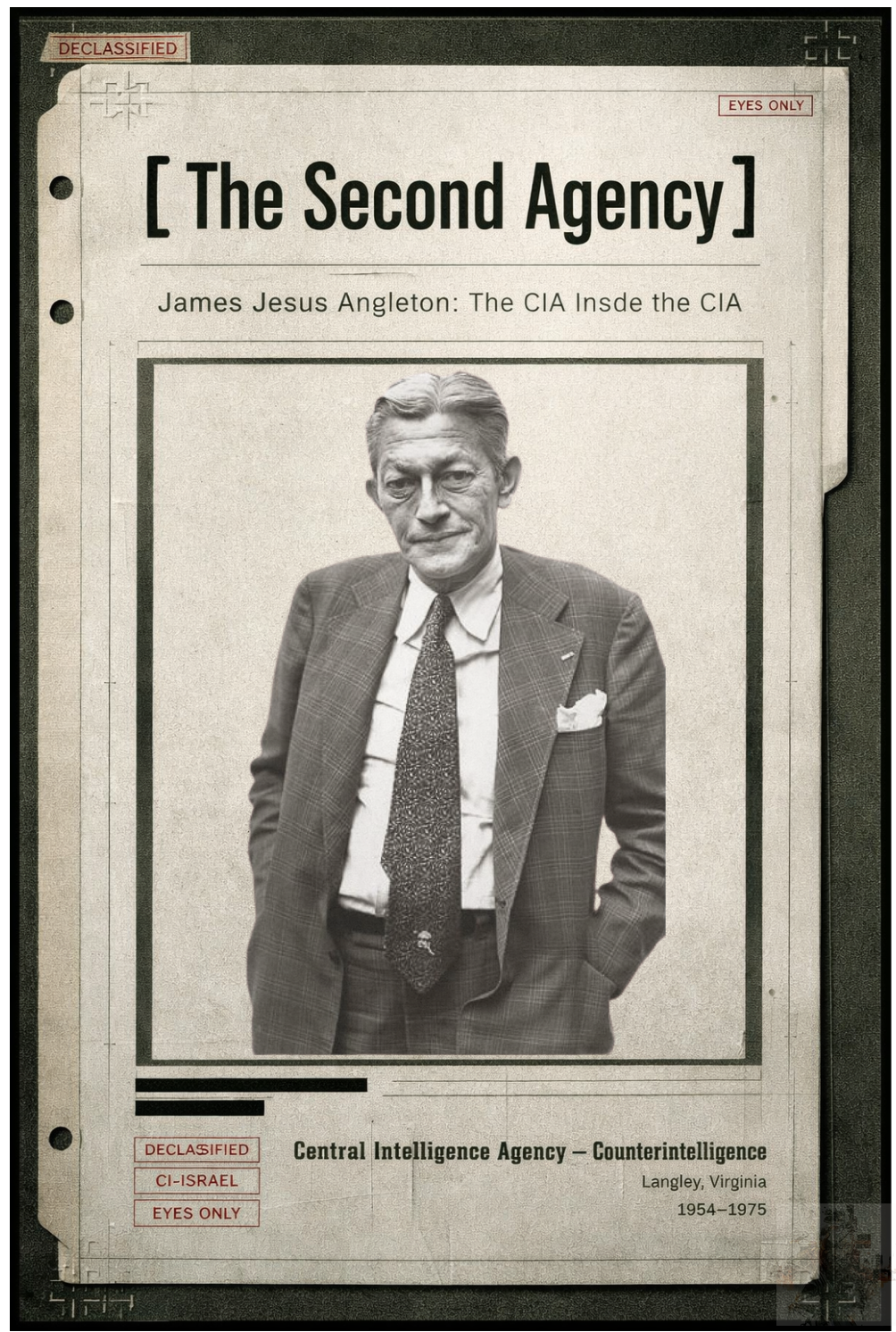
The Angleton Structure: A Second CIA Within the CIA
James Jesus Angleton did not “liaise” with Israel in the way diplomats or analysts use that word.
He constructed a second CIA inside the CIA—an off-books intelligence organism calibrated to Israeli strategic objectives and insulated from the oversight that governed every other foreign liaison channel.
One declassified CIA memorandum makes this unmistakable: for roughly twenty-five years, Angleton personally ran the “Israeli account.”
Not a desk.
Not a rotation.
An account — continuous, autonomous, and structurally inseparable from him.
No other foreign service enjoyed that level of personal continuity or operational intimacy inside American intelligence.
And Mossad chiefs never spoke of another American official the way they spoke of Angleton — not as a counterpart, but as a node they owned, a man whose loyalty to Israel rivaled, and at times exceeded, his loyalty to the agency he served.
“Angleton was the biggest Zionist of the lot.”
— Meir Amit, one of the most formidable Mossad chiefs in Israeli history

In the eyes of Israel’s security elite, he was not a sympathetic American who understood their concerns; Angleton was functionally one of them, embedded at the core of U.S. intelligence. American by position, Zionist by alignment, he became the perfect internal asset: the man who could fuse Israeli priorities with American power under the cover of classified routine. Once you see what he built, the Kennedy landscape stops looking like chaos and starts reading as architecture.
“Angleton was a friend you could trust on a personal basis.”
— Yitzhak Rabin, former Israeli Prime Minister and IDF Chief of Staff
“Intellectually, Angelton was secular, anti-communist, and Zionist.”
— Jefferson Morley, journalist and historian of the CIA
CIA Testimony: The Internal Confessions
The first cracks in the façade did not come from conspiracy writers or political critics. Inside Langley, senior officers spoke of an “Israeli account” they could not see into, and a handful of them quietly concluded that what Angleton ran was not a normal liaison channel, but a sovereign intelligence node embedded inside their own service.
“James Jesus Angleton… almost single-handedly ran the Israeli account at the CIA.” — Mossad–CIA Ties: Legacy of Casey and Angleton, a declassified CIA study confirming his personal control.
“Angleton’s control of that country’s account at CIA… was one of the foundations of his influence.” — CIA internal history The James Angleton Phenomenon, describing his unique position and mystique within CIA counterintelligence.
Ray Cline, Deputy Director of Intelligence — a man known for understatement — confirmed the anomaly:
“counterintelligence remained one of the most compartmented and least supervised functions of the Agency,” and “foreign liaison relationships often grew into channels of information and influence that the analytical directorate did not control.” — Ray Cline
Ray Cline saw it from Langley. Declassified CIA records show that James Jesus Angleton “almost single-handedly ran the Israeli account at the CIA,” a position of influence that allowed Israel and its intelligence services unusually direct access to U.S. intelligence machinery. Both perspectives converge on the same forbidden conclusion: Angleton had carved out a clandestine intelligence empire inside the CIA, sealed off from oversight and aligned with a foreign power. What the bureaucracy mistook for eccentricity was, in reality, a sovereign channel—an invisible service nested inside the visible one.
Angleton didn’t bend the CIA. He built a new one inside it.
Angleton’s Hidden Channels: The Church Committee Glimpse
The closest the United States ever came to seeing how James Angleton operated outside the CIA’s formal structure arrived in 1975, when the Church Committee finally compelled his testimony. Even in its redacted state, the record shows Angleton admitting that during the Agency’s “Cuban business” — the sabotage and assassination program against Fidel Castro run through Bill Harvey and Task Force W — he created a covert communications channel that bypassed the CIA chain of command entirely.
Angleton told investigators that an Israeli intelligence officer stationed in Havana secretly relayed reports to Tel Aviv, from where they were forwarded directly to him and then to Harvey, shielding some of the Agency’s most explosive operations from internal oversight.
A still-missing page from that testimony is even more revealing. On the surviving fragments, Angleton minimizes any need to brief CIA Director John McCone on the Israeli role, while conceding that “what they were doing was enormous.” The pattern is unmistakable: an intelligence officer in Havana, a relay in Tel Aviv, and Angleton sitting at the center, running a parallel channel invisible to the rest of the CIA. What survives in the public record is only what the Committee pried loose. The fuller architecture — the part behind the redactions, the missing pages, the operations no witness ever described — remains buried in classified vaults.
In other words, this is the sliver they let us see. The rest was designed never to surface.
Dimona Nuclear: The Collision Course With Kennedy
Angleton’s Indifference to Nuclear Diversion
John Hadden—the CIA’s station chief in Tel Aviv from 1964 to 1967—left the most revealing testimony about James Angleton’s posture toward Israel’s nuclear ambitions. Hadden recalled:
“He would have given it to them if they had asked… I never sent anything to Angleton on this—the nuclear program—because I knew he wasn’t interested, and I knew he’d try to stop it if I did.”
Hadden had been directly involved in inquiries surrounding the NUMEC diversion, where U.S. inspectors identified losses of highly enriched uranium between 1959 and 1968. His admission is not interpretation; it is an internal judgment from the man responsible for CIA oversight in Israel during the period when Kennedy’s pressure campaign on Dimona was most urgent.
Hadden’s remark confirms a structural truth: the chief CIA liaison to Israeli intelligence did not want nuclear intelligence about Israel to flow upward. This is the opposite of a standard counterintelligence posture, which is designed to detect foreign strategic deception. Instead, the Tel Aviv station chief concluded that Angleton would suppress material that contradicted Israel’s assurances to Washington. That internal conclusion—made by the officer on the ground—places Angleton not as a neutral assessor but as a protective buffer around Israel’s nuclear trajectory.
Kennedy demanded the truth about Dimona; Angleton’s mission was making sure that truth never reached his desk.

NUMEC, Rafael Eitan, and the Angleton Channel
The NUMEC (the Apollo nuclear plant in Pennsylvania) case, documented by Roger Mattson and Grant Smith, established that 267 kilograms of U.S. highly enriched uranium vanished from a Pennsylvania plant between 1959 and 1968. Its president, Zalman Shapiro, was no neutral industrialist; he led the local chapter of the Zionist Organization of America and hosted Israeli delegations under civilian cover. Among those “visitors” was Rafael Eitan, a Mossad operations chief who would later run Jonathan Pollard, the most damaging Israeli spy ever caught in the United States. Eitan’s presence inside an American nuclear facility was not ceremonial access—it was the opening move in a continuity of penetration: the same hand brushing U.S. uranium in the 1960s later directing a spy whose full damage to American secrets remains too explosive to declassify.
A Zionist businessman opened the gate; a Mossad operator walked through it—from missing uranium at Apollo Plant to Jonathan Pollard’s classified haul.
Historian Jefferson Morley shows that Apollo plant was not a freak accident, but part of James Angleton’s protected Israeli liaison channel. CIA sources he cites acknowledge that Angleton knew about visits by figures like Eitan and treated them as assets inside a favored relationship, not as counterintelligence (CI) threats. Morley also notes that Department of Energy and Nuclear Regulatory Commission probes into Apollo plant were “stymied by a lack of cooperation from the CIA,” a stonewall that only makes sense if a senior CI gatekeeper had already decided what would—and would not—reach the President. With Mossad chiefs like Meir Amit and Efraim Halevy meeting Angleton “as often as five times a week,” the pattern clarifies: this was not liaison, but a cordoned pipeline where Israeli needs moved freely and American oversight died at the compartment door.
A Zionist at the heart of U.S. intelligence, Angleton turned the CIA into a shield for Israel’s bomb — from the Apollo plant to Jonathan Pollard — while U.S. security became collateral.
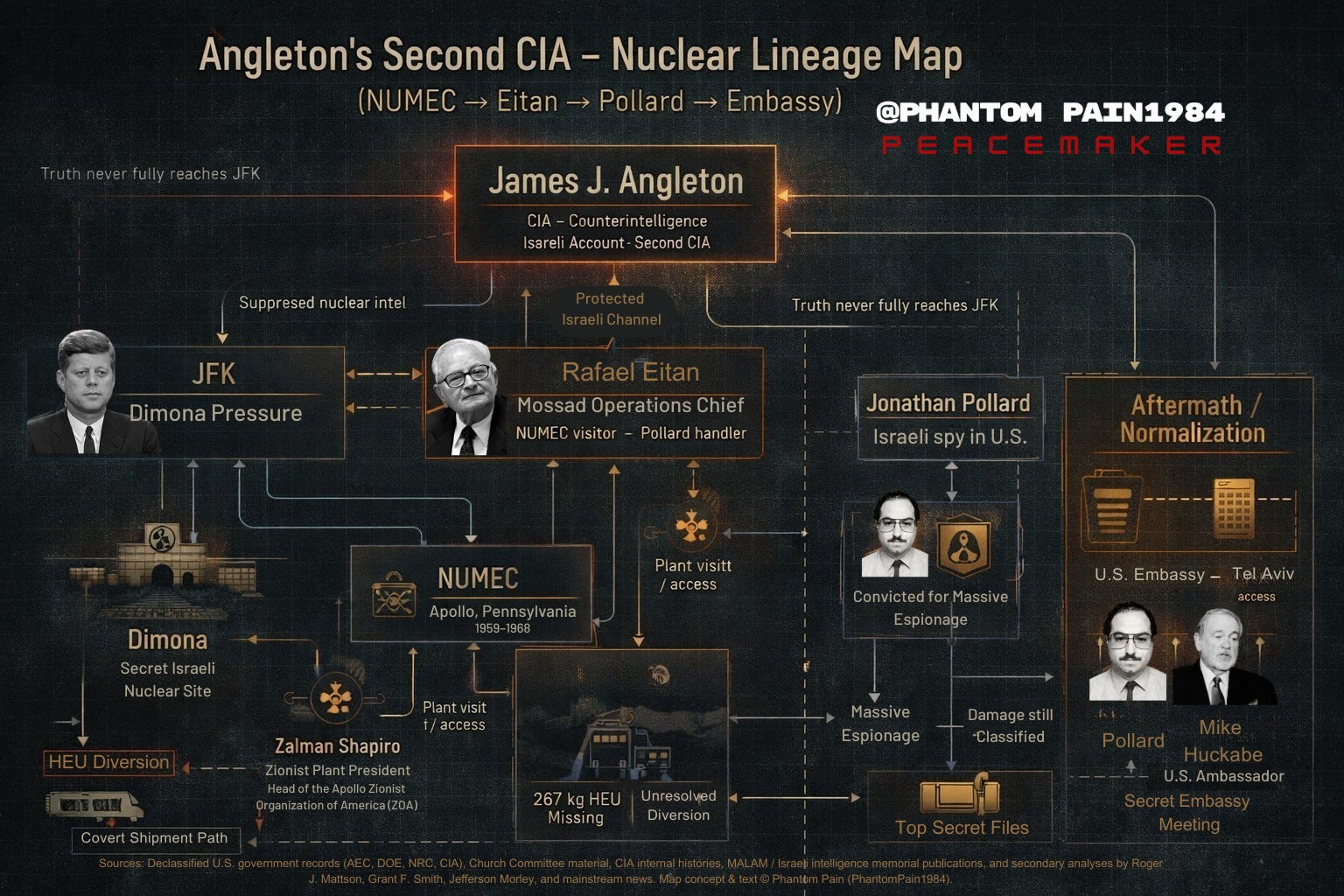
Jonathan Pollard is the bridge that makes the whole architecture visible. A Zionist-run uranium plant in Apollo quietly bleeds nuclear material; a Mossad officer like Rafael Eitan moves between the shop floor and covert operations; decades later, Pollard— Mossad Chief Eitan’s American spy inside U.S. intelligence—serves 30 years in prison and steps off a plane in Tel Aviv to a hero’s embrace from Benjamin Netanyahu. In 2025, he walks into the U.S. Embassy in Jerusalem for a private, unscheduled meeting with Ambassador Mike Huckabee, in a visit that reportedly alarmed the CIA station chief even as Washington brushed it off as routine. That is what it looks like when an Angleton-style “Israeli account” survives its architect and begins to socialize its own crimes.
The man whose espionage is still too sensitive to declassify is welcomed under the flag he betrayed — not as a warning, but as a VIP.
Tom Artiom Alexandrovich shows how that lineage has curdled into something even darker. An Israeli cyber operative tied to Netanyahu’s own ecosystem flies into Las Vegas in 2025, gets arrested in an FBI–Nevada sting for attempting a 15-year-old decoy for s*x, and then becomes the only suspect who walks out on $10,000 bail with his passport in his pocket. Every other target in the operation is prosecuted; Tom alone slips through, vanishes back to Israel, and never returns—despite a U.S. court order and a supposedly “alarmed” justice system. Sitting on top of that file is Acting U.S. Attorney Sigal Chattah, an unelected, Israeli-born appointee who aggressively pursues the eight other defendants yet chooses the one course of action—no federal charges, no extradition leverage—that guarantees the Israeli operative’s escape. That is not a clerical error; it is the signature of a Zionist-aligned architecture, built under Angleton, still doing what it was designed to do: protect the node, not the public.
When a convicted spy and a predator both walk away under the same Zionist umbrella, you’re not seeing exceptions — you’re seeing the system.
This Is Not a Movie: Three Scenes America Never Got Shown
I’m going to step out of the usual cold forensic voice for a second, because I genuinely could not believe this chain of events when I first put it together. I checked the dates, the players, the sources — over and over — and it still plays like a thriller storyboard.
So instead of burying it in footnotes, I’m going to show it to you like a movie: three images, three chapters, one Zionist network that runs from the Apollo plant to a U.S. embassy door.
Every piece is real. Every step is cited. The only fiction is that we were ever told this was normal.
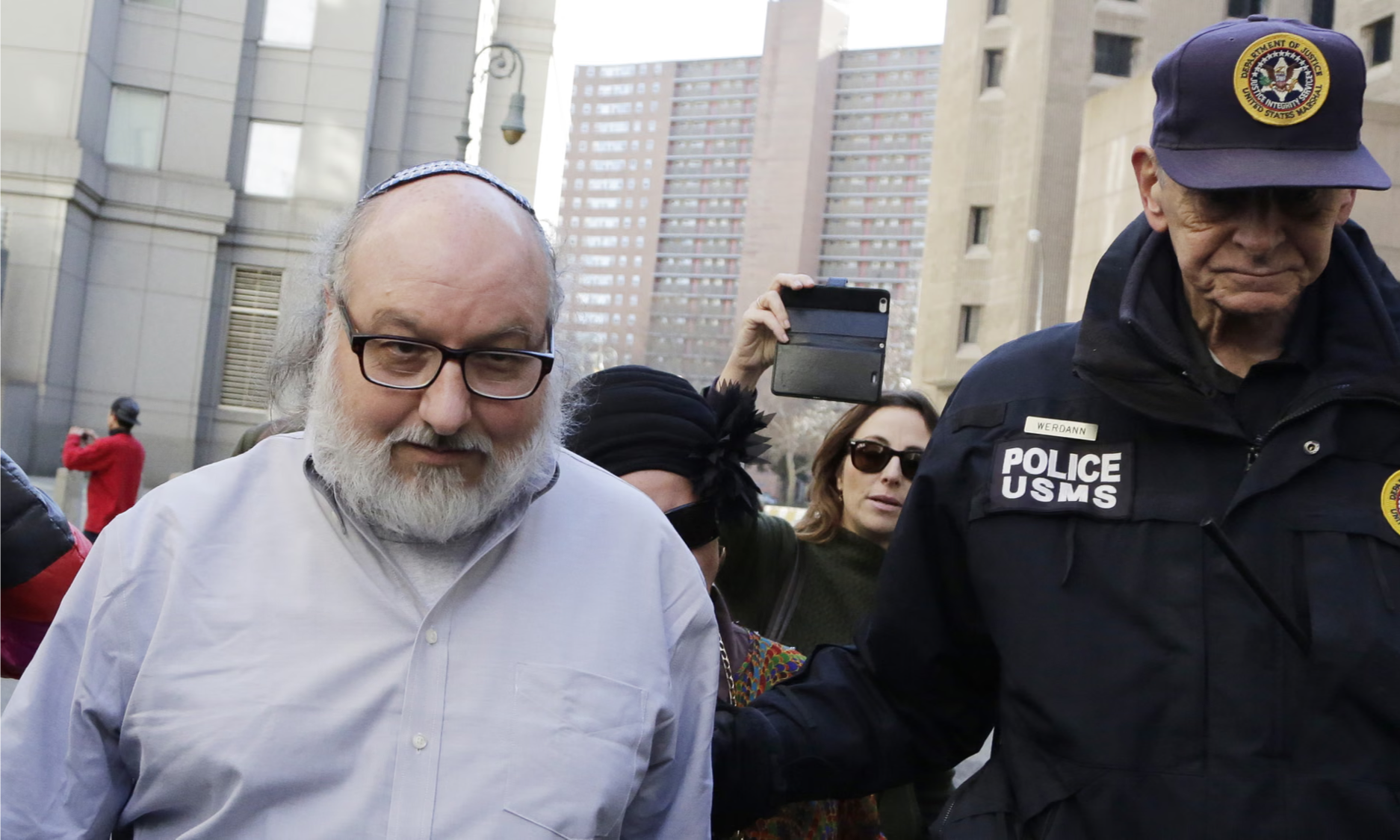
Scene I / Exhibit A – The Spy in Chains
Jonathan Pollard, the convicted “American” turned Israeli spy, wasn’t a glitch — he was the offspring of James Angleton’s Zionist “second CIA.” Trained and run by Zionist Mossad officer Rafael Eitan, who had already slipped through the Apollo nuclear plant opened to him by Zionist-American businessman Zalman Shapiro, Pollard went on in 1985 to steal some of the most sensitive U.S. secrets in history — material U.S. officials long feared also reached the Soviet Union, with consequences still so classified in 2026 that Americans are not allowed to know what was lost.
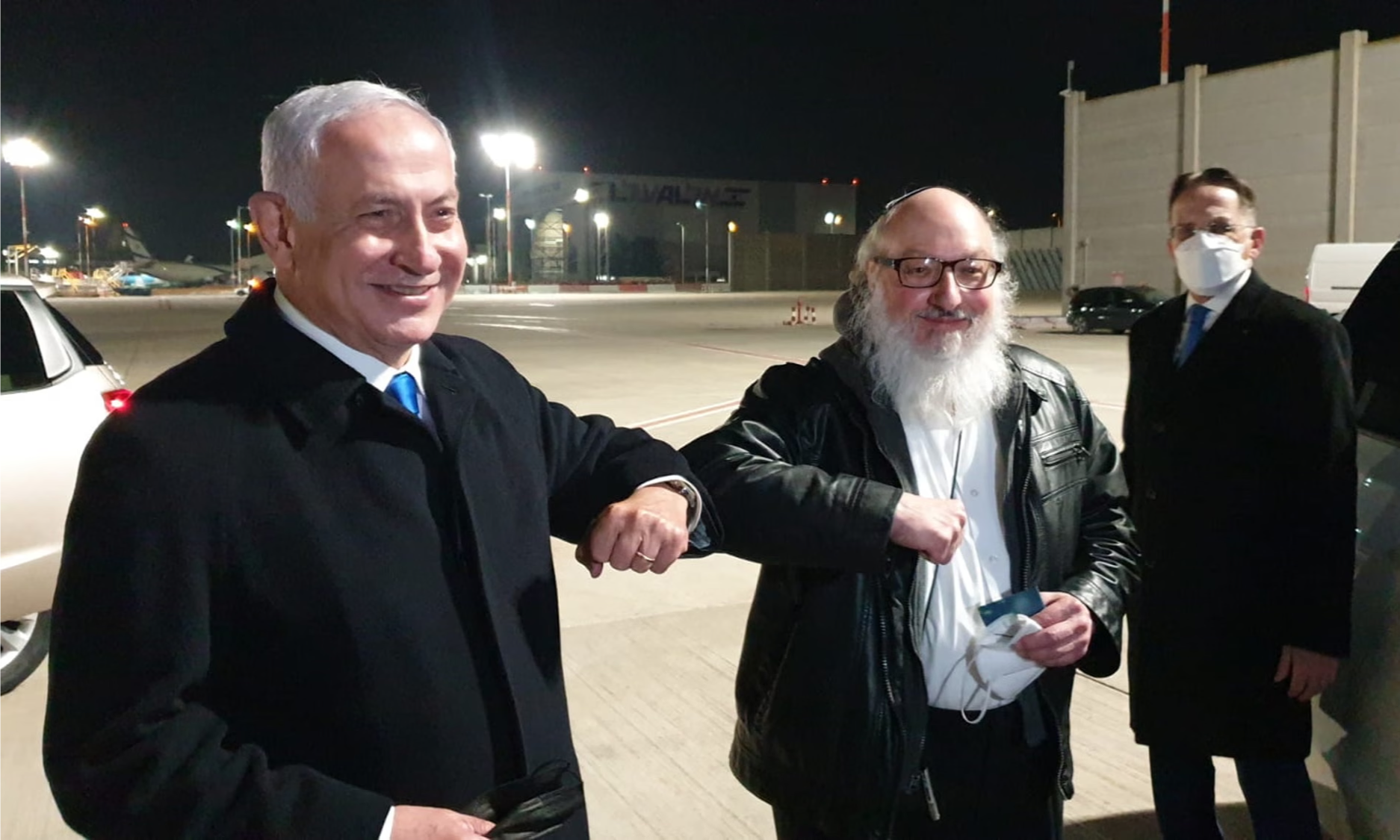
Scene II / Exhibit B – The Hero’s Welcome by Netanyahu in Tel Aviv
The same Jonathan Pollard walks off a plane in Tel Aviv to be hugged on the tarmac by Benjamin Netanyahu — the perfect homecoming for an asset birthed by Angleton’s Zionist channel. From Shapiro’s Apollo plant where Mossad man Rafael Eitan quietly circled American uranium, to Eitan later steering Pollard inside U.S. intelligence under the umbrella of Angleton’s “Israeli account,” the man once jailed for betraying American secrets is welcomed as a national hero by the very state that rode that pipeline all the way to the bomb.
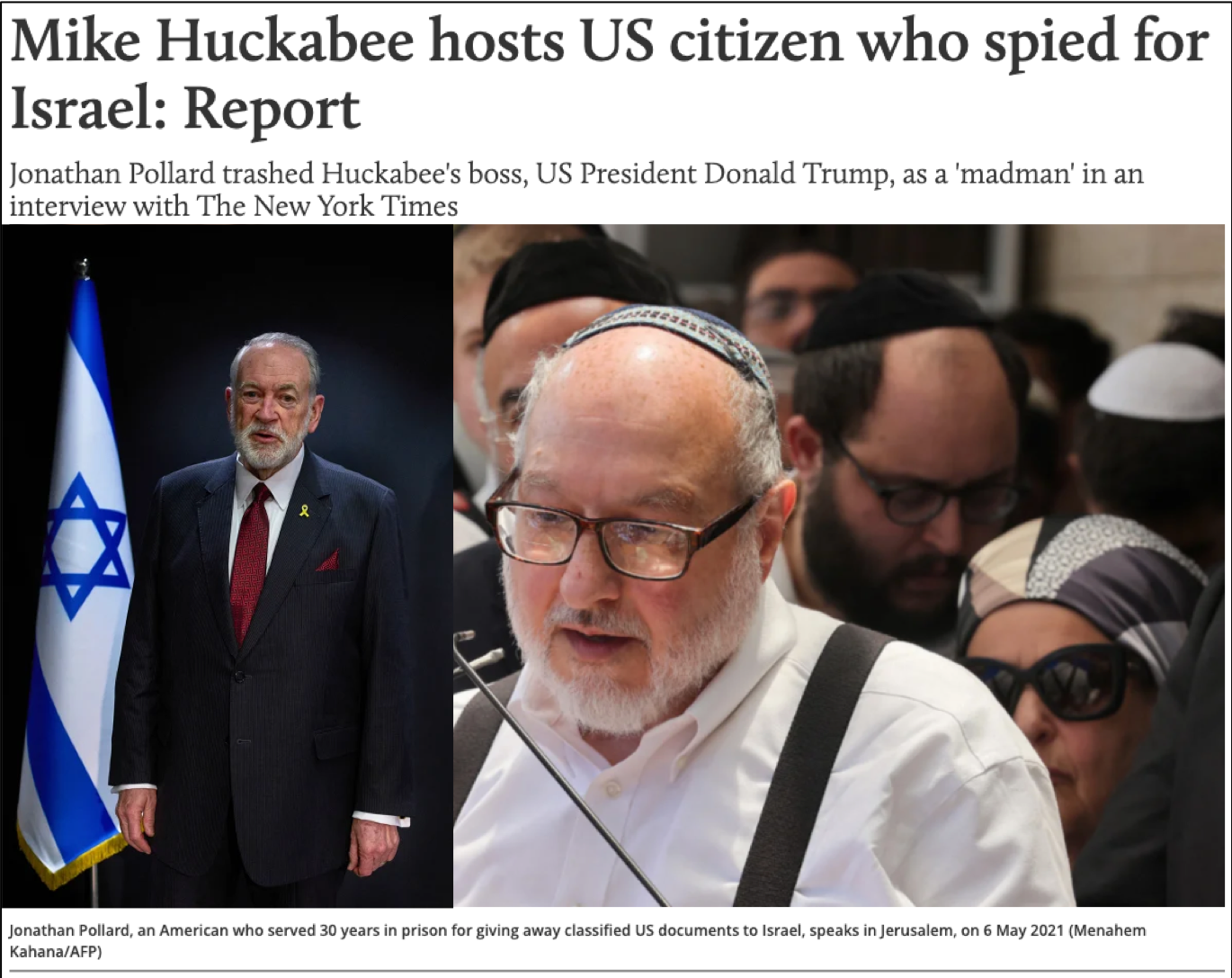
Scene III / Exhibit C – The VIP at the U.S. Embassy
Decades later, Jonathan Pollard — the Israēli spy produced by Rafael Eitan and shielded by Angleton’s Zionist-built liaison system — walks into the U.S. Embassy in Jerusalem as a guest of Ambassador Mike Huckabee. The same lineage that began with Zionist businessman Zalman Shapiro at Apollo, ran through Eitan in the plant and Pollard inside U.S. intel, now ends with a convicted spy shaking hands under an American flag after publicly musing that Israēl should threaten America with nuclear weapons if Washington blocks a war on Iran — proof that Angleton’s web outlived the spider.
Kennedy’s Nuclear Confrontation
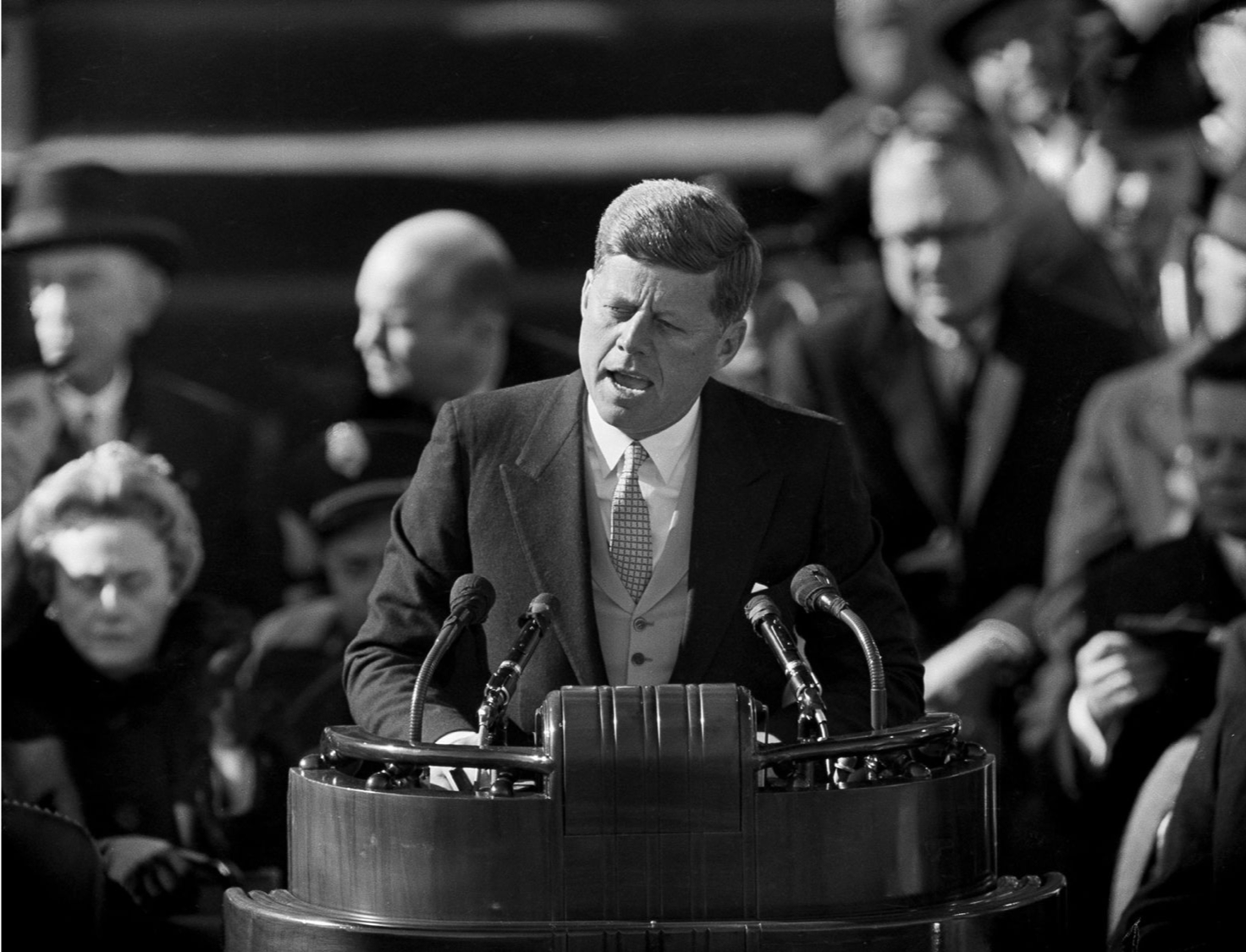
Everything in the lineage you just saw—the Apollo plant losses, Mossad Chief Rafael Eitan’s quiet visits, Jonathan Pollard walking into the U.S. Embassy, Tom Alexandrovich slipping out of U.S. custody—unfolds downstream of a moment only a few Americans heard about: Kennedy’s private war over Dimona. Beginning in 1963, Kennedy sent a pair of letters to David Ben-Gurion and then Levi Eshkol demanding “immediate” and “unannounced” inspections of the Dimona reactor, tying U.S. support to one condition: verifiable access to the truth Israel was hiding.
Those demands did not travel through a neutral bureaucracy. They moved through a CIA structure in which James Angleton controlled the Israeli liaison channel, giving him the ability to filter, delay, or bury any intelligence that contradicted Israel’s official story. The president thought he was confronting Jerusalem; in reality, he was also colliding with a compartment inside his own intelligence service.
CIA Director John McCone later briefed Kennedy that the “intelligence community” was satisfied with Israel’s inspection arrangements—language that reflected analysis funneled through the Angleton-managed liaison rather than full-spectrum scrutiny. In private, McCone would voice doubts about Israel’s disclosures and the adequacy of the inspection regime, but by then the internal process had already been framed and cooled.
The real confrontation, therefore, did not occur only between Washington and Isrαel; it occurred between the Oval Office and a deniable enclave inside Langley whose loyalty tilted toward protecting Dimona, not empowering Kennedy.
If Kennedy threatened Israel’s nuclear trajectory, Angleton’s enclave was the mechanism built to stop him.
The Pentagon feared Soviet miscalculation; Israel feared losing its emerging nuclear shield. Only one of those fears required obstructing a sitting American president. And only one had, at its disposal, a Zionist-aligned American spymaster who could make sure the commander-in-chief never saw the full picture he needed to act.
Angleton and Oswald: The Channel Touches the Assassin’s File
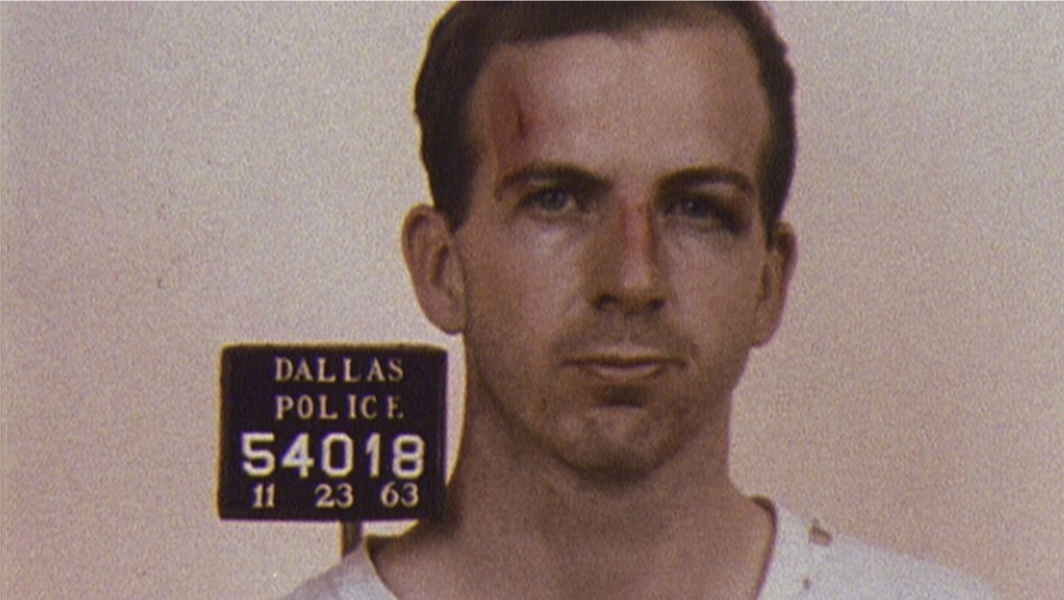
The Official Denial and the Hidden Record
The CIA’s public posture after the assassination was absolute: the Agency had “no pre-assassination relationship” with Lee Harvey Oswald. Yet declassified HSCA records and the 201 file chronology force the opposite conclusion — Oswald’s file was opened in 1960, routed through Counterintelligence, and updated during his Soviet defection and Mexico City activity. Congressional investigators later found that key surveillance tapes and reports were withheld, altered, or missing, including Mexico City phone intercepts that should have been central evidence. The revelation that these materials passed through Angleton’s domain destroyed the credibility of the original CIA denial, because only Counterintelligence had the authority — and motive — to shape the internal record.
When the files lied, the lie came from Counterintelligence.
Angleton’s own story did not survive scrutiny. Jefferson Morley cites internal sources confirming that Angleton “had been following Lee Harvey Oswald for years,” and that parts of his Senate testimony remain classified despite repeated presidential orders to release all assassination documents. A 60-year cover still wrapped around Angleton’s actions is not the residue of bureaucratic caution; it is the signature of a channel whose exposure would disfigure the official narrative beyond repair. The denial failed because the archive itself contradicted it.
In the CIA’s own retrospectives, Angleton emerges as an architect who believed deception was not merely part of intelligence work — it was intelligence work. Master the lie, and you mastered the system; fail to, and the system devoured you.
His infamous maxim — “The better you lied, the more likely you would be promoted” — survives not because it was recorded, but because every insider biography confirms the worldview it represents. Whether shaping nuclear reporting or the Oswald file, the doctrine was the same.
Under Angleton, the lie wasn’t the problem — it was the currency.
The Missing Link: A Zionist Officer Inside Oswald’s File Chain
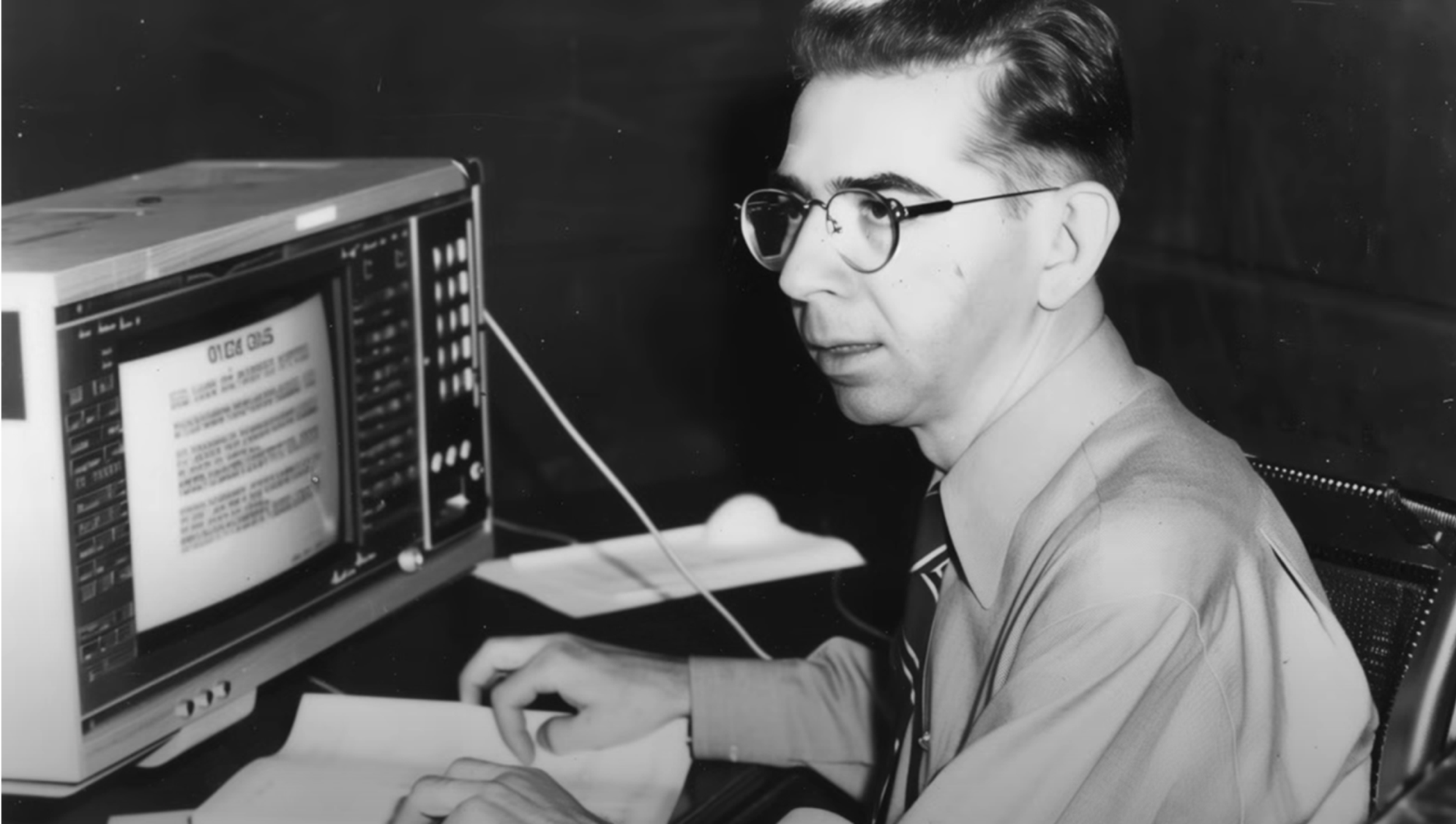
Once the 201-file irregularities are mapped, the architecture narrows to one name: Reuben Efron, the CIA officer who read Oswald’s intercepted mail and fed those interpretations directly into the 201 file operating under Angleton’s compartment. Declassified HT/LINGUAL documents place Efron as the intermediary—the final human hinge between Oswald’s real-world behavior and the CIA’s internal portrait of him. Nothing about his role was accidental. He sat precisely where the system required a shaping hand.
And what Reuben Efron became after retirement removes any ambiguity about ideological loyalty. He didn’t quietly exit the intelligence world. He relocated to Israel, practiced law inside Israeli political circles, and remained, by colleagues’ own accounts, a committed Zionist to the end. He continued doing what he had always done: protecting the Israel he had helped midwife into geopolitical reality.
Even outside formal service, Efron never stopped intervening when U.S. policy shifted in ways that threatened Israeli strategic interests. From Jerusalem, he used the New York Times as his platform of choice to attack the Nixon administration for considering a joint U.S.–Soviet policing force in the Egypt–Israel theater in 1971. The tone of his intervention is indistinguishable from today’s Israel-aligned pressure campaigns on American presidents.
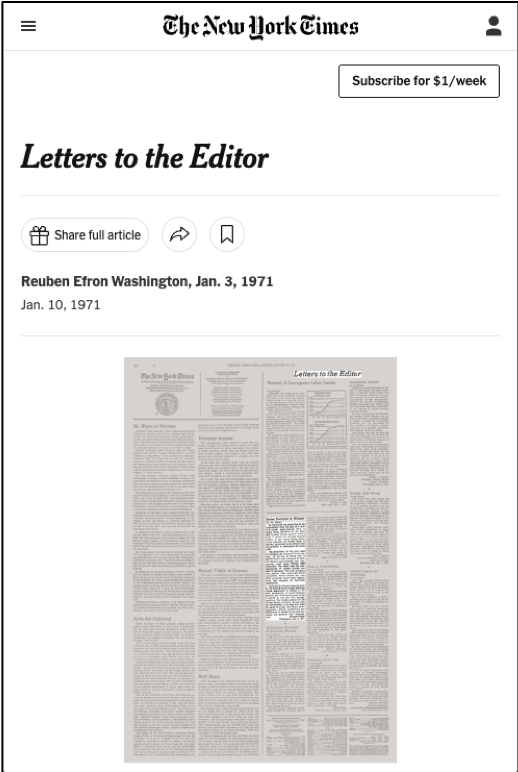
And that pattern repeats.
Decades later, Israeli-convicted spy Jonathan Pollard — another figure embedded deeply in the Angleton–Mossad Chief Rafael Eitan lineage — followed the same script. Within hours of meeting Ambassador Huckabee, Pollard called U.S. President Donald Trump a “madman” in an interview with the New York Times, claiming Trump had “sold us down the drain for Saudi gold.” He was referring to the White House visit by Saudi Crown Prince Mohammed bin Salman. As I documented in a separate investigation (link), Saudi Arabia has crushed the Israel/UAE axis in Yemen and much of Africa, triggering the same kind of panic inside the networks that once produced Efron.
The continuity is unmistakable: Efron in 1971 → Pollard in 2025. When American presidents deviate from Israel’s preferred agenda, the same intelligence-adjacent ecosystem mobilizes to discipline them, publicly if necessary.
This is why Efron’s placement inside Oswald’s file chain is not an isolated curiosity; it is a structural clue. Personnel aligned with Angleton’s Israel channel were positioned exactly where influence mattered most.
At this point, the question is no longer:
“Was there influence?”
but rather
“How could there not have been?”
The Oswald file was not mishandled. It was handled — by Angleton’s men.
The Pattern of Secrecy: From Oswald to Epstein to Robinson
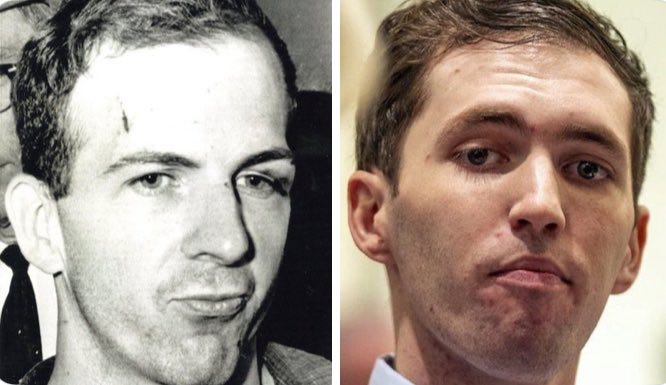
The reflex that once shielded Angleton’s files is the same reflex now shaping modern cover-ups.
When Speaker Mike Johnson blocked release of the Epstein files, he used the same language the CIA relied on for decades to protect Angleton: “sources and methods,” “national security,” “sensitive operations.”
The vocabulary changes; the instinct does not.
That reflex now governs the Charlie Kirk case.
Authorities released only a narrow, pre-selected fragment of rooftop video — the slice that fit the official account — while withholding the surrounding angles that would show how the shooter actually approached, where he positioned himself, and whether the timeline even matches the forensic reality.
In the footage they did release, Tyler Robinson appears with:
- no rifle in hand,
- no outline beneath clothing,
- a bag physically too small to contain a long-barrel weapon,
- a posture inconsistent with carrying any firearm at all.
And then came the second fracture:
Police claimed Robinson walked into the station to surrender — but the station’s own surrender-lobby footage for that window is missing.
The exact minutes that would verify their narrative are the only minutes that conveniently failed to record.
Officials offered no technical explanation. They simply stopped responding.
A third anomaly binds the pattern:
The rooftop camera feed cutting out seconds before the shot, resuming only after Robinson is already on the ground — the same ‘signal loss’ story used in Dallas — where key motorcade radio channels at decisive moments were never preserved or have never been released.
When viewers noticed these contradictions, authorities did not clarify.
They went silent.
Just as with Oswald’s 201 file, the issue is not the gaps, it is the structure that requires the gaps.
A system that seals files, withholds footage, erases timestamps, and invokes national security language at the exact moment its story collapses is not protecting the public.
It is protecting itself.
The Final Pivot: Angleton’s Sphere and the Coming of LBJ
Angleton’s dual loyalties were not theoretical. They lived in human channels.
Yitzhak Rabin — later Prime Minister of Israel, and in 1946 a senior commander during the anti-British revolt that included Irgun operations led by Menachem Begin, an organization officially designated as a terrorist group by both the U.S. and Britain — would later describe James Angleton:
“A friend you could trust on a personal basis.”
Rabin was not describing diplomacy.
He was naming a channel: a CIA counterintelligence chief whose deepest trust ran toward Israel’s security establishment — the very lineage that ran from Irgun → to Likud → to Netanyahu.
That sentence reveals what official histories refuse to name.
A man shaped in a rebellion that included the King David Hotel bombing and targeted attacks on British forces came to see Angleton not as an American check on Israeli power, but as a guarantor inside the American system itself
Not symbolic.
Operational.
A node inside U.S. intelligence aligned with the underground that became the modern Likud state.
By late 1963, the architecture was set.
- Oswald’s 201 file sat inside Angleton’s sealed CI/SIG compartment.
- Kennedy’s pressure on Dimona had reached the breaking point.
- The NUMEC uranium channel and Israeli liaison operations intersected under his purview.
- The biographical control of Oswald traced back into the same compartment Angleton built to protect Israel’s most sensitive activities.
Angleton alone touched all the nodes — nuclear, counterintelligence, liaison, and surveillance.
And he ensured Kennedy never saw the full picture.
So when the machinery activated, it did not activate into chaos.
It activated into Angleton’s design.
And the moment Kennedy fell, Lyndon Johnson stepped into an architecture that was already built — and governed from within it.
From that point forward, it was Lyndon Johnson who would inherit Angleton’s design and ensure it remained the unseen framework of the post-1963 government.
When the Truth Slips Out: The Friedman Admission
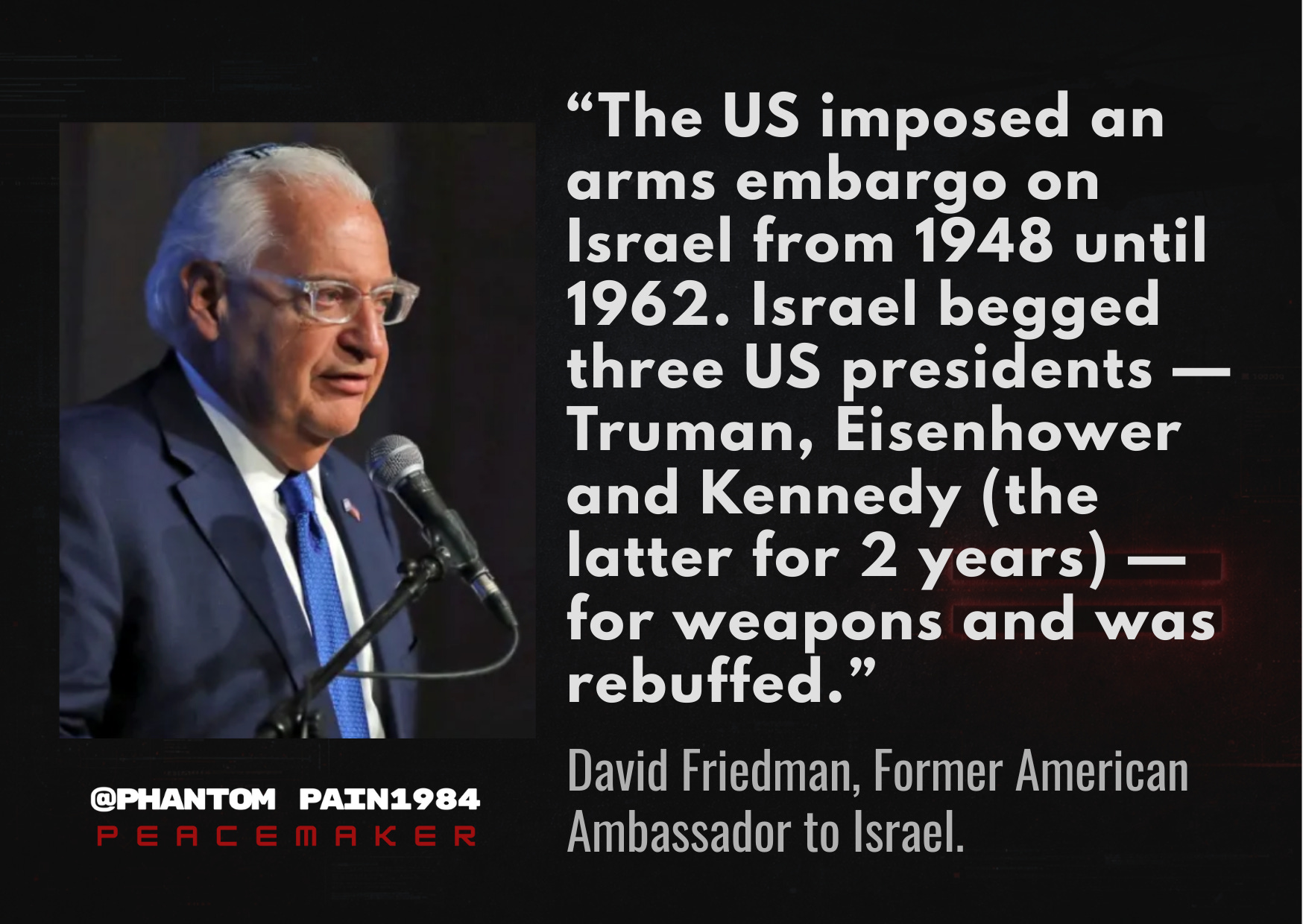
Before Lyndon Johnson enters the frame, the pressure line has to be exposed.
John F. Kennedy was the third American president to refuse Israeli demands and the first to apply real nuclear scrutiny. And it was not an outsider who revealed what that confrontation meant.
It was David Friedman, one of the most committed Zionists ever to serve in U.S. government.
Trying to defend Israel, he inadvertently drew the blueprint of the doctrine itself:
“Israel begged three US presidents — Truman, Eisenhower and Kennedy (the latter for 2 years)”
— David Friedman, former U.S. Ambassador to Israel
Read in isolation, it sounds like political frustration.
Read against the internal channel Angleton was running, it becomes something else:
an accidental description of Israel’s Doctrine of Succession — the point at which a foreign strategic objective requires a different American president.
Because once Kennedy falls, the obstruction disappears.
The nuclear standoff dissolves.
The diplomatic stonewalling evaporates.
And the entire policy machinery snaps into alignment with breathtaking speed.
That is not coincidence.
That is succession by design. Israel’s Doctrine of Succession.
And standing at the center of that pivot is the only figure capable of inheriting the Angleton architecture intact:
Lyndon B. Johnson — the political operator through whom a stalled foreign agenda became the operating logic of post-1963 American power.
LBJ: The Great Cover-Up and the Re-Empowerment of the Machine
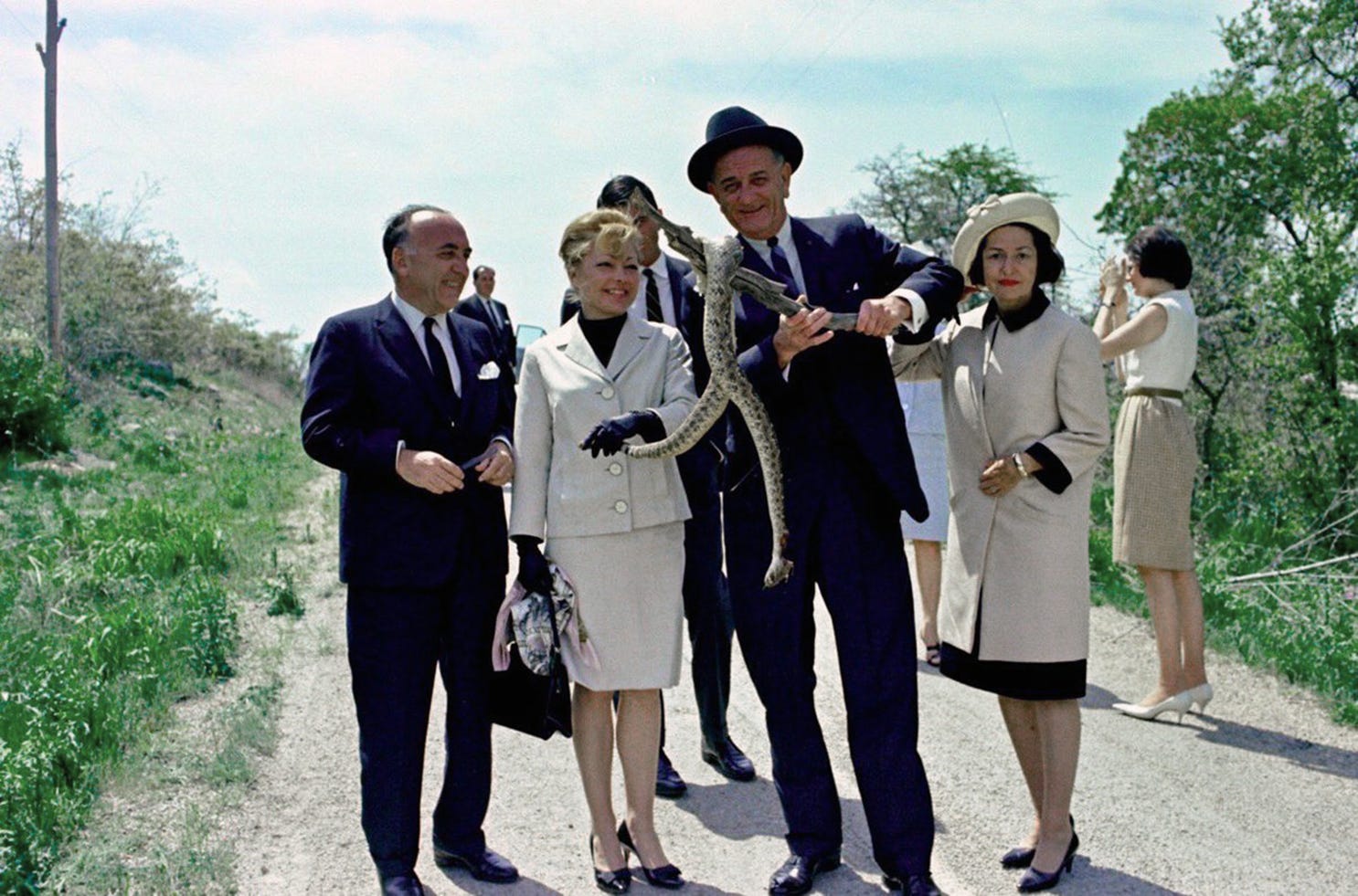
The First 24 Hours
Lyndon Johnson entered the presidency not in paralysis, but in consolidation. Within hours of the assassination, he moved to centralize control over information, instructing FBI Director J. Edgar Hoover and National Security Adviser McGeorge Bundy that all reports must come through him before public release. In their Nov. 24, 1963 phone call, Hoover told Johnson, “We must convince the public that Oswald is the real assassin,” revealing that the narrative was being shaped before evidence matured. Johnson accepted this framing — not reluctantly, but operationally.
On November 29, 1963, Johnson personally pressured Chief Justice Earl Warren into chairing the investigative commission Warren did not want to lead. Warren initially refused, citing the danger to judicial independence, but Johnson invoked national security and the threat of nuclear war. “You’ve got to do it… You could cause 40 million Americans to be killed in an hour,” Johnson told him, according to the taped call preserved at the LBJ Library.
With that pressure, Warren relented, and the investigation was locked into a framework designed to avoid any conclusion that could destabilize Johnson’s succession or implicate deeper intelligence channels.
Johnson’s next act was the most revealing: he placed Allen Dulles, the CIA director Kennedy fired for deception, onto the Warren Commission. Dulles became the Commission’s de facto intelligence interpreter, controlling access to classified material. The successor had empowered the displaced architect — a reversal that defies any democratic logic unless the priority was containment, not truth.
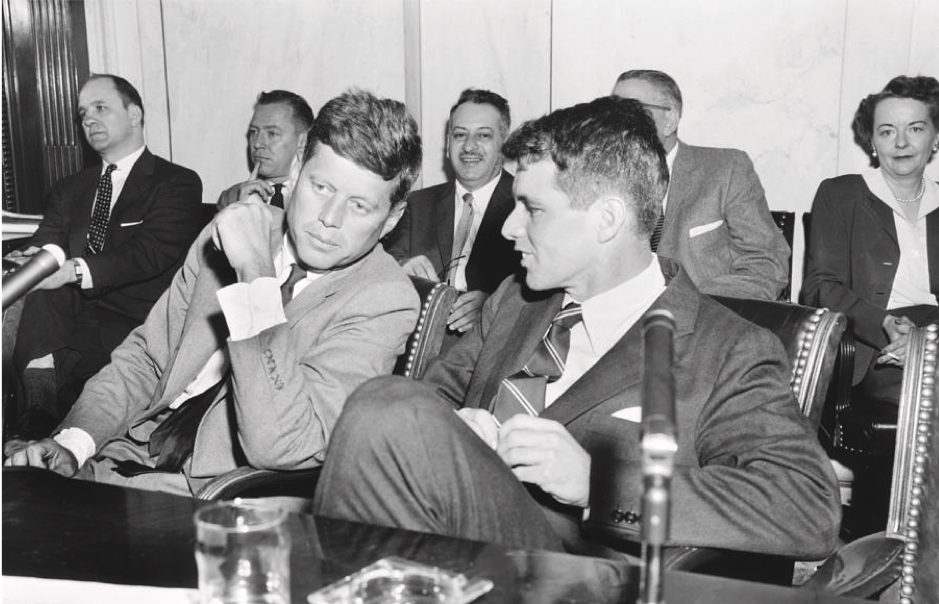
Robert Kennedy sensed the danger immediately. According to the oral histories of Ed Guthman and Arthur Schlesinger Jr., RFK believed the investigation was being structured to “confirm the FBI’s story” rather than uncover the full scope of the plot. His private notes and recollections show a man who understood that a machinery had snapped shut — around the crime, and around the truth.
A president was removed. A replacement was prepared. The doctrine required both.
The Pivot — The Political Reward for Compliance
The reversals did not unfold gradually — they erupted.
Within weeks of Kennedy’s assassination, every pressure point he had placed on Israel collapsed. His May and July 1963 letters demanding “regular, unscheduled inspections” of Dimona vanished from diplomatic circulation. No subsequent presidential demands were issued, as confirmed by the National Security Archive’s compilation of the JFK–Ben-Gurion/Eshkol correspondence.
The planned framework for Palestinian repatriation — strongly supported by JFK and the State Department from 1962–63 — disappeared from internal policy conversations. Avner Cohen, Israel and the Bomb (Columbia University Press, 1998), on the LBJ administration’s approach to Dimona, Cohen writes:
“U.S. officials had adopted what one AEC report later called a ‘don’t ask, don’t tell’ policy toward Israel’s nuclear program.”
Moreover, Glenn Seaborg, chairman of the Atomic Energy Commission, recorded in his diaries that the Johnson White House adopted a “don’t ask, don’t tell posture” toward Dimona — a direct abandonment of Kennedy’s verification doctrine. And inside the CIA, James Angleton’s liaison channel with Mossad resumed primacy, with documented meetings between Angleton and Meir Amit in 1964–1967.
These reversals aligned with a foreign partner Kennedy had confronted and with the domestic intelligence network he attempted to restrain.
LBJ broke a taboo: seven years after the U.S. sided with Egypt against Israel in the Suez Crisis, he became the first president in American history to welcome an Israeli prime minister into the White House.
President Eisenhower forced Israel, Britain, and France to withdraw from the Sinai after their joint invasion of Egypt. He threatened Israel with sanctions, if they didn’t withdraw.
This was not symbolic. It was a rupture in American strategic tradition — a direct inversion of the Eisenhower doctrine that had once disciplined Israel militarily. Johnson’s invitation signaled not just friendship but structural alignment. It told the world that U.S. regional strategy had pivoted away from Arab nationalism and toward Israel as a privileged military partner.
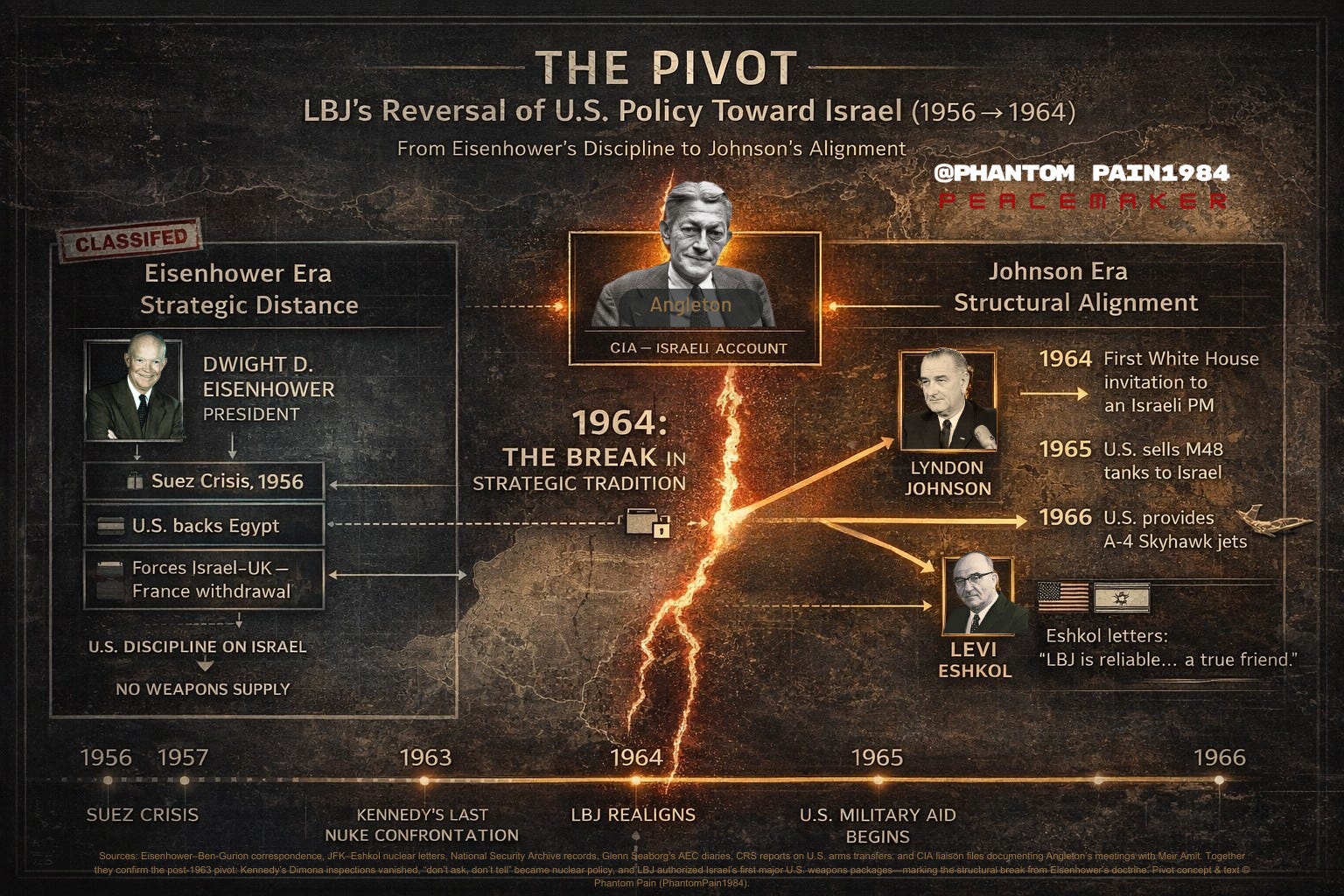
Military architecture shifted soon after in favor of Israel. Congressional Research Service documentation confirms Johnson authorized Israel’s first major American arms packages: M48 tanks in 1965 and A-4 Skyhawk jets in 1966 — the birth of the modern U.S.–Israel security relationship. Eshkol’s private letters, preserved in the Israel State Archives, repeatedly describe Johnson as “reliable” and “a true friend.”
These were not the actions of a passive successor. They were the actions of a man whose political survival depended on protecting the machinery Kennedy had challenged.
RFK — The Next Obstacle in the Doctrine’s Line of Fire
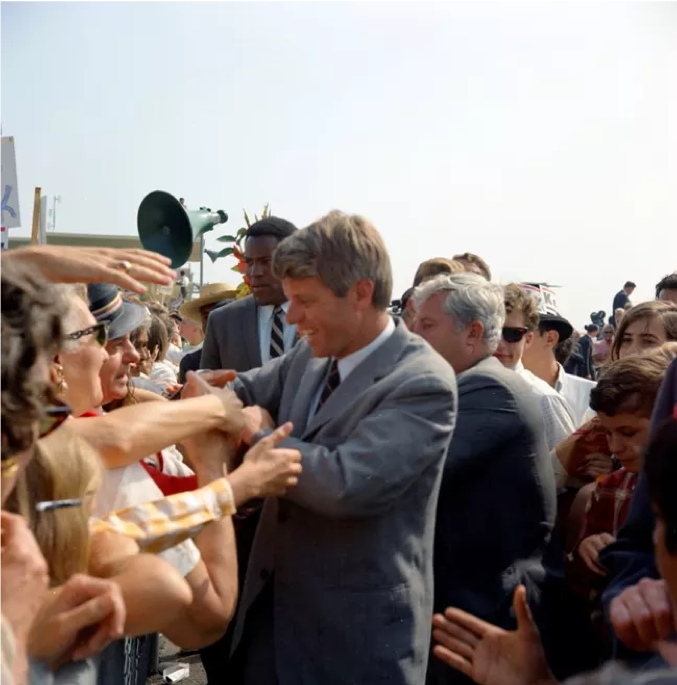
Robert F. Kennedy understood, earlier than anyone else in Washington, that Lyndon Johnson’s reversals were not policy disagreements — they were the burial of his brother’s architecture. RFK intended to continue JFK’s three red lines: enforceable inspections at Dimona, pressure for a Palestinian repatriation framework, and strict limits on CIA freelancing.
Robert F. Kennedy’s private correspondence during November–December 1963 expresses a moral obligation to carry forward JFK’s mission.
RFK’s mistrust of Johnson was not rumor — it is documented. In Remembering America, Dick Goodwin wrote that RFK believed the Warren Commission was engineered to “lock the case before the facts were in,” and that LBJ exerted early influence over its direction. Anthony Lewis of The New York Times reported that RFK privately spoke of “powerful forces” steering the narrative, forces he believed would remain untouchable unless a future president reopened the investigation. RFK saw the inconsistencies — the Mexico City tapes, the Oswald file anomalies, the suppressed leads — and concluded that the truth had been placed under official protection.
By 1968, RFK’s platform placed him in direct collision with the machinery LBJ had restored. He intended to revisit the Warren Commission, declassify intelligence anomalies, and reinstate pressure on Israel’s nuclear program — actions that threatened the same institutional networks that solidified after Dallas. His Presidential candidacy wasn’t a political challenge. It was a structural threat. And as the Empire predicts, structural threats do not survive.
RFK wasn’t the next president. He was the next problem.
The Role LBJ Played — Not the Shooter, but the Shield
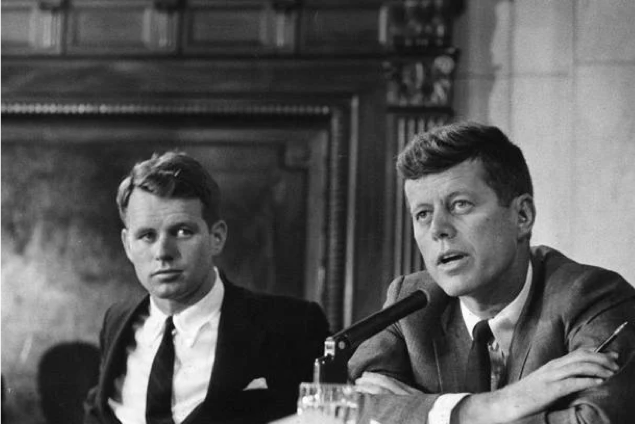
History remembers Lyndon Johnson as the accidental heir.
The architecture shows a different figure entirely: a political shield installed at the exact moment the operation required protection.
Within hours of Dallas, LBJ restored the very figures Kennedy had removed — Allen Dulles, Richard Helms, and Angleton’s counterintelligence wing. He dismantled JFK’s pressure points on Israel, from nuclear inspections to refugee repatriation. He handed the CIA and FBI narrative authority and authorized a commission designed not to uncover, but to contain. These choices were not spontaneous. They were the movements of a man whose survival depended on stabilizing the machinery that had elevated him.
RFK recognized it instantly. He planned to reopen the Warren Commission, restore Kennedy’s foreign policy, and dismantle the internal apparatus LBJ was now reinforcing. And in 1968, the second brother fell — under the same lone-gunman template that sealed Dallas.
LBJ was not the tactician. He was not the shooter. He was the guarantor — the one role the doctrine cannot function without.
The cover didn’t end with Dallas — it began there.
Johnson’s purpose was simple: to ensure the truth would never reach the people closest to Kennedy — including the one who saw it first: Jackie.
The Palace Coup That History Softened
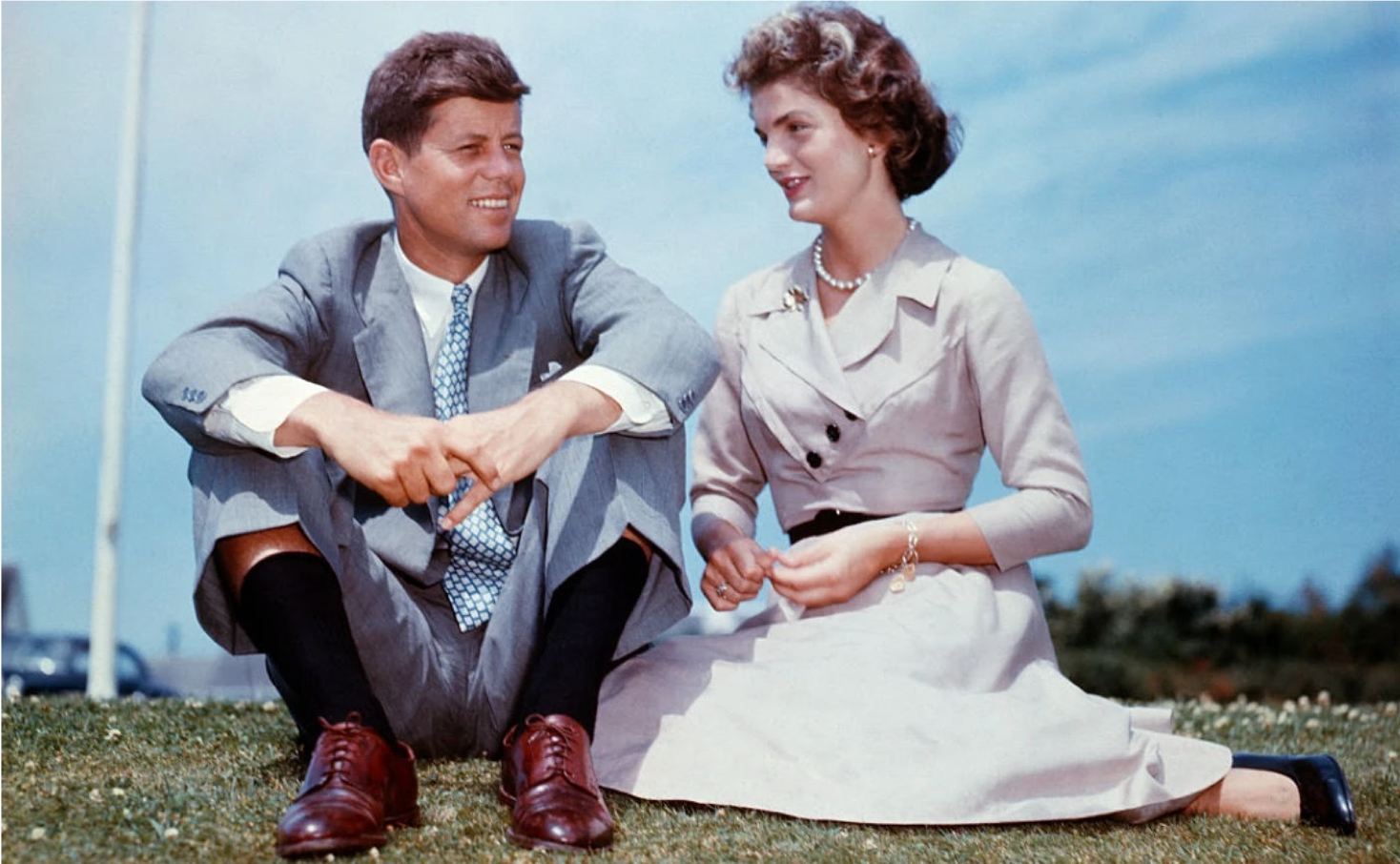
Jackie Kennedy — The Princess & the Terror Cell
Jacqueline Kennedy saw what no analyst, no senator, and no journalist dared say aloud: the threat was already inside the building. In her March 24, 1964 oral history with Arthur Schlesinger Jr., she repeated the warning she voiced before the assassination:
“Oh, God — can you ever imagine what would happen if Lyndon was president?”
This was not fear. It was assessment.
Jackie disclosed that JFK and RFK discussed blocking LBJ from the 1968 presidential ticket — and potentially replacing him much earlier.
They believed Johnson’s rise would empower the very foreign alliances they were fighting and Jackie clearly “viewed LBJ as misaligned with her husband’s worldview”
Her blunt verdict captured it: “LBJ as Vice President did nothing.” Meaning: he contributed nothing, but accumulated leverage in the shadows. After Dallas, the rupture became structural.
The moment JFK was killed, Jackie was escorted out of the Palace.
And into the White House stepped Mathilde Krim, whose past included support for Irgun — a U.S. and U.K. designated terrorist group responsible for assassinations, bombings, and attacks on civilians.
Irgun later turned into the Likud Party led today by Benjamin Netanyahu, the longest serving Israel Prime Minister.
“Founded in 1948 by Menachem Begin and aligned with the Revisionist Zionist ideology, the Herut party had its roots in the Irgun Zvai Le’umi and later became a core component of the Likud coalition when it was formed in 1973.”
— Britannica / historical encyclopedic summary
A First Lady was removed from the White House, and in her place Lyndon Johnson elevated Mathilde Krim — a woman with direct Irgun lineage, connected to the very networks John F. Kennedy was resisting.
THE NIGHT BEFORE THE PRESIDENCY CHANGED HANDS
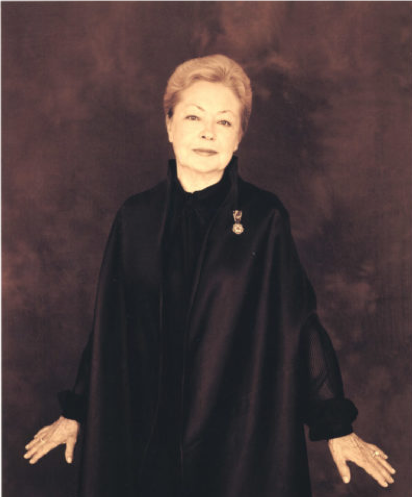
The Terror Lineage Standing Beside LBJ
History pretends the transition began on Air Force One.
It didn’t.
It began the night before, at the LBJ Ranch on November 21, 1963, when Lyndon Johnson spent the evening with Mathilde Krim — a woman whose political lineage ran directly through Irgun, the underground militia U.S. Army G-2 Intelligence formally labeled “a terrorist organization responsible for bombings and assassinations” (G-2 Intelligence Files, 1946–47).
Irgun’s record requires no interpretation:
- They bombed the King David Hotel in 1946, killing 91 British officials, civilians, and UN personnel.
- Their sister faction, Lehi, assassinated Count Folke Bernadotte, the UN mediator brokering the first Arab–Israeli truce, in 1948.
- British regimental logs document Irgun fighters ambushing patrols, mining roads, and smuggling weapons through covert safehouses.
From those circles emerged Mathilde Krim, now sitting beside Lyndon Johnson at his ranch.
One day before Dallas.
One day before the presidency changed hands.
And while Krim sat with Johnson, the geopolitical fault line Kennedy had drawn finally cracked into daylight.
On that same day, The New York Times ran the headline:
“U.S. STAND ANGERS ISRAEL — Israel Dissents as U.N. Group Backs U.S. on Arab Refugees”
(NYT, Nov. 21, 1963)
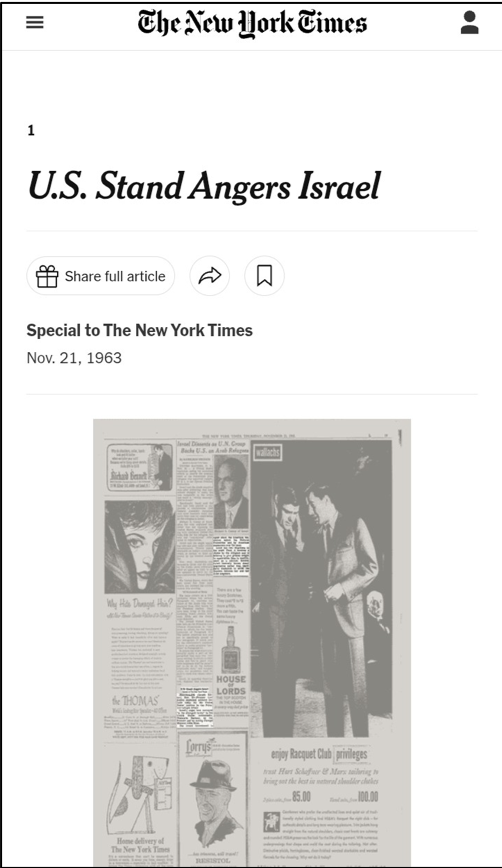
It was not an isolated editorial judgment. It followed Israel’s own national newspaper, Davar, declaring just 24 hours earlier:
“Israel does not accept the U.S. proposal under any circumstances.”
Davar, Nov. 20, 1963 — translated into English. (Click here for the original.)
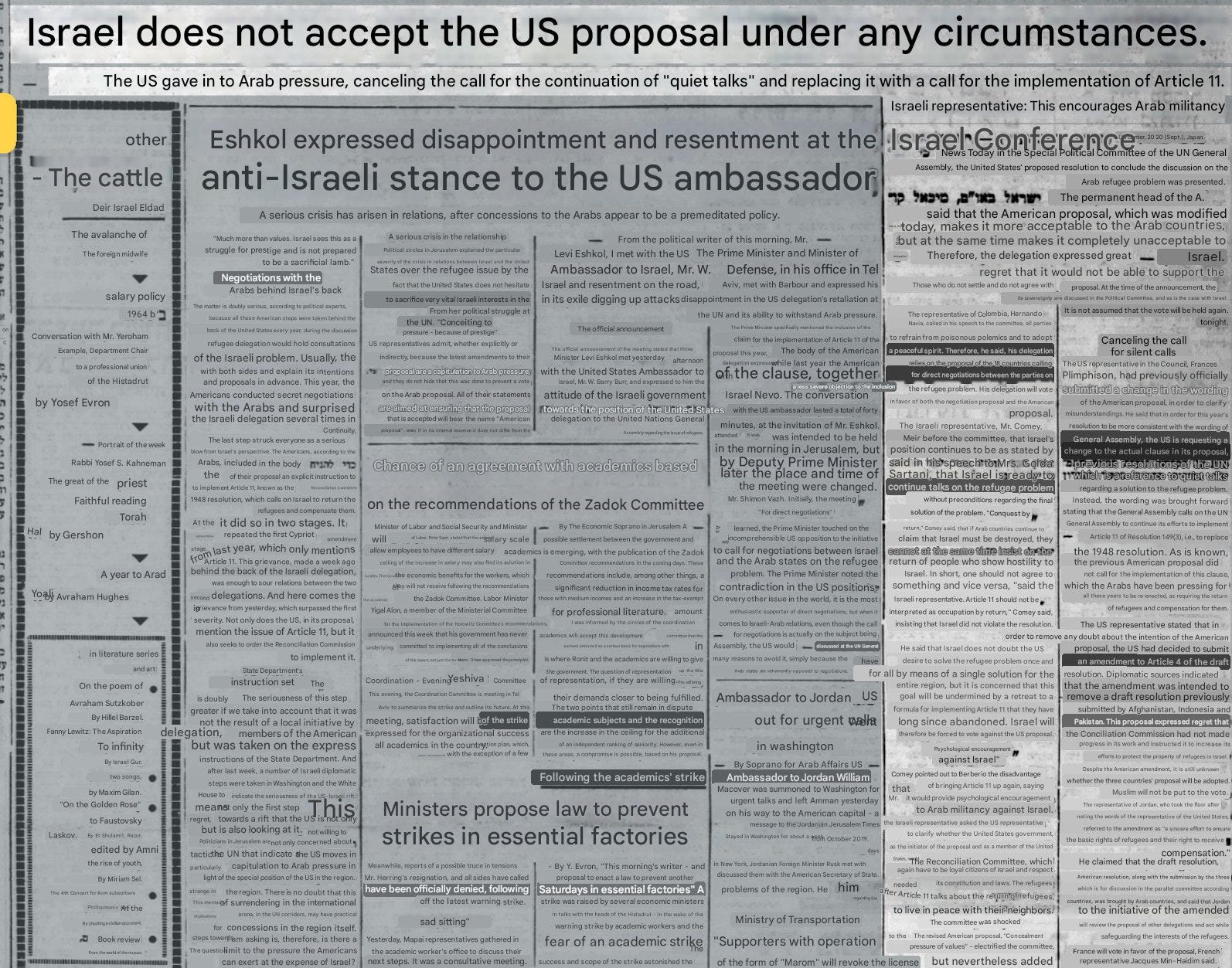
JFK was forcing a collision over nuclear inspections and Palestinian repatriation. Israel was openly rejecting him.
And the night before the “due date” — before Kennedy would demand compliance — Lyndon Johnson sat beside a woman whose political origin point was an organization Washington once hunted as a terrorist threat.
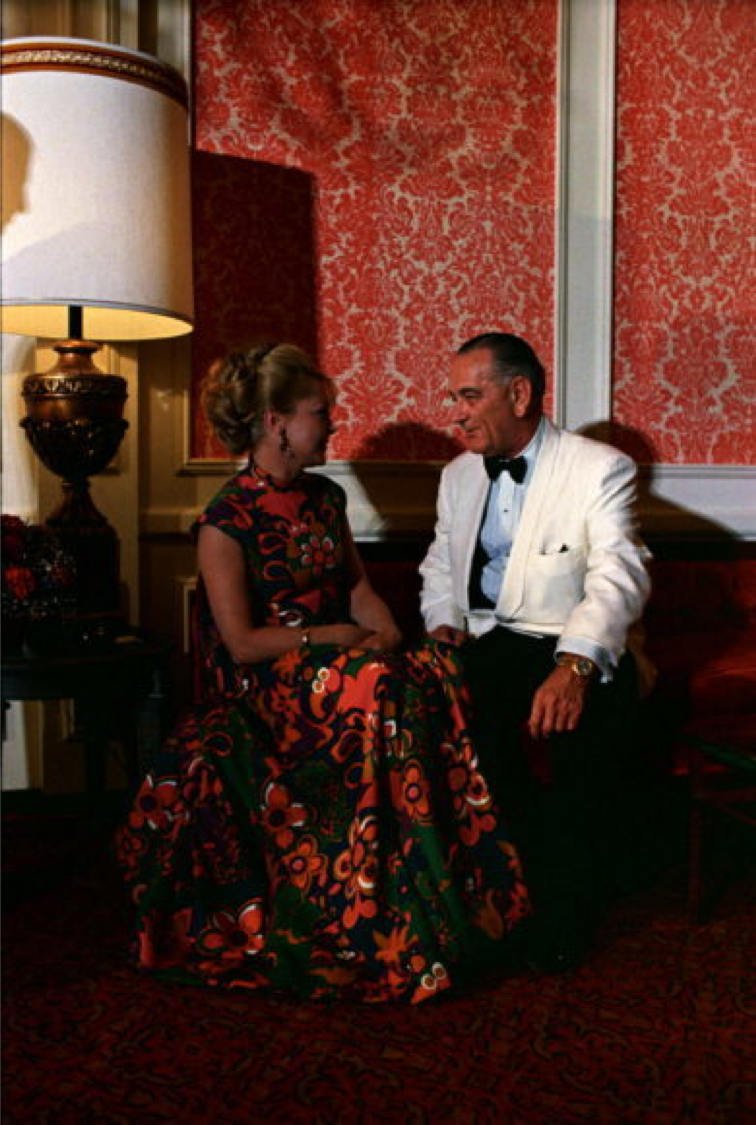
Camelot Ends. The Network Enters.
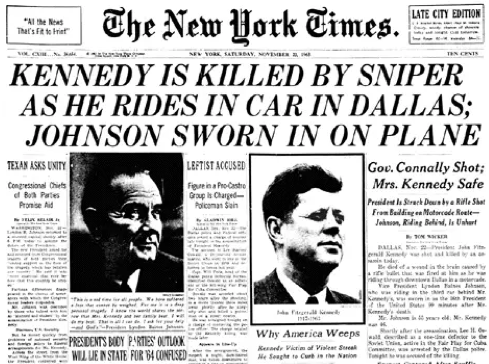
November 22, 1963 — the day the world stopped breathing.
A president was cut down in broad daylight. A First Lady held her dying husband in her lap. And in the space between two heartbeats, the American story split into a before and an after. To the public, it was tragedy. Inside Washington’s machinery, it became transition.
Jackie Kennedy boarded Air Force One still wearing the blood-soaked pink suit that testified to the brutality of the moment. Lyndon Johnson, expression fixed and surrounded by the men who would define his presidency, placed his hand on a Bible and took the oath. Camelot did not fade — it was overtaken.
Then came November 23.
The day Jackie Kennedy walked out of the White House, Mathilde Krim walked in.
The widow left with her children and her grief.
And replacing her was Mathilde Krim — until recently tied to Irgun, a terrorist designated group by U.S. military intelligence responsible for mass-casualty bombings assassinations, and targeted killings of civilians. Mathilde entered LBJ’s world as part of “The Krims,” the small private circle closest to the president.
In surviving footage, she recounts that LBJ “insisted” she construct a home inside his ranch for his birthday, and that he was “fascinated” by her beauty and her access to the entertainment industry.
The visual record is presented below.
The rituals looked familiar.
The power shift did not.
On November 23, LBJ and Mathilde Krim appeared in White House images showing a scene utterly foreign to the grief stalking the country: relaxed bodies, familiar warmth, the tone of a house already claimed. Jackie Kennedy had left the residence; “The Krims” inner circle had arrived. The difference between the two days was not emotional. It was systemic.
Camelot was gone.
The network had arrived.
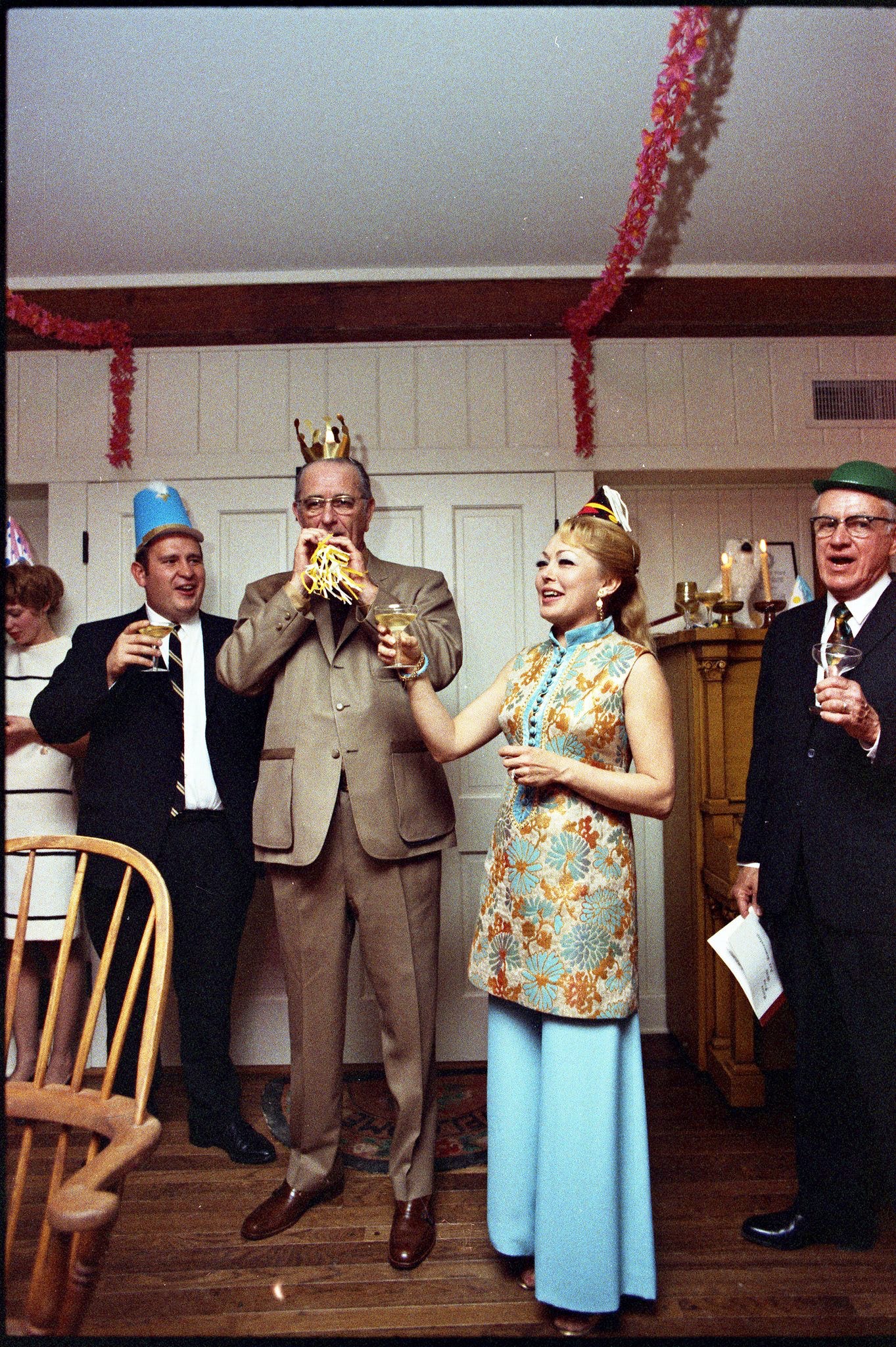
The Birth of Modern Terrorism: From Irgun to Likud to U.S. Power Centers
Mathilde Krim — The Bridge No Historian Wanted to Name
The story of Mathilde Krim does not begin in Washington. It begins in the militant underground of Mandate Palestine, where Irgun — described in U.S. Army G-2 intelligence files (1946–47) as “a terrorist organization responsible for bombings and assassinations” — pursued its political goals through force. The organization killed British servicemen, detonated mines under patrol convoys, and bombed the King David Hotel, producing one of the deadliest attacks of the decade. Its sister faction, Lehi, assassinated UN mediator Count Folke Bernadotte in 1948, eliminating the international official attempting to stabilize the region.
https://www.youtube-nocookie.com/embed/f-5Qtu5qQjQ?rel=0&autoplay=0&showinfo=0&enablejsapi=0
Irgun’s what Israel first prime minister David Ben-Gurion’s called “Periphery Doctrine,”: asymmetric strikes, clandestine cells, and political infiltration. British regimental logs from 1945–47 record roadside mines detonated under troop convoys, ambushes of patrols, and coordinated smuggling of weapons through European safehouses. This operational culture later migrated into the political movement Herut, and eventually Likud — the party later led by Benjamin Netanyahu. This is not ideology; it is institutional continuity across decades.
The operational grammar pioneered by Irgun did not evaporate after 1948 — it metastasized into the foreign reach of Israeli intelligence. The same asymmetric principles that defined Irgun’s underground war—penetration of rival factions, targeted assassinations, deniable sabotage, and deep infiltration of exile communities—reappeared in Mossad’s operations across Europe and the Middle East.
In Jordan, the 1950s–70s saw Mossad-run networks conducting clandestine assassinations and political disruption; in Lebanon, Mossad operatives coordinated covert militias, bombings, and the destabilization of Palestinian leadership; in London, the 1987 attempted assassination of Palestinian cartoonist Naji al-Ali carried Irgun’s signature triad: a migrant cell, a cutout gunman, and plausible deniability.
Across Europe, from the Lillehammer affair in Norway to espionage rings in Paris, the continuity is unmistakable. These were not improvisations. They were the maturation of an Irgun-born doctrine into a global intelligence architecture.
The road from the King David Hotel leads, step by step, to the Oval Office.
Krim’s Operational Biography — From Underground Courier to Transnational Connector
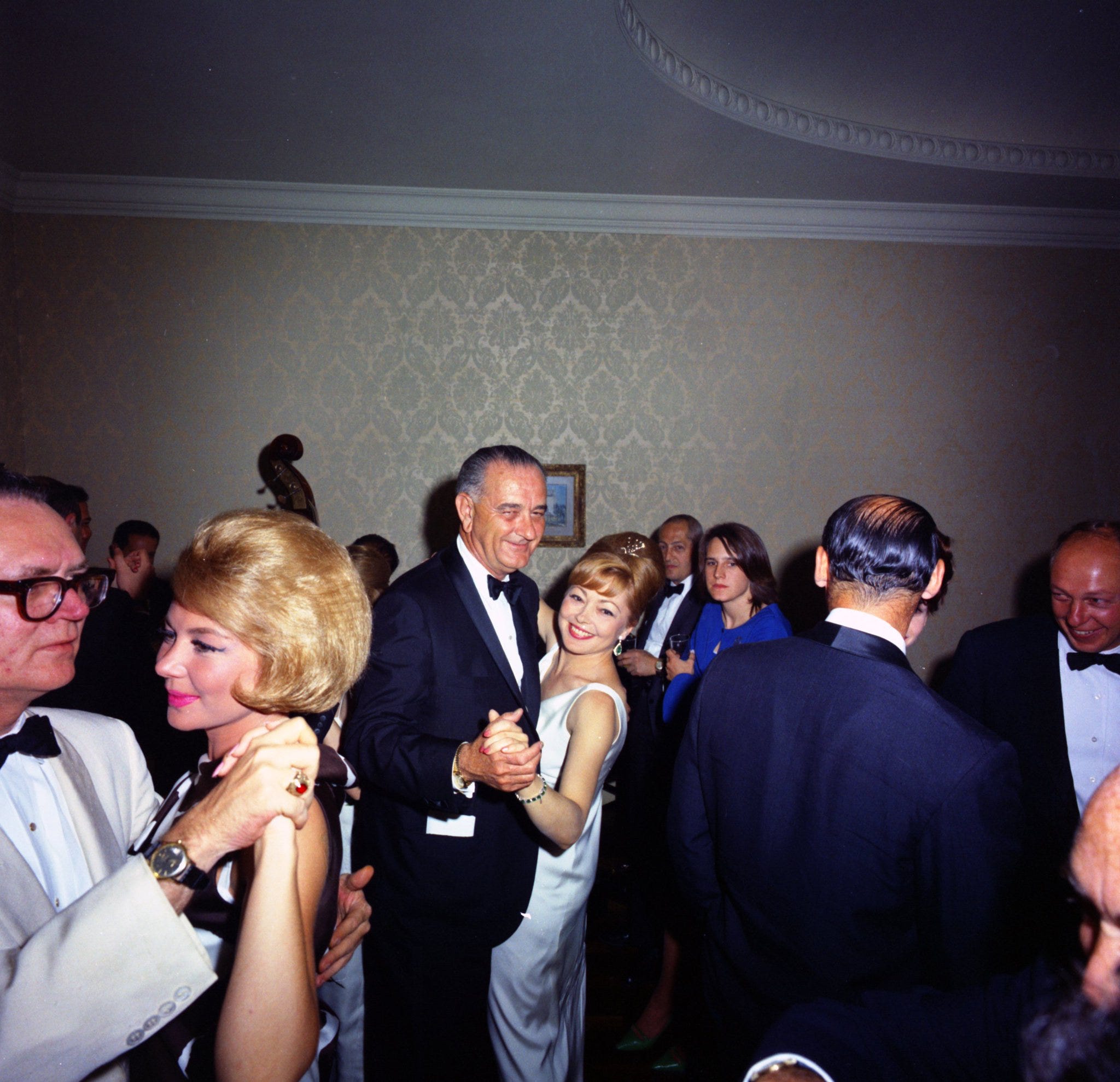
And when Mathilde Krim — born of the same militant tradition that bombed the King David Hotel — entered the White House on November 23, 1963, Israel’s Doctrine of Succession reached operational maturity. To see her clearly, we must return to her point of origin.
In 1940s Switzerland, she married Irgun operative David Danon, who used his academic postings as cover for underground assignments. The established biographical record shows her transporting coded messages, explosives components, and logistical materials for Irgun’s European cells — the precise facilitation role intelligence archives identify as the backbone of Irgun’s foreign operations.
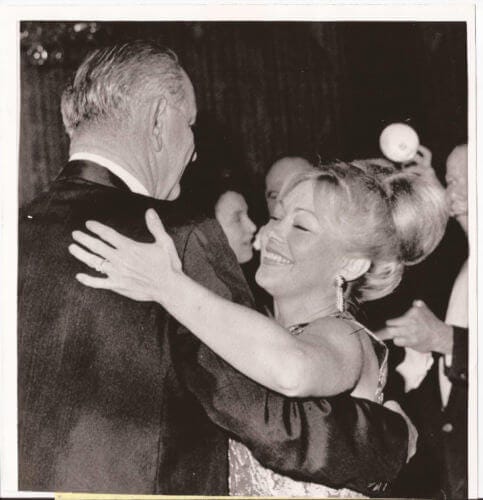
Mathilde Krim’s operational biography extended beyond her marriage. Irgun’s Geneva structure relied on couriers, sympathizers, and safehouse contacts to move matériel and messages into Palestine during the final years of the British Mandate. Krim’s own descriptions, as captured in later interviews and biographical treatments, reference aiding her husband while he was “on assignment,” a term consistent with Irgun’s nomenclature for covert duties. These roles place her not on the margins of the militant underground, but inside its logistical bloodstream.
Mathilde Krim did not leave the underground behind — she carried it into the White House.
Migration Into American Elite Networks — The Social Vector of Influence
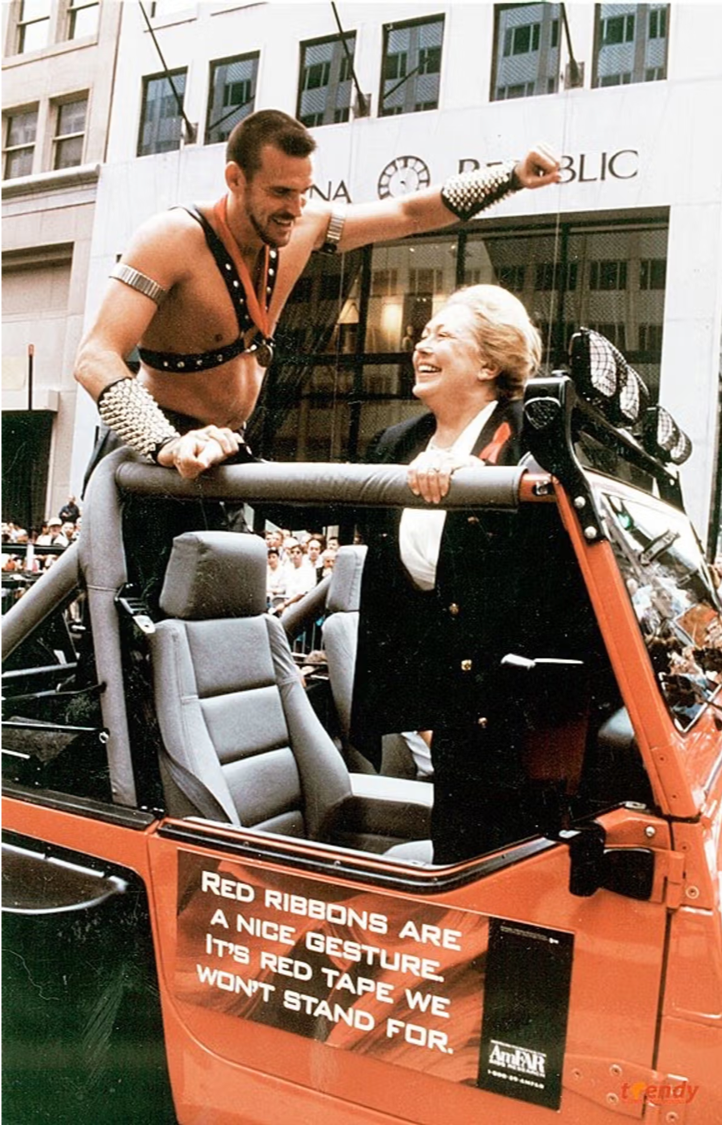
By the early 1960s, Mathilde Krim emerged in an entirely different environment: the American cultural and philanthropic elite. Her second husband, Arthur Krim, chaired United Artists and later Orion Pictures, giving the couple high-level access to Hollywood’s political donors and New York’s financial class. This circle — documented in White House social logs and the memoirs of Democratic Party fundraisers — functioned as a gateway between entertainment capital and presidential power. It was here, not in diplomacy, that Mathilde refined the skill that later mattered most: proximity to decision-makers.
This social formation became known informally as “The Krims,” a tight donor–political nucleus with unusually intimate access to presidents. Biographers of the Johnson presidency — from Seymour Hersh to Randall Woods and Jack Valenti — all place Mathilde squarely inside this core group, distinguishing it from ceremonial guest lists or routine social events. In their accounts, her presence was not intermittent but embedded — a figure whose counsel, charm, and cultural leverage intersected with LBJ’s political decision-making at sensitive moments.
In Washington, titles matter less than proximity — and she had proximity.
https://www.youtube-nocookie.com/embed/wPpm2o37GG4?rel=0&autoplay=0&showinfo=0&enablejsapi=0
When the Guns Went Silent, the Cover-Up Began — The USS Liberty Story
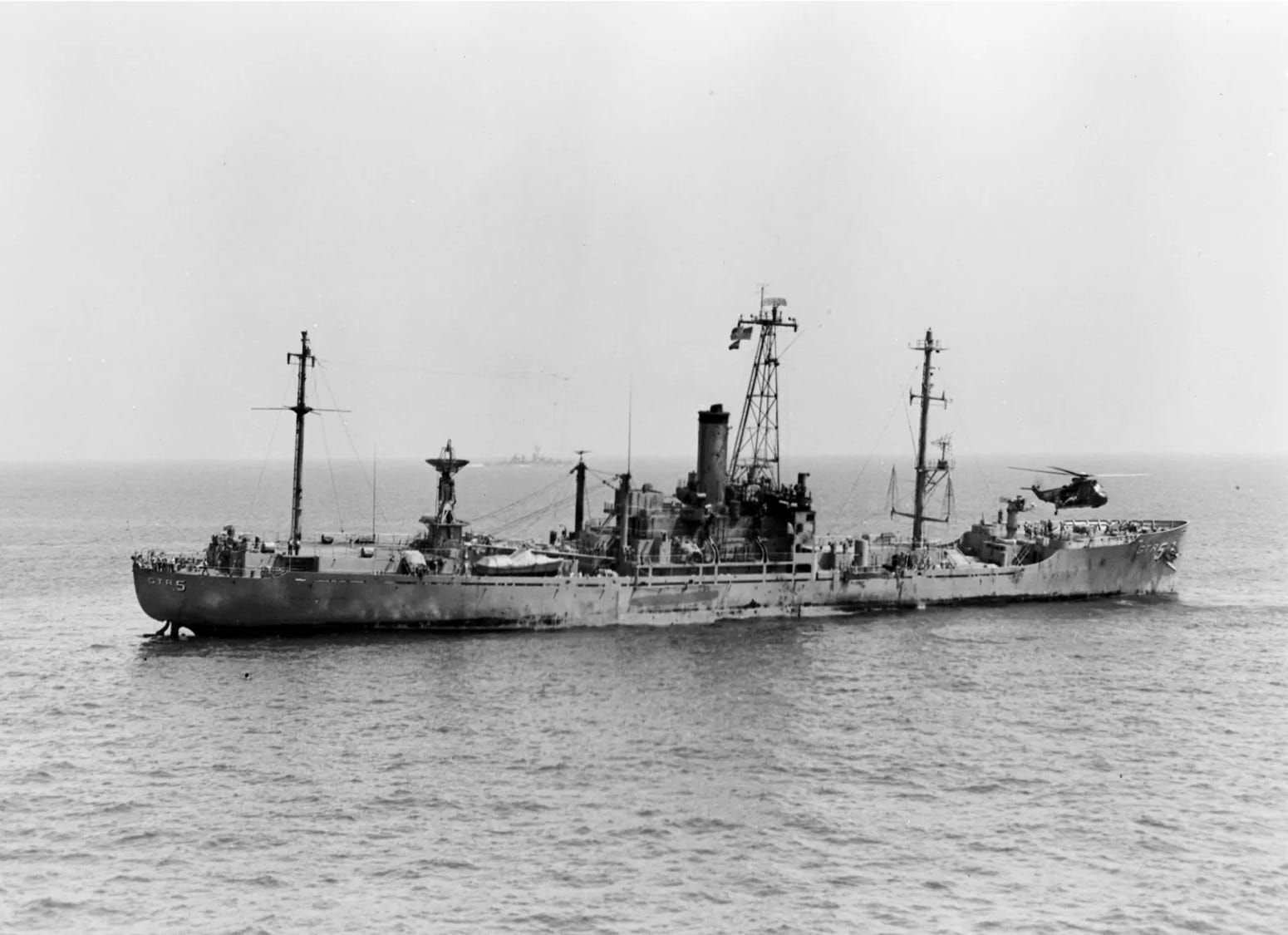
The USS Liberty is where Mathilde Krim’s proximity to the presidency becomes more than biography. It becomes consequence. On June 8, 1967, Israeli forces attacked a clearly marked U.S. Navy intelligence ship in international waters, killing 34 American servicemen and wounding 171 more. The assault unfolded in coordinated phases—jet strikes, torpedo runs, and the jamming of U.S. communications—while Lyndon Johnson’s inner circle, already reshaped by Mathilde Krim’s presence, prepared the political response that would define the value of American lives lost at sea.
Survivors have spent decades describing what Washington refused to confront. One of them put it without hesitation:
“It was no mistake. We were betrayed.” — James M. Ennes Jr., USS Liberty survivor
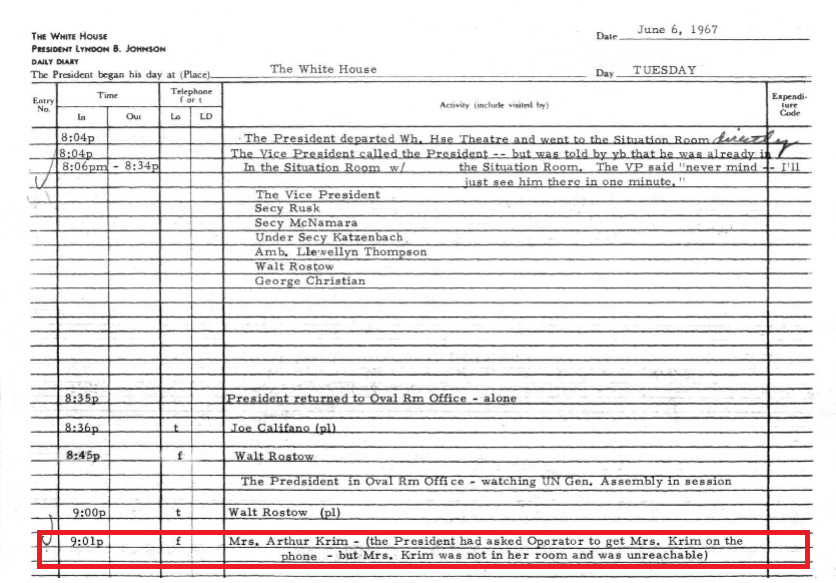
June 6, 1967 — LBJ’s Daily Diary
President LBJ personally instructs the White House operator to reach Mathilde Krim—on the eve of the USS Liberty attack.
I know one of the survivors — U.S. Navy Petty Officer Phil Tourney. A man who has carried the heat and smoke of that day in his lungs for decades.
Phil’s testimony — along with the accounts you will read directly below from survivors and the military personnel who received the orders that day — is not analysis; it is memory:
memory of a ship left defenseless, rescue aircraft launched then recalled, and a White House that buried its own men beneath political calculation.
“I don’t give a damn if every man drowns and the ship sinks. I will not embarrass our ally.”
— President Lyndon B. Johnson, during the Liberty attack response.
Admiral Geis told Liberty survivors he had ordered jets to defend the ship—until Washington intervened:
“President Johnson is not going to embarrass an ally.”
And while the Liberty burned, Mathilde Krim, an Irgun courier from a group Western intelligence labeled a terrorist apparatus, occupied the president’s inner orbit. The White House Daily Diary records LBJ personally seeking her during the crisis.
Not admirals.
Not intelligence officers.
Her.
“LBJ set us up to sink us fast, blaming Nasser… SAC bombers were already on the way to nuke Egypt. This was a setup by our government bowing to the Zionist state.” — Phil Tourney, USS Liberty Survivor.
This is the architecture that matters:
At the defining moment when American sailors needed truth and protection, the president’s emotional and strategic gravity aligned not with his own military — but with the network tied to the state conducting the attack.
“Phantom Pain your spot on LBJ set us up to sink us fast…
This is our country the politicians sold their souls to Israel…
Ben Shapiro is a liar… Liberty is the most egregious…
This flag we salute 🇺🇸”
— Phil Tourney, USS Liberty Survivor.
June 13, 1967 — LBJ’s Daily Diary
The White House – President Lyndon B. Johnson – Daily Diary – Tuesday, June 13, 1967
Highlighted Entry: 10:07 p.m. — Mrs. Arthur Krim arrives.
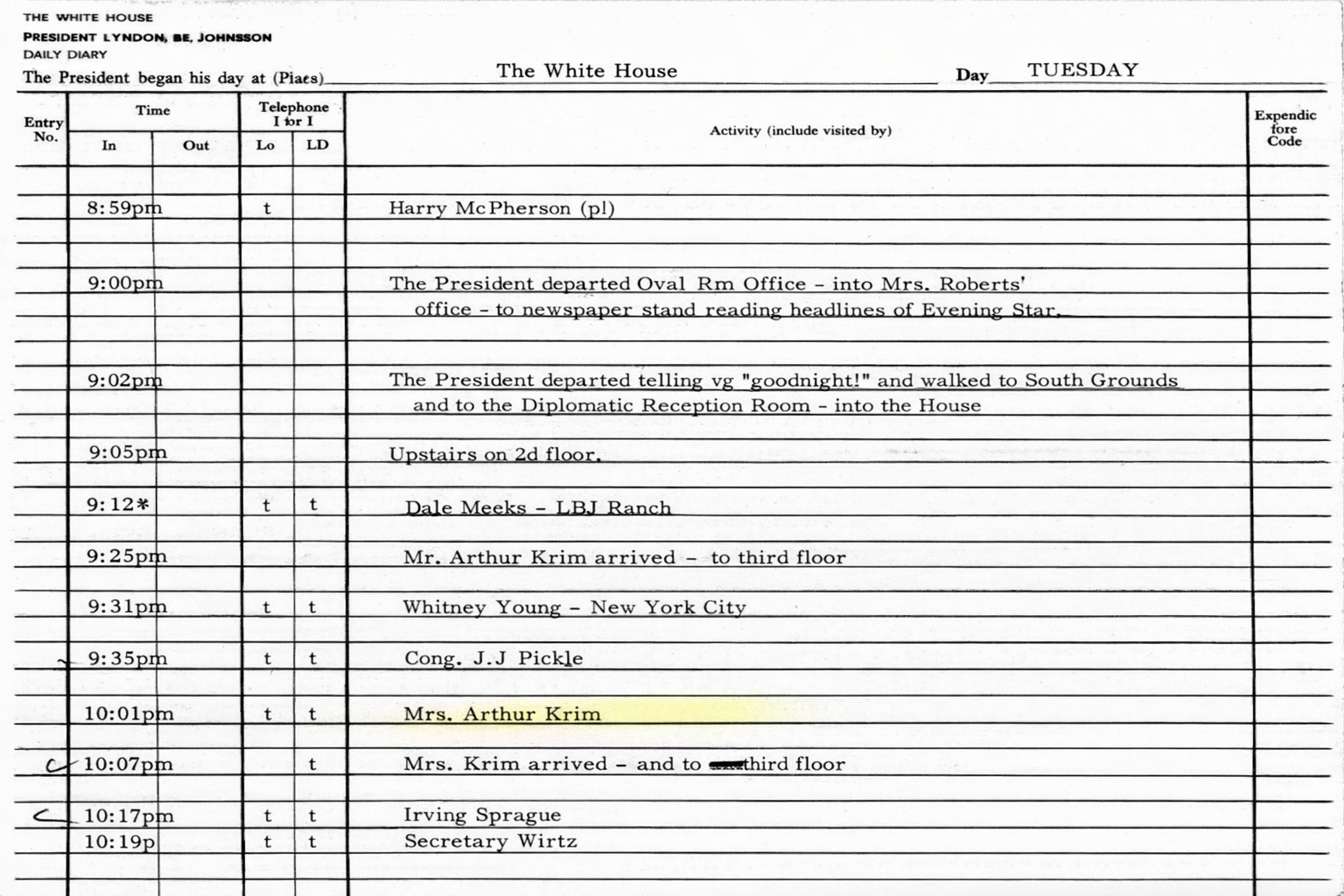
The June 13th White House Diary entry is not trivial ink on paper.
While Liberty families were identifying bodies, Mathilde Krim was being ushered into the president’s inner rooms.
This is what the survivors lived with for decades: a government that buried their dead and then buried the truth.
To men like Phil Tourney, who carried that day in his bones, the silence was another wound.
But the doctrine they tried to seal is now breaking open because witnesses still speak, documents still surface, and America’s conscience has not gone extinct.
This chapter does not close with the cover-up.
It closes with a promise:
We will not let the truth die the way Washington let your ship burn.
For the USS Liberty’s dead and living — the record is no longer negotiable.
Historical Record of Israel’s False Flags
This short documentary had two goals:
use only first-hand testimony and keep the evidence concise.
Inside it, you’ll find documented false-flag operations spanning decades:
• King David Hotel (1946) — including the on-camera admission of Irgun member Izhak Zadok, smiling as he describes planting explosives while disguised in Arab clothing.
• London Embassy Bombing (1994) — explained by former MI5 intelligence officer Annie Machon, who details how the operation was falsely attributed and politically weaponized.
• Baghdad & Basra Attacks (1950–51) — where Zionist underground units bombed Iraqi synagogues to trigger Jewish flight to Israel, documented by historian Avi Shlaim and former underground operative Naeim Giladi.
• USS Liberty (1967) — featuring leaked Israeli military recordings showing foreknowledge that the ship was American, and survivor testimony confirming Israel jammed U.S. frequencies — something only an ally should never do.
This documentary is just an entry point. All expanded evidence, documents, and detailed analysis appear in the sections below.
The Architecture of Deception: A Historical Record of Israeli False Flags
The USS Liberty was not the first time the world saw a lie wrapped in friendly colors. Long before American sailors were left to burn at sea, a pattern had already taken shape — a pattern of violence staged, masked, and reassigned to someone else. These were not accidents of war or fog-of-battle mistakes. They were operations designed to move nations, shape public opinion, and bend history toward a single strategic horizon.
These are the documented cases — the real precedents.
False flags with bodies, archives, trials, confessions, whistleblowers.
The foundation of a method that has crossed oceans and decades.
1. The Lavon Affair (1954) — A Confirmed State False Flag
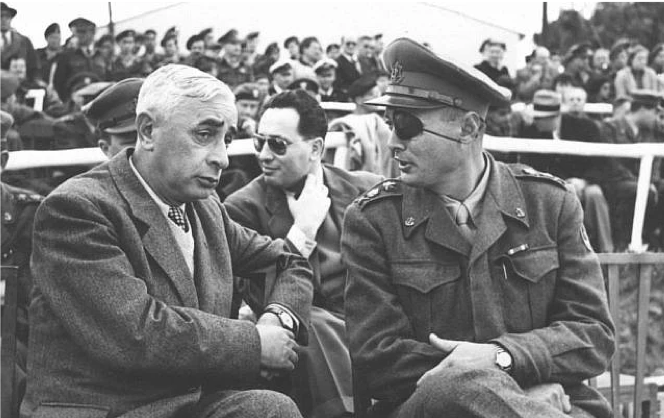
In the summer of 1954, Israeli military intelligence (Aman’s Unit 131) activated a covert cell inside Egypt to plant bombs in civilian sites — American libraries, cinemas, and British offices — while making the attacks appear to be the work of Egyptian nationalists or the Muslim Brotherhood. The plot collapsed when operatives were arrested; two were executed, and the scandal erupted into Israel’s political system. Israel denied the operation for five decades before finally honoring the surviving agents in 2005.
Lavon is not allegation — it is the textbook definition of a state false flag.
2. The 1950–51 Baghdad Bombings — Testimony From the Jews of Iraq Themselves
Between 1950 and 1951, a series of bombs exploded outside Jewish sites in Baghdad — cafés, synagogues, the Mas’uda Shemtov School — at the precise moment Israel was urgently trying to accelerate the emigration of Iraq’s 130,000-strong Jewish community. The Iraqi government blamed Zionist agents. Israel blamed Iraqi nationalists. But the most damning testimony did not come from courts or colonial officials.
It came from the Iraqi Jews themselves.
Naem Giladi, a Baghdad-born Iraqi Jew who later became an Israeli dissident, wrote plainly in Ben-Gurion’s Scandals that Zionist operatives carried out the attacks to terrorize the Jewish community into fleeing:
“We were bombed by Zionist agents — not Arabs — to force us to leave Iraq.” — Naem Giladi, Ben-Gurion’s Scandals
Giladi recounts names, cells, safehouses, and the mechanisms used, including planted grenades, smuggled explosives, and coordinated propaganda spread through Zionist emissaries. His testimony is echoed by numerous Iraqi Jewish elders who survived the period and later spoke publicly about pressure, threats, false rumors, and intimidation designed to create panic.
Oxford historian Avi Shlaim, himself an Iraqi Arab Jew, concludes the same:
“The evidence of Zionist involvement in the Baghdad bombings is incontrovertible.” — Avi Shlaim, Three Worlds: Memoirs of an Arab-Jew
Multiple oral histories from Iraqi Jewish communities — recorded in memoirs, academic studies, and diaspora archives — describe the same pattern:
- Zionist underground cells stockpiling weapons and explosives
- Arms caches discovered in synagogues and private homes tied to the movement
- Community members warning that Jews were being attacked “from within”
- Panic rising only after Zionist agents spread rumors of imminent Arab pogroms
These testimonies form a consistent, devastating picture:
The bombs were not meant to kill large numbers.
They were meant to terrify, to force flight, to empty Iraq of its Jews so Israel could claim them as demographic reinforcement.
Israel has never formally admitted responsibility — but the survivors of that era, the very people the movement claimed to rescue, have spoken loudly enough.
The Baghdad bombs did not drive Jews to safety. They drove them into the arms of the state that planted them.
3. Mossad Agents Posing as CIA to Recruit Jundallah (2007–2010)
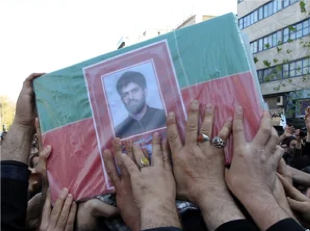
A classified CIA memo (later revealed through Foreign Policy reporting) documented that Mossad officers impersonated CIA agents in London to recruit operatives from Jundallah, a Sunni militant group attacking Iran. U.S. officials described the Israeli operation as “false flag tradecraft” that risked entangling the United States in unauthorized covert warfare.
A false flag against America is not an accident — it is Israel letting the United States absorb the consequences of its covert wars.
4. The London Embassy Bombing (1994) — MI5’s Own Officers Point to a False Flag
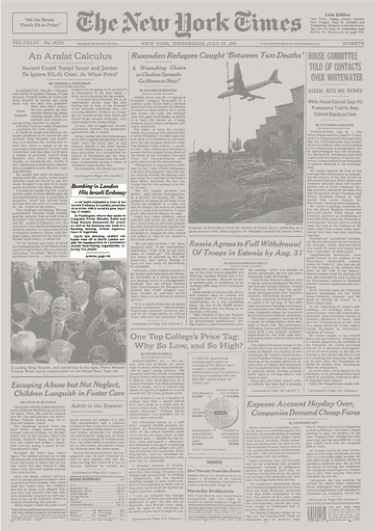
In July 1994, a car bomb detonated outside the Israeli Embassy in London. Within months, two Palestinian activists — Jawad Botmeh and Samar Alami — were convicted and sentenced to 20 years in prison, despite providing no confession, no forensic evidence tying them to the explosives, and no motive that aligned with intelligence assessments. Amnesty International and multiple British legal scholars later criticized the case as structurally unsound.
Then came the rupture.
Former MI5 intelligence officer Annie Machon, drawing directly from internal MI5 assessments she handled during her service, publicly stated that British counter-intelligence believed the embassy bombing was a Mossad false-flag operation, intended to blame Palestinian activists during a sensitive period in the Israeli–Palestinian conflict. Machon recounts that senior MI5 analysts concluded:
- Mossad had the capability, motive, and operational footprint
- The Palestinians convicted were not the perpetrators
- The political utility of blaming them was obvious
- Israel benefited immediately from the narrative
This was not fringe speculation — it was an MI5 officer describing the internal view of Britain’s own counter-espionage division.
Botmeh and Alami remain the living proof of the consequence:
decades in prison for an operation MI5 believed Israel carried out against itself.
MI5 concluded the bomb came from Mossad, but Britain jailed two Palestinians instead.
5. King David Hotel (1946) — Disguised Attack Framed on Arabs
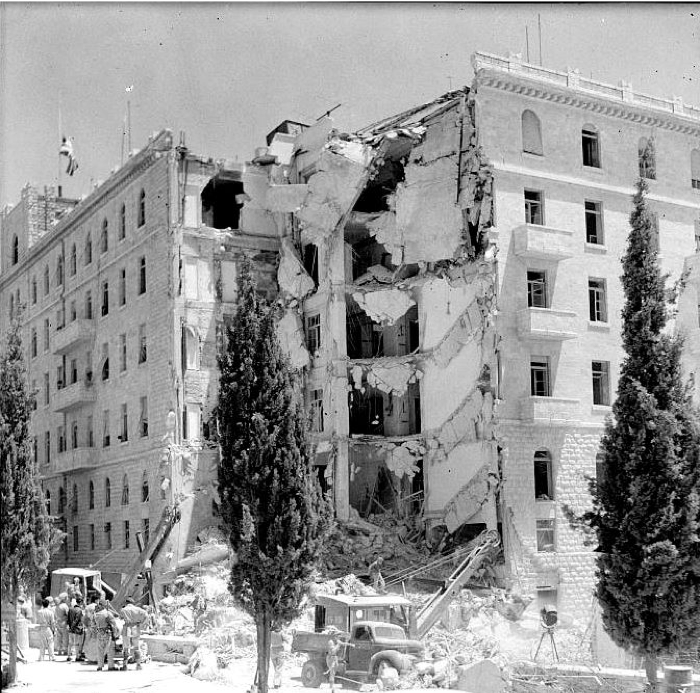
Irgun militants — the same underground tradition that shaped Mathilde Krim’s early world — bombed the King David Hotel in 1946, killing 91 civilians, clerks, soldiers, and staff. The attackers wore Arab clothing, a deliberate masquerade designed to redirect blame toward Palestinians in the crucial first hours. British authorities initially accepted the deception, until forensic and intelligence findings revealed Irgun responsibility.
And it was not only the British.
Menachem Begin, Irgun commander and later prime minister of Israel, publicly confirmed in his memoir The Revolt: Story of the Irgun:
“We carried out the operation at the King David Hotel.”
Benjamin Netanyahu’s own father, historian Benzion “Netanyahu” Mileikowsky, defended Irgun’s rationale.
Former Irgun members have repeatedly admitted the use of disguise and misdirection as intentional operational method — not battlefield improvisation.
Irgun changed their clothes; history was forced to change the culprit.
6 – Mexico, 2001 — The False Flag That Almost Broke Cover
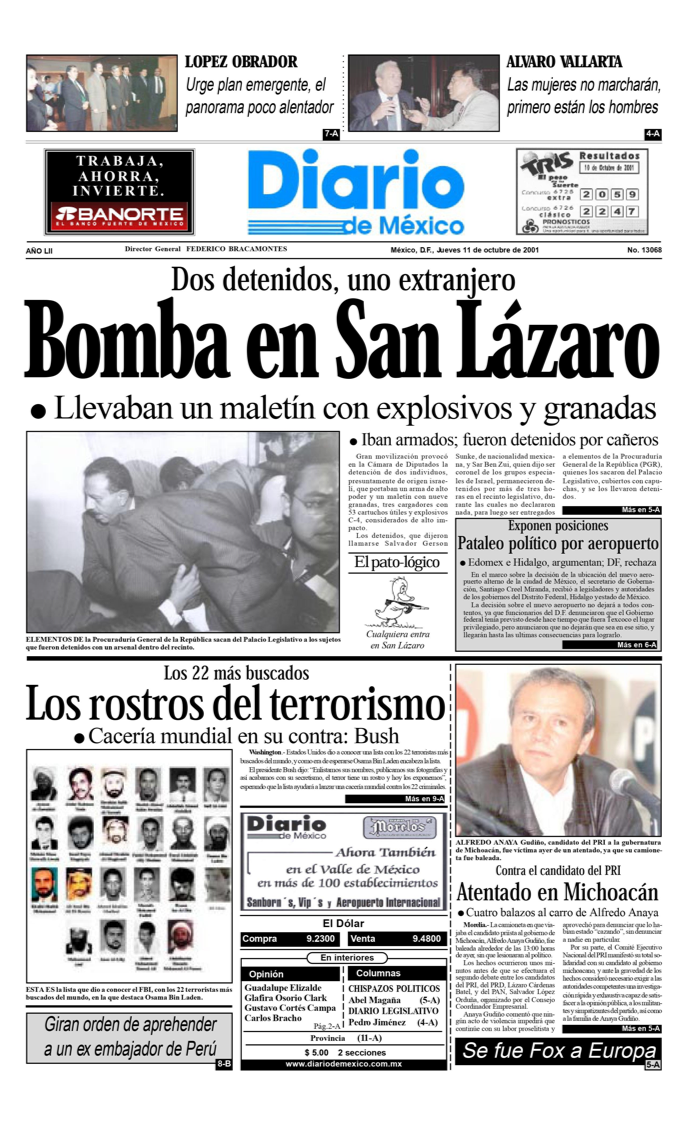
In October 2001—barely a month after 9/11—a breach occurred inside the Mexican Congress that should have detonated across the world. Instead, it was buried.
Two Israelis — Saar Noam Ben Zvi and Salvador Gersson Smeck — were arrested inside the Chamber of Deputies carrying:
- hand grenades
- explosives
- detonators
- a 9mm pistol
- false Pakistani passports
This was not rumor.
It was confirmed by Mexican congressional security and reported in real time by Diario de México under the headline:
“Bomba en San Lázaro.”
October 11, 2001 — detailing the arrests and weapons seizure from inside the legislature.
A retired IDF colonel with intelligence ties infiltrating a foreign parliament under Pakistani cover one month after 9/11 is not coincidence. It is design.
And yet, the operation did not fail because it was exposed late. It failed because it was exposed early.
- Israeli diplomats arrived in emergency meetings,
- Mexican officials were pressured at the highest levels,
- U.S.-linked military intermediaries entered the loop,
- and the two suspects were quietly released,
- then extracted from the country.
The story vanished from global media almost instantly.
Not because it lacked evidence.
But because it threatened to reveal a mechanism:
a doctrine that uses crisis to manufacture narratives—
and uses power to erase the evidence when the script collapses.
When an operation fails, the doctrine does not retreat. It escalates pressure to erase the failure.
A doctrine that begins with disguises in Jerusalem ends with diplomatic immunity in Washington.
The Lineage Inside The State: From Irgun Terror Group to America Power
The story did not end with Mathilde Krim walking into the White House after Kennedy’s death.
It began there.
What looks like an anomaly — an Irgun operative courier in the presidential residence — is, in truth, only one expression of a larger political inheritance. The militant underground that bombed the King David Hotel, murdered the UN’s mediator, and pioneered the grammar of modern false-flag operations did not dissolve. It migrated. It adapted. And eventually, it entered the governing institutions of the very superpower it once manipulated from afar.
This is the continuity the doctrine requires the reader to see:
Irgun → Herut → Likud → Diaspora networks → U.S. political infrastructure → executive proximity.
Mathilde Krim was not the end of the thread. She was merely the first knot the public can see.
The line stretches far beyond her — into political offices, media power centers, religious machines, and intelligence corridors.
Below are some of the successors of that lineage.
I. RAHM EMANUEL — THE WHITE HOUSE CHIEF OF STAFF WITH IRGUN BLOODLINES
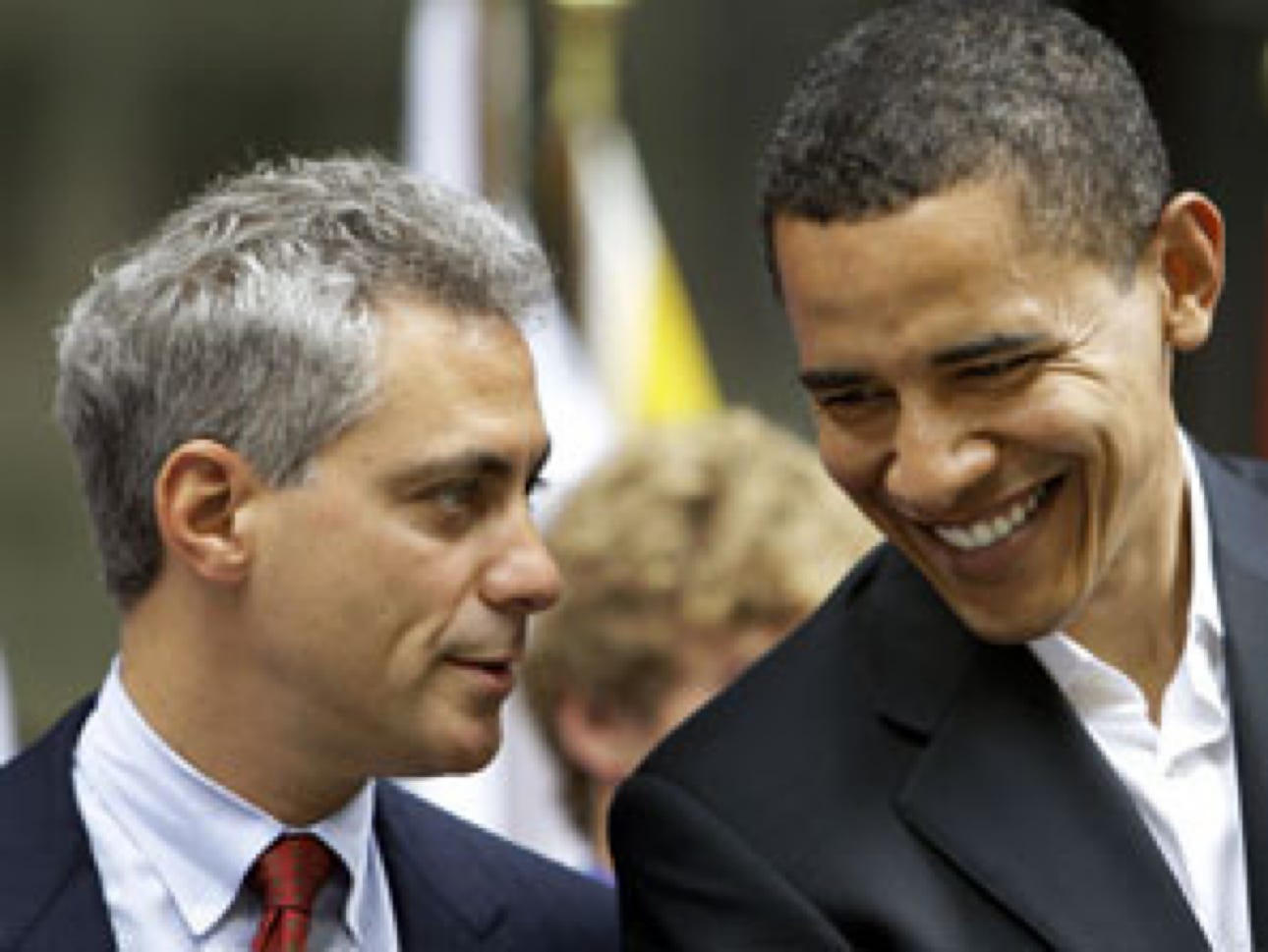
Barack Obama’s Chief of Staff, Rahm Emanuel, did not rise through American politics untouched by history.
He rose through a lineage.
His father, Dr. Benjamin Emanuel, had been part of the Irgun’s U.S. support apparatus — the same militant organization designated as a terrorist group by Britain and flagged in early U.S. intelligence files. In a 1997 interview, when asked whether his son’s position might help relations with Palestinians, Benjamin Emanuel’s response revealed the worldview carried forward:
“We are not Arab. We don’t owe the Arabs anything.”
The statement was not a slip.
It was a posture: the explicit rejection of Palestinian legitimacy, spoken by a former militant sympathizer whose son would soon oversee access to the U.S. president.
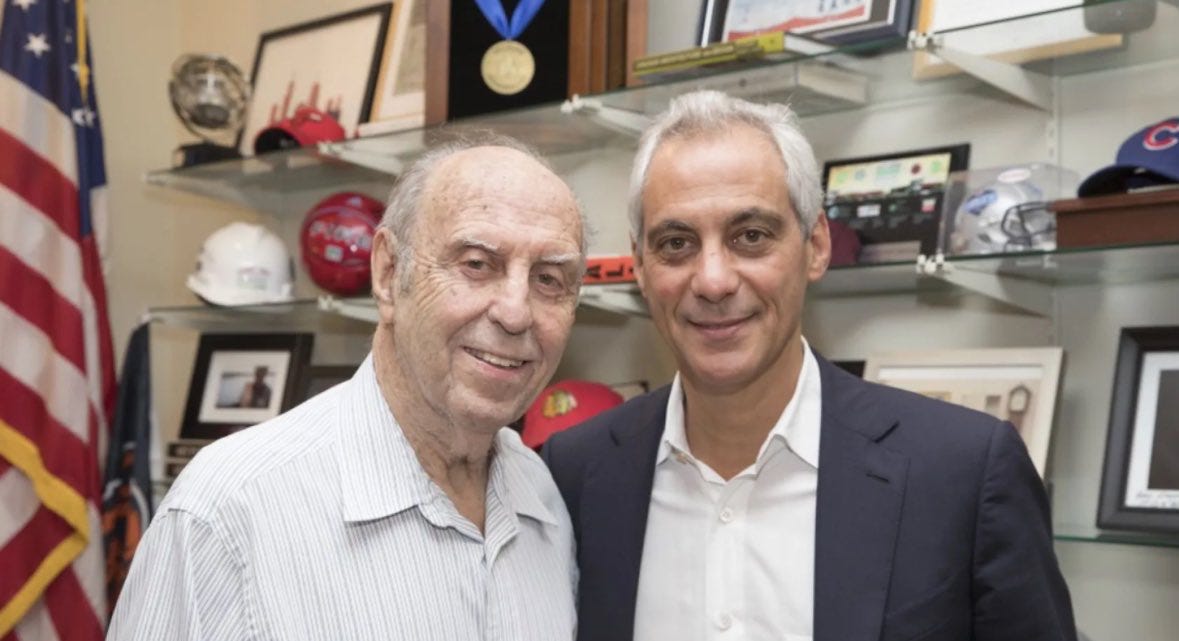
Rahm Emanuel later became one of the most influential gatekeepers in the Obama administration — a figure who repeatedly shaped political framing around Israel, pressured congressional blocs, and killed early diplomatic space for Palestinian rights, including efforts to restrain settlement expansion.
What migrated into the Oval Office was not merely a résumé.
It was an inheritance — militant worldview → political machinery → executive influence.
When the son of an Irgun operative becomes Chief of Staff to a U.S. president, the lineage is not historical — it is active.
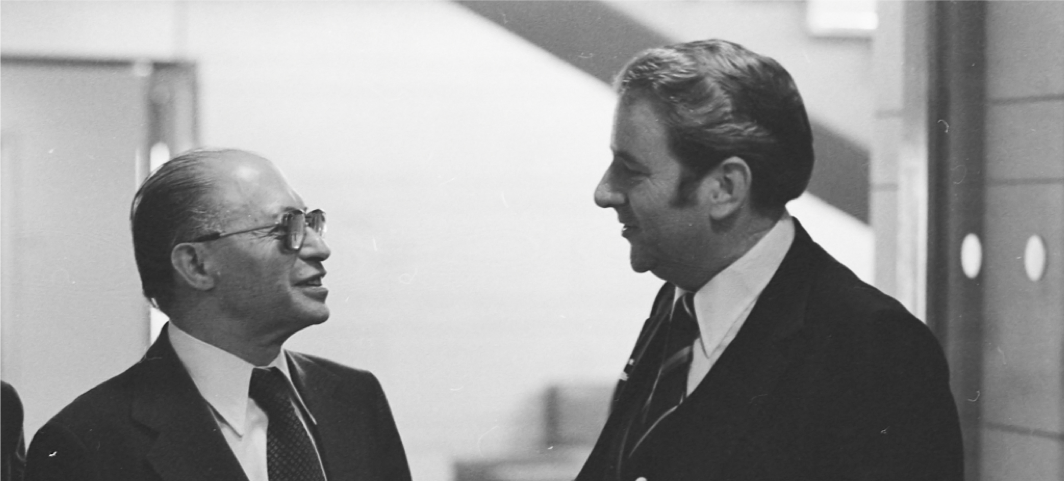
II. The Pastor and the Bomber: Jerry Falwell with Menachem Begin of Irgun, whose 1946 Attack on The King David Hotel Killed 91 People.
The Zionist underground did not vanish when it put on suits; it evolved.
The next stage emerged when Former Israel Prime Minister Menachem Begin — the Irgun terrorist who masterminded the King David Hotel bombing attack — entered into strategic alliance with Jerry Falwell, converting militant ideology into American religious mobilization. This was not spiritual fellowship. It was political engineering.
Menachem Begin supplied Falwell with money, access, and even a private jet because he understood what Israeli intelligence channels alone could never achieve:
a permanent, emotionally mobilized American voting bloc that would defend Israeli policy as divine mandate.
Begin’s Irgun built Likud; Likud built Netanyahu.
The underground simply changed uniforms and entered government.
Jerry Falwell’s rise rested on a foundation laid decades earlier: the Scofield Reference Bible, funded and promoted by early Zionist financiers such as Samuel Untermeyer. Scofield’s annotations rewired American Protestantism by inserting doctrines foreign to historic Christianity:
- prophecy timelines centered on modern Israel,
- unconditional political loyalty to the Israeli state,
- and a theological framework that treated Palestinian ethnic cleansing as a sacred necessity.
And the institution Falwell built—Liberty University—would decades later collapse under his son’s s*x-for-power scandal, kompromat allegations, and political entanglements, revealing how the same machinery that manufactured loyalty also manufactured vulnerability.
The model worked so well that it persists today. In 2025, Israel flew more than 1,000 U.S. pastors into the country for coordinated “briefings,” instructing them to return home and shape American opinion, elections, and congregations. These were not pilgrimages.
They were political indoctrination seminars targeted at millions of American voters.
When prophecy becomes policy, religion becomes an instrument of state power.
III. Amit Segal — From Underground Terror Lineage to American Influence
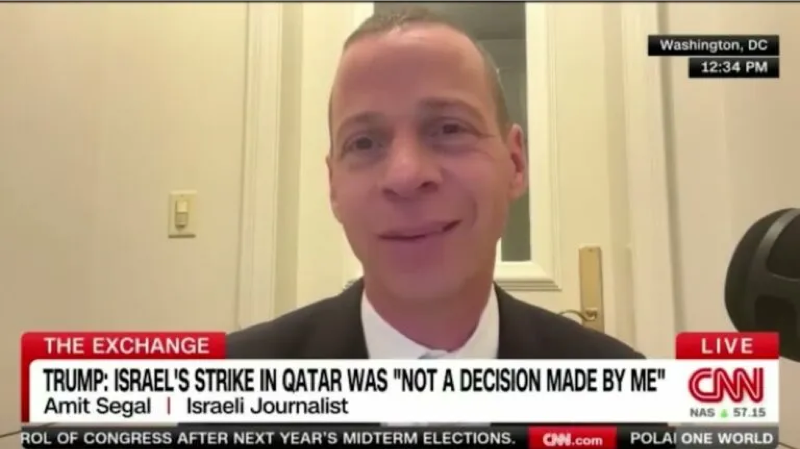
Amit Segal does not appear in the American media ecosystem as a neutral journalist or foreign analyst. He arrives carrying a lineage.
His father, Hagai Segal, was a convicted terrorist member of the Jewish Underground — a militant cell that bombed Palestinian mayors, planted explosives, and pursued political violence as strategy. That operational worldview did not disappear; it matured, entered Likud, and ultimately became central to Netanyahu’s political doctrine.
Amit is its media-facing descendant.
For years, American networks treated him as a harmless Israeli pundit. But when CNN finally broke the pattern — pressing him with real questions about occupation, settlements, and Qatar attack — something revealing happened:
Segal faltered. The narrative apparatus cracked on live television.
And the response came not from PR teams or diplomats, but from the financial architecture of Zionist power itself.
Within weeks, Zionist billionaire Larry Ellison — a Netanyahu ally and longtime pro-Israel mega-donor — launched a proxy bid to acquire Warner Bros Discovery, the parent of CNN. A move not to inform the public, but to discipline a media institution that dared step outside the approved script.
What you saw on screen was discomfort.
What moved behind the scenes was doctrine.
Irgun became Likud. Likud shaped Netanyahu. Netanyahu’s networks now reach into American media — not through argument, but through ownership.

THE EMPIRE CONSOLIDATES: How Israel’s Strategic Agenda Drives Larry Ellison’s Media Takeover
·
Jan 12
IV. Yechiel Leiter — From JDL-Linked Militancy to Washington’s Policy Pipeline
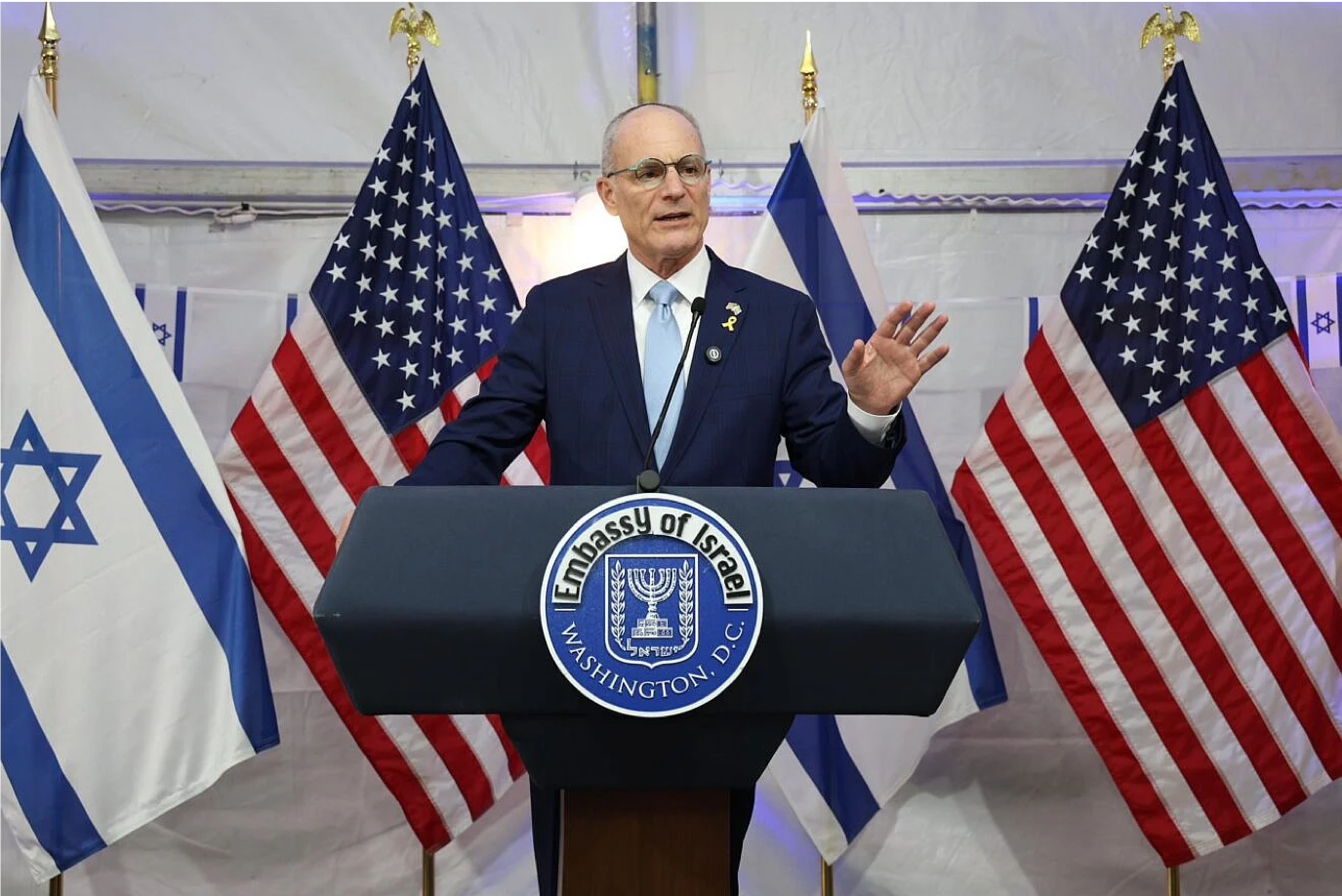
Before he became a respected Israel Ambassador in America advising Congress on Iran, sanctions, and U.S. security strategy, Yechiel Leiter spent his early political life inside circles tied to the Jewish Defense League (JDL) — an organization the FBI formally classified as a terrorist group responsible for bombings, arson attacks, and violent plots on U.S. soil throughout the 1970s–1990s.
The JDL did not debate policy.
It detonated it.
Leiter later rebranded into academia and diplomacy, yet his public rhetoric never fully left that lineage. In multiple interviews and policy forums, he has argued that Israel must shape — and when necessary, discipline — American discourse on the Middle East. His own phrasing has been blunt: that Israel must “We must shape the narrative before others do.” in the United States. The implication is unmistakable:
Control the narrative, and you control the foreign policy.
This is what turns his biography from curiosity to architecture.
A man shaped within the orbit of a militant organization that bombed American targets now walks freely through the halls of Congress, briefing U.S. lawmakers on what threats they should fear, which enemies they must confront, and how tightly they must synchronize with Israel’s strategic needs.
And the pattern is not isolated.
The JDL — once hunted by the FBI — is now treated in some Zionist American circles as a potential “protector” movement. The most brazen example came when Laura Loomer publicly called on X for the JDL to be revived in the United States, proposing that a foreign-designated extremist ideology be resurrected to police American speech and dissent. In any other context, demanding the rebirth of a terrorist group would end a career.
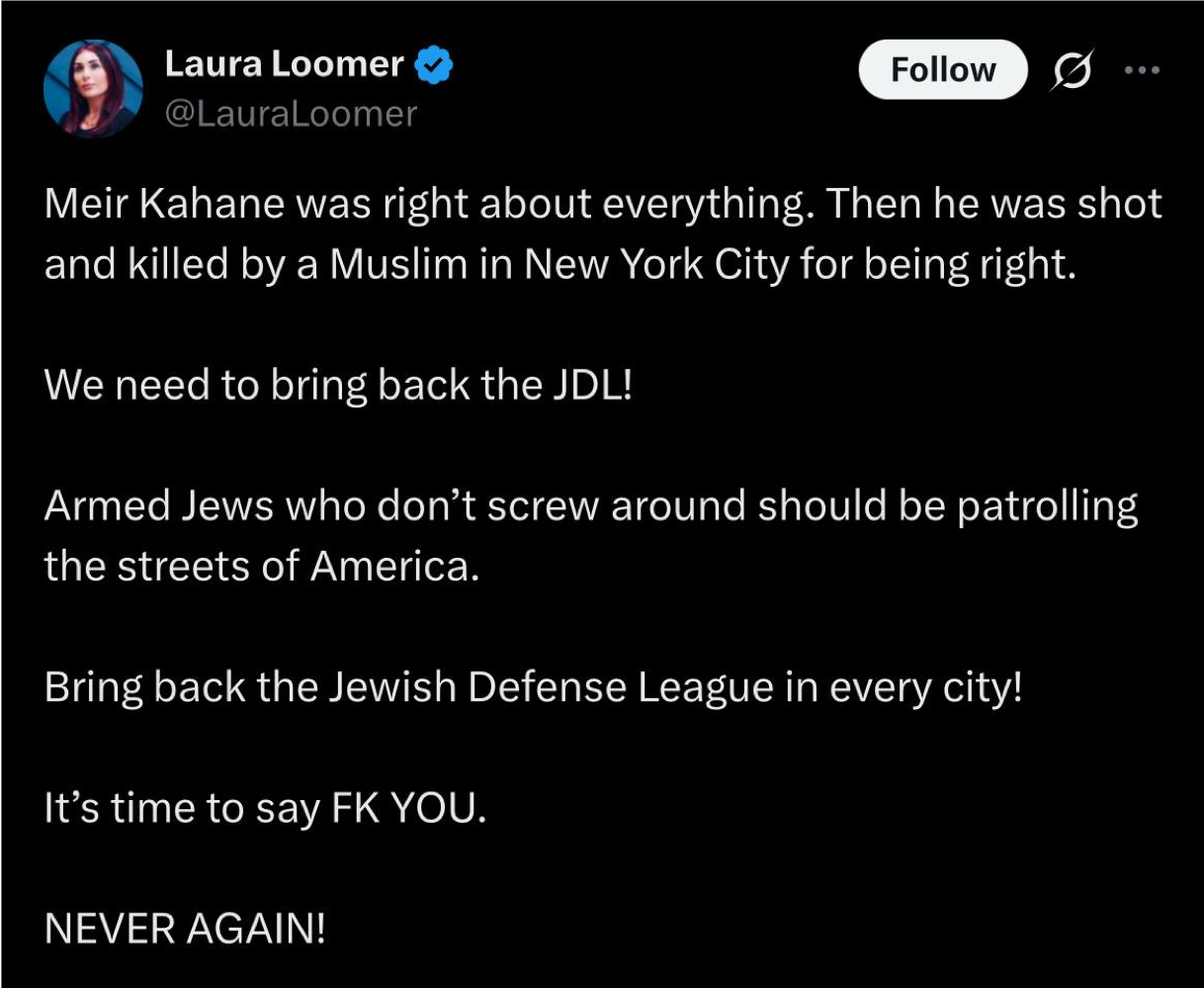
When a foreign-born ideology built on extremism becomes embedded in American political instincts, the boundary between imported militancy and domestic activism collapses.
Loomer isn’t innovating. She’s simply repeating a logic the doctrine already normalized.
This is the same logic that turned Irgun militants into Israeli prime ministers,
and JDL bombers into Washington policy advisors.
Now it produces something new:
Zionist Americans advocating for foreign terrorist group on U.S. soil.
When Zionist militancy becomes American common sense, the danger is no longer foreign infiltration — it is domestic adoption.
V. The Deep Structure — Israeli Intelligence Channels Inside the U.S. Government (1950s–60s)
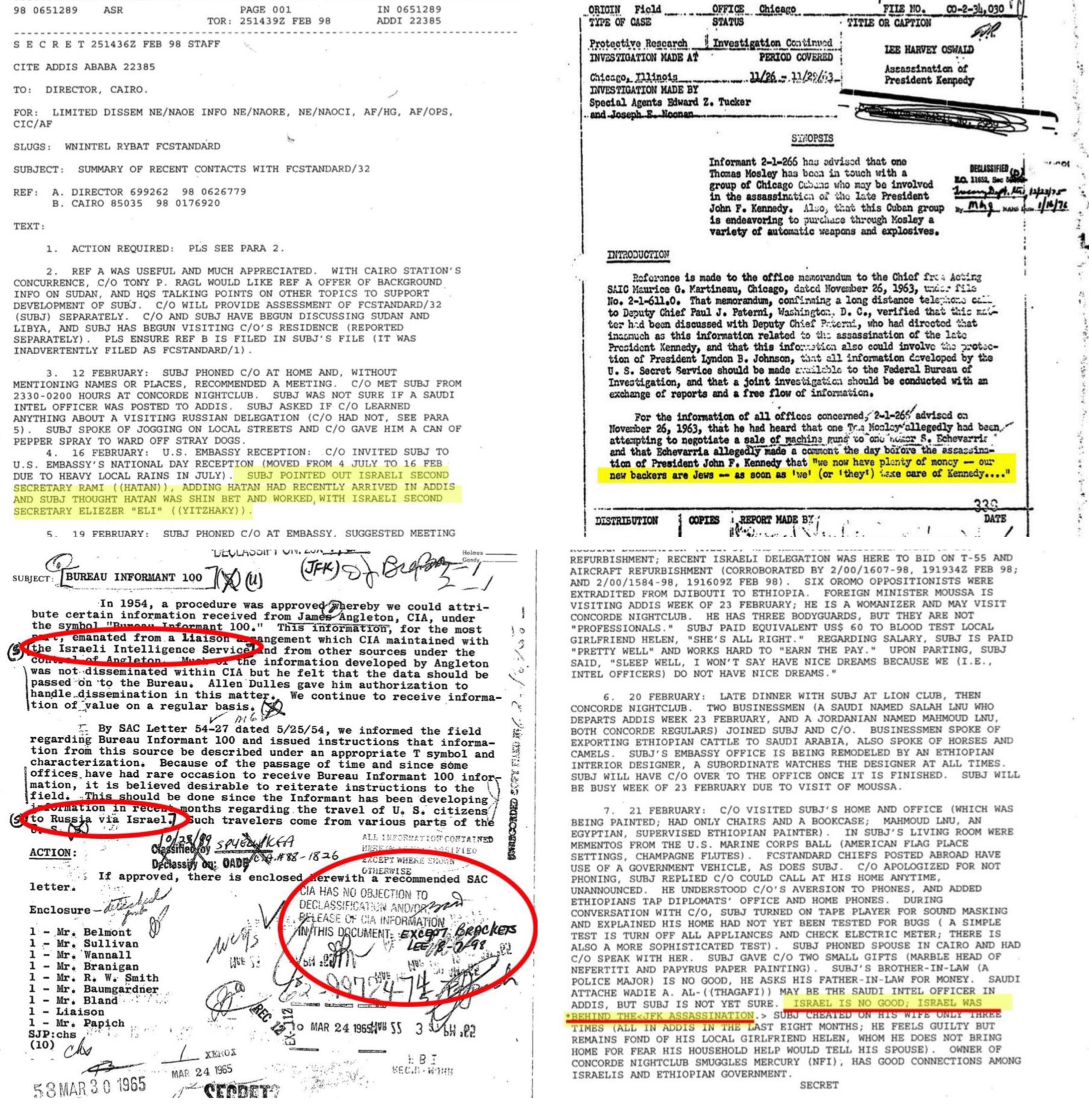
The public was shown diplomacy.
The archives reveal infrastructure.
Declassified FBI, CIA, and State Department files from the 1950s–60s show that Israeli intelligence had already established covert operational channels inside the United States long before the JFK–LBJ transition — pathways that bypassed diplomatic procedure and relied instead on private intermediaries, political patrons, and undeclared influence networks.
Below is the architecture these documents confirm. (Left to right)
1. FBI Counterintelligence Files — Israeli Covert Activity in the U.S.
(National Archives, RG 65 — FBI Records)
What the document show:
- Unregistered Israeli agents operated inside the U.S., conducting political influence and intelligence-gathering operations.
- FBI identified covert funding streams tied to Israeli ministries, routed through community organizations and donor networks.
- Early cases show Israeli operatives attempting to shape U.S. public messaging and influence congressional pressure points.
- Reports warned that Israeli intelligence was using American citizens as cut-outs, obscuring foreign operational fingerprints.
Why it matters:
The FBI was raising alarms as early as the Eisenhower years — warnings that were suppressed.
2. CIA Liaison Files — A Special Intelligence Channel for Israel
(National Security Archive — CIA Israel Files)
What the document show:
- CIA created dedicated liaison systems for Israel — separate from normal allied channels — due to “politically sensitive collection.”
- Internal CIA notes describe Israel as “operationally aggressive inside allied nations,” requiring a shielded diplomatic layer to avoid political fallout.
- Reports highlight Israeli attempts to circumvent U.S. intelligence oversight, especially around nuclear issues (Dimona).
- CIA analysts documented that Israel tried to extract intelligence from U.S. officials through informal, social, or personal means.
Why it matters:
This special channel enabled covert access long before Irgun operative Mathilde Krim entered LBJ’s orbit.
3. State Department INR Reports — Israeli Disinformation and Influence Networks
(National Archives, RG 59 — State Dept. Intelligence Files)
What the document show:
- INR analysts tracked Israeli disinformation campaigns, including planted narratives in American media.
- Reports flagged covert lobbying targeting Congress and the White House — years before AIPAC existed in its modern form.
- State Department cables describe Israeli diplomats using private American intermediaries to push policy preferences.
- Some assessments warn that Israeli intelligence bodies were operating parallel channels to official diplomatic missions.
Why it matters:
These files prove the architecture was already in place — the network only needed proximity to power, not permission.
4. CIA–FBI Coordination Memos — A Recognized Pattern of Foreign Penetration
(CIA CREST Declassified Archive)
What the document show:
- CIA and FBI jointly tracked Israeli attempts to recruit U.S. officials, lobbyists, and scientists.
- Intelligence coordination flagged Israel’s use of dual-use cultural organizations as operational cover.
- Reports describe U.S. concern that Israeli intelligence was collecting classified American data, particularly regarding nuclear programs.
- Internal communications characterize Israel as a “high-risk close ally” whose intelligence penetration attempts were “systematic.”
Why it matters:
This is the institutional backdrop against which Irgun operative Mathilde Krim entered the presidency — not anomaly, but continuity.
The Damage Assessment — What These Structures Did to America
When viewed together, the FBI, CIA, and State Department documents reveal that:
- Foreign intelligence was shaping American political inputs, not just observing them.
- U.S. sovereignty was silently eroded, replaced by a system where an ally exercised influence without accountability.
- Presidential decision-making could be surrounded, softened, or redirected through private channels — exactly the role Irgun Operative Mathilde Krim filled for LBJ.
- Policy outcomes mirrored foreign strategic priorities, not democratic debate.
This is not speculation. It is architecture.
Influence does not appear in a moment — it arrives through the channels built for it.
The Moment Charlie Kirk Broke
A short clip of Charlie Kirk’s emotional confession to Megyn Kelly — the moment the pressure finally reached him.
https://www.youtube-nocookie.com/embed/TkNHyhWwe8I?rel=0&autoplay=0&showinfo=0&enablejsapi=0
Where the Architecture Meets a Human Being
When the system that shaped presidents and investigations finally touched an ordinary American life, the impact landed on Charlie Kirk:
“I’m an American, and American First. Period. End of story.”
Charlie Kirk didn’t shout it.
He confessed it — the way a man speaks when the truth costs more than silence.
Then, with his hand shaking, he lifted his phone to Megyn Kelly:
“I have text messages calling me an antisemite…
Not my decisions — my moral character.
I’m a bad person if I do this.”
He wasn’t describing criticism.
He was describing punishment — the moment he discovered there was a rule in American public life that he was never supposed to find, let alone challenge.
And Megyn Kelly felt it in real time.
What began as neutrality turned to alarm as she realized the pressure on Charlie was coordinated — not organic, not ideological, but enforced.
Then the The Doctrine of Pressure touched her home, too.
A so-called “pager joke.”
A threat disguised as humor.
A warning sent to a mother who refused to read from their script.
The machine was revealing itself.
The System That Waited for Its Next Obstacle

What began with Irgun and Lehi in the 1930s–40s did not disappear; it graduated into state power.
Menachem Begin (Irgun terrorist commander) became Prime Minister.
Yitzhak Shamir (Lehi terrorist chief) became Prime Minister.
Rafael Eitan (Irgun/Palmach, later Israeli Spy Jonathan Pollard handler) became IDF Chief of Staff.
Their militant worldview — deniable strikes, narrative control, strategic deception — migrated directly into Likud Party, Mossad tradecraft, and the diaspora networks that would later penetrate American political life.
That lineage entered Washington through Irgun operative Mathilde Krim, whose access to LBJ aligned Israeli strategic interests with the presidency at the most sensitive moment after JFK’s assassination.
It resurfaced in 1967 with the USS Liberty betrayal, and expanded through the 1980s–1990s as sons of Underground militants became media authorities, JDL-linked activists entered Washington policy pipelines, and declassified U.S. intelligence files confirmed Israeli covert channels embedded inside America’s political bloodstream.
By the 2000s, the architecture was mature.
By the 2010s, bipartisan.
By the 2020s, public.
And by 2025, it collided with a man who broke the pattern.
Forty-eight hours before his assassination, Charlie told a Zionist donor — who had just withdrawn $2 million to punish him for refusing to disinvite Tucker Carlson:
“I cannot and will not be bullied like this.
You leave me no choice but to leave the pro-Israel cause.”
That sentence was the modern mirror of JFK’s final public defiance:
“Israel does not accept the U.S. proposal under any circumstances.”
— Davar, November 20, 1963
Two men.
Two ruptures.
Both exactly 48 hours before the “due date.”
Two times in history when the doctrine could not afford dissent from an American figure capable of moving millions.
Charlie Kirk didn’t die for speaking. He died for caring — about Americans, about truth, and about children his enemies needed him to ignore.
The Question That Triggered the Cover-Up
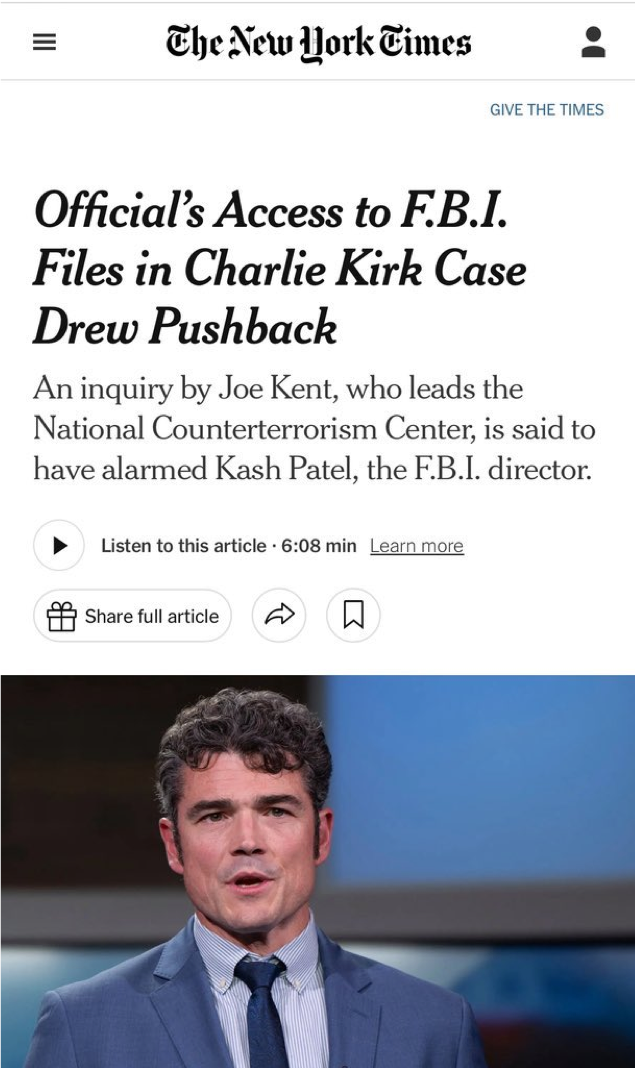
What happened after Charlie Kirk’s assassination was not confusion.
It was choreography.
Joe Kent — Director of the National Counterterrorism Center, former CIA paramilitary officer, a man who once belonged to the very establishment he now challenges — made the inquiry his office exists to make:
Was there foreign involvement in the killing of Charlie Kirk?
The New York Times described the internal reaction with careful understatement:
“An inquiry by Joe Kent, who leads the National Counterterrorism Center, is said to have alarmed Kash Patel, the F.B.I. director.”
— The New York Times reporting on the Charlie Kirk investigation
The FBI’s response was exactly what the New York Times described:
“alarmed.”
Not collaborative.
Not transparent.
Alarmed.
That reaction makes sense only when you understand the thread Kent tugged:
Charlie Kirk → Tucker Carlson → JD Vance → Joe Kent
A sequence the system could not allow:
- Charlie refused to exile Tucker Carlson and refused to bow to Zionist donor demands.
- Tucker countered the establishment by pushing Trump toward JD Vance — the VP choice every donor bloc tried to stop.
- JD Vance rejected the Christian Zionist conditioning that ruled GOP foreign policy for decades and brought Buckley Carlson into his ranks despite media attacks.
- Joe Kent, Tucker’s ally inside the national-security structure, became the one man positioned to uncover foreign fingerprints — and was immediately blocked.
This is the same alliance Charlie defended in his final 48 hours.
The same alliance donors tried to fracture.
The same alliance Netanyahu called the “woke Reich” a play on “Third Reich,” during a meeting with pro-Israel influencers in late September 2025
The same alliance Lindsey Graham, a $1-million-AIPAC-polished Christian Zionist crusader, suddenly embraced only after his faction lost the fight:
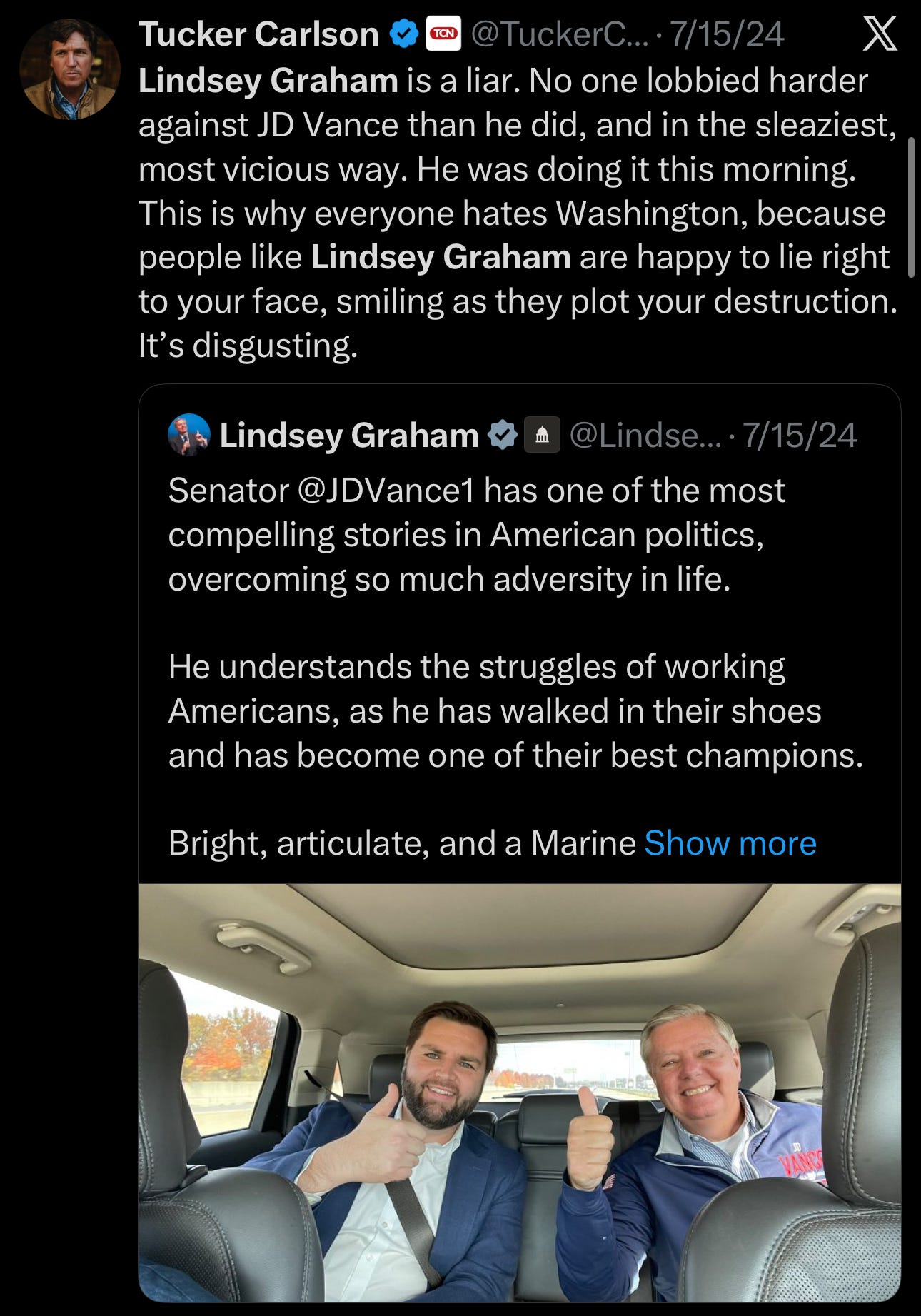
And now, as any Game of Thrones reader knows, once the factions are clear, so is the battlefield.
There are only two forces left on the board:
America First — and the system that must prevent it.
The cover-up was never about evidence.
It was about preventing the Charlie–Tucker–Vance–Kent axis from pulling the thread that reveals the architecture beneath the crime.
They did not stop the truth by killing Charlie.
They stopped the investigation — and hoped the truth would die with it.
What Remains is The Second Front of The Doctrine.
48-Hour Doctrine: Part II will examine how the structure moved through JD Vance, Lindsey Graham, the donors, Netanyahu, and Erika Kirk.
The same architecture that closed around Charlie did not stop with him.
Intro to “Israel’s Global Doctrine of Fragmentation”
How Covert Operations and Strategic Instability Shape the Modern World
If you think Israel’s doctrine operates only inside American politics, you’re wrong.
What you saw in Israel’s Doctrine of Succession is just the domestic front. The same architecture functions globally — far older, broader, and far more destructive.
This investigation shows how Israel expanded its internal doctrine into a worldwide strategy of engineered instability, rooted in David Ben-Gurion’s Periphery Doctrine.
What began as regional alliances evolved into something far more aggressive:
the export of fragmentation — weakening states, inflaming divisions, and shaping conflicts to maintain strategic advantage.
You’ll see how this doctrine expresses itself across continents:
- Middle East: Syria’s collapse, Iraq’s fracture, Lebanon’s paralysis.
- Africa: Sudan, Somalia, Nigeria, — destabilized in patterns that match the doctrine’s logic.
- Latin America: indirect pressure through U.S. sanctions on states like Venezuela at Israel’s urging, producing economic collapse and mass migration.
The global refugee crises tearing through Europe, the Americas, and Africa are not accidental.
They are the predictable outcome of a system designed to break regions before they can challenge Israeli interests and the elites who profit from permanent instability.
If Israel’s Doctrine of Succession explains how power is bent inside the United States…
Israel’s Doctrine of Fragmentation explains why the world keeps breaking in the same places.
Final Judgment — LBJ & Angleton at the Center of the Machine
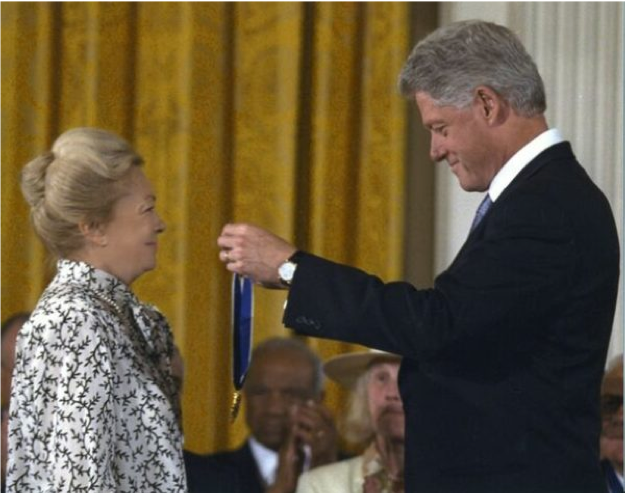
Strip away speculation.
Strip away personalities.
Follow only the structure.
LBJ was the one man whose rise instantly solved every crisis Kennedy created for the entrenched networks around Israel, Angleton, and the CIA.
Five facts survive every revision of history:
1. LBJ restored every force Kennedy had removed.
Within days LBJ reinstated the CIA and counterintelligence figures JFK had sidelined — most importantly James Jesus Angleton, who re-consolidated his Israeli channel and resumed the very operations Kennedy had begun to dismantle.
2. LBJ controlled the investigative machinery.
From the moment he seized the Oval Office, he dictated the posture of the FBI, the Warren Commission, and every channel of inter-agency communication.
Then came the clearest signal of all:
LBJ reinstated Allen Dulles — the CIA Director Kennedy had fired for lying, running unauthorized covert wars, and deceiving the White House — and placed him on the commission responsible for determining the truth of Kennedy’s death.
A dismissed spymaster was returned to power to judge the event that removed the president who dismissed him.
There is no lens — legal, historical, or moral — through which this can be interpreted as anything but outcome orchestration.
LBJ did not want an investigation. He wanted a verdict.
And Hoover delivered it immediately.
On November 24, 1963, the FBI Director issued the instruction that froze the narrative before evidence existed:
“The public must be convinced that Oswald acted alone.”
— J. Edgar Hoover, internal memo, Nov. 24, 1963
This was not analysis. It was command.
A command crafted to protect LBJ — and the Irgun genealogy that arrived through Mathilde Krim, once an operative of the proscribed terrorist force that became the Likud machine Netanyahu now leads.
3. LBJ oversaw the suppression grid — including the Secret Service.
The declassified Secret Service document is not rumor.
It is a federal record of a pre-assassination statement, officially filed only after the killing, when the machinery of silence was already in motion:
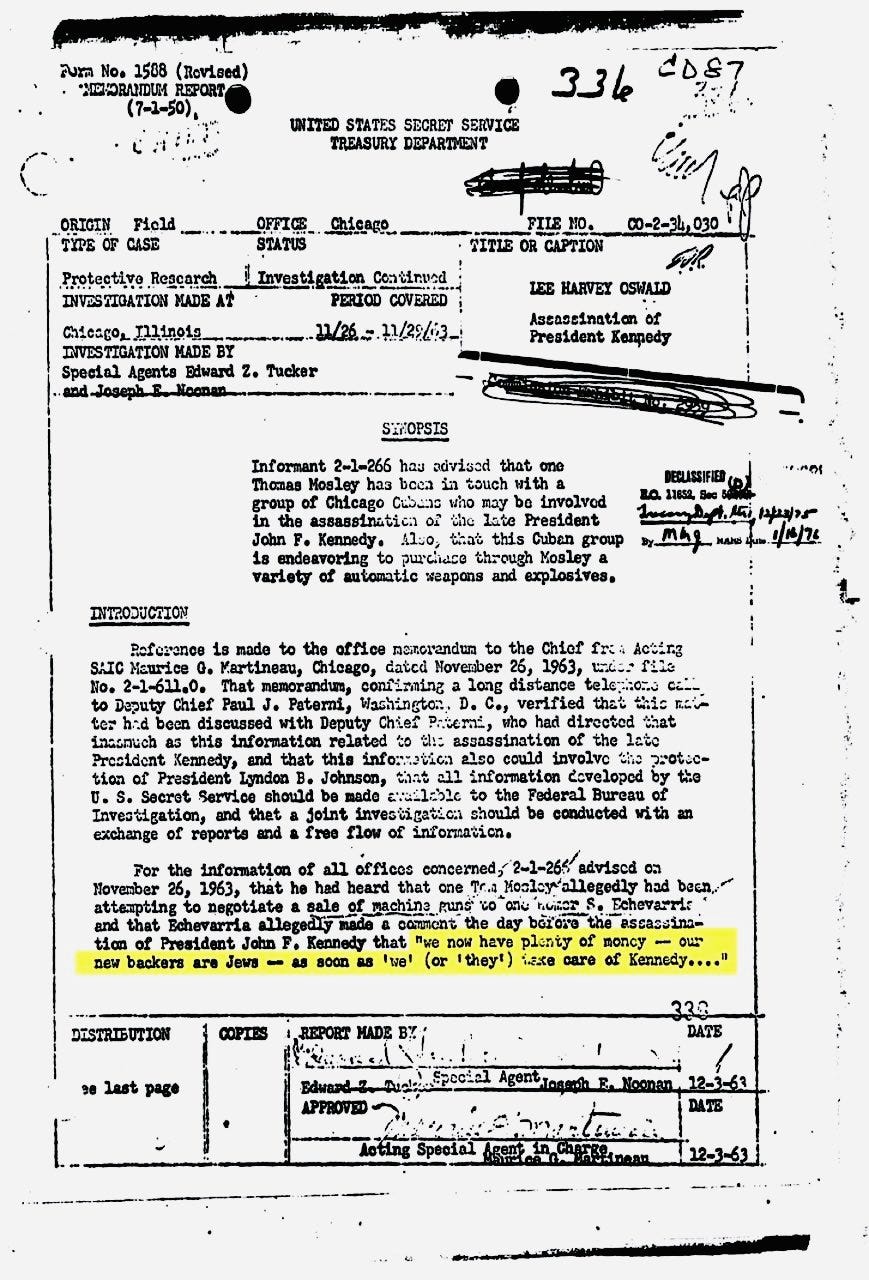
It records a statement made the day before Kennedy was shot, but the federal system only logged it after the killing, when the cover-up machinery was already in motion:
“We now have plenty of money — our new backers are Jews — as soon as we (or they) take care of Kennedy…”
— U.S. Secret Service, Chicago Field Office, filed Dec. 3, 1963
Three elements in nine words:
Funding. Foreign-aligned stakeholders. A timetable for removal.
Instead of sparking investigation, it was neutralized — exactly as Hoover’s directive ensured.
This is not how you solve a presidential assassination. It is how you bury one.
The Motorcade — A Manufactured Vulnerability
Dallas police officers and Secret Service agents themselves later testified that the motorcade’s configuration on November 22nd was “highly irregular” and “unusually exposed.”
- Motorcycle units were reduced from the standard protective diamond to a minimal formation — confirmed by Dallas Police Chief Jesse Curry and Officers Stavis Ellis and Bobby Hargis, who both stated they were shocked at the thinning of the flanking escort.
- Agents were ordered off the presidential limousine’s rear bumper, per statements by former Secret Service agent Clint Hill and multiple Warren Commission testimonies.
- The route was altered to make the sharp deceleration turn into Dealey Plaza — a change documented in the Dallas Police files and the Warren Report.
- Sheriff Bill Decker’s deputies were told to stand down, a fact recorded in his office’s own operational instructions.
These were not tactical mistakes. They were conditions conducive to success.
4 – The Intelligence Compartment
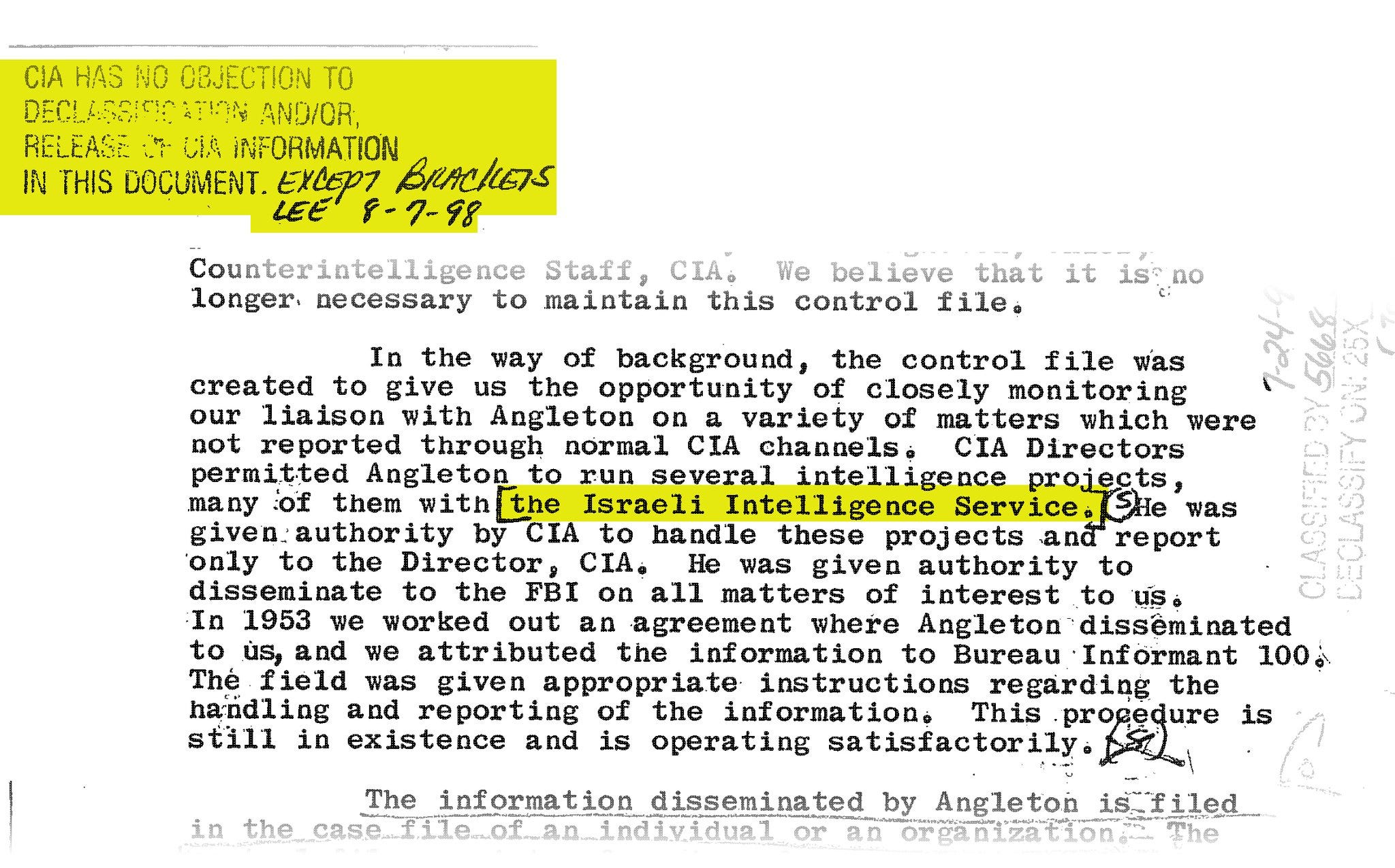
Reuben Efron sat inside Angleton’s CI/SIG not as a mastermind, but as a marker, the Israeli-linked interpreter reading Oswald’s mail under a program Angleton controlled.
And the CIA’s own memo above confirms the hierarchy:
all Angleton files were cleared for release except those involving his Israeli intelligence projects.
The channel wasn’t incidental. It was protected — by Angleton, by CIA leadership, and by the architecture surrounding the Oswald file.
5- The Day After — Replacement in Plain Sight
Jackie Kennedy walked out of the White House.
Mathilde Krim — Irgun lineage, Likud antecedent — walked in.
Smiling photographs. Cocktails. Relaxed intimacy. This was not transition.
It was succession.
The Irreducible Core
LBJ made it possible.
Angleton made it invisible.
Likud’s lineage made it permanent.
When Kennedy fell, LBJ empowered Angleton, protected the CIA’s Israeli channel, and opened the door for the Irgun–Likud worldview to enter the White House.
Give Me a Place to Stand — And I Will Expose the Empire That Once Took a President, Attacked a Ship, and Now Hunts Its Own Dissidents
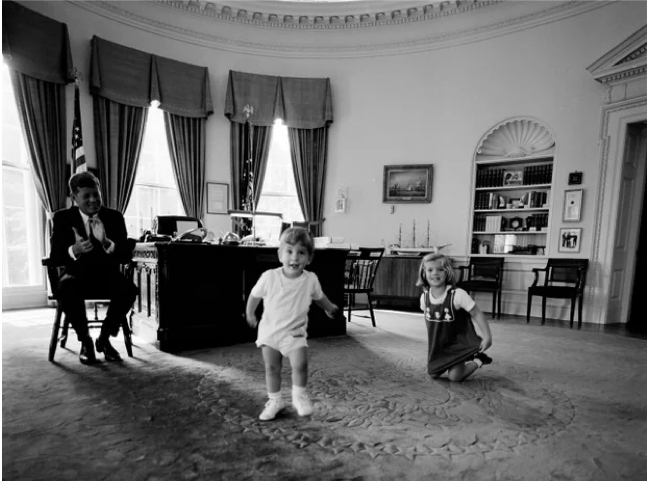
Few remember where that line came from.
It was John F. Kennedy, standing before the United Nations General Assembly, calling the world’s leaders toward peace with a conviction so unguarded it felt like a challenge to history itself:
“Give me a place to stand, and I can move the world.”
He spoke those words in 1963 as both a plea and a warning.
To Kennedy, peace was not an ideal — it was a strategic lever, a force capable of resetting the trajectory of nations.
But peace is also the one thing the doctrine cannot survive.
And it is no coincidence that the president who demanded nuclear inspections, transparency, and justice for the refugees was the one removed — setting into motion the chain that would culminate in the USS Liberty, the decades of covert alignment, and now the pressure campaigns against American dissidents who refuse to bow to foreign interests.
This is the Place where silence ends.
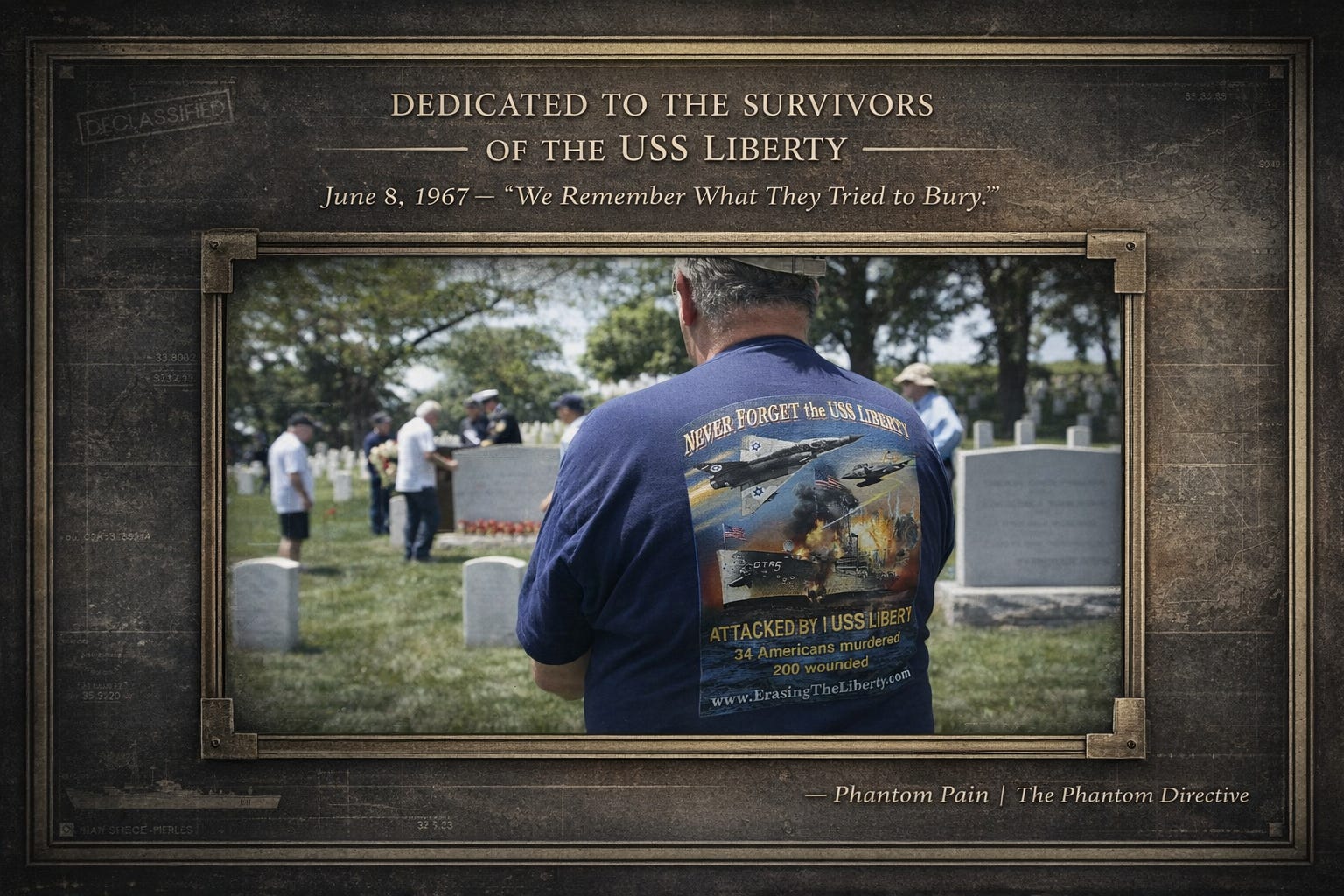
The UN Speech That Triggered the Succession Machine
https://phantompain1984.substack.com/p/israels-doctrine-of-succession