
Jokes, Jews, & Gentiles
The question is whether the Jew as such, that is, the Jew who himself admits that he is compelled by his true nature to live permanently in separation from other men, is capable of receiving the universal rights of man and of conceding them to others.
—Karl Marx, On the Jewish Question
***
“Noticing” can be a crime, as Steve Sailer elaborated in his book, Noticing: an Essential Reader (1973–2023) . To “notice” aspects of reality that challenge politically correct articles of faith can be a perilous undertaking that may end your career, blacken your reputation, alienate friends and family. Consider what happen to science titan, James Watson for “noticing” certain aspects of IQ and race.
In that light, I ponder these days about how tricky it is to talk about “Jews.” Or should I say, “things Jewish.” Perhaps I am paranoid, but am I the only person who has noticed how circumspect one must be in choosing between the adjective “Jewish” and the noun “Jew” when in polite company one speaks about the current and past comings and goings of … well, “Jews,” or people who happen to be “Jewish”?
Compare these two responses to the question: “Do you know the family who moved in across from the Clarks?”
“You mean the Jews who moved in three months ago?”
“You mean the Jewish family who moved in three months ago?”
The first response, I would wager a hefty sum, would arouse immediate suspicion of “antisemitism” from the conversation’s initiator. The second response is much safer. “Jewish” comes off simply as a modifier attached to an innocuous noun simply to help confirm the identity of the family for the questioner. More like, “Oh, yes, the black family” or the “Vietnamese family.”
From my experience, Jews are uninhibited about referring to themselves as “Jews.” Most Jews I have met very quickly after making their acquaintance let me know that they are Jewish—typically referring to themselves as “Jews.” Jews seem very inclined to muse about being Jewish around their gentile friends, perhaps as a subtle reminder of a separation that can never, nor should, be completely overcome. Jews in many different ways maintain a focus on their Jewishness. That makes it continuously, consciously complicated for Gentiles to talk candidly about Jews. Jewish conduct over the last two years in Gaza has greatly heightened that complication as evidenced by the attempts in the U.S to criminalize speech that criticizes the ethnic cleanings underway conducted by the state of Israel under the rationale of “self-defense,” keeping “Orwellian” relevant in the 21st century.
Jews like to joke about being Jews, and this bespeaks to something that may not be immediately evident about an outsized source of Jewish cultural power, i.e. Jewish humor. Professional American comedy, a subset of the entertainment industry, has been overwhelmingly dominated by Jews for the last one-hundred years. In 1978, Time magazine claimed that 80 percent of all stand-up comedians in the United States were Jewish. And this at a time when Jews made up only 3% of the U.S. To cite just a sampling of American Jewish comedy-stars, both male and female, ranging across many decades: Groucho Marx, George Burns, Joan Rivers, Gilda Radner, Roseanne Barr, Jack Benny, Don Rickles, and Jerry Lewis. More recently: Jon Stewart, Jerry Seinfeld, Larry David, and Sarah Silverman.
One of my favorites was Jackie Mason, whose routines focused heavily on themes that enforced negative Jewish stereotypes.
“Money is not important. Love is important. Fortunately, I love money.”
“My grandfather always said that I shouldn’t watch my money. That I should watch my health. So while I was watching my health, someone stole my money. It was my grandfather.”
Mason’s Jewishness, apart from his comedically cultivated Jewish persona, is particularly notable for certain supremacist features. Born in 1928, Yacov Moshe Maza, Mason was an ordained rabbi. He is reputed to be an admirer of Rabbi Meir Kahane, founder of the Jewish Defense League whose sole purpose was to combat antisemitism—“combat” as in physical attacks on “enemies of the Jewish people.” Kahane was convicted of multiple acts of terrorism in the U.S. and in Israel. Mason is quoted as saying in the Evening Star (March 7, 1971): “Democratic principles shouldn’t apply to Israel like they do to America.”
Humor has enormous subversive power in its capacity to expose the vulnerabilities of power elites with the use of ridicule. For an outgroup gifted with linguistic and dramaturgical skills seeking to destabilize or subvert a system perceived as oppressive, they are frequently employed with great precision and effectiveness. Recall Saul Alinsky’s Rules for Radicals, rule number five: “Ridicule is man’s most potent weapon. It’s hard to counterattack ridicule, and it infuriates the opposition, which then reacts to your advantage.” A comedian’s protection against counterattack for ridicule lies in his professional status as a jokester, a feigned non-serious person whose act is intended simply to entertain, to elicit laughs. “Hey, I’m joking! Whatsa matter, can’t take a joke?” Jon Stewart, born Jon Stewart Leibowitz, is perhaps the perfect illustration of this. Hip and an expert in comedic mugging for the cameras, Stewart hosted the extremely popular Daily Show on Comedy Central where he routinely mocked Republicans, conservatives, and Christians. Stewart was a master of gaslighting his critics, as he would invoke his “comedian” status, disavowing the “seriousness” of his tirades, while launching waves of devastating ridicule at them to the roaring approval of his studio audience.
All of this points to a crucial element of humor, the role of comedy in shaping culture. One can’t help but notice the profound effects Jewish comedy has had since the 1960s cultural shift of America to the left with the embrace of multiculturalism and the push for “sexual liberation” that would erode the structure of the traditional American family.
Think of the career of Lenny Bruce in the early 1960s as a milestone in what would lead to the ubiquitous vulgarity of current popular culture with its relentless efforts to normalize what was widely regarded as obscene and pornographic and to sexualize the lives of young children. According to his Wikipedia page, Bruce (who died of a heroin overdose at age 40), “forged new paths in comedy and counterculture. His trial for obscenity was a landmark of freedom of speech in the United States.” This is the patois favored by our self-proclaimed progressives: “forging new paths,” “breaking boundaries,” “expanding freedom”—language that camouflages the nihilism behind the imagined “arc of history bending toward justice.” They never ask: what is “new” about the “new paths”? And, are we better off where they take us? What is so wrong with the “boundaries” that they need to be “broken”? Is the limitless expansion of “freedom” unquestionably desirable?
Think, also, of the career of Norman Lear, an American screenwriter and producer who produced, wrote and created over 100 television shows. Lear, as well as being an incredibly prolific and creative producer of situation comedies, was tirelessly active in supporting and funding “progressive” and liberal causes. In 1980 he personally founded People for the American Way, a “progressive” advocacy group whose purpose was to combat the influence of the Christian right. Edgy, ribald comedy challenging long-established standards of decency for public entertainment was piped into the living rooms of millions of Americans. One intended outcome was the demolition of those standards such that fifty years later all barriers to excessive profanity, explicit sexual portrayal, and graphic violence in the entertainment industry are gone. Lear would deploy his comedic genius as a powerful weapon to subvert the forces of which he perceived as ruling an illiberal, reactionary, bigoted Christian America.
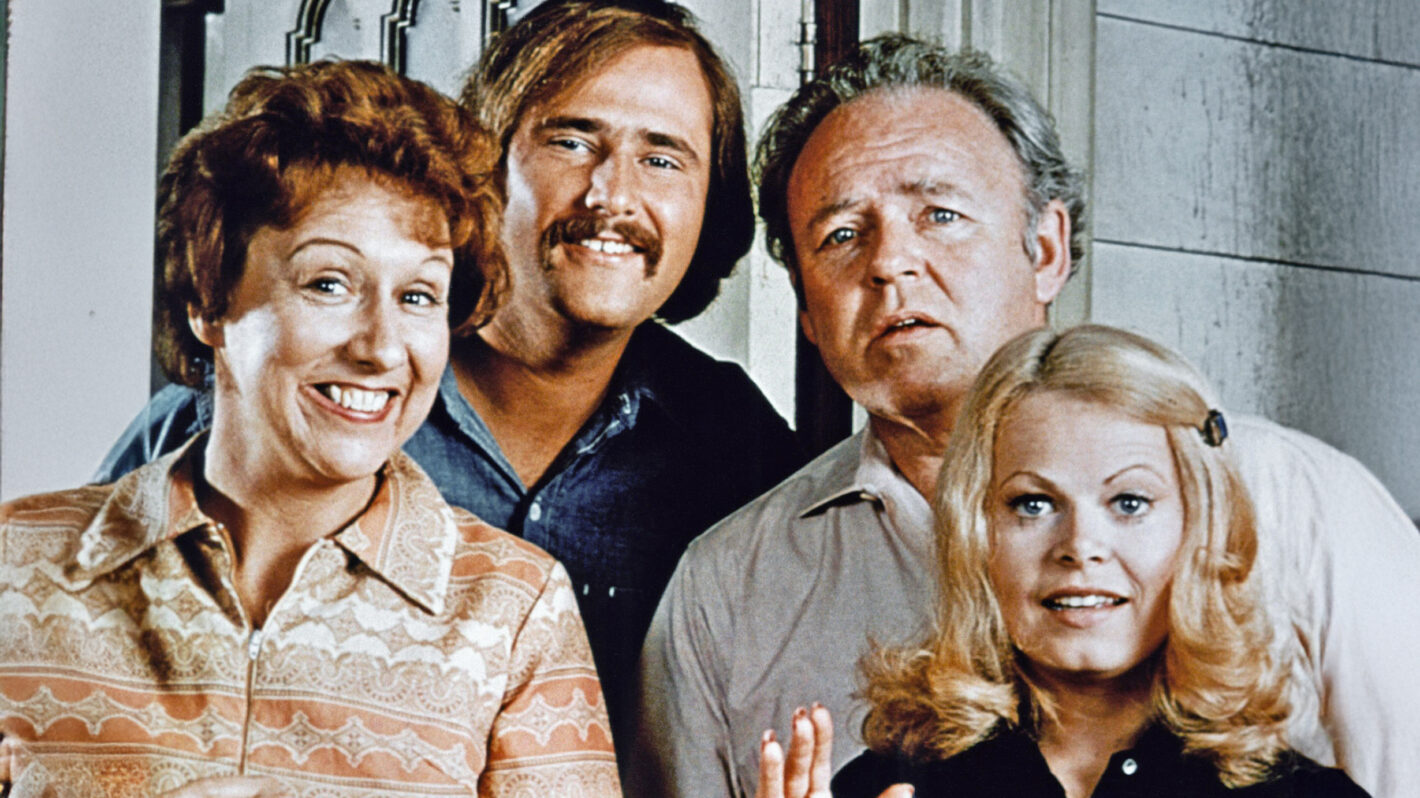
Lear, who died in 2023 at 101 years of age, had what was perhaps his greatest “progressive” achievement with All in the Family, a hugely popular sitcom which ran throughout almost the entire decade of the 70s (January 12, 1971, to April 8, 1979, with a total of 205 episodes). Here is how the sitcom is represented in its Wikipedia page:
[The show] broke ground by introducing challenging and complex issues into mainstream network television comedy… The series became arguably one of television’s most influential comedies, as it injected the sitcom format with more dramatic moments and realistic, topical conflicts.
The show certainly “broke ground” (“breaking” is always good) with the “challenging and complex issues that infused most of the episodes. However, it was not the infusion of these “issues,” but the ideological framing of these issues within the plots and character development that with the so called “realism” made it so different from the typical sitcom of the 1950s (I Love Lucy) and 1960s (I Dream of Genie). Both were rife with “sexist” themes abhorrent to the coming tsunami of 1970s feminism.
All in the Family was built around a generational conflict that pitted the counterculture of the 1960s against the older Waspish WWII generation with Carroll O’Connor’s masterful acting that made his character “Archie Bunker” an eponym for a broad spectrum of bigotry – anti-black, antisemitic, homophobic, male chauvinist. In this generational conflict, Archie, crudely, helplessly, obtusely resists the burgeoning “enlightenment” of his counterculture-inspired feminist daughter, Gloria, and fellow traveler son-in-law, “Meathead” Mike. Across the ’70s decade that this show ran, its unprecedented success was evidenced by the transition of the counterculture into its place as main steam. All the “isms” and “phobias” would be firmly fixed in the daily vocabulary of Americas without their complete realization as weapons to destabilize old order. The totality of its ideological components—feminism, egalitarianism, anti-racism, and sexual liberation—would guide those who eventually took command of America’s social and political institutions. Archie symbolized the morally corroded old order, swept away by agents of enlightened thinking who make the world a better place. Lear’s genius was, with his comedic tools, to make what was a “revolution” seem so natural, so inevitable, so much fun to watch. How many of the millions out there in TV Land grasped the nature of manipulation that was underway with agitprop skilfully masked as “entertainment”?
To see where the “new paths” of 60s Lenny Bruce and Norman Lear’s New American Way of the 70s and 80s were headed, fast forward to the 21st century and another popular Comedy Central Jewish comedian, Sarah Silverman. From her Wikipedia page:
Her comedy roles address social taboos and controversial topics, including racism, sexism, homophobia, politics, and religion, sometimes having her comic character endorse them in a satirical or deadpan fashion.
No one needs to guess who the bad guys are going to be with any of these “controversial topics”; the usual yahoo-suspects carried over from the heady 1960s: patriarchs, antisemites, homophobes, white racists, and traditional Christians. What distinguishes Silverman’s 21st century style of comedy bent on smashing boundaries and taboos is its unremitting coarseness and vulgarity at a level few people a generation or two earlier would imagine. “On September 13, 2008, Silverman won a Creative Arts Emmy Award for writing the song ‘I’m Fucking Matt Damon.’” This is what now garners acclaim by the cultural gate keepers who decide what counts as “creative” and who gets the laurels.
But to reflect a moment longer on taboos. Old ones are gone, but new ones are firmly in place and are rigidly enforced, specifically those that protect the central dogma of the left reaching back to the French revolution: equality, with the corollary that “inequality” is an unnatural state created by an oppressor class. Anyone who dares to question the eligibility of any group awarded the officially approved status of “victim” of oppression will be punished as a carrier of what might be regarded as “moral leprosy.” It presents in different forms—racism, sexism, homophobia, and the more recently discovered “transphobia”—and to prevent its contagion, carriers are banished from the workplace and polite society.
Jews joke about Jews, as I noted above. That said, the real jokes are on the Gentiles. One does not have to be sociologist or political scientist to understand that, using its immense imaginative powers, the entertainment industry has for decades used that power to advance ideological goals inimical to the interests of non-Jews, especially white people and Christians. Thus, the mere mention of the “entertainment industry” leads us back to the complications relating to the constraints of gentiles when they want to talk about Jews, particularly when that talk relates to those sectors in American society where Jewish power is concentrated.
The Anti-Defamation League (ADL) is a hugely funded organization dedicated to monitoring the pulse of “antisemitism” – like “racism,” always on the rise – in the U.S. It is an ever-vigilant thought-police-agent that exclusively and aggressively protects Jewish interests. The ADL is particularly sensitive to the widely held and, what would appear to be a fact-based view, that the Jews control the key components of the entertainment industry, including Hollywood. See An Empire of Their Own: How the Jews Invented Hollywood:
The assertion that Jews “control” Hollywood, the media, banking and finance, among other things, is an anti-Semitic canard which dates back more than 70 years to an anti-Jewish campaign waged in the 1920s by the Dearborn Independent, a long-defunct publication backed by the late industrialist Henry Ford Sr.
Got that? In a single sentence: “anti-Semitic canard,” “anti-Jewish campaign” going back “more than 70 years,” “Henry Ford Sr.” (famous anti-Semite)—all the angles of bullet-proof victimhood are covered. Transgressors beware!
“Hollywood is run by Jews” is a no-no for non-Jews to say. But what do Jews say about Hollywood?
Joel Stein in the Los Angles Times:
I have never been so upset by a poll in my life. Only 22% of Americans now believe “the movie and television industries are pretty much run by Jews,” down from nearly 50% in 1964. The Anti-Defamation League, which released the poll results last month, sees in these numbers a victory against stereotyping. Actually, it just shows how dumb America has gotten. Jews totally run Hollywood… The Jews are so dominant, I had to scour the trades to come up with six Gentiles in high positions at entertainment companies. When I called them to talk about their incredible advancement, five of them refused to talk to me, apparently out of fear of insulting Jews. The sixth, AMC President Charlie Collier, turned out to be Jewish.
As a proud Jew, I want America to know about our accomplishment. Yes, we control Hollywood. Without us, you’d be flipping between The 700 Club and Davey and Goliath on TV all day.
Jews and gentiles, each group with a different set of rules for talking about Jews; rules for both groups set by the Jews. All of this proves the adage: “If you want to know who rules over you, just look for who you are not allowed to criticize.”