
MAHA Played Key Role in Defeating Big Pharma Shill Bill Cassidy in Louisiana
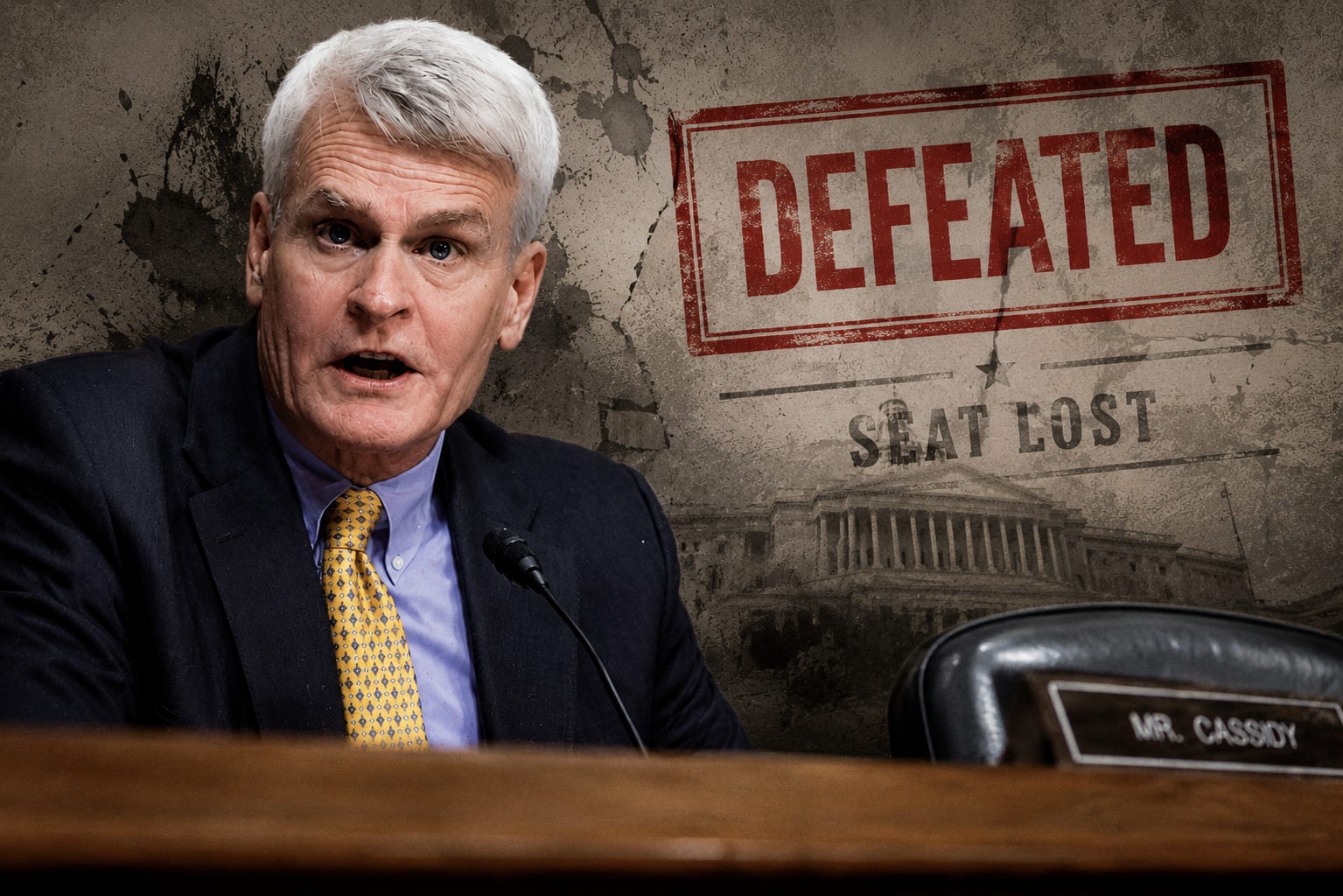
Bill Cassidy lost his Senate seat Saturday. Every outlet says it was Trump’s revenge. They’re missing three other reasons — and the most important story of what comes next.
When Senator Bill Cassidy finished third in Louisiana’s Republican primary on Saturday, every major news outlet reached for the same explanation. Trump’s revenge. Retribution. Vengeance tour. The words were nearly identical across CNN, NPR, BBC, Reuters, Fox News, and the New York Times — a unanimity so complete it should itself prompt a question.
When every outlet in a corpus uses the same three words, you’re not reading independent journalism converging on truth. You’re reading a consensus frame. And consensus frames, however useful for quick comprehension, have a way of making inconvenient complexity disappear.
Here is what disappeared this weekend.
I Was in That Room
Eight months before Cassidy lost his seat, I was sitting in the Senate HELP Committee hearing room on September 17, 2025.
The hearing was titled “Restoring Trust Through Radical Transparency.” Kennedy was not invited to testify. His accusers were. Two former CDC officials — fired or departed under his tenure — sat at the witness table. The Guardian published a piece within minutes of the hearing’s conclusion that read, in structure and substance, as though it had been written before the gavel fell.
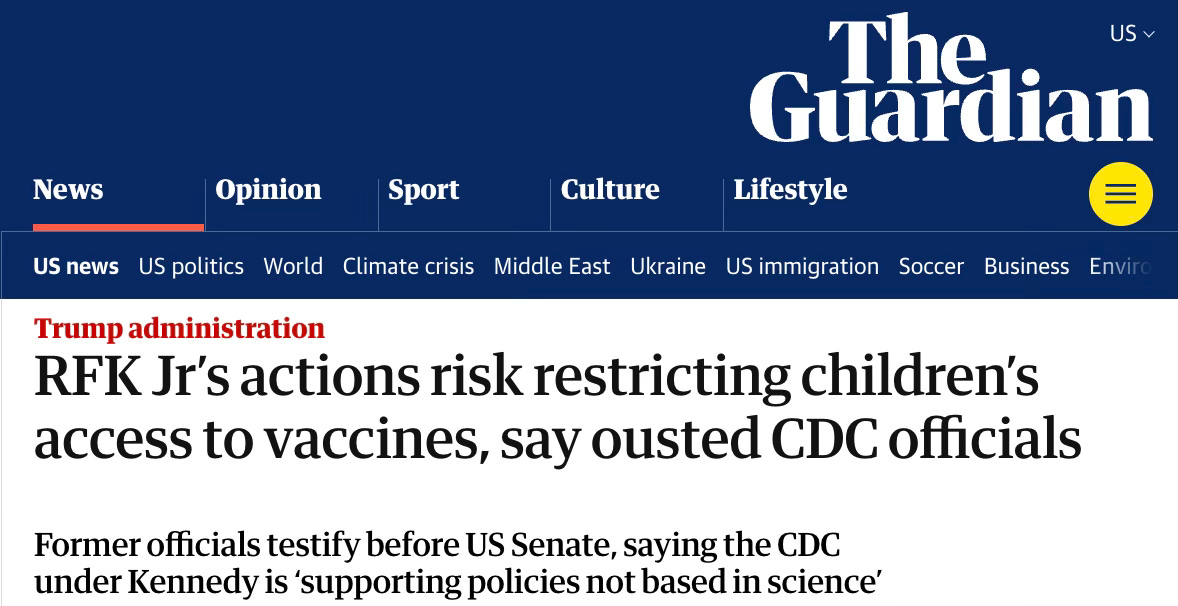
I watched Cassidy chair that hearing. What I observed was a man who believed he was executing a plan that was already working.
He was wrong.
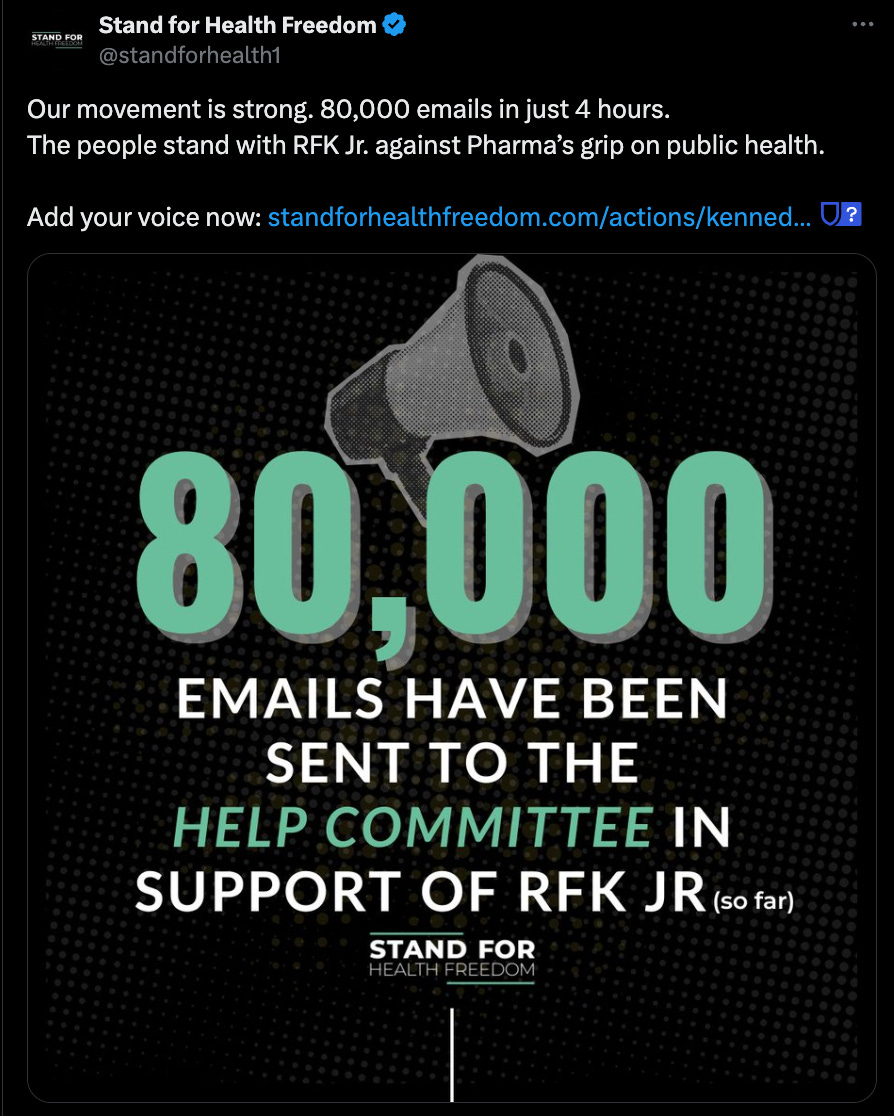
Within 24 hours, 80,000 constituent contacts — emails and calls — flooded congressional offices in response. I have co-founded Stand for Health Freedom for years. I have never seen a response like it. That single 24-hour mobilization exceeded more than half the total contact volume we generated during the entire month-long run-up to Kennedy’s Senate confirmation. One day. Eighty thousand people.
Cassidy reversed course the following day. He announced he would invite Kennedy to testify — the opportunity for response that had been deliberately denied at the original hearing. That was not the plan. That was the plan failing.
By then, we had already won that battle.
What Politico Had to Acknowledge — Then and Now
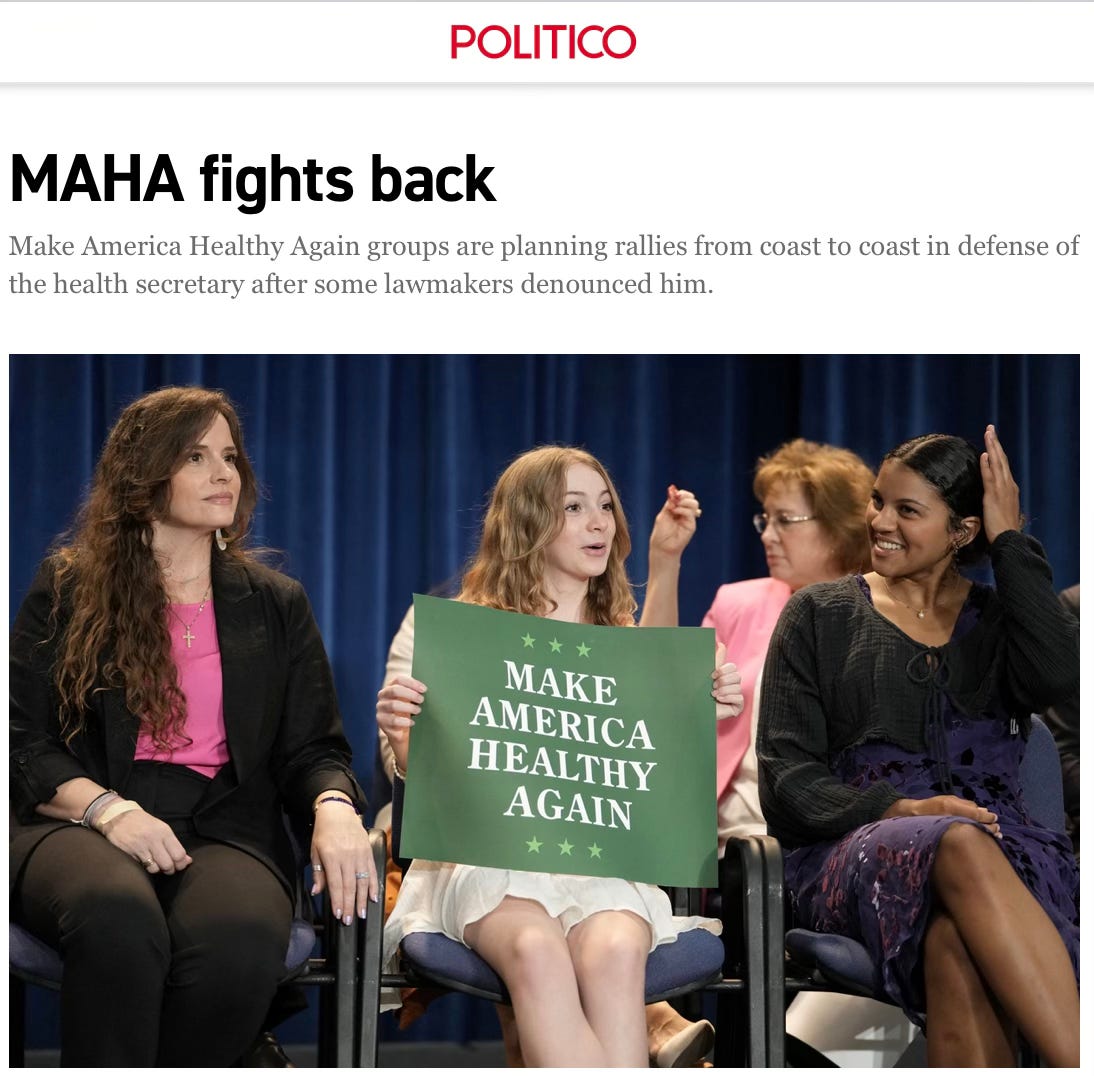
The day after the September hearing, Politico published something remarkable. Under the headline “RFK Jr.’s movement is coming to his defense,” they reported rallies planned in nearly a dozen cities — from Florida to California — to “show lawmakers that MAHA represents a powerful political force” and that opposing Kennedy carries “their own political risk.”
Politico also acknowledged my own prior reporting — noting Kennedy supporters had “alleged before the hearing a plot by pharmaceutical interests to get Kennedy fired.” That allegation was grounded in a leaked April 2025 memo from the Biotechnology Innovation Organization, independently reported by STAT News, showing BIO leadership concluding it was time to “go to The Hill and lobby that it is time for RFK Jr. to go” — and naming Cassidy specifically as a “strategic ally.”
Tony Lyons told Politico directly: “Cassidy is defending corrupt corporate-sponsored science.”
Calley Means said MAHA would “defeat what are clearly some very subversive and dark forces trying to tell the American people that these positive actions are a threat to public health.”
Politico printed both without rebuttal. That was September. Now it’s May.
This weekend, Politico returned to the same story — and went further. Under the headline “How Cassidy’s loss could turn into an even bigger win for RFK Jr.,” they reported that Senator Roger Marshall of Kansas — founder of a MAHA caucus in the Senate, who once said he’d “never seen a person whose words have been so misattributed, exaggerated, sensationalized and taken out of context” as Kennedy’s — is actively angling to replace Cassidy as chair of the Senate Health Committee.
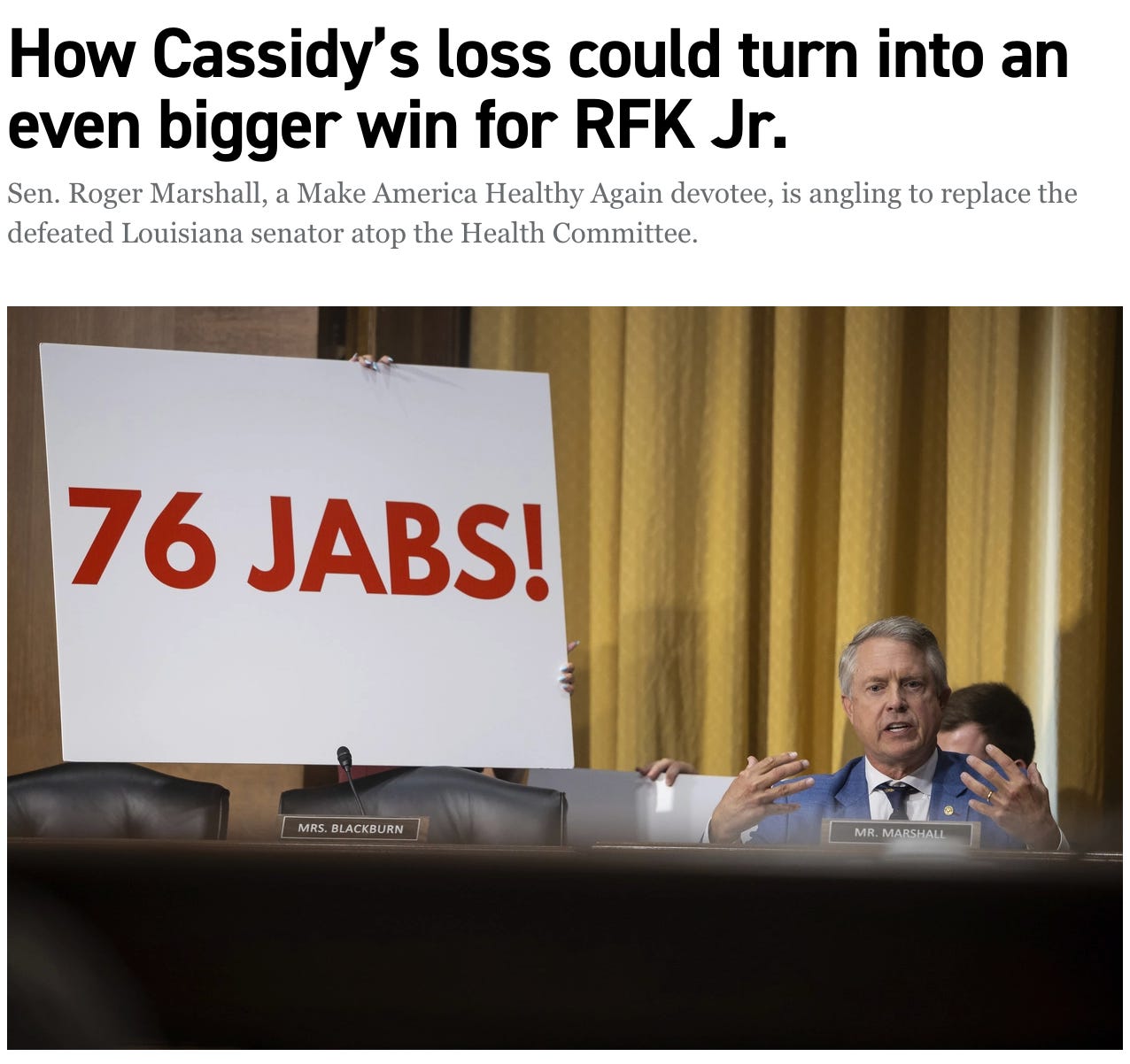
That matters concretely. Cassidy’s Health Committee blocked three Kennedy-aligned nominees: CDC director nominee Dave Weldon, and two surgeon general picks, Janette Nesheiwat and Casey Means. All three were withdrawn because of the impasse. A Marshall chairmanship changes that calculus entirely.
Politico noted this directly: Cassidy’s loss “could turn into an even bigger win for RFK Jr.”
This is not the “Trump retribution” story. This is a policy story about the composition of a Senate committee that directly shapes American health governance. And MAHA is at the center of it.
The Four Causes Nobody Is Counting
Cassidy lost Saturday for at least four documented reasons. The consensus frame gives you one.
The first is real and dominant: Trump endorsed Letlow, campaigned hard, and called Cassidy a “sleazebag” on Truth Social. That mattered enormously.
The second received almost no coverage: Louisiana’s newly implemented closed primary system, signed by Governor Landry, effectively disenfranchised the unaffiliated voters who formed a critical part of Cassidy’s coalition. Cassidy’s own campaign manager called it an “intentionally difficult process.” In a race decided by margins, that structural change was significant — and virtually no national outlet reported it.
The third was Landry’s own active opposition. Also largely unreported.
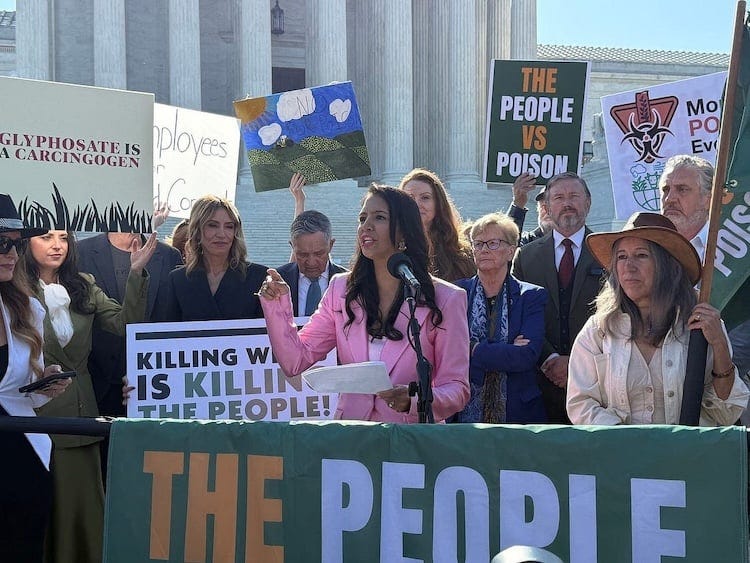
The fourth is MAHA. MAHA PAC spent six figures opposing Cassidy in Louisiana. The movement that had generated 80,000 contacts in 24 hours the previous September had not forgotten what happened in that hearing room. MAHA was not acting as Trump’s instrument. It was acting on its own political logic — the logic of a movement that watches who chairs one-sided hearings against the official they sent to Washington to reform captured health agencies, and responds accordingly.
What the Single-Cause Narrative Hides
The “Trump retribution” frame is not wrong. It is incomplete in a way that serves a specific purpose: it makes MAHA invisible as an independent political force.
Under the retribution frame, MAHA’s role disappears entirely. The movement that mobilized 80,000+ grassroots contacts in a single day, that spent real money in this primary, that has been building genuine cross-partisan constituency for years — that movement becomes a passenger in Trump’s vehicle rather than a driver with its own destination.
CNN’s own polling showed Kennedy with the highest net favorable rating of any Trump administration official — sitting at minus 7, significantly outperforming Pete Hegseth at minus 14, JD Vance at minus 11, and Marco Rubio at minus 10. That number tells a story about a genuine political constituency that the retribution frame makes invisible.
That constituency watched what happened in the September hearing. It responded in 24 hours. It showed up in Louisiana on Saturday. And if Roger Marshall takes the Health Committee chair — giving Kennedy an ally where Cassidy placed an obstacle — it will have shaped the trajectory of American health policy in ways that have nothing to do with Donald Trump’s personal grievances.
What Comes Next
For any lawmaker calculating the political cost of opposing MAHA’s agenda: Cassidy’s primary is a data point worth studying. Not because MAHA alone defeated a senator — the Louisiana race involved forces far larger than any single movement. But because MAHA demonstrated it can be a meaningful, independent factor in a contested race.
The movement holds receipts. It demonstrated that in September. It demonstrated it again on Saturday.
Washington is taking notice. The question now is who chairs the Health Committee — and whether the institutional obstruction that blocked three Kennedy nominees gets replaced by genuine oversight aligned with the public health reforms that 80,000 Americans demanded in a single day.
Democracy is not a spectator sport. Neither is MAHA.
https://sayerji.substack.com/p/why-cassidy-really-lost-the-story