
My WIFI is Watching Me Suffer
There is a box in your house right now, blinking a friendly little green light, that can tell whether you are standing or sitting. It can count your breaths. It can find your heartbeat through a closed door. It can sketch the outline of your body in the dark, in the next room, while you think you are alone.
You bought it yourself. You probably rent it from the cable company for fourteen dollars a month.
It is your Wi-Fi router, and the dirty secret of the last twenty years is that it was never just moving Netflix into your eyeballs. It was also reading the room. Literally. All of them. And the only reason you are hearing about this NOW instead of in 2013 is that the people who built it were waiting on one missing ingredient, which arrived on schedule, which is the part that should make the hair on your neck stand up. The ingredient was artificial intelligence smart enough to read what the router was already seeing. It arrived in 2022.
Dina Katabi Built Superman’s X-Ray Vision And Nobody Panicked
Let us go back to the scene of the crime, which is an MIT laboratory, which is where most of the things that eventually terrify you are born.

The name is a mashup of “Wi-Fi” and “vision,” because academics are required by federal law to name their surveillance tools like they are pitching a Saturday morning cartoon. Wi-Vi did one thing. It used ordinary Wi-Fi signals to detect a human being moving on the OTHER SIDE OF A WALL.
Then they built a sequel, because of course they did, and they called it WiTrack. WiTrack could pin a human body’s location in three dimensions to within about four to eight inches. It could track which direction your hand was pointing. And in a detail I want you to sit with for a moment, it could detect when a person FELL DOWN with 96.9 percent accuracy, from another room, using nothing but the radio waves bouncing off their collapsing body.
The press coverage at the time was adorable. Reporters compared it to Superman’s X-ray vision (true) and breathlessly explained how this would revolutionize VIDEO GAMING (sure). Professor Katabi herself pitched it as the future of the Xbox Kinect, where you could run down your real hallway to escape virtual enemies. Everyone clapped. Tech blogs called it “privacy-friendly” because it didn’t use a camera, which is a bit like calling a wiretap “privacy-friendly” because it doesn’t use a stenographer.
Within a couple of years the same broad family of research had moved from “is someone in the room” to “what is their breathing rate and heart rate while they sleep.” Radio waves, it turns out, are extremely nosy houseguests. They bounce off your rising chest. They bounce off your beating heart. The reflection comes back microscopically different, and a clever enough machine can read those differences like a doctor reading an EKG, except the doctor is in a van and you never consented to the appointment.
This was all public. Published. Peer reviewed. Presented at conferences with little name tags and bad coffee. And almost nobody outside the field noticed, because in 2013 the technology had a glass ceiling. The signals were a screaming mess. Wi-Fi doesn’t just bounce off you, it bounces off walls and furniture and the floor, and those reflections are tens of thousands of times stronger than the faint little echo coming off your body. Reading a human out of that noise was like trying to hear one specific cricket at a Metallica concert.
To get past that ceiling, you needed a pattern-recognition engine far more powerful than anything that existed in 2013.
Then AI was born.
The Part Where Facebook’s AI Learned To Draw Your Skeleton
In December 2022, three researchers at Carnegie Mellon University named Jiaqi Geng, Dong Huang, and Fernando De la Torre published a paper with a title so flat and bureaucratic that it functions as camouflage. The paper is called “DensePose From WiFi.” It reads like a tax form. It is one of the most quietly horrifying documents of the decade.
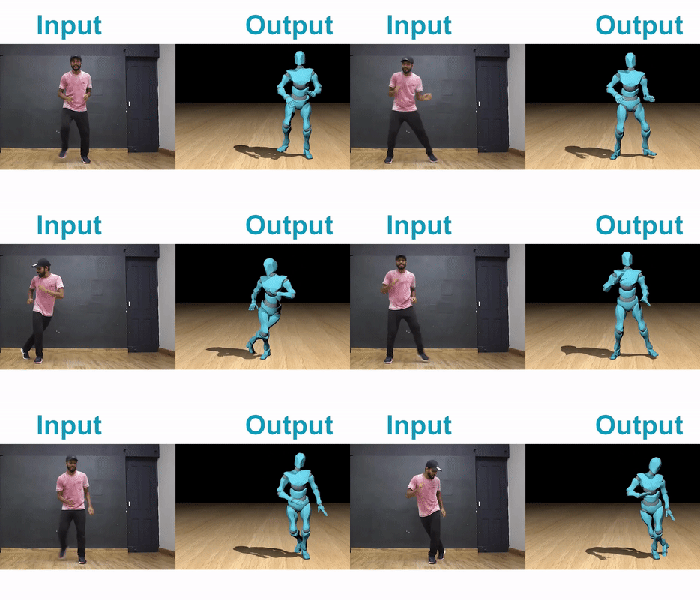
The Carnegie Mellon team fed DensePose a different diet. Instead of photographs, they fed it raw Wi-Fi signals. Just the radio. No camera. No light. They built a neural network that translated the phase and amplitude of ordinary household Wi-Fi into the SAME full-body maps DensePose produced from pictures.
The result, in their own dry academic phrasing, performed comparably to camera-based systems. It could map MULTIPLE people at once. It worked through occlusion, which is the polite scientific word for “walls.” A neural network looked at the invisible radio fog filling a room and reconstructed the living, posed, three-dimensional human bodies standing inside it.
That is the whole game right there. The router was always the camera. Artificial intelligence was the lens. The lens got ground and polished in 2022, and now the picture is in focus.
And before you comfort yourself that this requires a Carnegie Mellon laboratory and a research budget, I would like to introduce you to a man on the internet with one cheap circuit board.
Your Wi-Fi Is A Bat And You Are The Moth
Let me explain how this works, because once you understand the physics you will never look at the blinking green light the same way, and I consider that a public service.
Think of a bat. A bat screams into the dark, the sound bounces off a moth, and the echo that returns tells the bat exactly where the moth is, how big it is, and which way it is flying. The bat “sees” with sound. This is called echolocation and it is one of God’s more unsettling design choices.
Your Wi-Fi router is a bat that screams in radio. Every signal it sends bounces off everything in your home, including you, and a portion of every signal comes back. When you move, when you breathe, when your heart squeezes, those returning signals change in tiny, specific, measurable ways. The technical name for the detailed measurement of how a Wi-Fi signal got mangled on its round trip is Channel State Information, or CSI, which is also a network television franchise about people who reconstruct crimes from invisible traces, which I am choosing to believe is not a coincidence because nothing is a coincidence anymore.
CSI is the fingerprint. Your breathing leaves one. Your heartbeat leaves one. Your particular way of standing in your particular kitchen leaves one. Feed enough of those fingerprints to a hungry enough AI and you do not need a camera. You never needed a camera. The room itself becomes the camera, and you are always standing in the frame.
There is a class of hobbyist hardware called the ESP32. It costs roughly the price of a fast food combo meal. Curious people have flashed open-source firmware onto these eight-dollar boards, pointed them at themselves, and watched the thing detect their presence, read their breathing rhythm, estimate their pose, and track multiple people walking around a room. With ONE board, in an apartment, the output is admittedly janky. There is a famous demo where the software, confused by having only a single sensor, renders a frantic “ghost person” jittering around the real person like a haunted Roomba. It is genuinely funny to watch.
It is less funny when you remember that the janky ghost-person version runs on eight dollars of hardware and a weekend of free software. Then you remember that Qualcomm has baked Wi-Fi sensing directly into its commercial networking chipsets, available to any hardware company that wants to write the software for it. The eight-dollar version sees a ghost. Ask yourself what the version with a billion-dollar chip company behind it sees.
It does not see a ghost.
They Made It Official And Called It 802.11bf
Here is the part where the warning stops being theoretical, because the engineers stopped treating sensing as a clever side effect and started treating it as a feature to be standardized, branded, and shipped to everyone on Earth.
The IEEE, the global body that writes the technical standards every Wi-Fi device must follow, formed an entire task group whose sole purpose is turning your network into a sensor. The standard is called 802.11bf, also marketed under the focus-group-approved name “Wi-Fi Sensing.” It moved toward finalization in 2024 and 2025. Its explicit, written-down, not-hidden-at-all purpose is to standardize the use of Wi-Fi hardware to detect the “features” of “objects” in an “area of interest.”
Allow me to translate the engineering nouns. “Features” means range, velocity, motion, and biometrics. “Objects” means humans and animals. “Area of interest” means, and I am quoting the actual official documentation here, your home, your enterprise, and your vehicle.
So the official global Wi-Fi standard now includes a built-in protocol for one device to ask another device to please measure the humans in the house. This is not a leak. This is not a conspiracy I am dragging into the daylight. It is published on the IEEE’s own website with an agenda and meeting minutes, written in the deadening language of committee work, which is exactly how you hide a panopticon in plain sight. You do not hide it in a vault. You hide it in a 400-page technical amendment that nobody reads, sandwiched between sections on frame aggregation and quality-of-service tagging.
The genius of it is the deniability. There is no lens to cover. No microphone to unplug. No little camera dot to put tape over. The surveillance device is the same box that gives you the internet, and you will keep it plugged in and powered on twenty-four hours a day because the alternative is no Netflix, and we both know which one you are going to pick.
It Is Already In Your Living Room, Karen
I know what you are telling yourself. You are telling yourself this is all future-tense, a thing that COULD happen, a slippery slope that hasn’t been greased yet.
It shipped. It is in houses right now. Possibly yours.

It turns the router into the alarm system. No new sensors. No cameras. Just the Wi-Fi, watching. Origin Wireless, for the record, holds more than two hundred patents on the specific art of detecting motion through standard Wi-Fi signals. Two hundred patents. On watching you with your own router. Somebody has been very, very busy.
Amazon has been filing patents as recently as 2024 to build motion and presence sensing into its Eero mesh routers, which millions of people have voluntarily installed in every room of their homes because the Wi-Fi in the back bedroom was a little weak. A Canadian outfit called Cognitive Systems has already licensed its Wi-Fi motion technology to internet providers including Plume and some Comcast Xfinity deployments. Plume’s version, called Motion Aware, launched at the Consumer Electronics Show to applause and has been pushed out through some of the largest internet providers on the planet, including Comcast, Bell Canada, Liberty Global, and Vodafone.
That is not a fringe startup. That is the infrastructure. That is the actual plumbing of the modern internet, and the sensing layer is being switched on across millions of devices that are ALREADY in the field, in homes, blinking their friendly green lights, requiring no new hardware and no visit from a technician and, crucially, no second conversation with you about whether you would like to be watched.
You said yes years ago. It was in the terms of service. It was on page sixty-one, right after the part about the binding arbitration.
No Camera, No Crime, No Warrant, No Problem
The developers who build these systems are not shy about the use cases. They list them right on the brochure. Some are genuinely fine. Elderly care, where a router notices that Grandma fell in the bathroom and hasn’t gotten up. Hospital patient monitoring. Detecting that someone in the house has stopped breathing. I am not going to pretend those are evil. A tool that calls an ambulance when an old man collapses alone is a good tool, and I will say so.
But scroll down the brochure, past the wholesome stuff, into the section they put in a slightly smaller font.
The hospitality industry pitch includes, and I want to be precise about this, monitoring “minibar and bathroom usage patterns” in hotel rooms. So somewhere there is a hotel executive looking at a spreadsheet of how often you, personally, used the toilet during your stay at the Marriott, justified on the grounds that it saves fifteen to twenty percent on HVAC by not heating empty rooms. They are tracking your bathroom trips to save money on the thermostat. The romance of travel.
And then there is the part they put in the font you need a magnifying glass to read. Border and perimeter security. Detecting human presence in tunnels, behind fences, inside vehicles. Passive scanning, which means it sends out no obvious signal that would reveal that scanning is happening. The selling point, stated plainly, is that because there is no camera, the technology sails right past the privacy regulations that would slow down an actual camera.
Sit with the logic of that pitch. The feature is that it is unregulated. The feature is that the law has not caught up. The feature is that they can watch you in ways the rulebook never anticipated, because the rulebook was written by people who assumed surveillance required a lens, and this requires only the air in your house.
When the sales deck for a technology lists “evades existing privacy law” as a benefit and not a problem, you are no longer looking at a product. You are looking at a confession.
Technocracy Inc Never Died, It Just Bought A Router
Regular readers know I have spent a lot of ink on Technocracy Incorporated, the 1930s movement that wanted to throw out money, throw out democracy, and run human civilization as a giant engineering problem managed by experts measuring and metering every joule of energy and every unit of human activity. It was not a joke and it did not die. Its DNA runs straight through the modern obsession with smart cities, digital identity, programmable money, and the dream of a society where every action is logged, scored, and optimized by people who are quite certain they know better than you do.
A technocracy has one non-negotiable requirement. It must measure everything. You cannot manage what you cannot measure, and the technocrat wants to manage all of it. Your movement, your energy use, your habits, your body, your presence. For ninety years the limiting factor was data collection. You can’t put a clipboard in every room.
But you can put a router in every room. And now the router is the clipboard, and it never blinks, and it never gets bored, and it never goes home at five. The Wi-Fi sensing grid is the missing sensory organ of the technate. It is the part that lets the system finally feel you inside your own walls, in the dark, breathing, where the camera could never legally go.
And that brings me to the only frame that has ever made sense of any of this, which is not political. It is older than politics.
The Counterfeit God Wants To Know When You Are Sleeping

The real God is omniscient. He knows all. The counterfeit builds a surveillance grid and calls it omniscience. The real God is omnipresent. He is everywhere at once. The counterfeit builds a network in every home, every vehicle, every tunnel and fence line, and calls it omnipresence. The real God knows the number of hairs on your head and the words you have not yet spoken. The counterfeit settles for your heartbeat, your breathing, and your bathroom schedule, and considers that a fine start.
The Psalmist wrote three thousand years ago that the Lord searches him and knows him, knows when he sits down and when he rises up, discerns his thoughts from far off, hems him in behind and before. For the believer that is the most comforting sentence ever written, because the One who sees everything LOVES you. Being fully known by a God who loves you is heaven.
Being fully known by a system that does not love you is something else. It is the same intimacy with the love surgically removed. It is Psalm 139 rewritten by a committee with a profit motive and a contract with the Department of Homeland Security. He knows when you sit down and when you rise up, and He is selling it to your hotel.
Jesus said something that I cannot stop thinking about every time I read another patent filing. He said there is nothing covered that will not be revealed, and what you have whispered in private rooms will be proclaimed from the housetops. He said it as a warning about the judgment of God, the final accounting where nothing hidden stays hidden. The enemy, who reads the same book we do and has had a few thousand years to study it, appears to have decided he would like to build that himself, ahead of schedule, in the private rooms, for the housetops, today. A do-it-yourself day of revelation, brought to you by your internet service provider.
He is not God. He cannot become God. The real One is coming and that account will be settled. But in the meantime he is building the cheap knockoff, the surveillance counterfeit of divine omniscience, and he is installing it one fourteen-dollar-a-month rental router at a time, and most people will never know it is there because there is no lens to see.
The physics was never a secret. Anyone who understood radio knew the signal carries information about everything it touches. The engineers knew. They have known for decades. The only thing they were ever waiting on was a machine smart enough to read it, and that machine woke up in 2022, and the standard to deploy it everywhere was finalized right behind it, and the security companies and the cable companies and the chip companies are switching it on right now while you read this on a device connected to the very network I am describing.
The walls have ears. That part is old. The new part is that the walls have eyes, and they do not need the lights on, and they have already seen you.
https://www.thewisewolf.club/p/my-wifi-is-watching-me-suffer