
Never Again, Again and Again: American Nuclear Guinea Pigs

Reviewing Congressional investigation reports from 1986 and 1993. Dep of Energy and military experiments on humans without informed consent.
This article is about the sordid history of US Government conducting nuclear/radioactivity experiments on unsuspecting or poorly informed subjects. This is one example of many for those who claim “but the government would never do that to us!
In the late 80’s – early 90’s two Congressional reports investigated a scandal – experimentation with radioactive materials on unsuspecting Americans (some were on poorly informed volunteers) in military/Dep or Energy experiments on large population exposures. These two investigations can be deemed “Nuremberg-light” – it was found that the US government, indeed, designed and funded experiments using radioactive materials on human subjects, some without any informed consent or knowledge of the experiment, and including on children and pregnant women. However, true to the government’s form, it was claimed that “mistakes were made” and nobody was punished, we are not those bad Nazis… you understand.
The first report was prepared by the staff of Massachusetts Congressmen Markey in 1986. This report detailed the extensive use of human subjects in radiation experiments conducted by the federal government over a period of about 30 years, from the early 1940s to the early 1970s.
Link to Markey’s 1986 Full Report
Paperback version of Markey’s report on Amazon
The report stated that there had been 31 human radiation experiments involving nearly 700 people. Markey urged the Department of Energy to make every effort to find the experimental subjects and compensate them for damages, which did not occur. Department of Energy (DOE) officials knew who had conducted the experiments, and the names of some of the subjects. The 1986 report received only cursory media coverage and resistance to open an investigation from the Reagan/Bush administration.[6][7]
The Markey report found that between 1945 and 1947, eighteen hospital patients were injected with plutonium. The doctors selected patients likely to die in the near future. Despite the doctors’ prognoses, several lived for decades after.[8] Ebb Cade was an unwilling participant in medical experiments that involved injection of 4.7 micrograms of Plutonium on 10 April 1945 at Oak Ridge, Tennessee.[9][10] This experiment was under the supervision of Harold Hodge.[11]
The Markey report stated:
“Although these experiments did provide information on the retention and absorption of radioactive material by the human body, the experiments are nonetheless repugnant because human subjects were essentially used as guinea pigs and calibration devices.”[6]
The release of this report revealed that the U.S. government had engaged in activities that most citizens would consider unethical and harmful. The experiments included feeding radioactive substances to pregnant women, injecting radioactive materials into patients, and exposing individuals to radioactive gases.
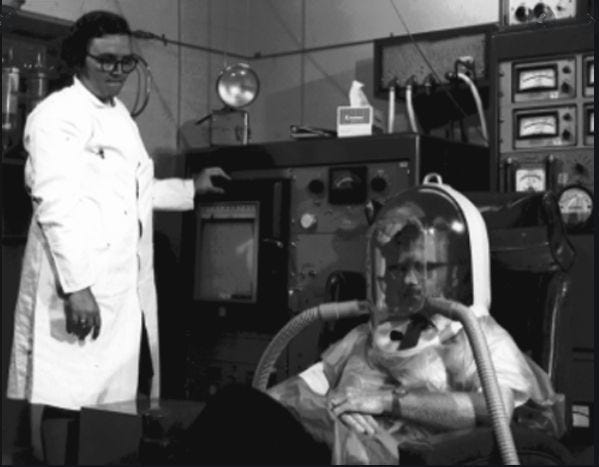
Experiment involving inhalation of radioactive substances.
1993 Advisory Committee on Human Radiation Experiments
The report prompted the creation of the Advisory Committee on Human Radiation Experiments by President Bill Clinton in 1993, which further investigated and documented these practices. Full report here.
The precursor to the 1993 Advisory Committee on Human Radiation Experiments was a series of Pulitzer Prize winning investigative reports by Eileen Welsome in The Albuquerque Tribune,[12] entitled The Plutonium Experiment, published as a series starting on November 15, 1993. This report was different than Markey’s, because Welsome revealed the names of the people injected with plutonium.[13] Welsome originally discovered the experiments while sifting through some documents at Kirtland Air Force Base in Albuquerque in the spring of 1987. What got her curiosity was a report on radioactive animal carcasses. The report identified the victims only by code names.[3] After receiving the 1994 Pulitzer Prize for her article, Welsome would go on to publish much more information in 1999 in a book titled The Plutonium Files: America’s Secret Medical Experiments in the Cold War.
Key Findings from the 1993 Advisory Committee Report
Full version Accessible here
Human Radiation Experiments
- Between 1944 and 1974 the federal government sponsored several thousand human radiation experiments. In the great majority of cases, the experiments were conducted to advance biomedical science; some experiments were conducted to advance national interests in defense or space exploration; and some experiments served both biomedical and defense or space exploration purposes. As noted, in the great majority of cases only fragmentary data are available.
- The majority of human radiation experiments identified by the Advisory Committee involved radioactive tracers administered in amounts that are likely to be similar to those used in research today. Most of these tracer studies involved adult subjects and are unlikely to have caused physical harm. However, in some nontherapeutic tracer studies involving children, radioisotope exposures were associated with increases in the potential lifetime risk for developing thyroid cancer that would be considered unacceptable today. The Advisory Committee also identified several studies in which patients died soon after receiving external radiation or radioisotope doses in the therapeutic range that were associated with acute radiation effects.
- Although the AEC, the Defense Department and the National Institutes of Health recognized at an early date that research should proceed only with the consent of the human subject, there is little evidence of rules or practices of consent except in research with healthy subjects. It was commonplace during the 1940s and 1950s for physicians to use patients as subjects of research without their awareness or consent. By contrast, the government and its researchers focused with substantial success on the minimization of risk in the conduct of experiments, particularly with respect to research involving radioisotopes. But little attention was paid during this period to issues of fairness in the selection of subjects.
- Government officials and investigators are blameworthy for not having had policies and practices in place to protect the rights and interests of human subjects who were used in research from which the subjects could not possibly derive direct medical benefit. To the extent that there was reason to believe that research might provide a direct medical benefit to subjects, government officials and biomedical professionals are less blameworthy for not having had such protections and practices in place
Intentional Releases
- During the 1944-1974 period, the government conducted several hundred intentional releases of radiation into the environment for research purposes. Generally, these releases were not conducted for the purpose of studying the effects of radiation on humans. Instead they were usually conducted to test the operation of weapons, the safety of equipment, or the dispersal of radiation into the environment.
- For those intentional releases where dose reconstructions have been undertaken, it is unlikely that members of the public were directly harmed solely as a consequence of these tests. However, these releases were conducted in secret and despite continued requests from the public that stretch back well over a decade, some information about them was made public only during the life of the Advisory Committee.
Uranium Miners
- As a consequence of exposure to radon and its daughter products in underground uranium mines, at least several hundred miners died of lung cancer and surviving miners remain at elevated risk. These men, who were the subject of government study as they mined uranium for use in weapons manufacturing, were subject to radon exposures well in excess of levels known to be hazardous. The government failed to act to require the reduction of the hazard by ventilating the mines, and it failed to adequately warn the miners of the hazard to which they were being exposed.
Secrecy and the Public Trust
- The greatest harm from past experiments and intentional releases may be the legacy of distrust they created. Hundreds of intentional releases took place in secret, and remained secret for decades. Important discussion of the policies to govern human experimentation also took place in secret. Information about human experiments was kept secret out of concern for embarrassment to the government, potential legal liability, and worry that public misunderstanding would jeopardize government programs.
- In a few instances, people used as experimental subjects and their families were denied the opportunity to pursue redress for possible wrongdoing because of actions taken by the government to keep the truth from them. Where programs were legitimately kept secret for national security reasons, the government often did not create or maintain adequate records, thereby preventing the public, and those most at risk, from learning the facts in a timely and complete fashion.
Contemporary Human Subjects Research
- Human research involving radioisotopes is currently subjected to more safeguards and levels of review than most other areas of research involving human subjects. There are no apparent differences between the treatment of human subjects of radiation research and human subjects of other biomedical research.
- Based on the Advisory Committee’s review, it appears that much of human subjects research poses only minimal risk of harm to subjects. In our review of research documents that bear on human subjects issues, we found no problems or only minor problems in most of the minimal-risk studies we examined.
- Our review of documents identified examples of complicated, higher-risk studies in which human subjects issues were carefully and adequately addressed and that included excellent consent forms. In our interview project, there was little evidence that patient-subjects felt coerced or pressured by investigators to participate in research. We interviewed patients who had declined offers to become research subjects, reinforcing the impression that there are often contexts in which potential research subjects have a genuine choice.
- At the same time, however, we also found evidence suggesting serious deficiencies in aspects of the current system for the protection of the rights and interests of human subjects. For example, consent forms do not always provide adequate information and may be misleading about the impact of research participation on people’s lives. Some patients with serious illnesses appear to have unrealistic expectations about the benefits of being subjects in research.
Current Regulations on Secrecy in Human Research and Environmental Releases
- Human research can still be conducted in secret today, and under some conditions informed consent in secret research can be waived.
- Events that raise the same concerns as the intentional releases in the Committee’s charter could take place in secret today under current environmental laws.
In conclusion, the Markey’s report brought up the really ugly truth, and the broad 1993 commission effectively diffused the information taking the usual approach – admit that “mistakes were made” in some distant past, and claim everything has been fixed and nothing like this will be repeated again.
I have purchased a book describing proceedings of the 1993 commission and the history of the evolution (or rather devolution) of the US policy on informed consent of research subjects, especially in the dual-use military area. The Nuremberg code, which was adopted by the Army research policies right after the Nuremberg trials as the ethical guideline, was quickly hacked and neutered by the human-experiment-hungry academia-military -industrial complex.
By the time of the 1993 commission, the experiments on humans already moved on to another lucrative space:
After another Pentagon briefing I chatted with a senior Army physician, a conversation that put me on the road to writing this book. At one point he leaned back in his chair, put his hands in his pockets, and said, “If you ask me, you won’t stop here.” What do you mean?, I asked. “I think you go on to biological and chemical (weapons). That’s where the real action is.”
https://sashalatypova.substack.com/p/never-again-again-and-again-american