
No Matter Who We Vote for, We Get George Bush
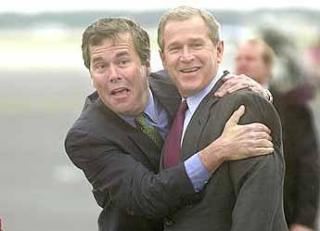
The striking parallel between Trump/Rubio and Obama/Hillary that gives the game away.
Today I was watching NBC’s interview with the foreign minister of Iran, Dr. Abbas Araghchi, and I was reflecting on the intelligence, composure, and dignity of Iran’s top diplomat in contrast to his counterpart in the United States, Secretary of State Marco Rubio.
Then, my mind drifted back to ten years ago, when I voted for an anti-neocon candidate in the 2016 Republican primary.
It was around this same time of year, late February or early March, that I remember the race heating up the most between then-presidential candidate Donald Trump — and Marco Rubio.
And I thought: how did this man become Donald Trump’s Secretary of State?
By his time ten years ago, Jeb Bush had dropped out of the presidential race, along with most of the other contestants, and Rubio was considered the last, best hope of the neocons.
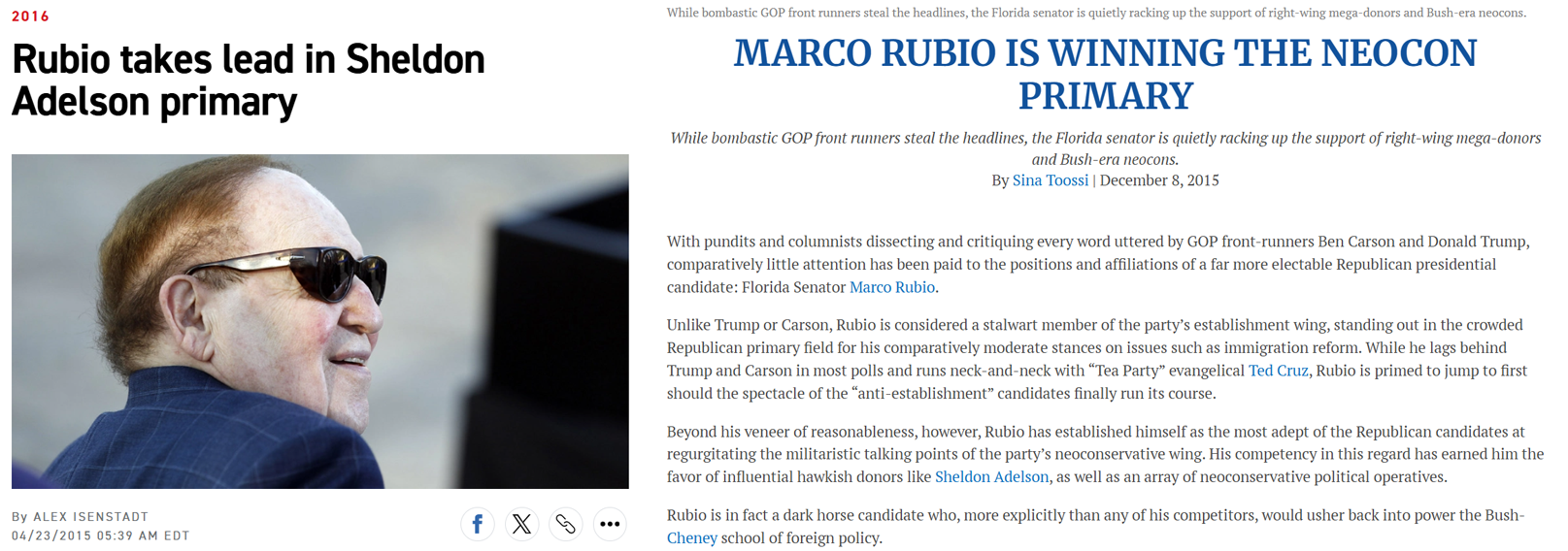
An article from Politico dated April 23, 2015 titled Rubio takes lead in Sheldon Adelson primary, explained then-Senator Rubio’s appeal to the GOP megadonor:
Adelson’s attraction to Rubio is in no small part centered on the Florida senator’s outspoken support for Israel, an issue near and dear to the billionaire’s heart. Rubio has reached out to Adelson more often than any other 2016 candidate, sources close to Adelson say, and has provided him with the most detailed plan for how he’d manage America’s foreign policy.
Since entering the Senate in 2011, Rubio has met privately with the mogul on a half-dozen occasions. In recent months, he‘s been calling Adelson about once every two weeks, providing him with meticulous updates on his nascent campaign. During a recent trip to New York City, Rubio took time out of his busy schedule to speak by phone with the megadonor.
Rubio’s “hawkish defense views and unwavering support for Israel” were described as aligning well with Adelson’s. Meanwhile, Florida Governor Jeb Bush remained Adelson’s favorite, no doubt because of the latter’s neocon bona fides and being the brother of former president George W. Bush.
Bush’s failure to win the primary is largely attributable to popular backlash against the Iraq war, and with it, the neoconservative ideology. This backlash was most forcefully expressed by outsider candidate Donald J. Trump on the debate stage in South Carolina, the night of February 13, 2016:
MR. DONALD TRUMP: Obviously– the war in Iraq was a big, fat mistake, all right? Now, you can take it any way you want. And it took J– (APPLAUSE) it took Jeb Bush, if you remember at the beginning of his announcement, when he announced for president, took him five days, he went back, “It was a mistake, it wasn’t a mistake.” Took him five days before his people told him what to say. And he ultimately said, “It was a mistake.” The war in Iraq, we spent 2 trillion dollars, thousands of lives, we don’t even have it. Iran is taking over Iraq with the second-largest oil reserves in the world. Obviously it was a mistake. So George Bush made a mistake. We can make mistakes. But that one was a beauty. We shoulda never been in Iraq. We have destabilized–
JOHN DICKERSON: All right.
MR. DONALD TRUMP: –the Middle East.
JOHN DICKERSON: But tell you– so, I mean, let’s–
(OVERTALK)
JOHN DICKERSON:–you said yourself that he should be impeached.
GOV. JEB BUSH: I think it’s my turn, isn’t it?
MR. DONALD TRUMP: You do whatever you want. You call it whatever you want. I wanna tell you. They lied.
JOHN DICKERSON: Okay.
Mr. Donald Trump: They said there were weapons of mass destruction. There were none. And they knew there were none. There were no weapons of mass destruction. (BOOING)
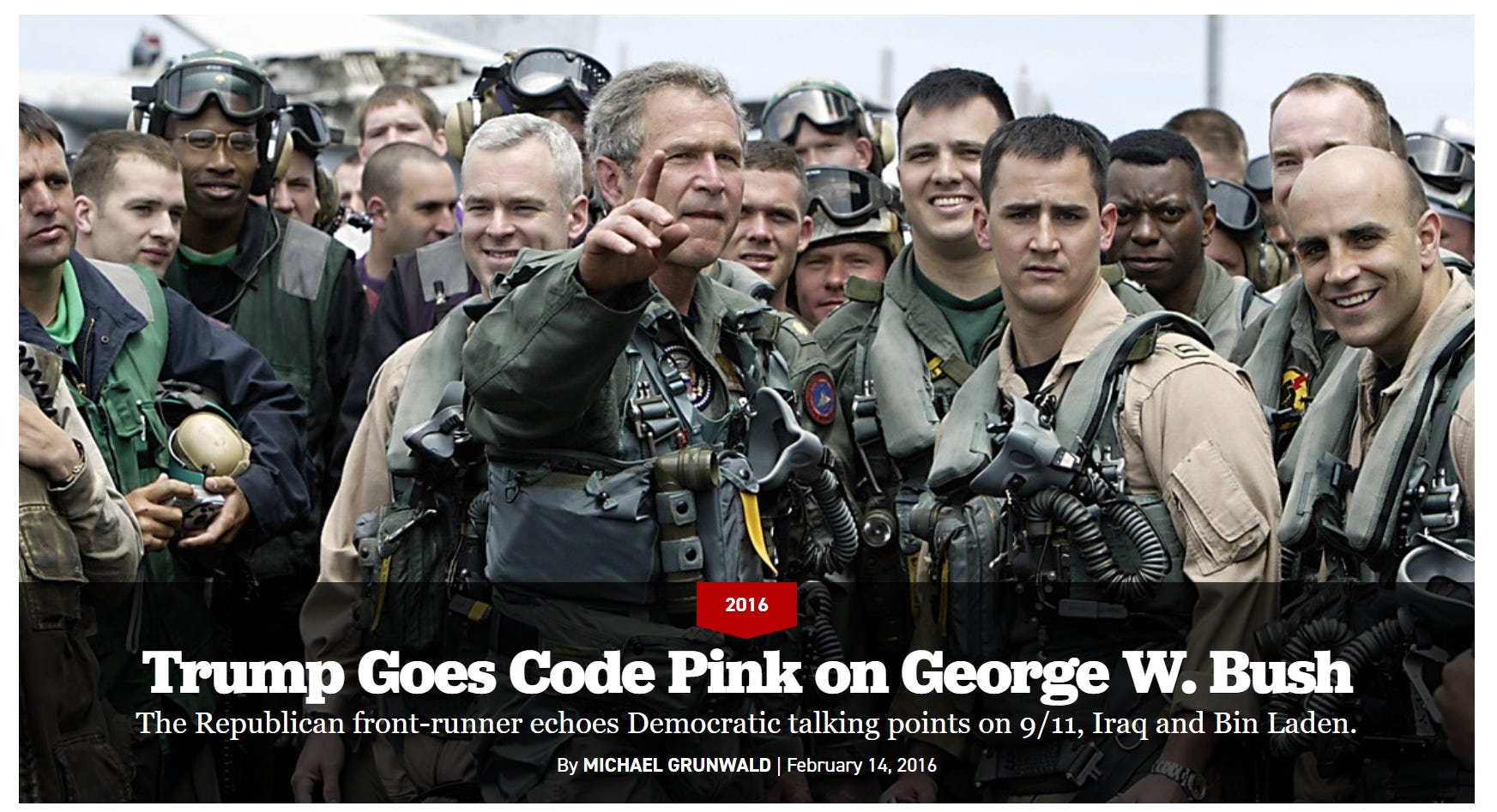
At that time, this was the most dramatic denunciation of the Iraq war by any candidate on the debate stage in either party. Michael Grunwald of Politico Magazine was aghast, claiming Trump Goes Code Pink on George W. Bush:
It was weird that an angry Code Pink-style protester interrupted last night’s Republican presidential debate with a barrage of familiar Democratic talking points about George W. Bush—that he lied the country into a disastrous war in Iraq…. It was especially weird that the protestor was one Donald J. Trump, who happens to be the front-runner for the Republican nomination…. Maybe Trump believes there’s an untapped GOP anti-war contingent. Maybe he’s still plotting to run as an independent. Maybe he just enjoys tweaking the Bush family, since he spent much of the night mocking George’s brother Jeb as a weak, incompetent, lying loser. But Trump’s extended Bush-lied-people-died diatribe, featuring repeated scoffing at Republican Bush-kept-us-safe dogma, was the most surreal stretch of a debate that generally could have been scripted by Salvador Dali.
Yet it was arguably the moment which won Trump the election.
Jeb suspended his campaign just one week later, after coming in fourth place in the South Carolina primary with only 8% of the vote (Donald Trump won SC with 33%).
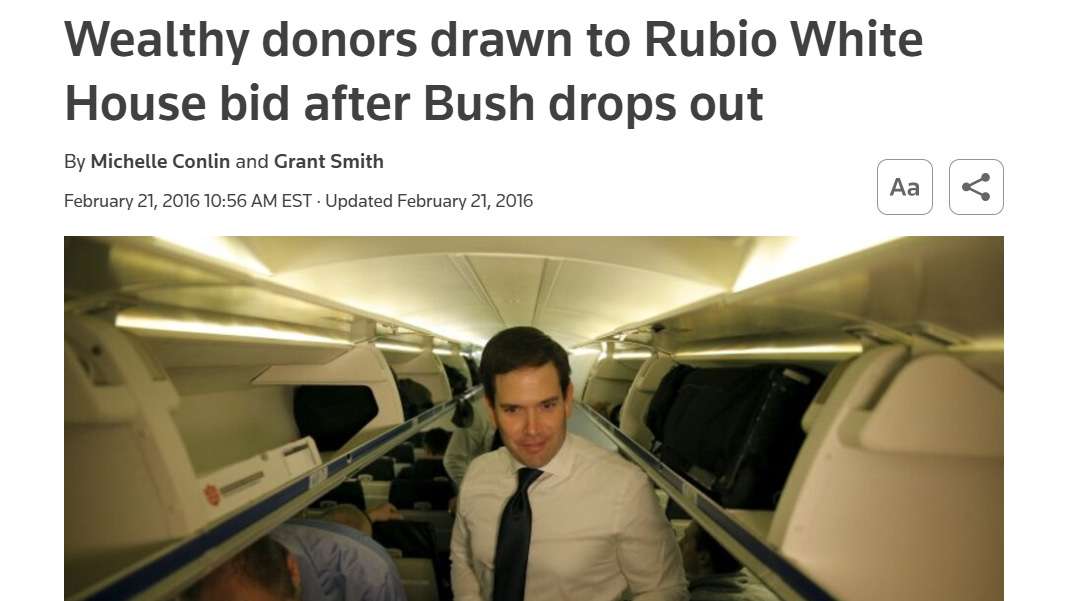
On February 21, Reuters ran a piece titled, Wealthy donors drawn to Rubio White House bid after Bush drops out.
Within minutes of Jeb Bush dropping out of the presidential race Saturday night, some of his donors were preparing to throw their financial support behind Marco Rubio, who has emerged as the strongest candidate among the establishment wing of the party.
“Jeb’s network is already naturally migrating to Marco,” said Gaylord Hughey, a top Bush fundraiser from Texas, echoing what four other top donors told Reuters. “It’s the clear path.”
“It’s a stampede,” added another donor, who spoke on the condition of anonymity because he wanted to give Bush some time after dropping out before he went public with his support of Rubio, the U.S. senator from Florida.
Three other Bush donors, who declined to be named, also said they now planned to support Rubio.
For months before that, Rubio had already been a favorite of many neocons, even more so than Jeb, as reported in a piece from Foreign Policy in Focus titled, Marco Rubio is Winning the Neocon Primary.
Beyond his veneer of reasonableness, however, Rubio has established himself as the most adept of the Republican candidates at regurgitating the militaristic talking points of the party’s neoconservative wing. His competency in this regard has earned him the favor of influential hawkish donors like Sheldon Adelson, as well as an array of neoconservative political operatives.
Rubio is in fact a dark horse candidate who, more explicitly than any of his competitors, would usher back into power the Bush-Cheney school of foreign policy.
Bolstered by an all-star cast of Bush-era foreign policy ideologues, the Florida senator has echoed Israeli Prime Minister Benjamin Netanyahu that the “conditions” do not exist for a two-state solution to the Israeli-Palestinian conflict; vowed to renege on the Iran nuclear deal and re-impose sanctions on the country, potentially putting the United States on the path to another catastrophic war in the Middle East; and promised to rescind the Obama administration’s diplomatic achievements with Cuba, further alienating the United States in Latin America.
Trump’s subsequent triumph over Rubio in the 2016 GOP primary, who dropped out on March 15, 2016, could be seen as the final defeat of the neocon wing of the party after the heyday of the neocon foreign policy during the George W. Bush administration.
Trump vs. Jeb/Rubio was a clash of worldviews: a foreign policy that puts America First vs. an Israel-first, neocon foreign policy. And the neocons were decisively defeated.
So the decision of president-elect Donald J. Trump, in November 2024, to announce he was nominating none other than Marco Rubio to be his new Secretary of State, was a political reversal worthy of Nineteen Eighty-Four.
Basically, Trump took the guy whose foreign policy views were the opposite of his own, whose views he most forcefully ran against and won in 2016, who represented the antithesis of everything Trump stood for and why his voters supported him—and he put that guy in charge of his foreign policy.
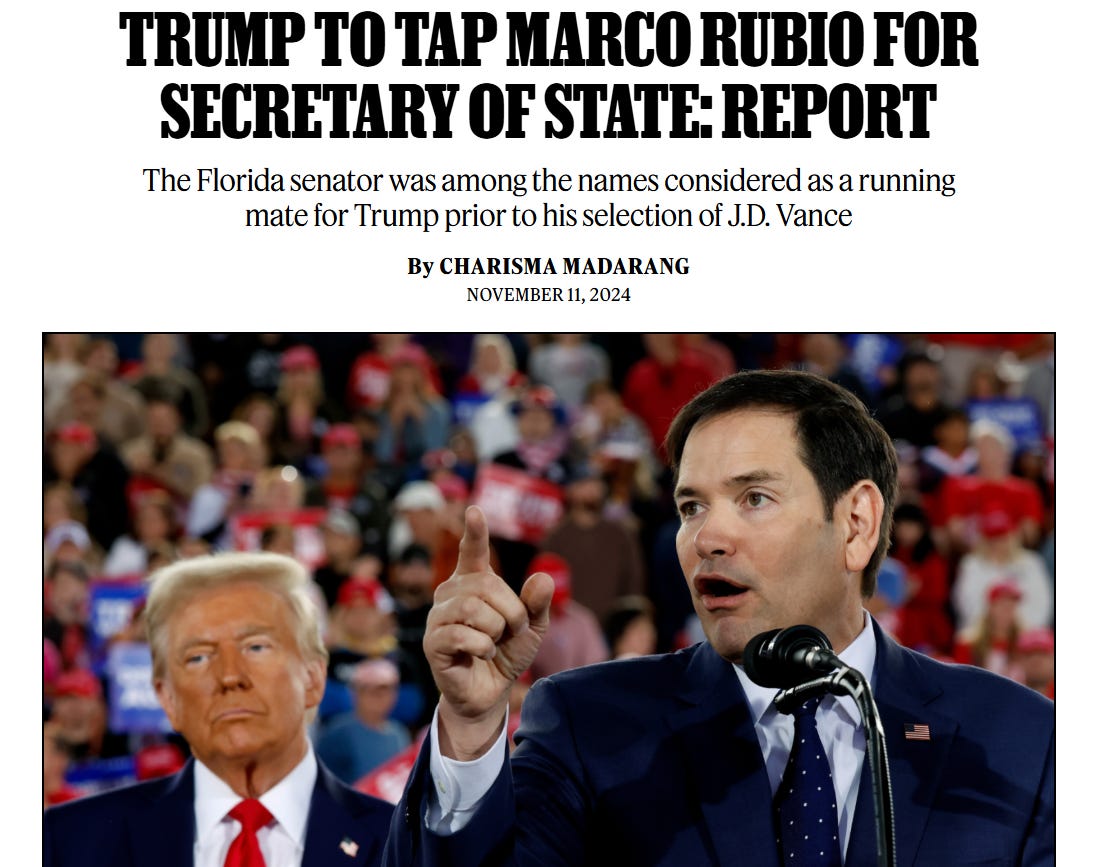
But this was not without precedent. And it gives me incredible déjà vu.
If I carry my memory back 18 years, I recall another primary where I voted for an anti-neocon candidate. At that time I was a Democrat, and a young upstart from Chicago named Barack Obama was challenging establishment favorite Hillary Clinton, wife of former president Bill Clinton, for the presidential nomination of the Democratic Party.
Even though Hillary had the majority of big donors and name recognition, she was being beaten by Barack Obama primarily because she voted for and had been a vocal supporter of the Iraq war, while Obama had spoken out against it.
Obama’s opposition to the Iraq war was one of the greatest sources of his appeal. Headline after headline from the 2007-2008 primary show how this issue dominated the debate.
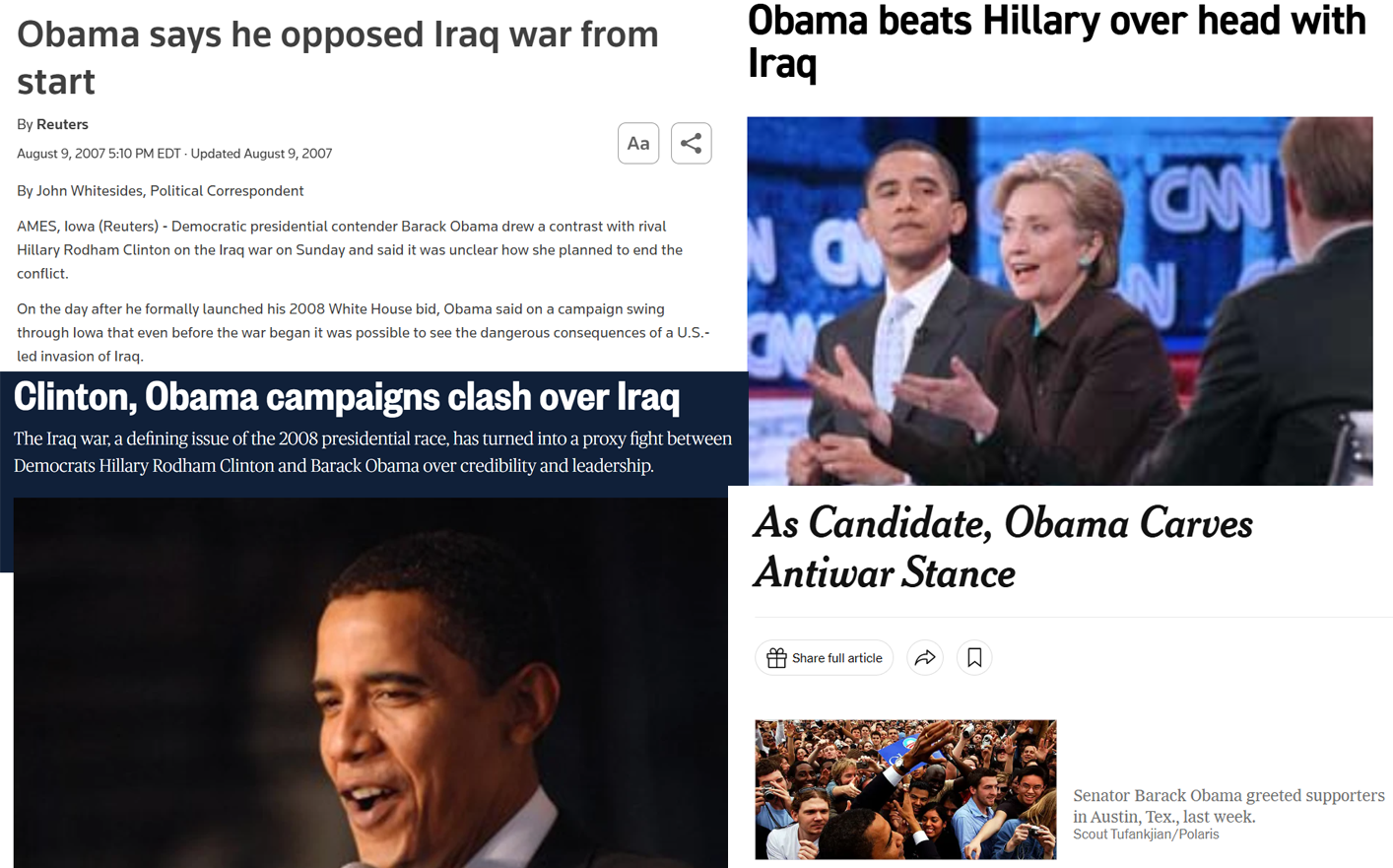
As the New York Times reported on February 27, 2007:
Senator Barack Obama is running for president as one of the few candidates who opposed the Iraq war from the beginning, a simple position unburdened by expressions of regret or decisions over whether to apologize for initially supporting the invasion.
Iraq remains a defining topic in the opening stages of the 2008 presidential race…. As Mr. Obama has introduced himself in the opening weeks of his candidacy, few subjects have garnered more applause than his criticism of the war. He does not refer to the conflict as Mr. Bush’s war, which antiwar candidates in the Democratic Party did in the 2004 election, but rather is seeking to expand the circle of responsibility to those who supported the invasion.
“We continue to be in a war that should never have been authorized,” Mr. Obama told an audience in Iowa last week, making a not-so-subtle reference to Mrs. Clinton and other Democratic rivals. Two days later, at a Texas rally, he said, “I am proud of the fact that way back in 2002, I said that this war was a mistake.”
If the 2016 GOP primary came down to a contest between the neocon Marco Rubio and the anti-Iraq war Donald Trump, the 2008 Democratic Primary came down to a contest between pro-war Hillary Clinton vs the anti-war Barack Obama.
And just like Trump eight years later, Obama trounced Hillary on the issue of Iraq, and more broadly, more unpopular foreign wars.
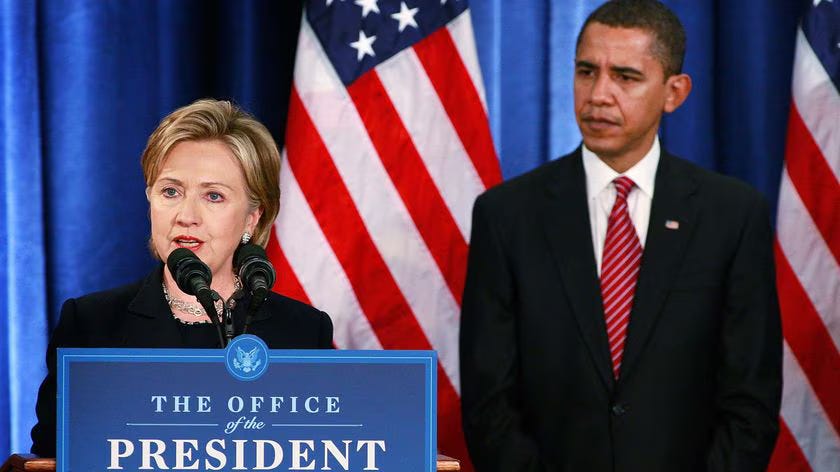
So it was more than a little Orwellian when Barack Obama, anti-war candidate, nominated his pro-war opponent Hillary Clinton for the job of Secretary of State on December 1, 2008 — just as Trump would do with Rubio.
The vanquished pro-war candidate gets put in charge of foreign policy by the victorious anti-war candidate, not once, but twice in 16 years.
Hillary went on to pursue both the intervention in Syria and the destruction of Libya, which resulted in both countries falling into chaos and sparked the largest refugee crisis in Europe in the 21st century. After the gruesome death of Libyan head of state Muammar Gaddafi in 2011, Hillary Clinton was caught on camera chortling that “We came, We saw, He died.” She later, in her role as Obama’s top diplomat, presided over the collapse of Libya into a failed state.
Two antiwar candidates.
Two outsiders who vault to the presidency by running against the neocon policies of the past.
Two establishment insiders who are defeated in elections because of their unpopular, pro-war views.
Both appointed to the same office — Secretary of State — by the antiwar outsiders, and both go on to wage reckless and devastating regime change wars in the Middle East, causing death and destruction on par with the 2003 Iraq war.
The one-to-one pattern is striking.
It reveals that as Americans, no matter who we vote for, whether on the Right or the Left, Democrat or Republican, we get the same unpopular pro-war figures in charge of our foreign policy, the same neocon wars in the Middle East.
There is only one explanation: the United States, including our political process and our foreign policy, is completely controlled by billionaire, Zionist Jews.
Our presidential elections are an utter a sham.
We the people have no say in who runs our foreign affairs, even on the most important questions of war and peace.
What we do with this information, has yet to be determined.
But after the illegal and immoral sneak attack launched against Iran by the U.S. and Israel on February 28 of this year, that we are living under a Zionist Occupied Government is no longer an open question.
https://warrenbalogh.substack.com/p/no-matter-who-we-vote-for-we-get