
On the Necessary Elimination of the Globalist Class
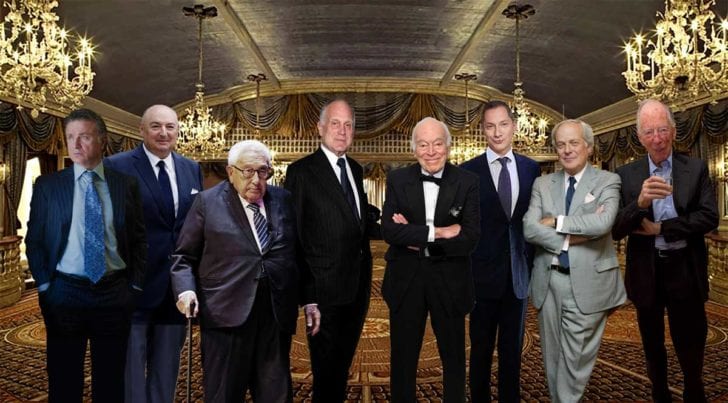
Over the past thirty-five years, a distinct social group has formed in our country—as in much of the rest of the world—that can be described as the “globalist class.” These are people who, during this period, have either amassed enormous fortunes or integrated into global processes in culture, science, and technology. Often, it was both.
Why do we call this group the “globalist class”? Because for all these years (with the possible exception of the last few years after the launch of the special military operation), globalist norms prevailed: rules, interaction algorithms, cultural orientations, symbols of prestige, and signs of success. What Jean Baudrillard described as “semiurgy”: the production of specific consumption symbols that elevated successful individuals to a “higher class” and confirmed their status, writes Alexander Dugin .
Pierre Bourdieu conceptualized this phenomenon using the concept of a “club.” Membership requires meeting numerous conditions: not only possessing large sums of money, but also living in a prestigious neighborhood, wearing the latest collections, visiting specific golf courses, pursuing the right education, and presenting oneself accordingly. Joining this “club” requires a range of skills that go beyond mere capital: the ability to allocate, accumulate, and conserve assets correctly, and avoid waste.
For the past twenty-five years, the entire system of characteristics that define membership in this “club,” the “entrance tickets,” and the evaluation criteria, has been dictated by globalist ideology. One had to be a “global citizen”: earn in one place and invest in another, live in multiple countries, be constantly on the move, or live extraterritorially, for example, on a yacht. One had to listen to the right music and share approved interests: environmental issues, feminist studies, or avant-garde transgressive practices. This extended to dietary choices, personal habits, and lifestyle, including building family relationships according to the “new rules” of gender politics (gender reassignment, transgender identity, and so on).
Anyone who truly wanted to be “progressive”—whether Chinese, Russian, American, African, Arab, or European—had to conform to this globalist code. This gave rise to a “globalist elite,” which became dominant in our society as well as many others. It consisted of oligarchs, high-ranking officials, and prominent figures from culture and science. Together, they formed a globalist class that united humanity’s economic and cultural elites.
Since globalist ideology prevailed during this period, those who reached the top were either accepted into this “club” or relegated to the status of “losers”—middling figures stuck in the middle class. Even significant wealth was insufficient to gain entry into the globalist class if someone had “coarse manners” or held “incorrect” political, religious, or family views from the club’s perspective. Complete conformity was required in all areas.
In Russia, this class has become almost indistinguishable from the ruling elite over the past thirty-five years. I’m not claiming that our entire elite belongs to it, but its most influential and visible representatives undoubtedly do. In the 1990s, it was openly declared a national goal to be part of this globalist class. Hence the purchase of Chelsea Football Club, living in Western capitals, and the export of capital. In the 1980s, this aspiration existed as a hidden obsession; in the 1990s, it became an explicit agenda; in the 2000s, it became partially concealed. Putin essentially declared: “Okay, you are who you are; I have no alternative ruling class. But now you have to consider the role of the state and sovereignty.” Some representatives of the globalist class resisted and lost their positions; others opted for a compromise: earn money here, in official or military positions, and spend it there.
This class is fundamentally incompatible with the emerging new multipolar world—a world characterized by sovereignty and a return to traditional values. The “globalist class” is being defeated everywhere. It lost to Trump, with his unvarnished MAGA values, and to his Vice President, J.D. Vance—an unashamed “provincial,” a man from the heartland.
At the same time, atypical figures have emerged within the globalist class itself, such as Peter Thiel or Elon Musk, who have openly opposed the mainstream. These members of the globalist class turned against it and, in effect, betrayed it from within. This rift gave rise to the MAGA movement and the rise of right-wing populists in Europe. By initiating the special military operation, Russia has definitively chosen a different path.
The representatives of the globalist class who have remained in Russia and still constitute a significant portion of the broader ruling elite are hindering our further development. Some argue that avoiding repression is a priority under these circumstances, but this approach is unsustainable. The choice is clear: either the “globalist class” or a sovereign Russia. Yes, our president is a restrained, humane, and balanced leader who avoids extremes. Yet, it seems clear that the country cannot progress without systematically removing this globalist class from Russian reality.
The class itself, of course, won’t disappear on its own. If direct flights to Courchevel are banned, they’ll find indirect routes. If Western assets are seized, they’ll build palaces in Dubai. The question remains: what should happen to them? Re-education or elimination? I think both are necessary. Harsh measures—including physical repression—must be taken against some to show the rest that refusing to change their positions will lead to the same result.
The “globalist class” functions almost like a world religion, complete with its own rituals, rites, beliefs, and “pilgrimages”—not to holy sites, but to international parties, fashion shows, and depraved orgies. Epstein Island was such a “sanctuary.”
Maintaining this class within the political elite condemns Russia to sabotage and paralysis. It has taken enormous effort to reach this point, if only to force them to refrain from open rebellion against the sovereign course set by our president. We have now reached a point where it is no longer feasible to tackle them individually or in small groups.
This issue goes far beyond corruption. The “globalist class” consists of people with a fundamentally different worldview—a different “operating system.” Calls for compliance with the law have no effect on them. They form the core of a “sixth column” operating within our society. Systematic repression is needed precisely against these kinds of actors. Just as certain institutions apply facial control based on visible criteria, it is possible to create a psychological profile of the typical representative of this globalist class in Russia—and we will recognize them immediately. Simply belonging to this circle should trigger sanctions. Finding a pretext is easy; the goal is to intimidate the rest and force a transition to a different way of life—to traditional values and patriotism. Without the threat of punishment, no one will change voluntarily.
It is time to acknowledge that a purge of our society from representatives of the globalist class formed over the past thirty-five or even forty years—beginning with perestroika—is inevitable. They betrayed and dismantled the country, and are at the root of the bloody war we are waging today. They are direct enemies of our sovereignty. The effectiveness of such repression should be judged not by its severity, but by its results. If genuine re-education follows, the emphasis can shift to instruction. If not, the process must continue. From a historical perspective, these measures are undoubtedly necessary.
https://www.frontnieuws.com/over-de-noodzakelijke-eliminatie-van-de-globalistische-klasse