
On the Virtue of Red Light Districts
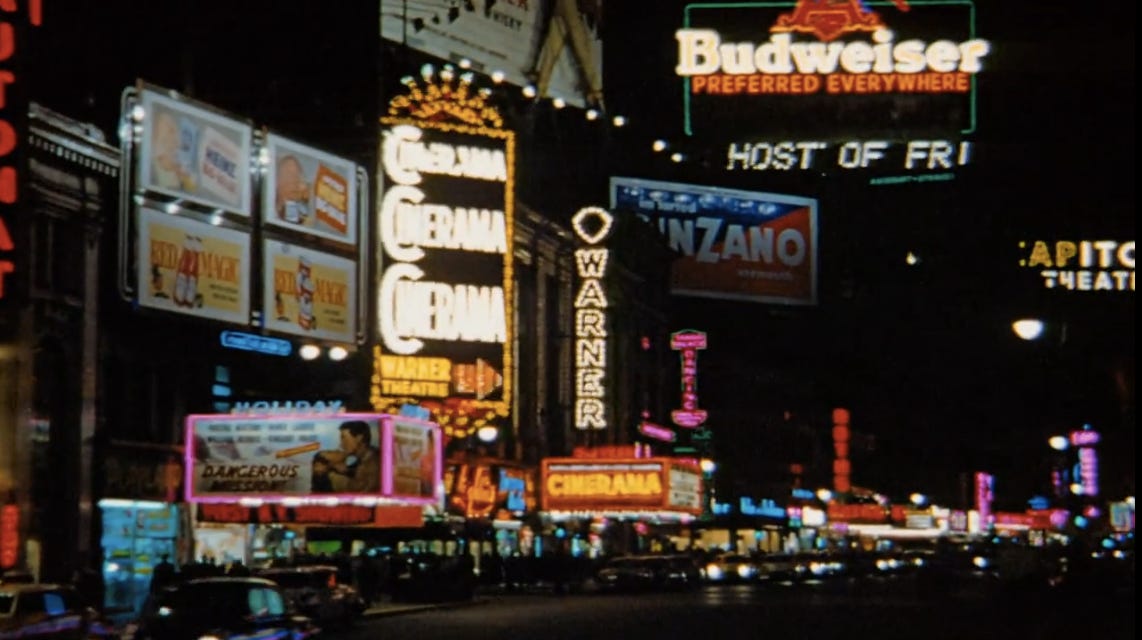
How “cleaning up” Forty-Deuce ruined New York and America.
I just finished rewatching the HBO series The Deuce, and it was even better the second time. It’s easily one of the best shows of the last twenty years. It’s not like Breaking Bad or The Sopranos, which are character driven; the main character of The Deuce is New York City itself, and specifically the part of Times Square around 42nd Street that was once one of the most famous, and most dangerous, red light districts in the world. Each of the three seasons showcases a different era: 1971, 1978, and 1985. It’s based on true stories of people who inhabited the area during that time, centering around two twin brothers—played brilliantly by James Franco, who you forget is just one actor—who worked for the mob as fronts for bars, nightclubs, massage parlors and peep shows. (The little that has been revealed of the real stories is even more interesting than the show, and I hope someone collects it all and writes a book or makes a documentary.)
I grew up on images of the Deuce from movies. The first big film to feature it in all its seedy glory was Midnight Cowboy from 1969. Then a few years later it provided the backdrop for Taxi Driver, which is probably the best cinematic capture of the look and feel of the place. One of the first films I ever saw of the Deuce was the 1980 vigilante flic The Exterminator, because it was one of my dad’s favorites—he had it on Betamax—and he let me watch R-rated films ever since I was five. All through the 80s, Times Square and dirty old New York featured prominently in films, from 1985’s Death Wish 3 to Tom Hanks’ breakthrough comedy Big. The Deuce had been a movie star for decades before David Simon and George Pelecanos decided to make a show about it.
Old Times Square centered around sex and drugs. Prostitution, though technically illegal, was rampant. There were adult book stores that sold legal porn over the counter, and illegal porn under the counter. The event that kicks off The Deuce in the early 70s was a decision by the courts that pornography was protected by the First Amendment. After that it didn’t take long to become ubiquitous on 42nd Street and in other similar areas in other cities. The show chronicles the birth of the porn industry in New York, along with the rise of quasi-legal prostitution brought about by the city’s decision to allow massage parlors.
Reading about old Times Square today, you encounter two attitudes simultaneously: it was a dangerous and filthy place, you wouldn’t want to go back there; and, it was awesome. It’s often the same person saying both. If you’ve ever been to a red light district, you can understand the ambivalence. They have an electricity that is palpable, you feel it coursing through you just walking around, emanating from the eyes of the people sizing you up—hookers and brothel owners, drug dealers, con men, thieves. You have to keep your wits about you and watch your back. At the same time, it’s exhilarating. BAP wrote about it in Bronze Age Mindset:
I’ve always been attracted to filth and dirt, because something in me knew intuitively that it is only in the underseam of life as it exists today that you find the real “lacunae,” the “holes” where its reach is limited or weak. I always sensed there was some real freedom in the blackest of red light districts among whores and junkies, perverts, and worse, with whom I’ve always chosen to take my dinners when I had the chance.
People romanticize old Times Square now, contrasting it to the sterile, lifeless Disney Times Square of today, but clearly it had a romantic quality even then, which is why so many films used it as a setting. The neon lights, the theater signs—in addition to porno theaters, Times Square had grindhouses showing every variety of b-movie, 24/7—the crazy characters walking up and down the block, all of it added up to an amazing spectacle. If you want a good contemporary portrait from 1984, watch the intro scene to Abel Ferrara’s Fear City. I posted it on X a while back with the caption: “New York was better when the mafia ran it.”
It unironically was. Today the mafia is no more, at least not in its 20th century, largely Italian and Jewish form. And the Deuce is no more, cleaned up through a decades-long effort by the city which began in the 80s—one of the main subplots of season 3 of The Deuce—and really took effect in the 90s during the Giuliani years. (There’s a scene in The Basketball Diaries from 1995 where the characters are walking down 42nd Street and all the old porno theaters are closed and boarded up. “What the hell happened to Forty-Deuce? Last time I was here that theater was playin’ Sperminator 2!”)
So what’s the result? Have people become more moral since the government eradicated the red light districts? Have vice and sin been stomped out? Hardly. What has happened since the 90s with the rise of the internet is that the vice which was once largely confined to places like old Times Square has metastasized and spread out into the entire culture. Porn is ubiquitous. Teenage girls don’t have to take a Greyhound to Port Authority to get into prostitution or skin flicks, they can just make an OnlyFans account. Gays don’t have secret clubs with passwords and code phrases—everywhere has become a gay bar. Times Square has become Disney-fied, but so has vice itself. By spreading out and becoming diffused throughout the entire society, vice has become diluted. It has lost all the charm and potency it once had, largely by virtue of having been taboo.
But it has not lost its destructive capacity. The result of vice and perversion spreading out from the confines of the red lights has not been sexual liberation, but sexual stagnation. The younger generations are having less sex, not more, and the sex they are having seems to be less and less satisfactory. They have become increasingly anhedonic. Their culture is the realization of what Barthes said decades ago: “Sex is everywhere, except in sexuality.” For them, sexuality became political rather than erotic.
It’s not possible to go back to seedy old Times Square, and as those who were there keep reminding us, you wouldn’t want to (but it was awesome). What would be possible, though, and what is desirable, is a more common sense approach to sex and vice that is neither the puritanical prudery of what my friend Gildhelm calls “the Youth Pastor Right” nor the sterile pseudo-libertinism of the left. I recommend the late Guillaume Faye’s Sex and Deviance for an idea of what a “third position” might look like.
https://semmelweis7.substack.com/p/on-the-virtue-of-red-light-districts