
Oracle and the Rise of the AI Surveillance State Under Trump
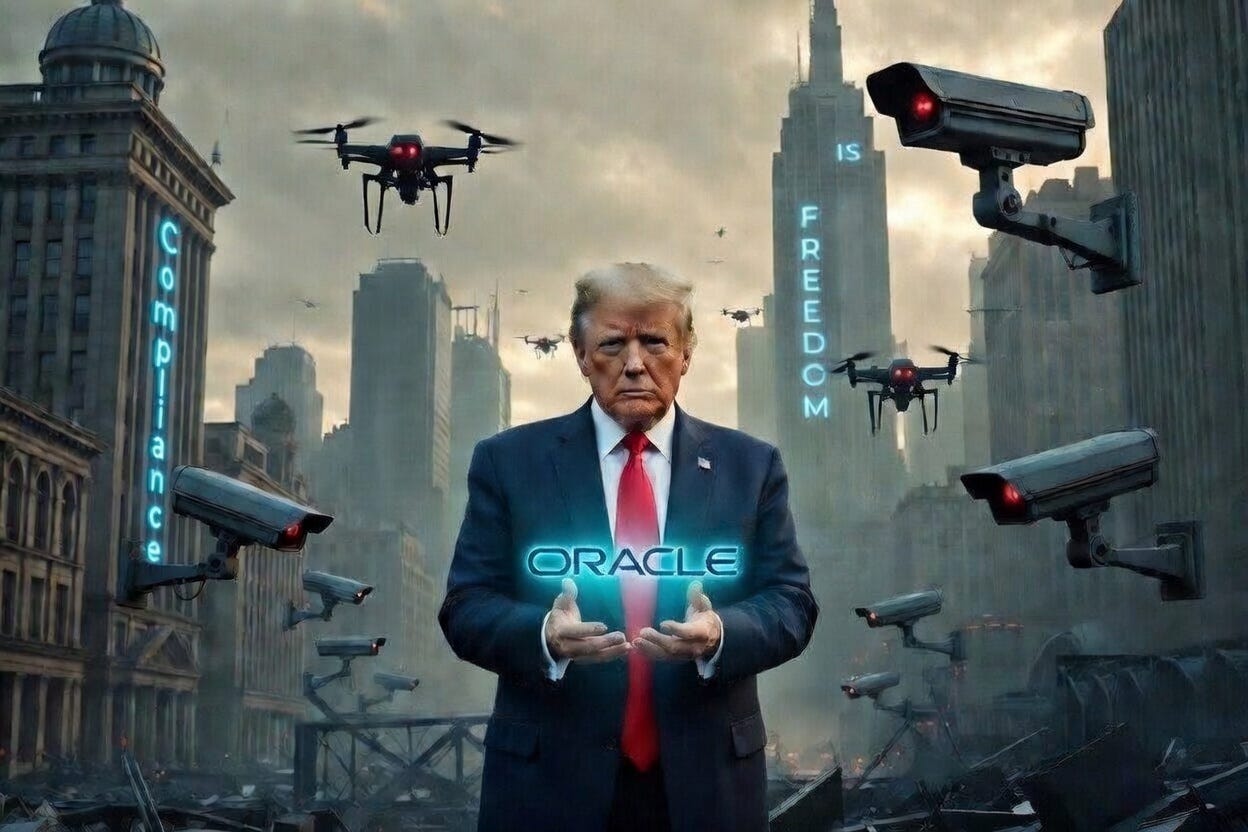
While Peter Thiel’s firm Palantir has rightfully gained the ire of the American public, Larry Ellison’s Oracle is also steadily becoming entangled with the US government—and that should worry all Americans.
The month of March saw tech giant Oracle affirm its already tight relationship with the US government as it expanded its influence via Artificial Intelligence (AI) technologies. These latest developments further cement Oracle among the leading Big Tech firms “winning” under the second Trump administration.
In fact, on Trump’s second day back in the White House, he announced the controversial $500 billion Stargate AI project, which directly involved Oracle. Larry Ellison, co-founder of Oracle, was present for the announcement as his company pledged $100 billion to kickstart the effort to build new data centers to power AI initiatives, including developing an mRNA “cancer vaccine.” Since that time, the relationship between the US government and Oracle has only grown stronger.
Here’s a look at Oracle’s recent moves and why they matter:
March 5 – The Signing of the Ratepayer Protection Pledge
The heads of numerous AI and technology companies gathered at the White House to sign the so-called “Ratepayer Protection Pledge,” aimed at keeping costs of new AI data centers from impacting Americans. Companies involved include Amazon, Google, Meta, Microsoft, OpenAI, xAI, and, of course, Oracle.
“Under this new agreement, Big Tech companies are committing to fully cover the cost of increased electricity production required for AI data centers—and that would mean prices for American communities will not go up, but in many cases, will actually come down,” Trump said in a press release for the pledge.
Oracle stated that it is “committed to paying our own way on energy, hiring locally, protecting local water resources, and enriching communities across the country.” The mention of protecting water sources comes as a growing number of communities are opposing new data centers due to strains on local water supplies.
While this pledge, if maintained, is a net positive for Americans concerned about rising costs related to the ever-increasing construction of data centers, it is yet another example of industry and government assuming that Americans actually want more data centers. There has been little to no public consultation or comment period for the construction of these facilities—just another push toward the Technocratic State where AI is ubiquitous.
March 20 – Trump Releases A National Policy Framework for Artificial Intelligence
Building on this momentum, the Trump White House released a set of legislative recommendations outlining their proposed approach to federal regulation of AI. The document covers seven areas, including child safety, community protections, intellectual property, free speech, innovation, workforce development, and federal preemption of state AI laws. While the document is not binding, it signals what Trump wants Congress to enact. The two most concerning parts of the framework relate to parental controls for AI and the preemption of state laws.
The section on parental controls explicitly states, “Congress should establish commercially reasonable, privacy protective, age-assurance requirements (such as parental attestation) for AI platforms and services likely to be accessed by minors.” (emphasis added)
While there are methods for verifying a user’s age which do not require biometrics, there is a growing concern that age verification using biometrics (face scans typically) will become the norm for accessing the internet and downloading apps, as governments in the UK and Australia press companies to implement such measures. Could the call for “protecting the children” be another gateway for the long-feared internet ID, which allows governments and Big Tech firms to control access to the internet itself? Time will tell.Regarding the preempting of states’ rights to pass laws regulating AI, the framework states:
“Congress should preempt state AI laws that impose undue burdens to ensure a minimally burdensome national standard consistent with these recommendations, not fifty discordant ones.”
“States should not be permitted to regulate AI development, because it is an inherently interstate phenomenon with key foreign policy and national security implications.”
In December 2025, Trump called for withholding federal broadband funding from states that attempt to regulate AI. This effort to limit what states can do to protect their communities from the various potential dangers posed by AI is reminiscent of recent efforts by the Federal Communications Commission (FCC) to do the same regarding 5G technology and AI.
Trump’s National Policy Framework for Artificial Intelligence document was developed by Office of Science and Technology Policy Director Michael Kratsios and White House Special Advisor for AI and Crypto David Sacks.
Within days of the framework announcement, Sacks confirmed that he was no longer serving as Czar. Sacks and Kratsios will now co-chair Trump’s newly announced President’s Council of Advisers on Science & Technology (PCAST).
As The Last American Vagabond (TLAV) has previously reported, Kratsios and Sacks are deeply connected to Peter Thiel, the Bilderberg Steering Committee Chair and co-founder of Palantir. Kratsios himself attended the 2025 Bilderberg meeting in Stockholm, Sweden. Curiously, while the Bilderberg Group typically meets in June, the group is slated to meet in Washington D.C., this weekend. Details on whether Kratsios or other Trump cabinet members will attend have not yet been released.
Why is @MichaelKratsios, Trump’s Director of the White House Office of Science and Technology, attending Bilderberg?
Remember, this is the same guy I reported has worked for two of Peter Thiel’s funds, Thiel Capital and Clarium Capital: https://t.co/toIOJG35LA pic.twitter.com/I2dEMGC7LU
— Derrick Broze (@DBrozeLiveFree) June 12, 2025
Other members of the PCAST include Oracle executive chairman Larry Ellison, Oracle executive vice chair Safra Catz, Meta CEO Mark Zuckerberg, Andreessen Horowitz co-founder Marc Andreessen, Google co-founder Sergey Brin, Nvidia CEO Jensen Huang, and Dell Technologies chairman and CEO Michael Dell.
The fact that Trump is appointing billionaire technocrats who are aligned with Peter Thiel—and, in some cases, influenced by Curtis Yarvin—should tell you that the council of advisers will continue to promote policies which increase the financial bottom line for their companies, but also expand the technocratic surveillance state.
March 31 – Oracle Announces Multiple AI Deals with the Trump Administration
On this day the company made several announcements relating to AI partnerships with the US government. These include “Oracle’s AI-Powered Financials Help Federal Agencies Modernize Operations and Advance Mission Outcomes“ and “Oracle Empowers Defense Industrial Base to Innovate at Scale with New Isolated Cloud.”
While these headlines are relevant to the overall expansion of the hand-in-glove relationship between Oracle and the US government, two other announcements made on the same day deserve our full attention.
First, “Oracle Unveils AI Data Platform for US Federal Government.” With this announcement, Oracle is giving federal agencies a “single, secure foundation to unify data and accelerate mission-driven AI capabilities.” This means federal agencies of the US government will rely on Oracle Cloud Infrastructure (OCI) to “reduce information silos, and make informed, mission-critical decisions at scale.” The US government will also have access to Oracle’s Autonomous AI Database, and OCI Enterprise AI.
In another press release from the same day, Oracle announced “Oracle Expands AI Infrastructure Options for U.S. Government Customers.” This announcement makes it clear that the US government will also have access to the use of Elon Musk’s xAI Grok and NVIDIA Nemotron AI models to further streamline completing tasks and streamlining data sharing.
While the press releases focus on efforts to increase the speed of communication between agencies and summarize data across varied agencies, the idea of having the U.S. government relying on a single AI platform to unify Americans’ data should send shivers down your spine. Can we really trust this company to hold our data and keep it private?
I would say no—especially after Oracle was forced to pay $115 million in July 2024 to settle a lawsuit accusing the company of invading people’s privacy by collecting their personal information and selling it to third parties. Specifically, Oracle was building “digital dossiers” which contained information on what websites people visited, where they banked, purchased gas, went to dinner, shopped, and used their credit cards. This data was then being sold to third-party marketing firms.
While the actions of Oracle as a company are worrisome enough, they are all the more concerning when you understand the history of Oracle and co-founder Larry Ellison.
The Oracle-US Government Nexus
Larry Ellison is currently the sixth-richest person in the world, after briefly dethroning Elon Musk as the richest person on the planet. Ellison supported Trump’s presidential campaigns, advised him during the COVID-19 panic, and joined Trump in announcing the aforementioned $500 billion Stargate Project.
Ellison’s company is known for having deep ties to the U.S. government, including the CIA. In fact, the CIA was Oracle’s first customer, and the company even takes its name from a CIA-project code-named “Oracle.”
“Oracle wouldn’t exist if it weren’t for government contracts,” Mike Wilson, author of the book, The Difference Between God and Larry Ellison, told the San Francisco Gate in 2002.
That report notes that after the 9/11 attacks, Oracle began pitching the idea of a national ID card to thwart terrorists and called for local governments to create “detailed digital maps.” In January 2002, Ellison published an op-ed in the New York Times calling for a digital ID to prevent terrorism.
“A national security database combined with biometrics, thumb prints, hand prints, iris scans or whatever is best can be used to detect people with false identities,” he wrote.
Oracle also has a history of lobbying both Democrats and Republicans, as well as employing ex-CIA agents in their lobbying efforts.
“Oracle has 1,000 sales and consulting workers focused exclusively on government work. And in the wake of Sept. 11, Oracle is counting on the heightened interest in staving off terrorism to boost its government ties even more,” the San Francisco Chronicle reported only eight months after the 9/11 attacks.
In September 2024, Ellison generated controversy with his statements regarding using AI to keep the populace on their “best behavior.” During an hour-long Q&A at Oracle’s 2024 Financial Analyst Meeting, Ellison starts out by describing how AI could be used to potentially prevent school shootings.
“Citizens will be on their best behavior, because we’re constantly recording and reporting everything that is going on”
Back in September 2024 during an Oracle Q&A, Larry Ellison spoke about how AI and cameras will be surveilling our EVERY MOVE, recording at ALL TIMES
Listen: pic.twitter.com/UGmwVXgPte
— Noor Bin Ladin (@NoorBinLadin) January 22, 2025
Ultimately, what he describes sounds eerily like a technocratic tyranny where privacy (and liberty) are a relic of the past.
Ellison has also maintained a cozy relationship with Peter Thiel. Oracle and Palantir partnered together for cloud and AI infrastructure in 2024, and Ellison and Thiel have been in Trump’s inner circle since at least 2018. This is why the fact that both Oracle and Palantir have seen record profits from contracts with the US government and military under Trump should come as no surprise.
Unfortunately, the merging of the US government with Big Tech firms like Palantir and Oracle is just one more step in the completion of the Technocratic Trump administration.
https://tlavagabond.substack.com/p/oracle-and-the-rise-of-the-ai-surveillance