
Our Corporate Dystopia
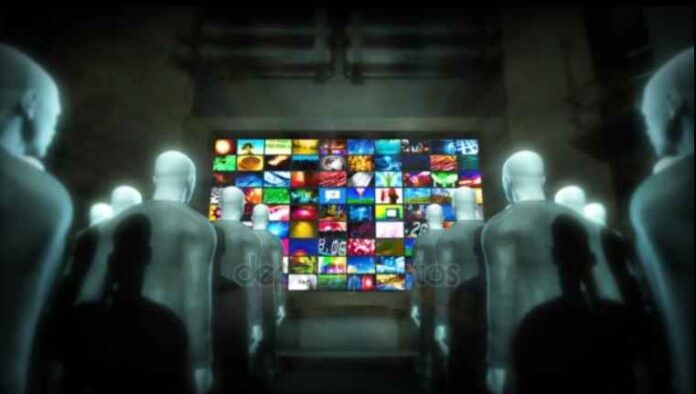
Just try to imagine this utterly unbearable, dystopian future:
1. We’re reaching a point where corporations have become so large and so incredibly wealthy that politicians can no longer afford to obstruct them by creating laws that curb their power. The corporations are simply too big to fail, writes Jonathan Cook .
2. In reality, politicians only pretend to be in charge of policy. Like other sectors of society, their services are effectively purchased by corporations. Secretly, politicians prioritize the interests of these corporations, and the billionaires behind them, over the interests of the public they are supposed to represent. Democracy serves as a facade behind which a kleptocratic class rules.
3. Corporations use their power to push through legislation that allows them to further concentrate their wealth. They monopolize large parts of the economy, like a parasite feeding on the blood of its host. When they disastrously mismanage these monopolies, as they occasionally do, they rely on the political class—their servants—to bail them out with public funds.
4. The greatest profits are made through war, which is ever-present. Corporations use their politician-servants to create enemies from which the public must be protected. This proves to be a great success. In a fear-driven society, the public is more likely to tolerate austerity—the gradual dismantling of public services, which corporations can then take over and exploit as profitable enterprises.
The public is convinced that the flow of money from their own pockets to corporate coffers—to expand the war machine—is necessary for national security. The public’s most cherished freedoms must be sacrificed, they are told, to prevent society from becoming weak and vulnerable. And the corporations vilify anyone who questions their power as an internal enemy, collaborating with the external enemy.
5. This massive deception only works because the billionaires also control the media, which serves their interests. The media tolerates limited dissent to give the public the feeling that a complete plurality of voices exists. But anyone who truly dissents—who challenges corporate power—is labeled by those same media as a lunatic, a socialist, an anti-Semite, or a terrorist. Few hear their real arguments, either because these labels are enough to deny them a platform, or because the media corporations use their control over the algorithmic foundation of modern communication to ensure that dissenting opinions are secretly herded into social media blind alleys.
6. As corporate rule goes increasingly catastrophically wrong—the resources needed for endless growth are running out; the externalized costs of corporate plunder of the planet are creating ever-increasing toxic waste products and disrupting the fragile climate balance—the role of the media is expanding.
Their job is to distract the public with an endless stream of minor crises that can be attributed to “enemies,” nature, or chance, but never to the corporations themselves. The public’s energy is diverted to concerns about—and discussions about—the threat from Eurasia and Eastasia, the dangers of terrorism, the threat from immigrants, the drug epidemic, health crises, unexpected “weather events,” the AI apocalypse, the dangers of free speech, and so on.
And while the public frets over these issues, corporations are sucking more money out of the economy, arguing that this is necessary to protect everyone from East Asia today and Eurasia tomorrow. That new technologies must be developed to eradicate terrorism and stop the ships. That a sophisticated war is being waged against drug lords, both domestically and internationally. That a brave new world of medical breakthroughs is being created. That investments are being made in essential “green” technologies that will save the day. That AI safeguards are being created. That more responsible ways of policing speech are being devised.
All of this is a bleak picture of a possible future. It probably won’t happen. Our societies are too robust, our freedoms too secure, and corporations too controlled to ever allow this bleak world to arise.
Postscript:
I hadn’t realized I’d have to explain what this piece says. It’s not a description of a possible future, as some seem to think. It’s entirely a description of our current time. I haven’t made anything up. I’ve drawn exclusively from things we should all be able to see happening around us. Unless we change our current course, the future will likely be far bleaker than anything I’ve described here.