
President Flip-Flop Reverses Himself, Joins Obama and Biden in Demanding “Clean” Renewal of NSA Domestic Spying Powers
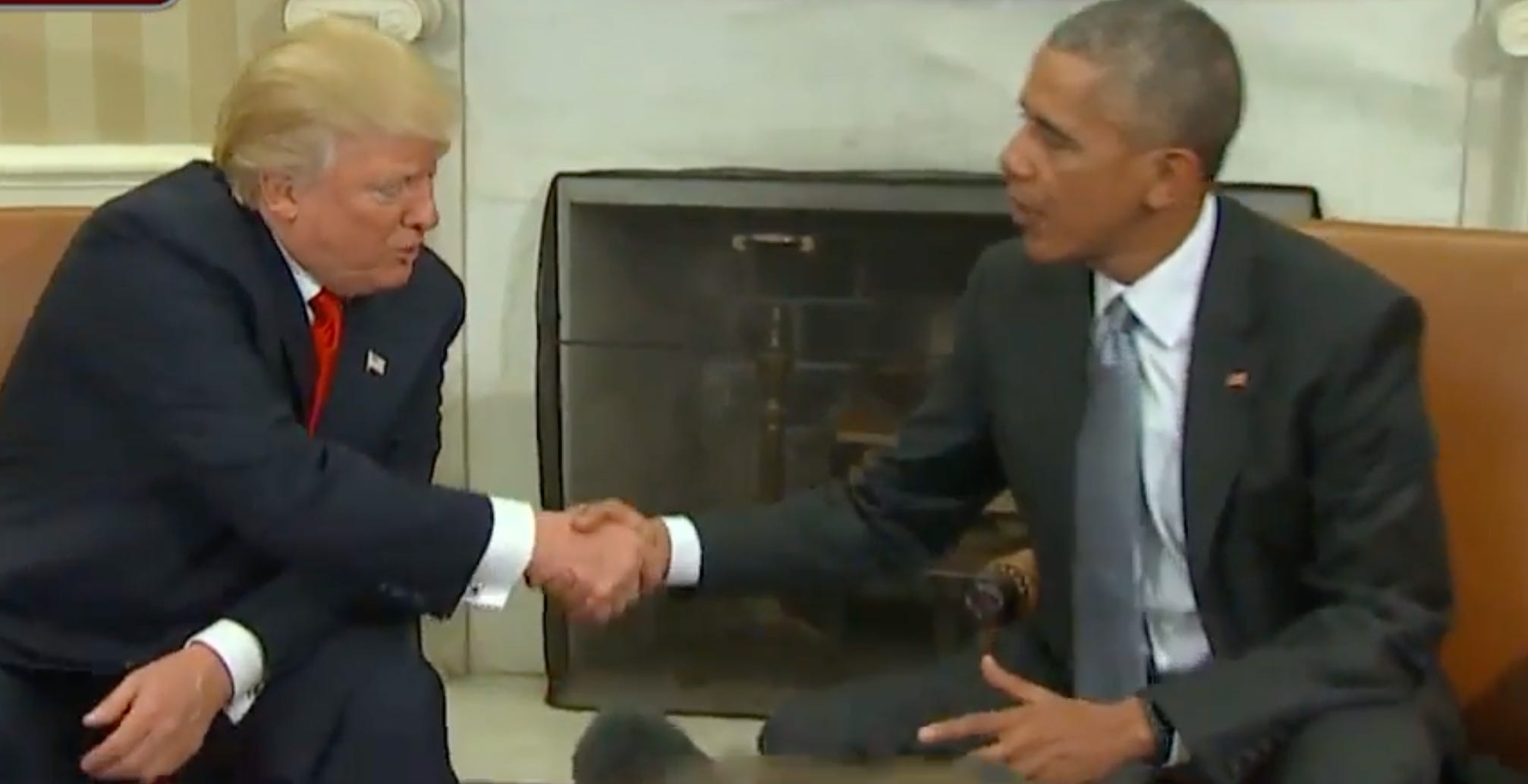
In 2024, Trump urged Congress to “KILL FISA.” With a vote upcoming this week, he now demands its renewal with no limits or safeguards, and he has ample Democratic support.
In August 2013 — in the wake of our Snowden reporting, which revealed the NSA’s mass warrantless domestic spying on Americans — an extraordinary bipartisan bill emerged. Jointly sponsored by one of the most liberal House members (Michigan Democrat John Conyers) and one of his most libertarian-conservative counterparts (Michigan Republican Justin Amash), the bill would have reined in the NSA’s domestic spying powers by imposing serious limits on how such powers can be exercised when aimed at American citizens.
When the Conyers-Amash bill was first introduced, “Official Washington” did not take it seriously. But the Snowden revelations were causing serious public anger about NSA spying, and many members of Congress shared that anger because they were not told that the NSA had implemented a system of mass warrantless surveillance aimed, in part, at Americans. As a result, support for the bill quickly picked up bipartisan steam, seemingly heading toward certain passage — until Barack Obama called Nancy Pelosi.
Despite running for President as a constitutional law professor who vowed to end the civil liberties abuses of the War on Terror, Obama had become an enthusiastic supporter — and user — of the NSA’s domestic spying system. He thus instructed then-Speaker Nancy Pelosi to whip enough Democratic House votes to kill the bill. She did as she was told, and the bill — which initially appeared on its way to approval — was defeated 205-217 (94 Republicans and 111 Democrats voted for the reform bill; 134 Republicans and 83 Democrats voted against it). Official Washington heralded Pelosi as the heroine who saved NSA warrantless spying on Americans:
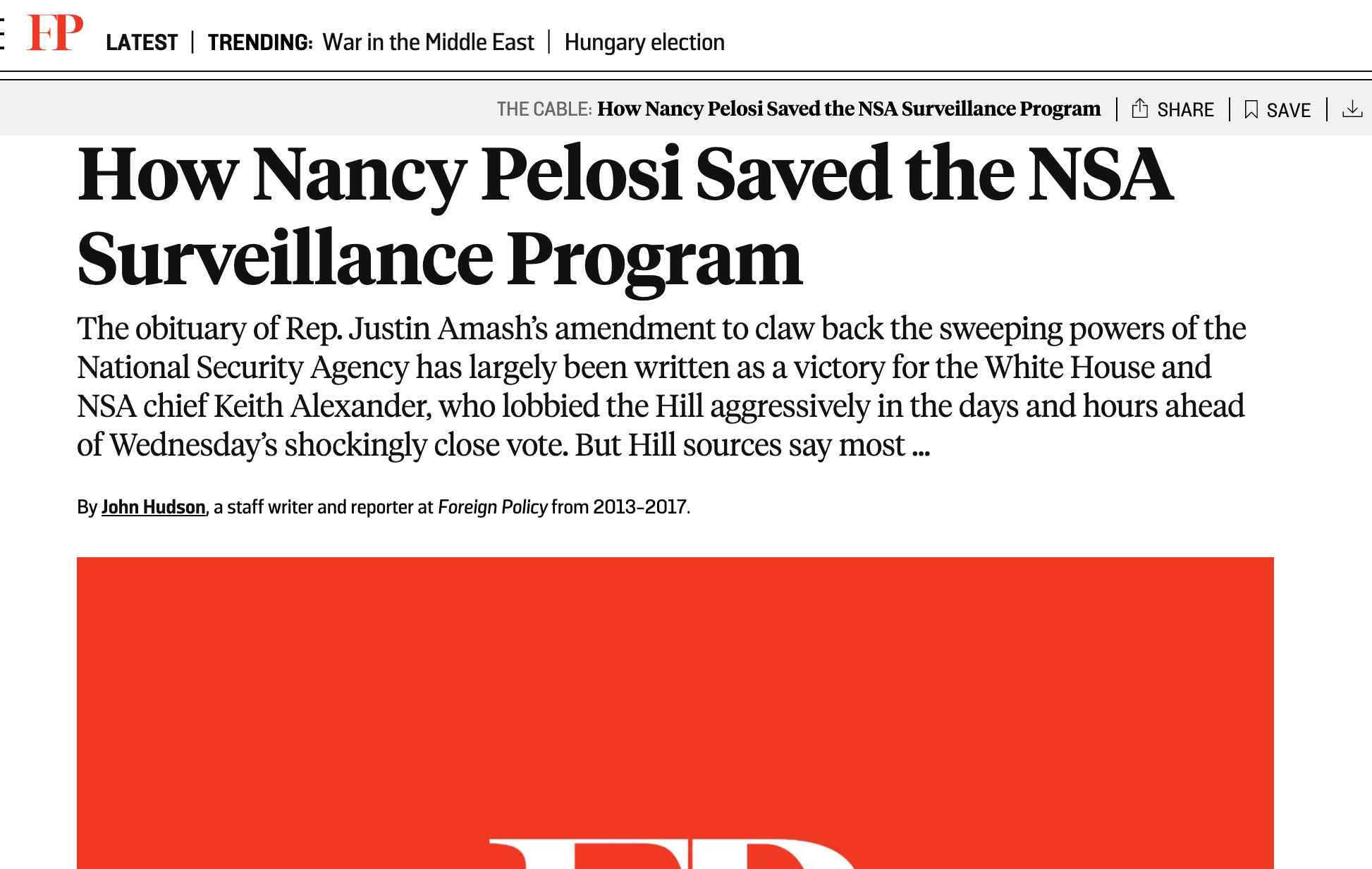
It is hard to overstate how significant the passage of this bill would have been. It would have been the first time in two decades that the U.S. Congress limited rather than increased the domestic powers of the U.S. security state. The era of the Patriot Act would finally have been confronted, or at least diluted. But Obama and Pelosi joined hands with the likes of GOP pro-spying members such as Peter King, Michelle Bachmann, and Kristi Noem to block any limits on the NSA’s power to spy on Americans without warrants.
Now, Donald Trump is on the verge of doing what Obama and Pelosi did back then. Despite running in 2024 by vowing to “KILL FISA,” based on his (quite valid) claim that spying powers had been abused against him for political ends in the 2016 presidential campaign, Trump on Monday demanded that FISA be fully renewed: yet again, with no reforms, safeguards, or limits of any kind.
Congress this week, perhaps as early as Wednesday, will vote on a renewal of Section 702 of FISA, which grants the NSA the power to spy on certain communications of American citizens without a warrant. Although it appeared that there was bipartisan support for finally imposing some limits and safeguards in the wake of years of documented abuses, Trump’s demand on Tuesday — that all House Republicans unite to renew the spying powers with no limits — raises serious doubts about whether any reform is now possible.
Section 702 of FISA has a nefarious genesis. And since its enactment in 2008, it has had a truly bizarre history of being renewed by Congress and the White House in the most confounding yet revealing ways.
After 9/11, the Bush administration — for the first time in American history — ordered the NSA to spy on the communications of American citizens without the warrants required by the law and the Constitution. They did so by eliminating the requirement that forces the NSA, when spying on foreign nationals, to immediately stop spying once it becomes apparent that they were listening to Americans on phone calls or reading their emails.
Instead, Bush-Cheney — in secret, and in violation of the clear terms of the law — ordered the NSA to keep listening and keep reading even if they knew they were spying on Americans without warrants. (Warrantless eavesdropping on Americans is blatantly illegal and unconstitutional. A core purpose of the Fourth Amendment is to require warrants before the government can spy on American citizens.)
The FISA Act was first enacted in 1978, and a core purpose was to require warrants for all NSA spying on American citizens after the Church Committee revealed extensive spying abuses aimed at Americans. During the War on Terror, several NSA whistleblowers — including Edward Snowden, Thomas Drake, and others — came forward when they discovered that the NSA had violated what they were taught was the core taboo of the U.S. deep state: not directing its vast power on foreign adversaries but instead turning its power inward on Americans.
(I wrote my first book in 2006, devoted exclusively to the Bush-Cheney NSA scandal and the illegality of this warrantless domestic spying, and wrote another book in 2013 on my work with Snowden, showing how NSA spying had become virtually ubiquitous under Obama. The attack on core constitutional privacy has been a focus of mine for two decades precisely because of the severity of its erosons.)
The revelations of this post-9/11 NSA domestic spying program in 2005 caused a major public scandal, presaging the much more extensive revelations from the Snowden archive. Americans are taught from a young age that a defining trait of our government is that it cannot spy on us — on our actions, our papers, our conversations, our emails — without warrants.
But rather than punish those who spied on Americans with no warrants, Congress instead acted to retroactively legalize this warrantless domestic spying in 2008 by enacting Section 702 of the FISA Amendments Act (when doing so, Congress also, for good measure, voted to retroactively immunize the large telecom companies that had allowed the U.S. government to illegally spy on Americans; at the 2008 Democratic National Convention in Denver, I covered a party that AT&T lobbyists threw for the “Blue Dog Democrats” to thank them for this retroactive immunity). Section 702 basically permitted the NSA to continue spying on Americans’ conversations when talking to targeted foreign nationals, even when no warrants were obtained.
https://greenwald.substack.com/p/trump-reverses-himself-joins-obama