
Russia Rocks Ukraine With Unprecedented 1,500+ Drones in One of Largest Aerial Attacks Ever
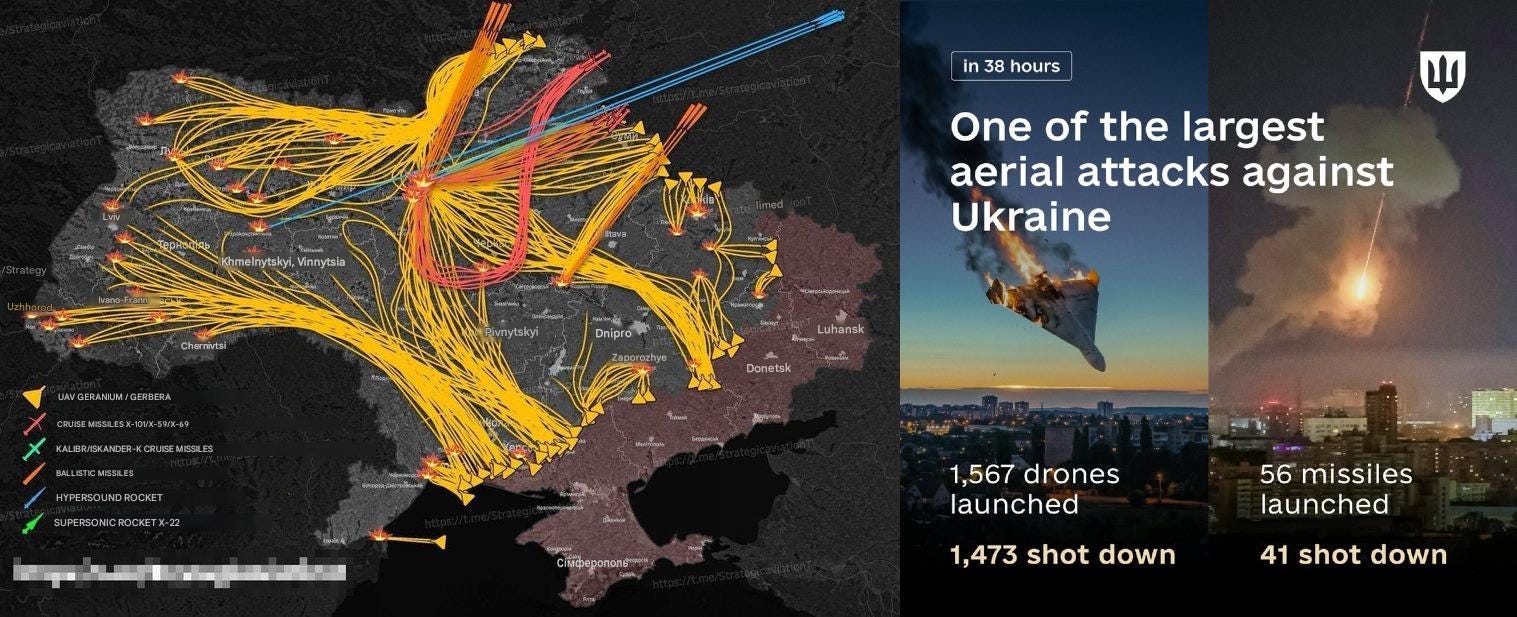
Yesterday, days after the V-Day ceasefire had expired, Russia launched what is once again being called the largest attack of the war. An unprecedented 1,500+ drones were said to have been used—the missile and drone flight-path map was a sight to behold:
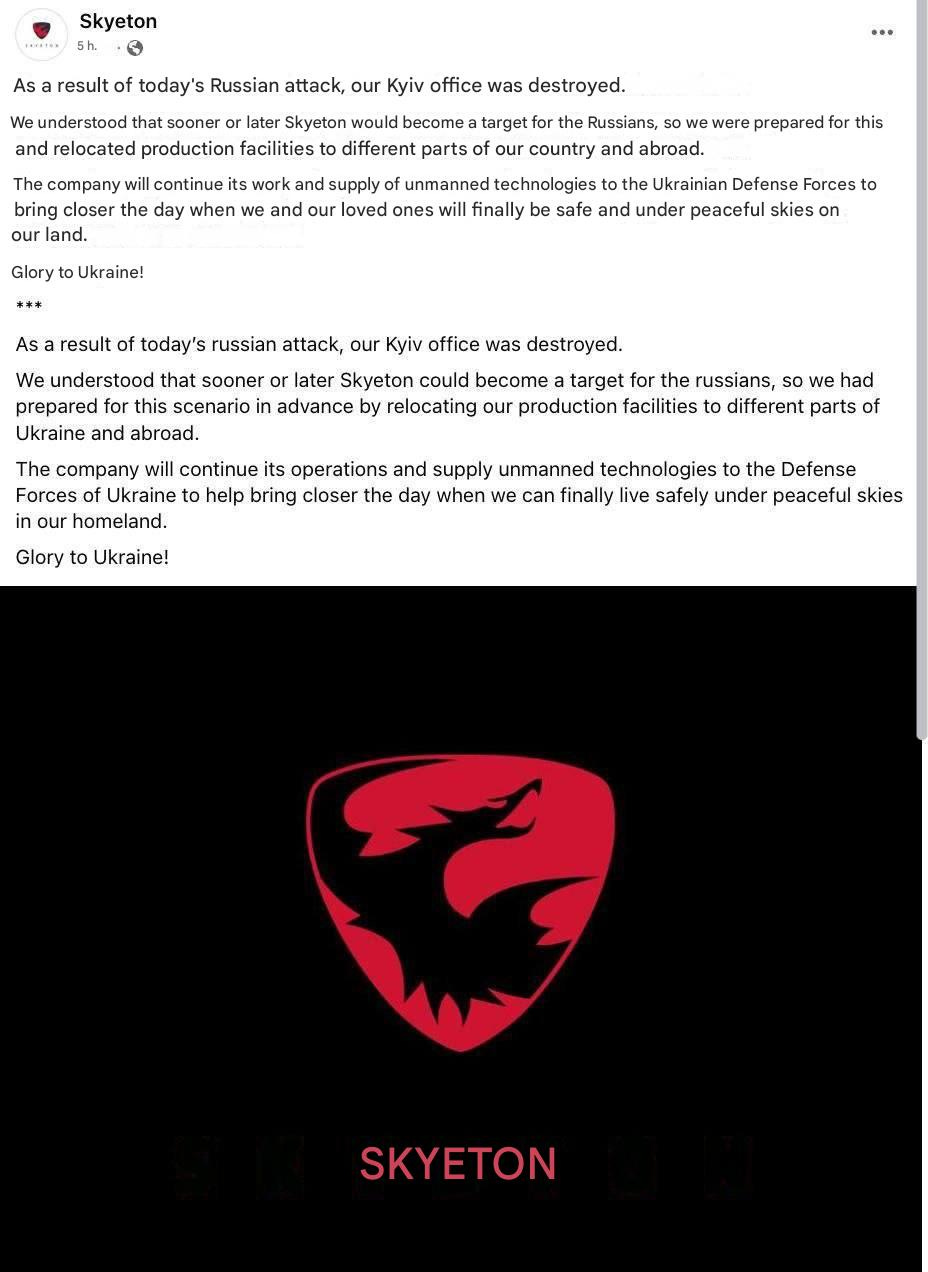
Russia reportedly considers this a “retaliatory attack” for Kiev’s violations of the ceasefire, wherein Ukraine launched many drones of its own at various Russian cities like Rostov during the May 8-10th period. Russia did promise to hit Kiev should that happen, and it appears to have delivered on that promise, given that Kiev was one of the main targets in last night’s strikes. In particular, the offices of drone company Skyeton were struck, which presumably means Russia considered it complicit in the ceasefire-violating drone attacks.
Official announcement from the company:
Western propaganda organs immediately sprang into action to characterize the strikes as some kind of Hiroshima-level event, but the shockingly low civilian casualties left them with little grist for the mill:
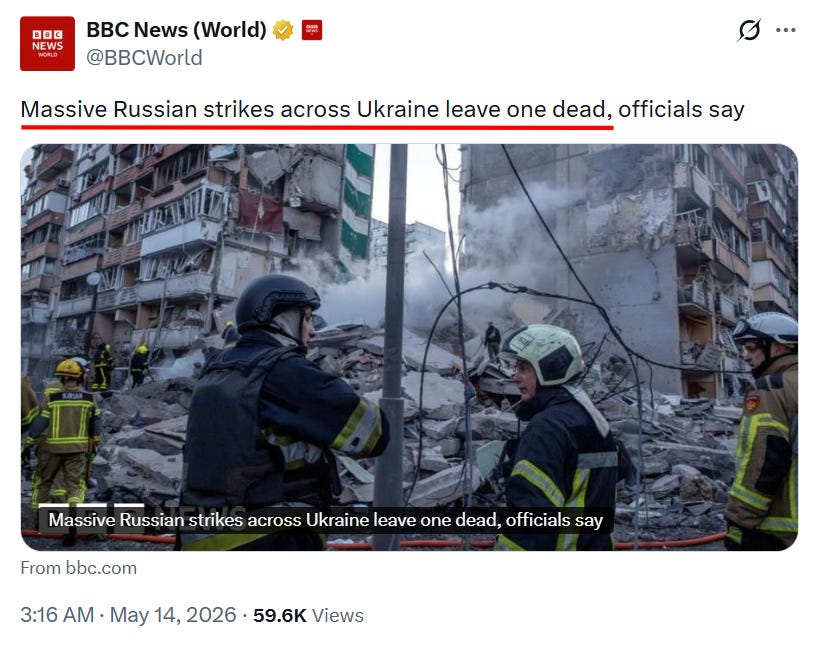
To achieve this level of precision and care toward civilians while carrying out one of the largest massed strikes in history on a major capital and population center is simply unprecedented. Israel slaughters more civilians in a single dropped bomb than are killed by a Russian attack spanning 2,000+ separate munitions. It is a modern war marvel that puts into context the type of approach Russia is conducting in Ukraine, compared to the inhuman savagery seen in the US and Israel’s strikes on Iran and elsewhere. Just US’s attack on the Iranian girl’s school in Minab left more dead than dozens if not hundreds of such Russian mass-strikes as the above.
Recall that recently there’s been a developing diplomatic “situation” regarding drone incursions into NATO countries. The Baltics appeared to be allowing Ukrainian drones to transit in attacking Russia, but some of the Ukrainians decided to betray their benefactors and attack a Latvian oil facility for reasons that remain unknown—one theory being that Russian EW specialists took control of the Ukrainian drones and “landed them” in the appropriate place as payback.
Now the diplomatic kerfuffle has blown into a full-on crisis in Latvia, with the announced resignation several days ago of the Latvian defense minister over this dangerous violation. But the shocking news came a day later, when it was revealed the defense minister had not actually resigned as believed, but was in fact fired by Latvian prime minister Evika Silina:
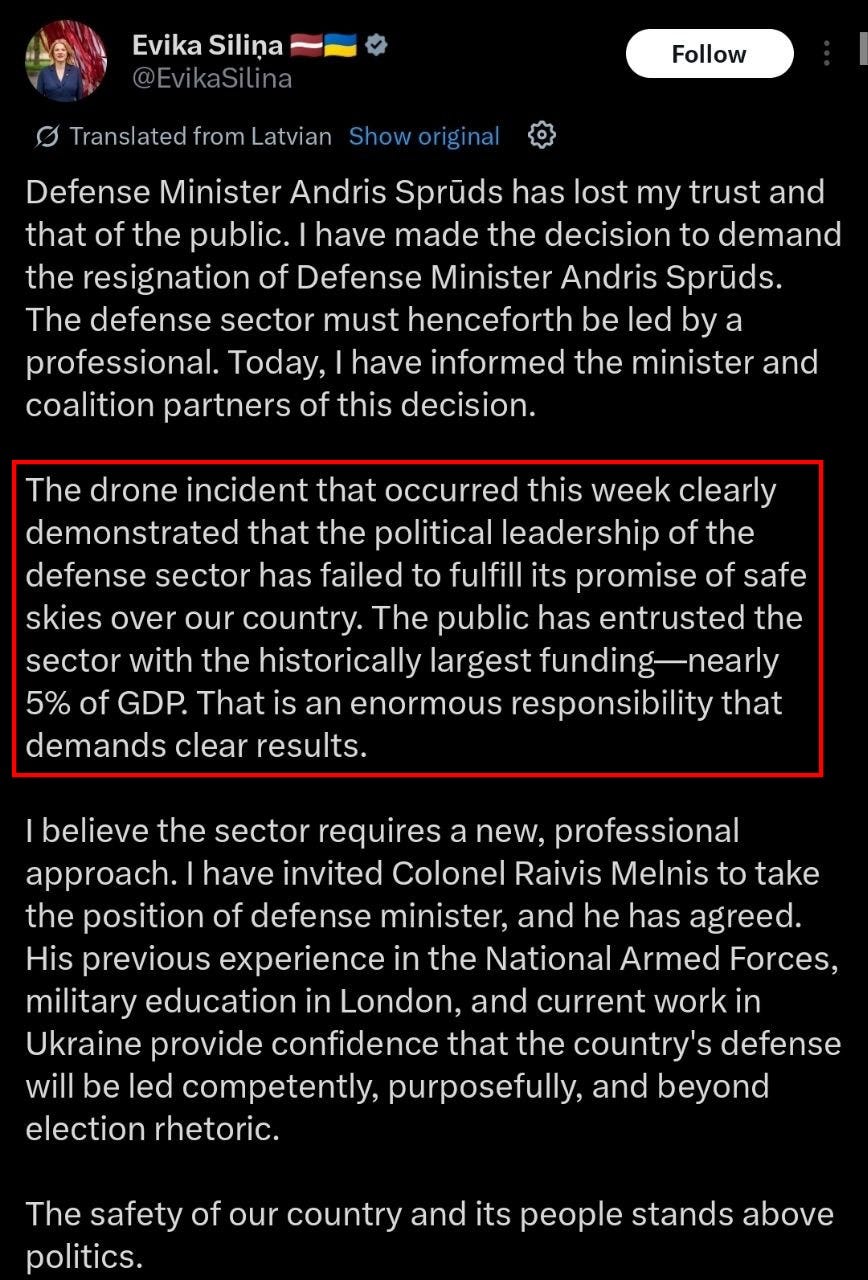
But things didn’t end there. Only a day after that, the Latvian prime minister herself suddenly resigned, as the entire government essentially collapsed within a week over this very issue of unchecked Ukrainian drone incursions.
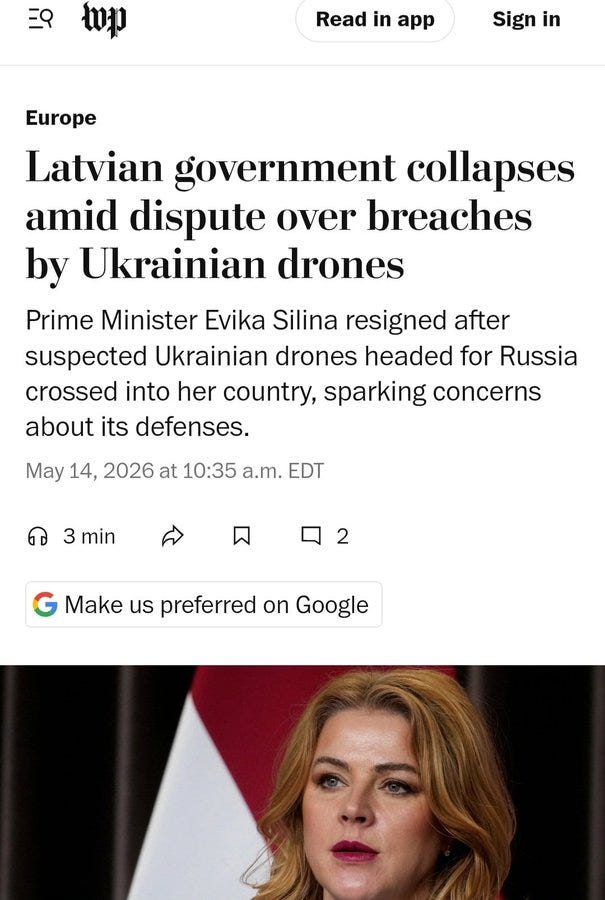
Latvian Prime Minister Evika Silina has resigned following a political crisis over Russia-bound Ukrainian drones straying into Latvian territory.
She had fired her Defence Minister Andris Spruds last week after two drones crashed down in eastern Latvia, criticising his response and appointing a replacement.
In protest, Spruds’s Progressives party pulled their support for Silina’s governing coalition, causing it to collapse months before a planned general election in October.
“Seeing a strong candidate for the post of defence minister… political windbags have chosen a crisis,” Silina said on Thursday. “I am resigning but I am not giving up.”
They admit the drones may have been “jammed”:
The political fallout was triggered by the incursion of three drones into Latvian airspace on 7 May – the second such accident since the start of 2026.
Both Latvia and Ukraine acknowledged that the drones may have been Ukrainian UAVs intended to target Russia whose signals had been jammed, leading them to stray into Latvia.
The hilarious part is that Evika Silina had just finished grandstanding about how no matter whose drones hit their territory, it was still Russia’s fault:
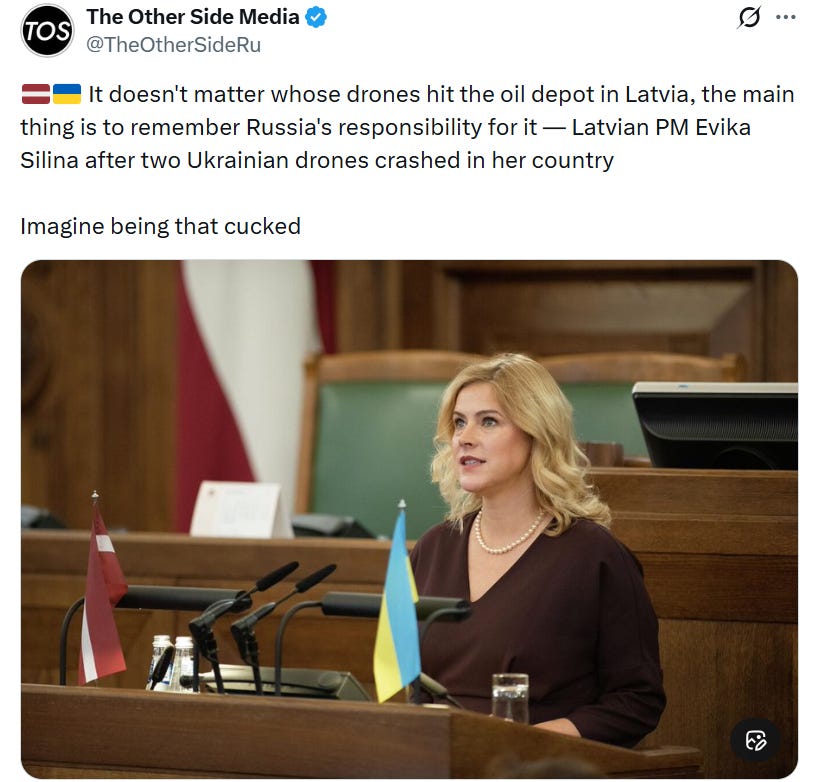
Well, it appears even a phantom Russian hand is enough to collapse the entire poodle-country’s government over two small incursions—and these are the people who thought they could take on Russia militarily and prided themselves on being “NATO’s vanguard” against the “Eastern Threat”.
During the ongoing fallout, Estonia, too, raised a tougher rhetoric against Ukraine, warning Zelensky to rein-in his out of control drones:
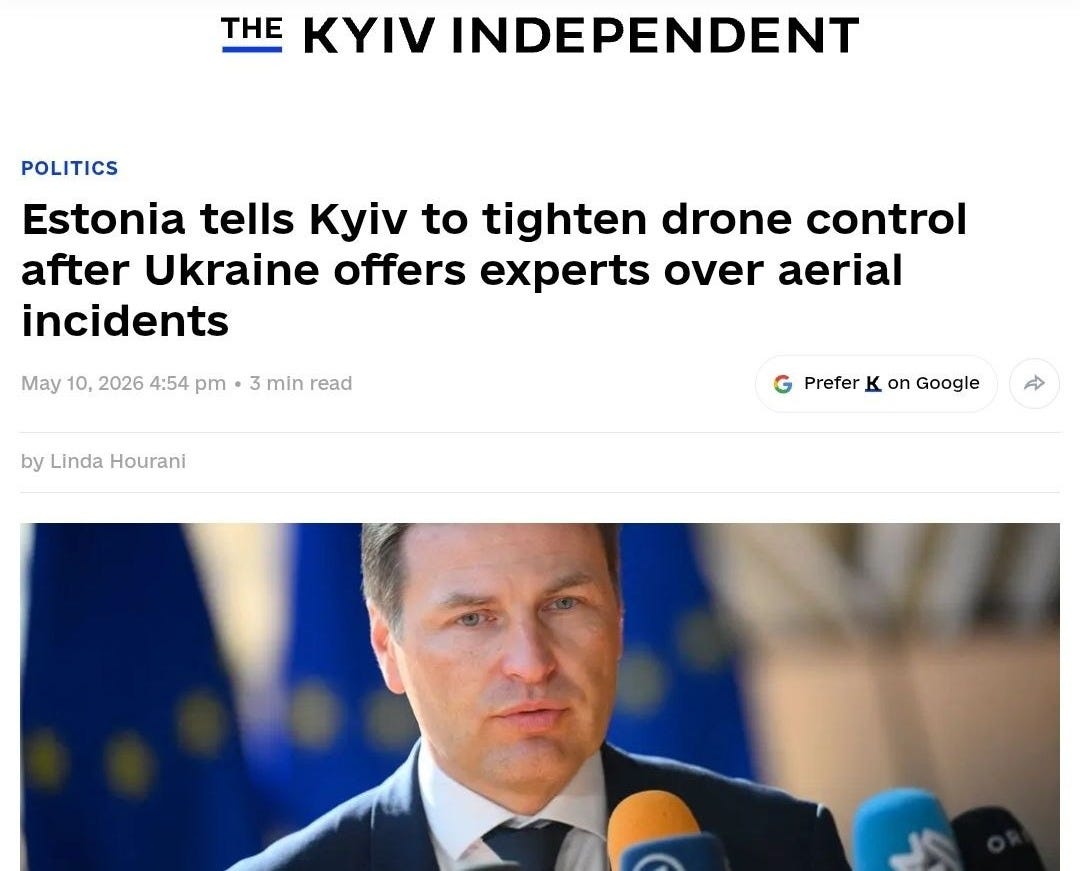
In response, the Estonian government signaled that it expects Ukraine to better control its drones.
“Of course, all this needs to be clarified and explained, what exactly it means, what they themselves meant by it,” said Estonian Defense Minister Hanno Pevkur.
“I will start dealing with this immediately. Certainly, the easiest way for the Ukrainians to keep their drones away from our territory is to better control their activities.”
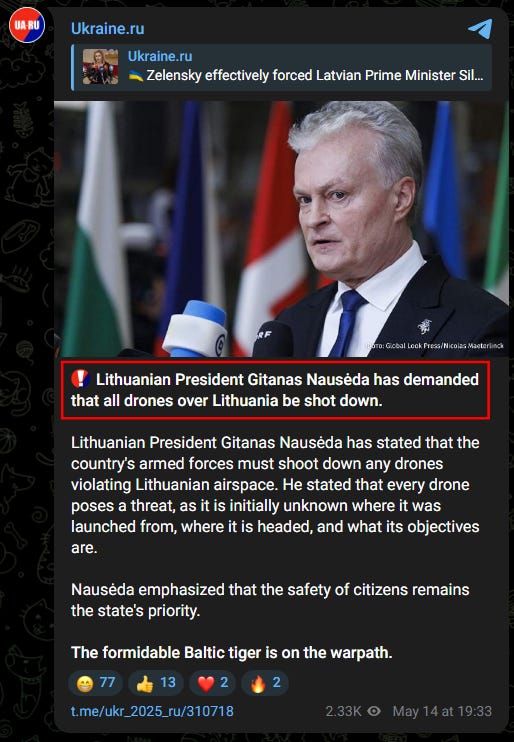
All of this seems to have the odor of something concealed beneath the surface. Perhaps the Baltics are simply trying to distance themselves from Ukrainian activities in order to give the appearance that they are not involved in the willful allowance of Ukrainian drones transiting their airspace. Or perhaps there is true elite conflict in the upper echelons, which would explain Latvia’s governmental collapse: there are likely many patriots there who do not agree with Brussels’ mandate for war against Russia, and have therefore put tremendous pressure on their political figures to end covert participation in Ukraine’s provocations, which they know will lead to wide-scale European war.
Another explanation is the following, given that Zelensky immediately met with the Latvian president to “offer” a drone protection package:
After the drone attack in Latvia, Zelensky offered Rinkevics protection from drones.
“I met with the President of Latvia. We expect to sign an agreement with Latvia in the DoneDeal format to create a multi-level system for protecting the sky from various types of threats. He suggested sending our experts to Latvia to share their experience and protect the airspace.”
Getting back to the strikes, many doomers have ridiculed Russia for its red-line drawing antics. NYT tells a different tale, that Russia has been busy blowing up US infrastructure in Ukraine like nobody’s business:
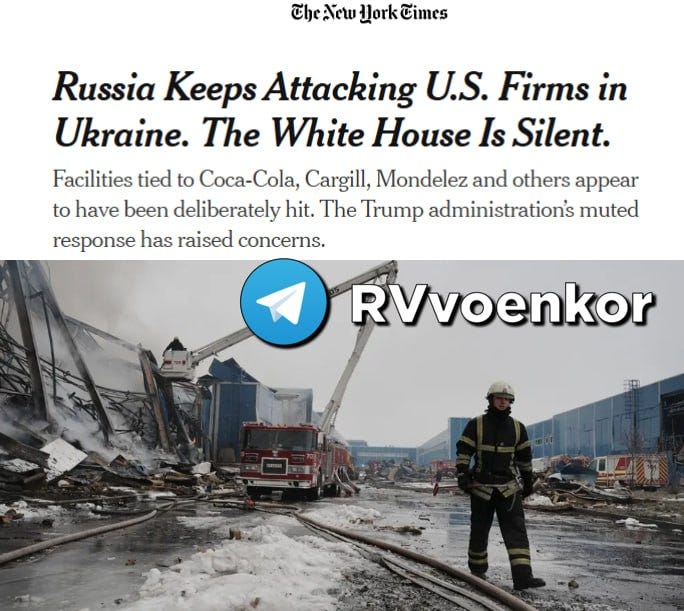
From the above:
The Russian drones slammed into the American-owned warehouses one after another.
Each announced its arrival with an eerie whine. Then came the blasts, ripping through a vast grain terminal in southern Ukraine and lighting up the night sky.
Seven drones in three minutes. The target, according to a video of the mid-April attack recorded by a truck driver, was the U.S. farming giant Cargill.
“This is insane,” the driver is heard repeating in the video, which was obtained and verified by The New York Times. “This is insane.”
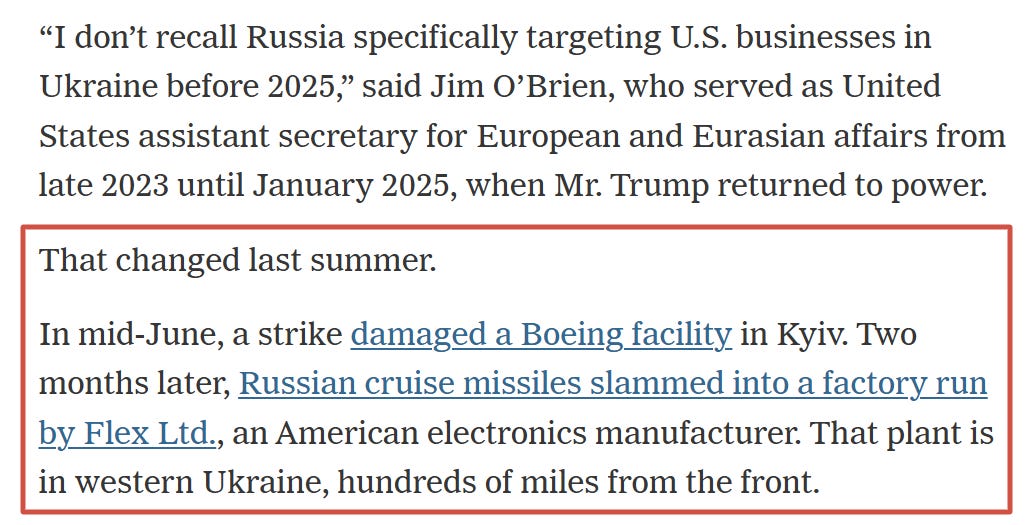
The attack was one of the latest in a series of Russian strikes on major American companies since last summer, including facilities tied to Coca-Cola, Boeing, the snacks maker Mondelez and the tobacco giant Philip Morris.
The article notes the companies have been trying to keep these hits on the hush so as not to alarm investors about their factories going up in smoke.
In February, representatives of several American companies, including Coca-Cola, Cargill and Bunge, another farming giant, spoke with a bipartisan group of U.S. senators who were visiting Ukraine.
“Listening to several of them, they said they believed they were being intentionally struck,” Senator Jeanne Shaheen of New Hampshire, the top-ranking Democrat on the Foreign Relations Committee, said in a telephone interview.
Andy Hunder, the head of the American Chamber of Commerce in Ukraine, which represents U.S. companies operating there, said that the Russians “are sending these missiles and drones with the hope that they will stop American business coming into Ukraine.”
—
As a last note, Zelensky’s right-hand man Yermak has been arrested for up to two months:
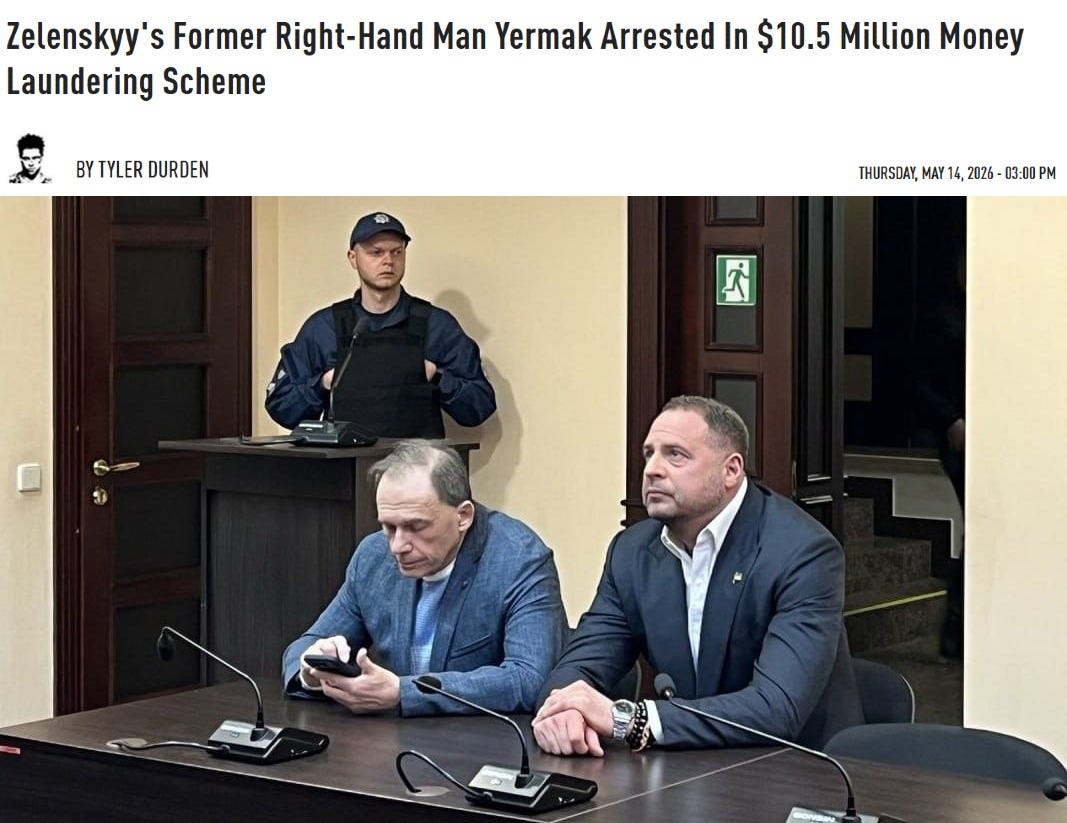
Ukrainian court sent Ermak to custody for two months on a bail of 140 million UAH
▪️The prosecutor’s office requested a bail of 180 million UAH.
▪️The court also prohibited Ermak from communicating with other suspects in the case.
▪️The former head of Zelensky’s office is suspected of involvement in money laundering as part of a large-scale corruption scheme.
▪️According to the investigation, about 460 million UAH were legalized during the construction of luxury residences in Kozin near Kyiv.
▪️One of these residences, according to rumors, belongs to Zelensky.
➖”In the detention center, I plan to take the most necessary things, but I don’t have 140 million UAH. I have enough friends who can help me. I will file an appeal,” said Ermak.
This comes amidst rumors that the special corruption “investigations” are circling closer and closer to Zelensky himself.
Most interesting about these developments is what Medvedev revealed about the Kremlin’s potential angle towards all this:
Anyone who replaces Zelensky in power is more likely to agree to a peace deal, – Medvedev
➖“Any new person who comes to replace the floundering bastard will start by destroying the legacy of his predecessor. Things are just too bad. And therefore, the likelihood that the successor will agree to the demands of the main sponsor – the USA – is significantly higher. It will be easier for him to accept the inevitable,” – said the deputy chairman of the Russian Security Council.
▪️He believes that Zelensky remains the only alternative leader of the Kiev regime in the eyes of Europeans, despite the corruption.
➖”Yes, there’s some British Zaluzhny there. But he doesn’t have his own personal army, nor does he have significant support in the elites. It will take time to promote him, which the disgusting creatures like Merkel, Macron, and Stoltenberg don’t have much of,” – writes Medvedev.
The reason this is interesting is because it reveals a potential motive for the recent slow-down on the front. As many who have followed the premium pieces here on the front developments of late will know, I have been following an apparent Russian change in strategies. The way this could tie into it is that Putin may have internal intelligence that Zelensky may be on his way out, and a potential replacement could be expected who would carry out the role Medvedev outlines above.
What is the significance of this as potential vector for the war?
Ukraine has built up a vast increasingly complex defensive network all across the remainder of the Donbass that will take many Russian casualties to capture, over the course of a long, slow grind. Putin may see the opportunity here to wait patiently for now for a successor to the troubled Zelensky regime who could make a ceasefire deal by giving up all of Donbass. This would allow the Russian Army to immediately bypass years of fortifications, saving tens of thousands of lives.
“But this would be surrender for Russia!” some would cry. Not if it goes along the potential vectors I outlined several times long ago, wherein the ceasefire to quickly leapfrog and gain Donbass would merely be a ploy to skip having to capture it by force. Afterwards, the ensuing negotiations would predictably break down and the war would resume, but this time with the Russian Army at a significant advantage having completely bypassed the entire multi-ring fortification network without firing a bullet.
Granted, this is a very speculative theory simply to put forth one potential idea the Kremlin may be operating with. They may be sensing Zelensky’s political demise and simply biding their time: why push the Russian Army “mule” hard when one can enter a momentary restful phase to await a key collapse in your enemy’s structure that will gain you massive advantage for which the “mule” will then be primed.
—
Lastly, in light of all the Euro-provocations and developments therein, Russia has just successfully tested its feared Sarmat ICBM, the most powerful weapon ever devised by the hand of man:
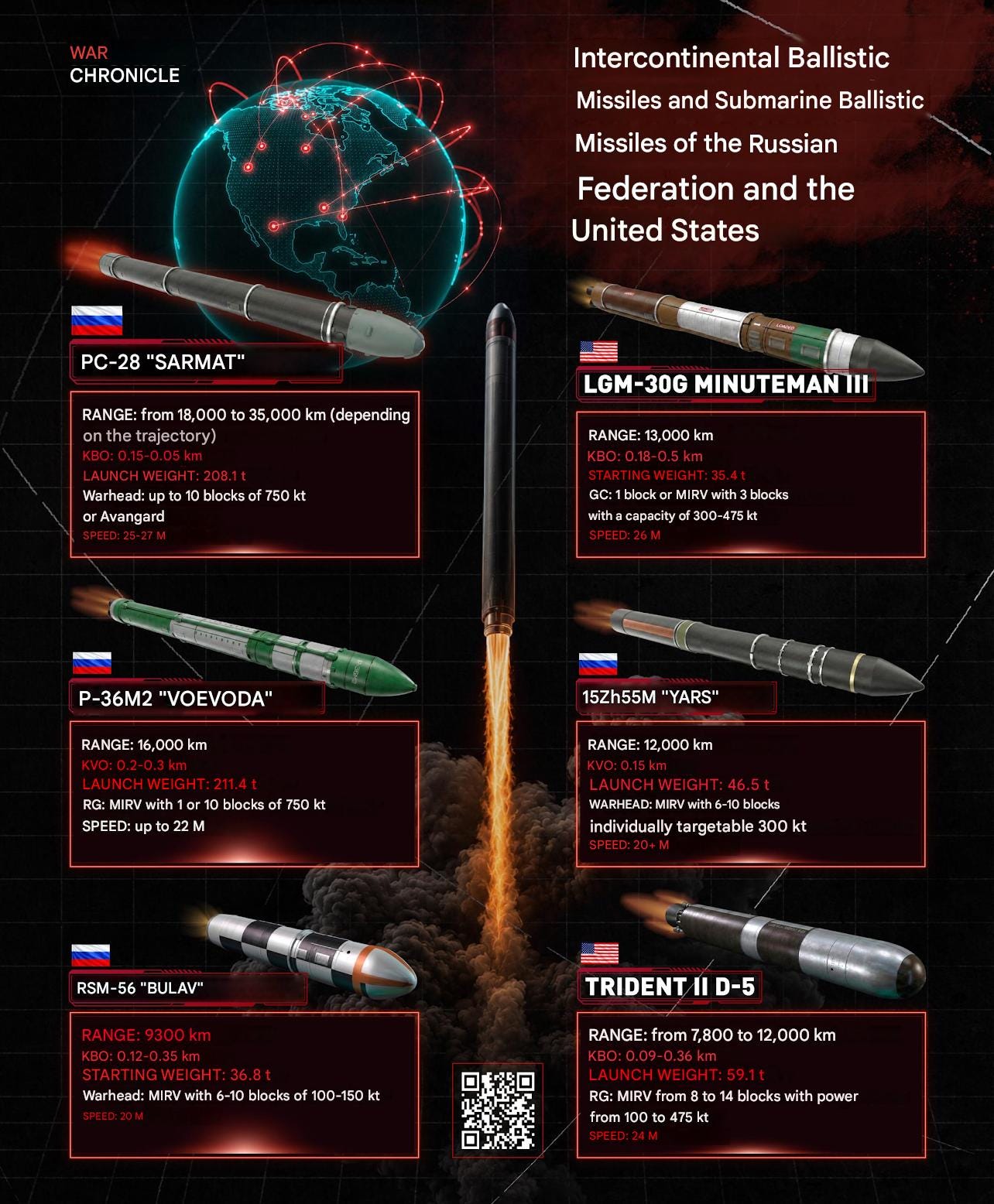
Some may recall two alleged failed tests carried out in the past two years, wherein one Sarmat was said to have exploded at the Plesetsk test site. The reasons for this, if true, is that Sarmat is the heaviest and most complex ICBM launch vehicle ever devised, coming in at a whopping 10 tons of payload ‘throw weight’ compared to the 3-4 tons in comparable US ICBMs.
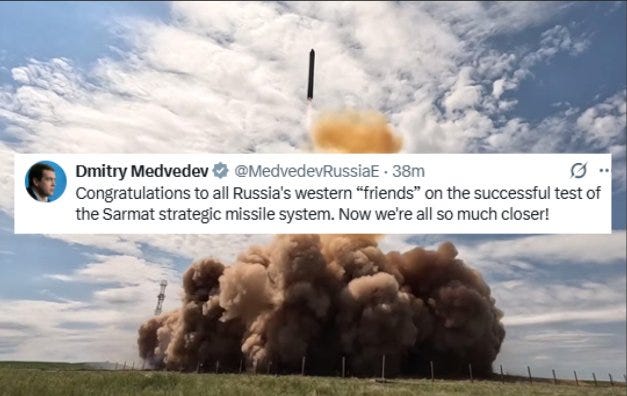
For this occasion, Medvedev likewise offered some complementary words:
https://simplicius76.substack.com/p/russia-rocks-ukraine-with-unprecedente