
So Much Winning

Please make it stop, Mr. President.
In 2002, the Pentagon spent $250 million on the largest wargame in US military history called ‘Millennium Challenge’. 13,500 participants, 2 years of planning, the works. The idea was pretty straightforward: simulate an invasion of a Middle Eastern country in the Persian Gulf. Suspiciously resembling Iran. The purpose was to demonstrate that America’s technological dominance could steamroll anything in its path.
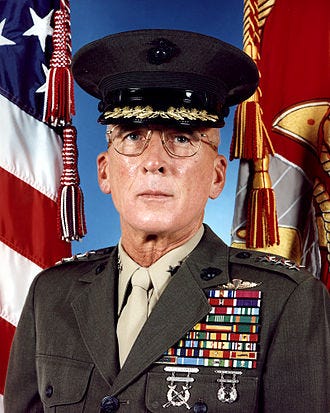
They picked a retired 3-star Marine named Paul Van Riper to play the enemy.
Van Riper, who spent 41 years in uniform from Vietnam to Desert Storm, took one look at the scenario and did what any self-respecting adversary would do. He ignored it completely. Instead of radios, he used motorcycle couriers. Attack orders were hidden in the daily call to prayer. Swarms of explosive-laden speedboats were sent through the Strait of Hormuz.
And in less than 10 minutes, he sank 16 US warships. An aircraft carrier, 10 cruisers, and 5 amphibious ships. Over 20,000 simulated American casualties. The equivalent of Pearl Harbor, executed with small boats and cruise missiles by a retired Marine with a phone and a bad attitude.
So the Pentagon did what any self-respecting institution does when reality disagreed with the plan.
The ships were un-sank. Van Riper’s forces had to turn on their anti-aircraft radar so it could be easily targeted and destroyed. They even told him he wasn’t allowed to shoot down the incoming 82nd Airborne. The whole rest of the exercise was scripted to guarantee an American victory.
Van Riper walked out in disgust. His parting words: “Nothing was learned from this. A culture not willing to think hard and test itself does not augur well for the future”.
That was 24 years ago. The conditions Van Riper exploited haven’t changed. They’ve only gotten worse.
And now we’re one month into this shooting war with Iran. “Operation Epic Fury”.
Let’s have a look at what we’ve achieved, shall we?
The Strait of Hormuz has been successfully transitioned from a free international waterway into a revenue-generating toll infrastructure, administered by the IRGC with a published fee schedule, a vetting corridor near Larak Island, and legislation pending to make it permanent. Ships currently pay $2 to $3.5 million per transit, settling in yuan through CIPS, which bypasses SWIFT entirely and represents a significant upgrade in settlement efficiency.
India has adopted the yuan. Japan has adopted the renminbi. Pakistan negotiated preferential rates at 2 tankers per day. Thailand secured bilateral access. Only COSCO, China’s state shipping line, moves freely, which streamlines the user experience considerably if you happen to be Chinese. The dollar’s share of global reserves has reached its lowest level in a century, which suggests the new framework is being broadly embraced.
This is the petrodollar in transition. The mechanism that has underwritten American empire since 1974 – Gulf oil priced in dollars, revenues recycled through US Treasuries, quietly funding a $39 trillion debt – is being replaced in real time by a yuan-denominated corridor that didn’t exist 5 weeks ago. And unlike a military defeat, which can be spun and repackaged for a news cycle to consumers with the attention span of a goldfish, a reserve currency transition is a one-way door.
The Navy has achieved a significant risk management milestone by declining to escort tankers through the Strait, citing conditions that were “too high” – a prudent assessment that prioritises fleet preservation over the stated objective of the war. 3,000 ships and 20,000 seafarers remain in the Gulf, representing the largest involuntary maritime community since the Age of Sail. Maersk has 10 container ships holding position, crews resourcefully extending provisions without fresh food. 470,000 TEUs of container capacity – 10% of the global fleet – is effectively in long-term storage, reducing wear on hulls. The insurance industry has contributed independently: 7 P&I clubs filing cancellation notices achieved what the entire US Fifth Fleet could not, surging war-risk premiums from 0.2% to 10% of hull value. Even after a ceasefire, insurers require 30 to 60 days of incident-free stability before reinstating cover. The Houthis’ Red Sea precedent: 26 months and still no policy written.
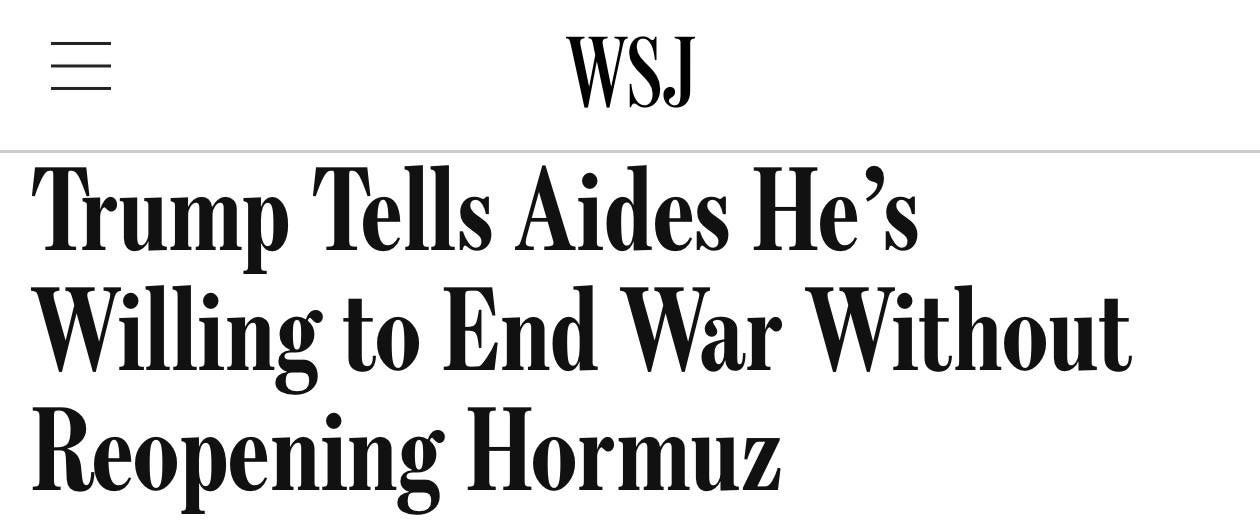
Flexibility in goal-setting is a hallmark of mature organisations, and the administration demonstrated this by quietly reclassifying the reopening of Hormuz from “strategic imperative” to “optional”. The waterway that carries a fifth of the world’s oil, that the war was partly launched to secure, is no longer required for the war’s conclusion. This frees up considerable strategic bandwidth to focus on objectives that are also not being achieved, but in less publicly measurable ways.
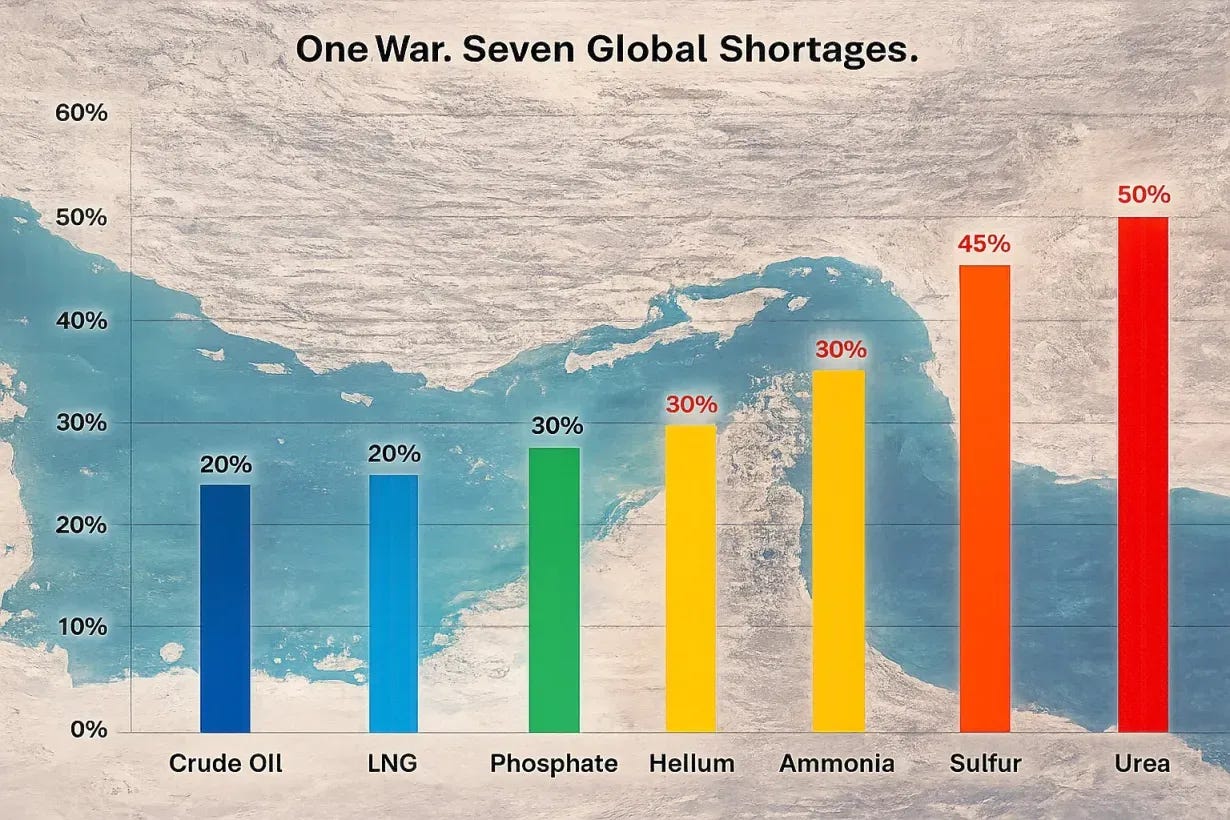
The war has successfully disrupted seven global commodity flows simultaneously, achieving a level of supply chain diversification that would be difficult to replicate intentionally.
The agricultural sector has been comprehensively de-risked from overreliance on Gulf-sourced inputs. Hormuz transit collapsed 97%, slashing maritime CO2 emissions in the Strait to levels not seen since the Age of Sail. An environmental triumph, really. It also took with it 80% of global sulfur production along with nitrogen capacity that was rendered uneconomic by gas prices. Russia contributed by halting ammonium nitrate exports. China pitched in by banning phosphate exports through August.
All those key macronutrients were successfully eliminated from global supply chains simultaneously, and during planting season no less. Urea at the Port of New Orleans hit $690 a tonne, a 45% gain in three weeks that commodity traders would kill for under normal circumstances. The nitrogen shortage has automatically opted one in four US farmers out of spring production.
318 million people were already at crisis-level hunger before February 28. That figure has been earmarked for aggressive growth, and with the planting window about to shut, the revised projections are locked in.
The plastics and pharmaceutical supply chains have undergone similar rationalisation. Three supply chains for polyethylene were streamlined in one stroke: Indonesia, South Korea, and Singapore. In a single week!
India, producer of 40% of US generic drugs, sources 87.7% of its methanol through the same 21 miles we just helped close, putting paracetamol, ibuprofen, and metformin for 537 million diabetics on an accelerated depreciation schedule.
The helium and semiconductor precursor chains have been successfully consolidated toward China, streamlining the global dependency structure. Qatar’s Ras Laffan is currently enjoying an operational pause of just three to five years, giving the industry a real chance to reset and innovate. A permanent inventory reduction of 200+ cryogenic containers has been achieved with helium proactively self-releasing to space – eliminating storage overhead entirely.
Airgas has proactively rightsized its supply commitments by 50% as they declared force majeure.
The few non-Chinese sources of gallium – a semiconductor precursor – have been dismantled in favour of a single consolidated Chinese pipeline.
Crude oil, LNG, phosphate, helium, ammonia, sulfur, urea. Pay for one war, get seven shortages for free!
The water infrastructure programme has delivered beyond expectations. Trump’s threat to “obliterate” Iran’s desalination plants – which supply less than 1% of Iranian water – successfully deterred Iran from retaliating against American assets entirely, redirecting its response to Kuwait’s West Doha facility instead. 38.5% of Kuwaiti national capacity offline.
The leverage dynamics are exceptional and speak to the programme’s broader vision. By committing 1% of its own exposure to the escalation, Iran has put 90% of its neighbours’ water supply at risk. We did that!
The Habshan-Fujairah pipeline – the last meaningful bypass for UAE crude exports – was struck twice in three days, Iran helpfully reconfirming our threat assessment on each occasion within 72 hours.
Financial market engagement has been robust. Someone placed a $1.5 billion bet in S&P futures 5 minutes before Trump’s “ceasefire” post, capturing a $2 trillion market surge in 6 minutes – outstanding timing that demonstrates growing confidence in the administration’s communication calendar. Iran denied everything within 30 minutes and a trillion evaporated, but early movers locked in gains, proving that speed of access matters more than factual accuracy.
On the last day of Q1, a 20-day-old peace headline was successfully repackaged during window dressing, generating a $1.7 trillion S&P rally – the best Q1-closing day since September 2008, confirming that news doesn’t need to be new to be effective.
Iran’s Parliament Speaker Ghalibaf has begun posting trading advice between missile salvos, telling followers to treat Trump’s announcements as reverse indicators. When a wartime adversary monetises your press releases more efficiently than your own allies, the information architecture is performing above expectations.
The US 10-year has reached 4.48%, Japan’s has achieved its highest level since 2000, and France’s has breached GFC levels, opening up fixed-income opportunities not seen in a generation.
$12 trillion in global market capitalisation has been successfully redistributed – more than the combined GDP of Germany, Japan, and the UK. Wealth destruction at that scale usually requires a full financial crisis. We achieved it with tweets.
Europe’s energy transition has been a resounding success. Germany led the way by decommissioning its nuclear fleet – an ageing, expensive liability propped up by politicians who subsequently secured well-paid positions at the energy companies they’d been subsidising, suggesting industry was keen to reward their regulatory foresight. The continent then cut Russian gas, because energy independence from authoritarian suppliers is a strategic imperative, and someone helpfully blew up Nord Stream to make sure nobody lost their nerve. The replacement strategy centred on Qatari LNG: long-term contracts, shiny new regasification terminals, a clean pivot executed with characteristic bureaucratic thoroughness. The LNG will resume flowing in just 3 to 5 years, giving European policymakers a comfortable planning horizon.
But the transition is working. Europe has successfully achieved independence from nuclear, Russian gas, AND Qatari LNG simultaneously, leaving it fully sovereign over its own energy policy and completely dependent on American LNG at 7 times the Russian price, under a deal Trump is threatening to revoke by Thursday. German diesel has reached a record €2.29 per litre in the meantime, providing the kind of demand destruction that Brussels has been trying to legislate for a decade.
Germany is exploring the opportunity to reclaim valuable real estate by closing US bases and repatriating 50,000 troops. Spain streamlined airspace management by closing it to US military traffic entirely. Italy denied access at Sigonella. France enhanced aviation security by refusing access to its airspace. Four NATO allies have completed the transition from collective defence to collective spectatorship.
Rubio asked a valid question to a shrinking audience: “Then why are we in NATO?”
China, meanwhile, controls 90% of rare earth refining, plus massive chunks of the pharmaceutical, polyethylene, battery, and semiconductor supply chains – a consolidated position that the war has helpfully strengthened by eliminating most of the non-Chinese alternatives.
The volatility is also helpfully stress-testing the financial plumbing. Private credit funds that loaded up during the cheap-money years are proactively reducing investor exposure as the AI bubble meets the liquidity crunch.
The radar modernisation programme got underway on day 1 of the war. Iran opened the campaign by retiring the $1.1 billion early warning radar in Qatar, then followed up with two radars in Jordan and the UAE. $2.7 billion in ground-based radar infrastructure comprehensively decommissioned in 48 hours, clearing the way for next-generation replacements that have not been ordered, budgeted, or designed, but the runway is clear.
That targeting programme continued for a month and this week delivered its headline results: an E-3 Sentry AWACS was destroyed at Prince Sultan Air Base, and two EC-130H Compass Call electronic warfare aircraft rendered permanently available for parts.
The AWACS – a $300-to-$500 million flying command post – had never been lost in combat in the type’s entire history. We achieved a first, which is almost worth celebrating. The EC-130H fleet provided the jamming capability meant to suppress Iranian air defences ahead of any ground assault. Fleet strength went from 3 to reportedly 1, a 67% reduction that concentrates institutional knowledge in the remaining airframe. Iran identified the tool designed to defeat it and removed it from service before it could be used. The aircraft had been parked in the open because nobody built hardened shelters, reportedly because shelters threatened the F-35’s share of the budget. Priorities were successfully maintained, though.
Munitions consumption has been outstanding. In the first 5 days alone we expended more Patriot missiles than the entire US manufactures in a calendar year, demonstrating a commitment to throughput that the production side has yet to match. The team then diversified the interceptor portfolio to include legacy PAC-2 systems manufactured during the Clinton administration, broadening our vintage range and proving that age is just a number.
The THAAD battery was reallocated from South Korea, freeing up resources in one theatre to address urgent needs in another – a logistics win, even if Seoul disagreed and North Korea expressed its appreciation with a cruise missile test the following day.
Iran also launched a flare decoy operation over Dubai that depleted roughly half the city’s interceptor stock chasing false heat signatures, demonstrating that the adversary is also innovating on cost efficiency – their expenditure on the operation was approximately zero. The manufacturer has since promised to quadruple production. THAAD output for 2026 remains at zero, but quadruple zero is still zero, so technically the target is already met.
RUSI forecasts Israel’s Arrow interceptors will be “completely expended” by April. It is April.
The Tomahawk inventory has been aggressively drawn down, with one third of the decade-accumulated stockpile deployed in just 27 days – a velocity of consumption that signals strong operational commitment. The JASSM cruise missiles have been fully utilised, successfully exhausting the entire stand-off weapons inventory and freeing up the mission profile for a more direct approach. B-52 bombers – an airframe older than the state of Israel – are now dropping unguided JDAMs directly over Iran, leveraging proven legacy platforms in a hands-on role. F-22 stealth fighters have been sent home as “no longer required”, reducing overhead. A-10 Warthogs – a close air support aircraft designed in the 1970s to stop Soviet tanks and scheduled for retirement since before some of its pilots were born – are being routed through England toward the Gulf, extending the airframe’s service life well beyond what anyone in procurement expected or wanted. We started the war with stealth fighters and precision cruise missiles and we are finishing it with gravity bombs dropped from planes your grandfather would recognise.
The cost-exchange ratio deserves recognition. Iran’s total offensive expenditure for the entire war: approximately $200 million. The Pentagon has requested $200 billion in supplemental funding. That’s a 1,000-to-1 ratio, which is the kind of return on capital most venture funds would kill for – just not usually on this end of it.
A $50,000 Shahed drone requires a $3.87 million Patriot to intercept, offering Iran an unmatched capital efficiency per engagement that our defence contractors can only admire.
Iran has no navy and no air force worth mentioning. It turns out you don’t need either. The doctrine IS the cost asymmetry: thousands of cheap drones, thousands of missiles, and the patience to fire them one at a time until the interceptor maths break. The per-sortie loss rate is running at a 300% improvement over Gulf War I benchmarks.
Further equipment milestones: 3 F-15E Strike Eagles retired by a Kuwaiti F/A-18 in a friendly fire incident (our ally; all 6 crew ejected safely, which counts as a partial win), a KC-135 Stratotanker lost in Iraq with all 6 crew, 5 more tankers decommissioned at Prince Sultan representing 16% of the in-theatre fleet (the tanker fleet being the life support of the air campaign), an F-35 damaged over Iran by an Iranian-made Mobin system (the first confirmed combat damage to an F-35 from an adversary – another first!), and 12+ MQ-9 Reaper drones contributed to the Iranian landscape on top of the 16 to 20 the Houthis had already collected before this war even started.
The USS Gerald R. Ford, nuclear carrier and flagship of the fleet, is enjoying an extended maintenance period in Crete following a laundry-related fire that took 30 hours to extinguish. Estimated return to service: 14 months, giving the crew ample time to upgrade the washing machines. As a commitment to our success, a third carrier group – the USS Bush – has been deployed from Norfolk. This is the first time since Iraq 2003 that three strike groups have converged on one theatre.
13 US service members killed. Over 300 wounded. Those are official numbers. 92% of polled Americans have indicated they’ve seen enough winning.
The coalition has grown in all directions, though not necessarily the intended ones. Iran’s 31 autonomous IRGC commands have launched 88+ waves, demonstrating a decentralised operating model that functions seamlessly without senior leadership – or indeed any identifiable leadership at all. Iraqi resistance groups have scaled to 47 operations per day, including sustained engagement with the US Embassy in Baghdad, a 104-acre facility whose generous footprint has facilitated targeting. Hezbollah has set daily operational records from Lebanon, achieving 5 Merkava tank kills by ATGM in a single 24-hour shift.
The Houthis have also officially joined, bringing proven Red Sea expertise to a second theatre. This is the same group that shut down international shipping for over a year, collected 16+ American Reapers, sank actual vessels, rerouted the world’s largest container lines around Africa, and absorbed 35 consecutive days of US bombing without meaningful impact on operations. Their 3-phase strategy – total naval blockade on Israel, closure of Bab al-Mandab, strikes on US bases across Saudi Arabia and Oman – would consolidate 30% of global seaborne oil under a coordinated interdiction framework if both Straits close simultaneously. Syria hasn’t joined yet, but Israel is still occupying the Golan Heights and the new government in Damascus has not yet expressed its gratitude. The coalition of parties willing to shoot at the United States is growing faster than the coalition willing to help it.
Iran’s tit-for-tat doctrine operates with the reliability of a utility company. Israel strikes Natanz, Iran services Dimona. USrael bombs steel factories, Iran returns the favour at Israel’s Beersheba complex within hours. This week Iran expanded to the data layer, striking Batelco’s AWS infrastructure in Bahrain and publishing a target list of 18 US tech companies valued at $15 trillion combined. Full-spectrum coverage.
Every Gulf state hosting a US base has received Iranian attention. Qatar, Saudi Arabia, UAE, Kuwait, Bahrain – Camp Buehring in Kuwait alone had hangars, barracks, a gym, warehouses, and a power station serviced by Iranian munitions. The one GCC country Iran overlooked: Oman. Oman has no American bases. $243 billion in annual Arab defence spending across the Gulf, and when Iran blocked the Strait, the collective military response was to place a phone call. Qatar’s Prime Minister: “Everyone knows who the main beneficiary of this war is”. Having a US base, it turns out, doesn’t enhance your security portfolio. It puts you on the mailing list.
The leadership decapitation programme achieved an impressive clearance rate. We killed Khamenei on day 1 – the CIA redirected 200 aircraft in real-time, eliminating 7 senior officials alongside him and 40 more commanders in the opening salvo. Then Shamkhani. Nasirzadeh. Pakpour. Intelligence minister Khatib. Larijani, described as the most powerful figure left in the regime. Ahmadinejad. The head of the Basij. Excellent throughput. The programme continued at pace until Pakistani intelligence intercepted an Israeli targeting operation on Iran’s FM and Parliament Speaker and delivered the observation that probably should have occurred to someone around assassination number six: “If you kill these two, there is no one left to talk to”.
The CIA’s own classified assessment concluded the regime would survive. “Possibly more radical and entrenched than before” – the moderates discredited by the bombs, the hardliners emboldened by surviving them. Trump was told this before he approved.
The programme has thus achieved the rare distinction of making the enemy simultaneously more radical and less reachable.
And from this position – bombed daily, leadership comprehensively downsized, navy decommissioned, air force grounded – Iran demands: full halt to aggression, reparations, closure of all US regional bases, and sovereignty over Hormuz. They told Washington to send Vance, not Witkoff. Vance got on the plane. A country with no navy and a cardboard cutout for a supreme leader is dictating which US officials are senior enough to receive its demands. That is the most extraordinary performance review of what this war has actually delivered.
Israel reports a 92% interception rate, a strong performance metric that the civilian population has been stress-testing in real time. 400+ ballistic missiles fired. Warning times have been optimised from 15 minutes on day 1 down to effectively nothing on many current strikes, allowing residents to experience the full excitement without the tedious waiting period. Dimona successfully attracted a missile to within 5 kilometres of the nuclear facility, demonstrating the site’s continued strategic relevance. The Haifa BAZAN refinery – over half of Israel’s domestic fuel supply – received two direct engagements in 24 hours, producing fires visible from the Mediterranean and achieving significant media coverage at no additional PR cost. Ben Gurion Airport has been closed for weeks, with outbound flights providing an exclusive departure experience of 130 persons per flight. The fleet administration has been greatly simplified due to the overheating of some private jets on the tarmac.
The “destruction of Iran’s capability” has been revised downward from 90% in week 1 to 82% in week 2 to 70% in week 3, shedding 10 percentage points per briefing cycle with the consistency of a subscription service. At current trajectory, Iran reaches full strength by May. We appear to be un-destroying things. JINSA’s own analyst cheered on March 5 that “Iran’s missile firepower has almost run out”. Three weeks later his own think tank published a report documenting the opposite. Iran is apparently getting un-bombed too.
Rubio then helpfully clarified the war’s “clear objectives” via the State Department’s official account. Four items: air force, navy, missiles, factories. Notably absent: uranium, nuclear weapons, regime change, and opening Hormuz – the four items the war was launched to achieve.
The timeline underwent a similar refinement: “two or three days” on February 28, “four weeks” on March 1, “four to six, maybe eight weeks” from Hegseth on March 4, Pentagon internally planning through September, and then silence.
Iran proved too hard, so now it’s “Cuba is next” – because when your fist breaks against a wall, the natural next step is to look for something smaller to punch.
The war has generated strong returns for stakeholders on all sides except the one funding it. Iran is producing 1.5 million barrels per day, up from 1.1 million pre-war, selling at $110 a barrel where it used to accept $47. That’s a win. Just not for us.
Oman crude hit $167 – an all-time record. Dubai crude above $170. WTI at $100. The $60-70 spread between a barrel trapped inside a war zone and one sitting in Cushing, Oklahoma represents a significant expansion of the global crude oil product range into two distinct asset classes.
The war has attracted significant third-party investment. Russia contributed the strike plan, 500 MANPADS launchers, and satellite intelligence. China contributed BeiDou navigation, base imagery, and fabrication tools. In return, both are collecting above-market premiums on every commodity the war has disrupted, while committing zero personnel and accepting zero risk. Iran has been capitalised just well enough to sustain the engagement without resolving it.
And this brings us to the most exciting deliverable on the roadmap. The air campaign has successfully exhausted 15,000 precision strikes, fully deployed the cruise missile inventory, and generated a $200 billion supplemental funding request – yet Iran continues to launch, export, administer the Strait, and issue demands. The enriched uranium remains 100 metres under granite that no ordnance in the US arsenal can reach, which creates a compelling case for boots-on-the-ground engagement. Polymarket agrees: 66-68% probability of US ground entry by April 30.
The addressable market is 87 million people across mountainous terrain purpose-built for extended engagement. 40 million fighting-age men, available year-round. 31 provinces with autonomous IRGC commands, underground missile cities at 500 metres, and pre-authorised standing orders that don’t require a government – convenient, since we already removed most of it.
Afghanistan offered a similar value proposition at half the scale – 20 years, $2.3 trillion, no lasting returns. Iran offers the same package at 2x the population, 3x the terrain, zero local partners, and a tunnel network that starts at 500 metres underground. What could go wrong?
One month. 88 waves. 40 destroyed energy assets across 9 countries. Seven supply chains severed. A yuan toll booth where the petrodollar used to be. A famine building in the planting data. A carrier in Crete. An AWACS burning in the Saudi desert. Cruise missiles spent. Bond markets screaming. Allies shutting bases. $12 trillion gone. And the only option left on the table is the one that turns all of this into a footnote.
We’re going to win so much.
You may even get tired of winning.