
Taco Tuesday and Dead End Donald

Another Tuesday and another TACO night. But of course we are not complaining that the bombs aren’t falling. Thank heavens for the partial and tenuous respite from the BibiDon mayhem in the Persian Gulf.
What this latest Trumpian gambit tells you, however, is something far more ominous: To wit, the blithering fool domiciled in the Oval Office started a war thinking it would be snatch-and-grab Maduro 2.0 type operation, but now has no idea whatsoever about how to end it.
And we do mean none, as in nada, nichts, nugatory and NFC (no f*cking clue). The Donald is just tacking, improvising and sliding by the seat of his ample britches, hoping to find an exit he can call “victory” and then move on. We’d guess the latter will turn out to be the impending “liberation” of Cuba, which, at length, is not likely to happen, either.
In this context, his apparent current silver bullet on the Iranian War—-the blockade of all tankers and other ships coming and going from Iranian ports—may be the biggest thumb sucker yet. We explain why in detail below, but here’s the crucial nub of it: The Donald is going to be waiting for Godot if he thinks this will force the mullahs/IRGC to surrender on the theory that the blockade will dry-up Iran’s cash flow and also quickly force the shutdown of its oil fields due to the filling-up of its above ground storage tanks on Kharg Island.
To the contrary, Iran has upwards of $5 billion worth of oil on 45 ghost-fleet tankers that are out on the blue water heading for STS (ship-to-ship) transfers and eventual delivery to customers, mostly in East Asia. Likewise, the blockade by all accounts from the professional firms which track global vessel traffic, such as Kpler and Vortexa, is leaking like a sieve.
Current estimates indicate that this may amount to 1.2 million barrels per day of Iranian exports which have gotten through the blockade during the first nine days. At that rate, these leaking exports would generate a revenue intake of about three-quarters of a billion dollars per week!
As for the projected constipation of the storage tanks on Kharg Island—forget about it. Iran has potentially vast underground storage capacity in salt domes and its massive industrial caverns inside the mountain ranges that ring the Persian Gulf and the vast interior of the country.
So we don’t think the mullahs or IRGC will starve and throw in the towel on those kind of rations any time soon. But if the blockade lasts for weeks and weeks—with the Donald alternating between bellicose bluster on the weekends and TACO Tuesdays thereafter—there will be another even more crucial clock ticking.
That is, the global above ground storage tanks for oil and gas liquids are being depleted at a rate of upwards of 20 million BOE/day. As shown below, Grok 4 estimates that the normal pre-war flow in BOE (barrels of oil equivalent) was 22.5 million/day for hydrocarbons sourced inside the SOH (strait of Hormuz), including the derivative products like LNG, urea, sulfur and helium which come from oil and gas.
Needless to say, the current 92% shortfall from normal flows is fanning out accross the global economy in ways that the Sunday afternoon warriors around the Donald can’t begin to imagine, let alone track. For instance, one of the Persian Gulf’s big energy exports is actually the natural gas embodied in the huge aluminum exports from Bahrain, the UAE, Qatar, Saudi Arabia and Oman.
As it happens, these exports of about of 14,300 tonnes of aluminum per day account for upwards of one-third of global aluminum trade and nearly 10% of global supply. And the reason that 250,000 BOE/day of natural gas ordinarily exits the SOH hiding in aluminum ingots and wrought light metal shapes is that smelters are god awful energy hogs, and the Gulf is the motherland of the cheapest energy around—-and relatively lax environmental controls, as well.
The same is true of industrial-scale helium. To move its massive reserves of natural gas from the giant North Field, Qatar built a huge natural gas liquefaction complex at Ras Laffan Industrial City.
As it happens, the North Field/South Pars (Iran’s side of the field) natural gas deposits—-by far the largest in the world—contain unusually rich helium content. So in the process of converting gas into cryogenic liquid form, there is a huge by-product off-take of helium, which remain in gaseous form owing to its ultra-low boiling point.
Accordingly, in becoming the world’s second largest LNG exporter Qatar also became the supplier ofone-third of global helium, which is the mother’s milk of semi-conductor factories the world around. Who knew?
Obviously, the Donald and his foreign policy frat boys—Hegseth, Rubio, Kushner—had no clue whatsoever. Nor did they know that the SOH is the gateway to 45% of the world’s seaborne sulfur trade.
Again, it pays to know something if you are going to start blowing up stuff. As it also happens, the prodigious crude oil and natural gas fields of the Gulf region are generally pretty sour, meaning that the local refineries and nat gas processing plants extract via desulfurization equipment a goodly amount of sulfur, amounting to upwards of 5 million tons per year.
And to put frosting on the cake, roughly 60% of global sulfur supply, in turn, goes into the production of phosphate fertilizers—the virtual lodestone of modern high yield farming. Accordingly, the Trumpian war party has scored a double whammy: By shutting down the Persian Gulf energy/industrial complexes it has also disrupted a huge 35% share of global trade in urea/ammonia/nitrogen fertilizer—along with the essential ingredient of the phosphate fertilizer supply. Alas, together nitrogen and phosphate fertilizers literally feed the planet.
So, can you say soaring food and grocery prices? As it were, they are already baked into the cake for the coming crop year because the fertilizer mother lode of the planet has been detoured into the Trumpian war zone.
Along with the multitude of refined petroleum product channels, all of the products listed in the table below flow into daily global commerce in material magnitudes relative to worldwide demand. And, now, the Donald has seen fit to gut every one of these arteries of commerce because Bibi told him Iran has a nuke. Which it doesn’t.
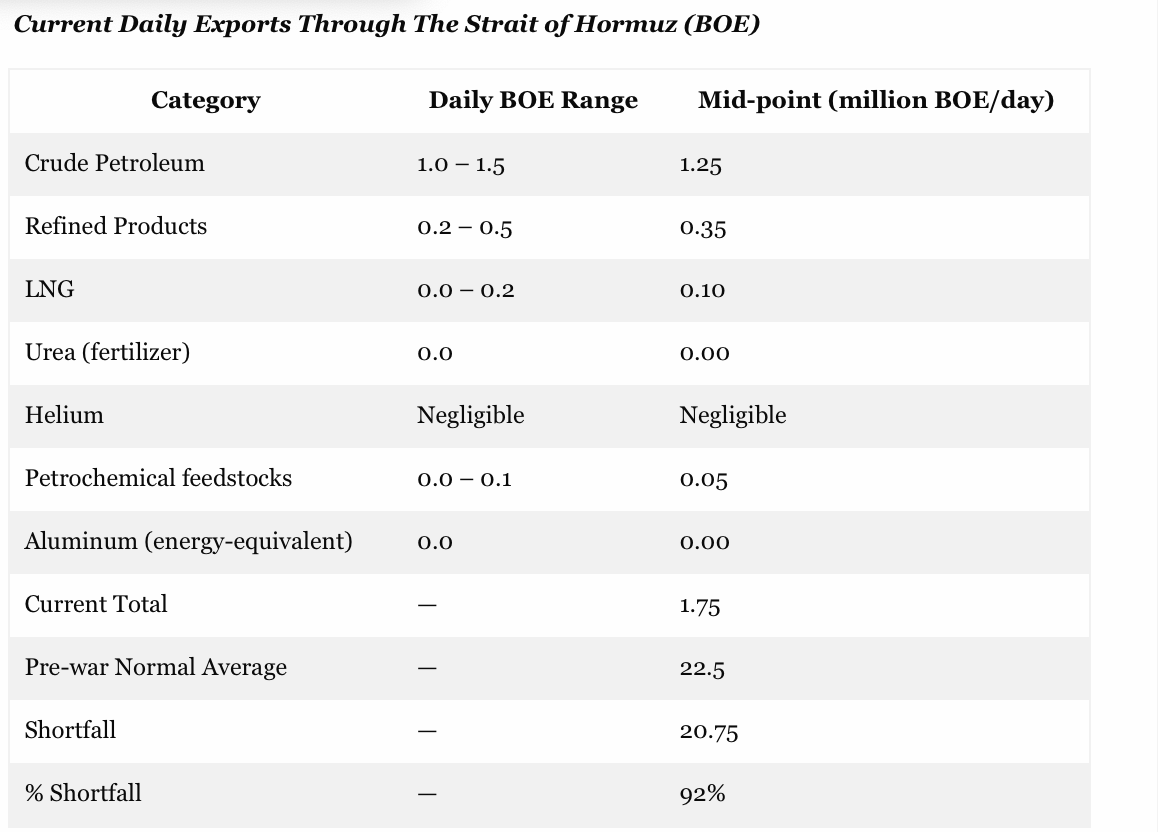
In any event, Washington’s current blockade strategy is going to keep the Gulf shutdown until the Donald, not the mullahs, cry uncle. But even if some of the 20.75 million barrels per day shortfall shown in the table above is subject to work-arounds, such as the 2-3 mb/d of incremental Saudi crude oil being diverted through the East-West pipeline to Red Sea ports, the fact remains that global stocks are being drained at a rapid rate.
Thus, there are normally 1.3 billion barrels of oil on the blue water, which amounts to about 12 days of global petroleum liquids consumption. The fact that tankers have not been loading at anything even close to normal rates means that waterborne inventory has already been drastically depleted.
The context of this daily drain on stocks is as follows: At the end of 2025, just before the conflict intensified, independent tracking firms estimated the global “oil on water” inventory at the aforementioned 1.3 billion barrels. This figure included both normal in-transit volumes and elevated floating storage built up during the previous year’s supply surplus. Because Persian Gulf crude and refined products have historically accounted for a large share of long-haul tanker movements, any major disruption in loadings from the region disproportionately affects this floating inventory.
Over the 53 days from February 28 to April 22, 2026, the Persian Gulf experienced an average daily production and export cutback of roughly 10–14 million barrels per day. Using a conservative midpoint of 12 million barrels per day as the representative reduction, the cumulative shortfall in tanker loadings reaches approximately 635 million barrels.
Accordingly, dividing this missing volume by the pre-war blue-water inventory of 1.3 billion barrels yields a depletion rate of about 49% already as of April 22. Even at the lower end of the cutback range (10 million bpd), roughly 530 million barrels — or 41% — of the floating stocks would have been drawn down. At the higher end (14 million bpd), the depletion climbs to approximately 742 million barrels, or 57% of the original inventory.
Therefore, a realistic first-order estimate is that 45–55% of the global blue-water petroleum inventory has already been depleted as a direct result of the Persian Gulf loading shortfall. This cumulative depletion is particularly significant because the pre-war 1.3 billion barrel floating inventory was already weighted toward Middle Eastern barrels. Long-haul VLCCs carrying Iranian, Saudi, Iraqi, and UAE crude typically spend weeks at sea, making the Gulf’s contribution to global “oil on water” structurally large.
As these tankers on the blue water unload in China, India, and other Asian destinations without being replaced by new Gulf loadings, the buffer will shrink rapidly.This drawdown helps explain the volatility evident in oil markets during March and April. Although the U.S. blockade has proven porous — with Vortexa data showing at least 10.7 million barrels of confirmed Iranian crude slipping through in the first nine days after April 13 — the overall volume of new oil entering the blue-water system remains far below normal.
The shadow fleet provides Iran with some revenue and breathing room, but it does not come close to restoring the full pre-war export rhythm of the broader Persian Gulf. In practical terms, nearly half of the world’s floating oil stocks that existed at the start of the year have now been consumed.
In turn, this depletion also increases reliance on onshore commercial stocks and strategic reserves to bridge the gap — inventories that are themselves being drawn upon in Asia and elsewhere. As to the former, the level of commercial above ground stock across the total global storage, processing and distribution grid was about 4.4 billion barrels prior to Feb. 28th. But as the bow wave of seaborne stocks continues to shrink day by day, normal above ground commercial stocks are being drained in lieu of new waterborne tanker arrivals.
Needless to say, most of this 4.4 billion barrels of above ground commercial stocks is comprised of “working” inventory. That is, everything from crude oil and product tanks at refineries, to storage farms for distribution systems, to oil tankers on the rails and highways, to gasoline in the 290 million auto gas tanks on the roads of America alone. To be sure, you can drain these working inventories somewhat, but if it becomes too pronounced or visible—production and distribution processes breakdown and waves of hoarding by users up and down the supply chains render stocks unavailable for the next level of users.
Finally, there is also 2.5 billion barrels of so-called government-held strategic reserves. But the IEA (International Energy Agency) has already authorized a drawdown of 400 million barrels or 16%—a one-time expedient that has tamped down global oil prices slightly, but is no real solution to a prolonged closure of the Gulf.
Moreover, the story is no better with respect to Secretary of the Treasury Scott Bessent’s silly plan to constipate the Kharg Island storage tanks. Or as he pontificated this AM: Iran’s storage tanks will allegedly fill-up within days owing to the blockade, leaving it no choice but to shut in wells, which is an expensive, technically risky move that could permanently damage reservoirs.
“In a matter of DAYS, Kharg Island [oil] storage will be FULL…” “…and the fragile Iranian oil wells will be SHUT IN.”
No, not at all—even with the Trumpian ALL CAPS.
Barely a week into the blockade, independent tracking data revealed a far different reality: Namely, that the embargo is already leaking badly—even as it is also become clear that Iran possesses a powerful, underappreciated backup plan rooted in its unique geology and decades of underground engineering.
As to the blockade breach, the cargo-tracking firm, Vortexa, whose data was first highlighted in a Financial Times report and amplified across social media, documented the scale.
Between April 13 and April 22 — roughly nine days — at least 34 tankers with clear Iranian links evaded the U.S. Navy blockade. Of those, 19 sailed out of the Persian Gulf and 15 entered from the Arabian Sea. Six outbound vessels were positively identified as carrying Iranian crude, totaling nearly 11 million barrels.
At prevailing wartime discounts of roughly $10 below Brent (Brent itself trading near $100 per barrel), that single confirmed tranche generated approximately $910 million in revenue for Tehran. Averaged over the nine days, the documented flow alone equated to the aforementioned 1.2 million barrels per day — a figure that almost certainly understates the true leak, because many additional tankers are operating in “dark” mode or using spoofed signals.
The fact is, Iran’s shadow fleet has refined evasion into an art form owing to decades of sanctions. Tankers routinely disable Automatic Identification System (AIS) transponders, repaint hulls, switch flags, and conduct ship-to-ship transfers in congested waters where the sheer volume of traffic overwhelms naval surveillance.
The Strait of Hormuz itself is one of the world’s busiest choke-points. Even with U.S. warships turning back dozens of vessels and boarding at least one (the Touska), the US Navy cannot physically intercept every tanker in such a narrow, high-volume waterway. The result is a blockade that is porous enough to keep meaningful volumes of oil moving — and revenue flowing—the US Navy to the contrary notwithstanding.
The leakage of this magnitude obviously eviscerates Secy Bessent’s timeline. Pre-blockade, Iran produced roughly 3.5 million barrels per day and refined about 2 million barrels for mainly domestic use. That left an excess of around 1.5 million barrels per day that normally needed to be exported or stored.
Public estimates of Iran’s surface storage capacity — focused on Kharg Island’s roughly 30 million barrels of tanks plus smaller terminals — suggested the country could absorb only 10–16 days of excess production before facing a genuine crisis. Bessent’s public statements framed this as animminent “storage cliff” that would force painful shut-ins.
Needless to say, if 1.2 million barrels per day continue to exit the SOH via the shadow fleet, Bessent’s storage clock will slow dramatically. The “days until shutdown” narrative assumes an airtight seal; the Vortexa data shows the seal is already seriously compromised.
What makes the situation even more resilient for Iran is a factor that rarely appears in Western commentary: Namely, its extraordinary underground storage potential. Iran sits atop some of the world’s most favorable geology for salt-cavern storage. The Zagros and Alborz mountain ranges contain extensive salt formations and domes ideal for solution mining — the same technique the United States has used for decades to create its own Strategic Petroleum Reserve.
We actually have some knowledge about the latter owing to our role as the champion of strategic oil storage rather than inefficient, government-subsidized energy autarky during the Reagan era. As it turned out, salt caverns came at de minimis cost versus the huge premiums for homegrown energy like coal liquefaction that were being pushed by the crony capitalist/ energy independence crowd.
The same economics lesson applies today. By pumping seawater underground, Iran can dissolve vast cavities in salt layers, creating bottle-shaped caverns hundreds of feet wide and thousands of feet deep. Salt’s self-sealing properties mean cracks heal naturally, making these structures exceptionally secure for long-term crude storage.
They are also buried deep beneath mountains, rendering them nearly impervious to conventional airstrikes. Not surprisingly, Iran has been preparing for exactly this contingency for years. Academic studies and technical papers dating back to the mid-2010s, in fact, examined the feasibility of converting abandoned salt mines — such as the giant Sardareh complex near Garmsar—one of the largest in the Middle East—–into petroleum storage.
The economics are compelling: Underground caverns cost far less to build and maintain than surface tanks. Tehran has publicly discussed plans to store millions of barrels in hidden “caves” and has drawn explicit comparisons to international models used by the United States, Saudi Arabia, and China. While Iran’s underground gas-storage program is more advanced, the same salt-dome technology translates directly to crude oil.
Recent reporting confirms accelerated use of Persian Gulf seawater to carve new caverns near the Strait of Hormuz, precisely for strategic oil reserves that remain invisible to satellite monitoring. These would be virtually identical to the U.S. Strategic Petroleum Reserve, which stores its crude in dozens of individual caverns, which have been solution-mined inside Gulf Coast salt domes.
The largest of these US sites, Bryan Mound in Texas, alone holds up to 254 million barrels across roughly 20 caverns. As it happens, a facility that size could potentially hold six months of current Iranian exports, even if the blockade somehow became air tight.
Obviously, Iran does not need to match even a fraction of that scale overnight. But even modest additional underground capacity — tens of millions of barrels — would extend the “storage cliff” from days or weeks into months. So when added to the ongoing shadow-fleet exports, the pressure on Iran’s surface infrastructure would drop sharply. Contrary to the know-it-all Wall Streeter at the Treasury Department, the Iranian regime can continue producing at near-normal rates without risking permanent reservoir damage from well shut-ins for an extensive period of time.
In short, the combination of leaky maritime routes and hidden subterranean storage creates a strategic buffer that the Donald’s advisors appear to have badly underestimated. As usual.
Meanwhile, the salt-cavern program leverages Iran’s two great advantages: Formidable mountain terrain that has shielded its nuclear and missile programs for decades, and a deep institutional expertise in underground construction born of necessity under sanctions.
Critics of the blockade have long warned that maritime enforcement in the Strait of Hormuz is inherently difficult. The waterway is only 21 miles wide at its narrowest, yet it carries a staggering volume of tanker traffic even in normal times. High-volume “wave” tactics — sending multiple vessels simultaneously — saturate monitoring assets.
Add AIS manipulation, flag-hopping, and the willingness of Chinese and other Asian buyers to accept discounted Iranian crude via ship-to-ship (STS) transfers in the Indian Ocean, and the embargo’s practical effect shrinks dramatically.
The regime has also already banned many petrochemical and urea exports to prioritize domestic needs, signaling a “fortress economy” mindset. But the oil lifeline remains open enough to prevent immediate collapse.
Bessent’s optimistic timeline assumed surface storage was the only variable, but Iran’s geology and ingenuity add a subterranean dimension that dramatically changes the equation. So the simple narrative of an airtight embargo forcing rapid Iranian capitulation has already given way to a more complex reality.
At the end of the day, what we really have now is dueling blockades: The Iranian one has dried up non-Iranian exports through the SOH almost completely, while the US blockade of the Iranian ports—-positioned outside the SOH for fear of Iranian missiles and drones taking out multi-billion US warships—is leaking like a sieve.
What that means is the impending catastrophe for the global hydrocarbon supply system and world economy is likely to come sooner than the day when Iran actually runs out of cash and storage capacity.
Needless to say, that won’t be any kind of “win” that the Donald can peddle to even the shrinking echo chamber in MAGA LAND. To the contrary, the loud belligerent voice now emanating from the Oval Office is likely to soon be taking on a different tone—hopefully the final blatherings of Dead End Donald.
https://davidstockman.substack.com/p/taco-tuesday-and-dead-end-donald