
Tax Season, Slavery, and Henry David Thoreau

I woke up to some e-mail questions from my accountant pertaining to my 2025 income tax return, and it reminded me of Henry David Thoreau.
In July 1846, Thoreau was jailed in Concord, Massachusetts for refusing to pay his poll tax as a protest against slavery and the Mexican-American War. It wasn’t a harsh penalty—just one night in jail until his aunt paid the tax without his consent, which resulted in him being kicked out of the jail.
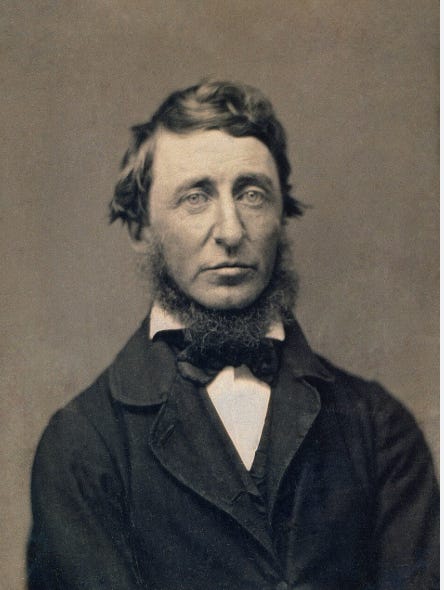
There in Concord—where colonists had begun their armed rebellion against the government of King George III in 1775—Thoreau meditated on how quickly a centralized government may be corrupted by a handful of powerful men. His meditations resulted in his 1849 essay “Resistance to Civil Government,” now more commonly known by the title “Civil Disobedience.”
In the opening section, he criticizes government as a tool that can be taken over and used in an abusive way, and he cites the Mexican-American War (1846–1848) as his primary example. As he wrote:
The objections which have been brought against a standing army, and they are many and weighty, and deserve to prevail, may also at last be brought against a standing government. The standing army is only an arm of the standing government. The government itself, which is only the mode which the people have chosen to execute their will, is equally liable to be abused and perverted before the people can act through it. Witness the present Mexican war, the work of comparatively a few individuals using the standing government as their tool; for, in the outset, the people would not have consented to this measure.
In other words, a standing government is inherently prone to capture by a small group who can use it to pursue their special interests.
Thoreau cited the Polk administration and its supporters, who pushed the Mexican War for territorial expansion. Thoreau and other abolitionists regarded this as an effort to expand slavery.
He contrasts the agenda of a small group of men with the interests of the broader populace, who he believes would have rejected the war if their will had been properly represented. Thoreau argued that individuals have a duty to resist perverse government actions rather than tacitly support them by paying taxes.
Here I want to be clear that—as much as I loathe the U.S. government and all of its Satanic designs—I will certainly pay my taxes.
The reason is because the U.S. government is now infinitely more powerful than it was in 1849, and it will have no compunction about pulverizing any man who gets in its way. I marvel at how We the People went from protesting customs and sales taxes levied on various goods in 1775 to surrendering a third of our annual income to an apparatus of centralized power run by people who should probably be in an insane asylum.
This state of affairs touches on what strikes me as one of the strangest features of being human and therefore a highly social being that lives in groups and polities. We as individuals and as a nation often don’t realize that we are being abused because we grow accustomed to it.
For unfortunate children, the abuse begins at home, and they may carry the internal working model of abuse into their other relationships. For a nation of people, the abuse begins when their government is taken over a small group of men who use the government to pursue schemes that are harmful to the broader populace. From being subjected to manipulation, intimidation, and propaganda, the people grow accustomed to being abused, and over time abuse is normalized.
When I went to college in Boston in the early nineties I occasionally went for a stroll around Walden Pond and thought about Thoreau, who died of tuberculosis at the age of forty-four. At that time in my life, it seemed to me that our country was so free. I felt so free. I therefore didn’t really understand Thoreau.
Now I believe I understand him, and it inspires me to make a pilgrimage to Walden to pay my respects to the spirit of one of our great American thinkers and writers. It reminds me of T.S. Eliot’s famous verse.
And the end of all our exploring
Will be to arrive where we started
And know the place for the first time.
https://www.thefocalpoints.com/p/tax-season-slavery-and-henry-david