
The $400 Steak Illusion
So, fellow shrews, tell me if I am crazy. What I am seeing makes no sense, and I am curious to know if any of you see this as well.
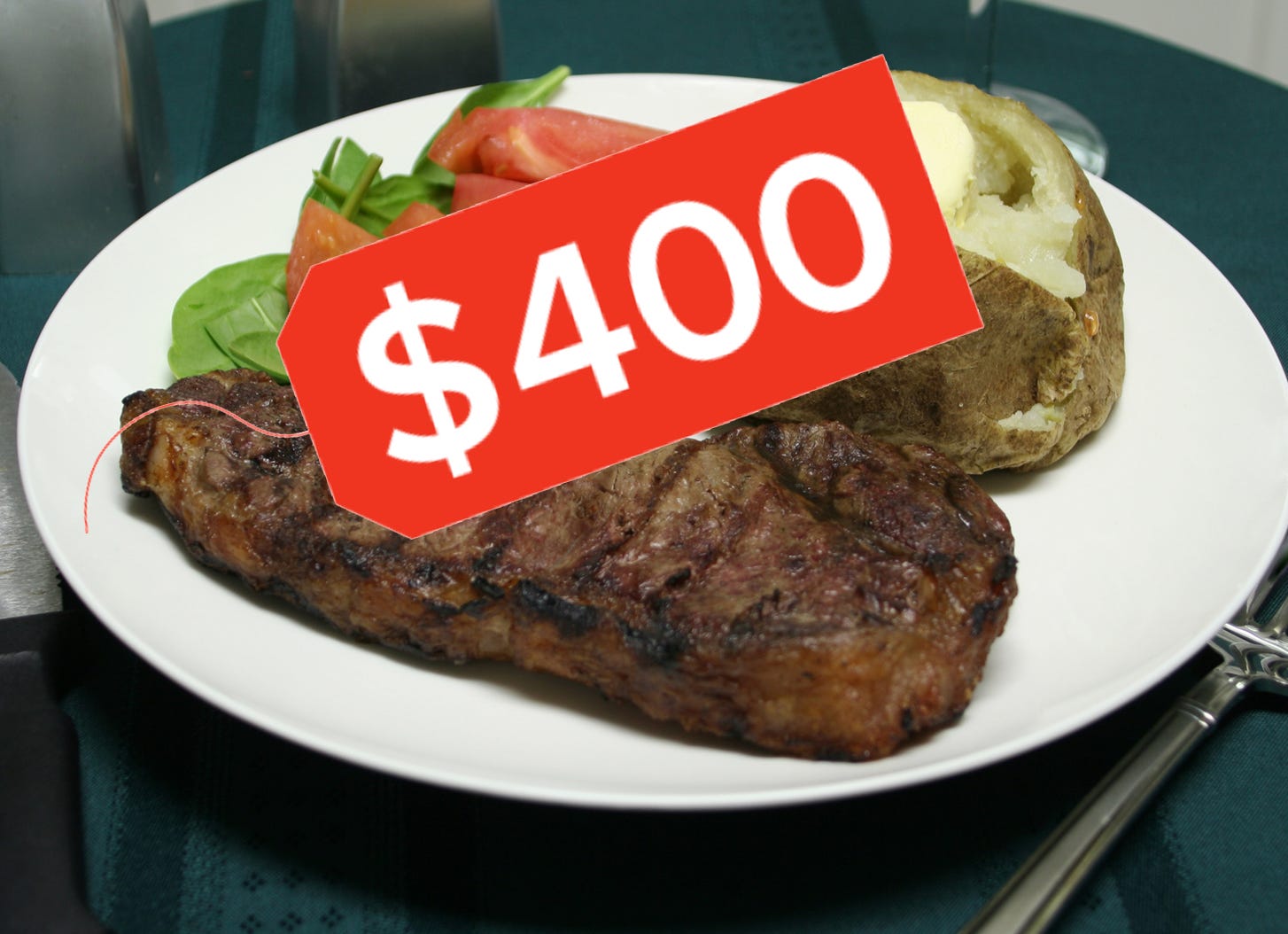
A colleague—one I have helped quite a bit in their career—took me out to dinner the other night. We went to a Canadian favourite, “The Keg,” which is a typical medium-to-high-end steakhouse chain. After a nice filet, a drink, salad, and dessert, the bill for two people landed at nearly $400. Four hundred dollars!! Good lord. And the place was packed. The lobby was so jammed with waiting steak consumers you could barely squeeze through.
“The Keg” is like yesterday’s “Bonanza Steak House” concerning its clientele. Not to sound like a snob (because I am including myself here), but most of my fellow diners were not part of the elite of Aurora. Sure, some had money—a few doctors, lawyers, and car-sale managers—but most were kids (anyone under thirty is a “kid” according to my old self), and the rest were just plain ol’ folks out for a steak and potato meal. The casual T-shirts, relaxed chatter, and easy laughter made it feel like just another Thursday night out, not some rare special occasion reserved for the wealthy. Maybe they all do this only once or twice a year, but I don’t think so. The energy in the room suggested this level of spending has become normalized for many, even as headlines scream about affordability crises.
Here’s more to add to my confusion. What about all the large, fancy malls in every neighbourhood, stuffed with classy-but-not-so-classy stores? I remember when paying more than $200 for a pair of shoes meant a special trip to some posh boutique on Rodeo Drive in Beverly Hills. Now you can find dozens of ultra-expensive choices—$300 sneakers, $400 designer loafers, even $1,000 handbags—right in your local mall. And people are lining up for them, credit cards in hand, as if this is perfectly normal. The same pattern repeats with clothing, electronics, and home goods. What used to feel like luxury has quietly slid into the everyday shopping experience for a surprising number of people.
And then there is travel. I hear places like Egypt—once an extravagant bucket-list destination—had some of their best tourist years ever in 2024 and 2025. People are everywhere, regardless of how much it costs. A decent 7-to-10-day Egypt tour package that might have run $1,500–$2,500 per person pre-COVID now easily hits $2,500–$4,000 or more, with luxury options climbing higher. Once in a while, my wife and I would go on a 7-day Greek Islands cruise, or something similar, for about $2,000–$3,000 per person. This was about ten years ago. The same kind of trip today starts north of $3,500–$6,000 per person (and the nicer cabins or packages people actually book are often double that). Flights, hotels, excursions—everything has jumped, yet the planes are full, the resorts are buzzing, and social media feeds overflow with sun-soaked selfies from far-flung ports. It seems no price tag is too high when the itch for adventure or escape kicks in.
But here’s the part that really twists the knife: these ridiculous price increases didn’t just happen by magic. They are the direct, lingering consequence of the draconian actions taken during the COVID pandemic—lockdowns that crippled supply chains for years, massive government money-printing and stimulus cheques that flooded the economy with cash while production was deliberately shut down, and labour shortages created by mandates, fear, and the so-called “Great Resignation.”[1] Ports jammed, factories idled, energy prices spiked, and suddenly everything from a steak dinner to a Greek Islands cruise carried a permanent premium. The revenge-travel boom and pent-up demand only made it worse, driving prices even higher as people rushed to “make up for lost time.”
Yet the sheep refuse to make this obvious correlation. They’ll stand in the packed lobby of “The Keg” complaining about how “everything is so expensive these days,” then turn around and defend the very policies that caused it, as if the two realities have nothing to do with each other. It’s classic sheep blindness—see the symptom, ignore the cause, and keep grazing like nothing ever happened.
I could go on and on with these comparisons: packed concert venues with $200+ tickets, new cars flying off lots despite high interest rates, and even everyday “splurges” like premium coffee chains or subscription services that add up fast. Why does it seem people have twice the money they used to, yet everyone is screaming poverty—or at least saying prices are escalating beyond reason—while somehow still affording anything their heart desires? “Extravagance” seems to be the clarion call for so many—the more you spend, the more in alignment with the good life you are, and the more likely you will scratch whatever instant-gratification itch you are feeling. It’s as if consumption itself has become a form of therapy or identity in a world that feels increasingly uncertain.
But how does this work?
It works through a potent mix of debt, denial, invisible support systems, and selective visibility that keeps the surface looking shiny while the foundations quietly dull. A big chunk of this apparent prosperity is pure credit-card and line-of-credit theatre. Canadian household debt reached a staggering record of $2.6 trillion by the end of 2025, with overall credit market debt climbing even higher toward $3.2 trillion in recent quarters. Many people are quietly running up balances or dipping into home-equity lines just to maintain the lifestyle they believe they deserve or have grown accustomed to. Post-pandemic “revenge spending” supercharged the behaviour—after years of restrictions, uncertainty, and isolation during the COVID era, a lot of folks adopted a “life is short, treat yourself” mindset. Dropping $400 at “The Keg” or booking an expensive cruise feels like reclaiming joy and normalcy, even if the math doesn’t add up on paper. It’s emotional spending dressed up as empowerment.
Then there’s the hidden intergenerational wealth transfer that props up much of the visible consumption, especially in expensive markets like Toronto. A surprising number of those “kids” in their twenties and thirties buying multimillion-dollar homes aren’t doing it solely on their own salaries. They’re getting substantial help from the Bank of Mom and Dad—parents who bought houses decades ago when they were merely expensive instead of insane, and who now have hundreds of thousands in built-up equity to pass along as gifts or low-interest loans. Studies and reports show that around 25-31% of first-time buyers in Canada receive family financial help, with average gifts often landing in the six-figure range in high-cost areas. This creates a two-tier system: those with family resources can still play the game of homeownership and lifestyle spending, while others are left renting, moving to cheaper suburbs, or quietly disappearing from the visible economy of fancy malls, packed restaurants, and exotic trips. It’s not raw personal wealth driving the spending for many—it’s inherited advantage quietly transferred across generations.
At the same time, the real economic squeeze is carefully hidden from view. The people who are truly struggling—cutting back on groceries, skipping vacations, working multiple jobs, or delaying big purchases—just don’t show up in the crowded lobby of “The Keg” or the departure lounge for that Greek Islands cruise. We only see the ones still performing the ritual of abundance: the ones maxing out cards, the ones getting family bailouts, the ones prioritizing experiences over long-term security because admitting the strain would force them to confront a much larger discomfort. This selective visibility creates a powerful illusion. Official narratives and everyday conversations fill with complaints about inflation, unaffordable housing, and shrinking paycheques. Yet the parking lots stay full, the malls remain busy, and social media overflows with evidence of carefree spending. It’s as if two parallel realities are running side by side: one of genuine financial pressure for the many, and one of performative prosperity for those still able (or willing) to participate.
This fog produces a strange psychological disconnect. On the surface, society appears resilient and even indulgent. Underneath, cracks are widening—record debt levels, wages that have fallen further and further behind the rising cost of living for most middle- and lower-income households, and an economy that continues to reward asset owners (those with homes or investments from earlier eras) while quietly punishing wage earners. Many of these people seem content to stay in the lane of consumption, chasing the next dopamine hit because pulling back would mean acknowledging the deeper unease: a system where “normal” now requires borrowing from the future or leaning on the past wealth of family.
Is all of this sustainable? My instincts tell me no. You can’t run a culture indefinitely on borrowed money, parental safety nets, and collective denial. Eventually the bill comes due—and when it does, it will be far more painful than a $400 dinner for two. The illusion may hold for a while longer, especially as long as credit flows and family wealth continues to trickle down, but the underlying tensions—rising debt servicing costs, potential economic slowdowns, and the exhaustion of “revenge” spending—suggest a reckoning is coming. When it arrives, the packed lobbies and full resorts may empty faster than we expect, revealing how much of the current exuberance was built on sand.
I suspect I’m not the only one noticing the absurdity—and wondering how long the illusion can last before the mask slips entirely.