
The 5 Mistakes of Orbán and the European Populists
The most important contemporary political phenomenon in Europe is the rise of so-called “populism” (sometimes also called “sovereignism”), which stems from what the mainstream media label as “the far right”. In practice, ‘populism’ is generally used simply to denote a demagogic form of politics in which a leader, in order to acquire and retain power or to gain the support of the people, appeals to the masses by giving in to their interests and offering quick solutions (even if not ideal) to their problems.
In this specific case of the contemporary populist phenomenon, however, the irritation of liberals simply stems from a genuine concern to reconnect democratic politics with the ‘general will’ of the people. Since the politics of the European Union have been conducted with their backs turned to the people, it is not surprising that a call would eventually arise to let the dissenting voices of the people be heard on issues such as immigration, membership in the EU, participation in NATO, etc., writes Raphael Machado .
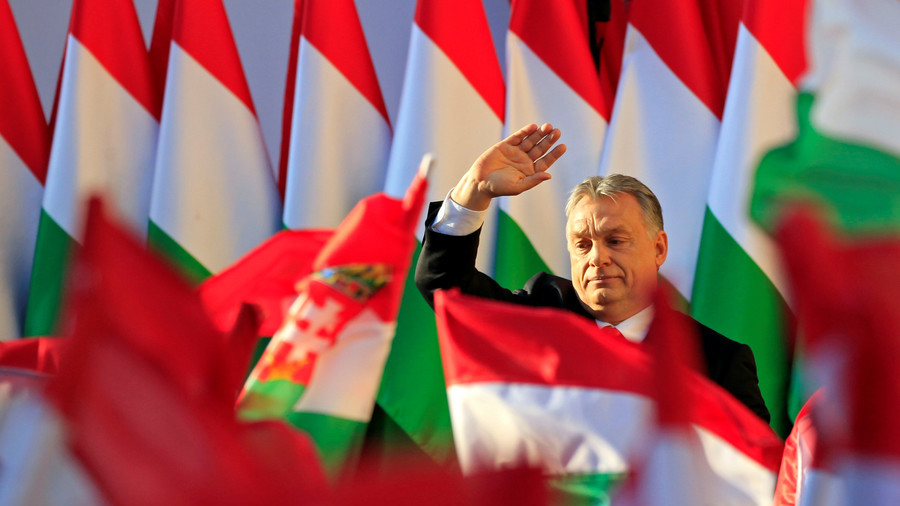
And in this context, the populists have indeed succeeded in coming to power in at least one place: in Hungary (with reference to Slovakia and, perhaps, Italy). Viktor Orbán was in power for sixteen years and repeatedly challenged the European Union in both domestic and international affairs. But a few days ago he suffered a heavy defeat, and his party emerged from the battle extremely weakened.
How could Orbán be defeated after being in power for 16 years, having implemented virtually all desired reforms and changes, and having had a free hand domestically?
The economic dimension cannot be ignored, given that Hungary has been in a recession, at least since the pandemic. It is a combination of factors: restrictions during the pandemic and supply chain disruptions + difficulties accessing cheap Russian gas due to sanctions, Atlantic pressure, and Ukrainian terrorism + the economic war waged by Brussels with the seizure of billions of euros in Hungarian assets.
But to a certain extent, the inability to address these problems reveals some structural weaknesses in Orbán’s government that can, perhaps, be extrapolated and applied to European populisms in general, at least broadly, to expose potential structural vulnerabilities.
1. Americanism
Here we have the paradox of the patriot who imitates the US or links the course of his movement to the direction American populism is taking in its Trumpian incarnation. Nothing is more contradictory than a European populist leader who claims to defend national identity but unconditionally adopts the geopolitical agenda of the United States. The “Americanism” of European populists ignores the fact that Europe’s strategic interests often diverge from those of the US — particularly in the areas of trade, technology, and the stability of the continent itself. By becoming an echo of Washington think tanks such as the Heritage Foundation, these parties lose their raison d’être.
I have already made remarks elsewhere about the fundamental contradictions between Europe and the US, and it is always important to reiterate this. Europe is indeed not an autonomous geopolitical pole today, because it is a militarily occupied continent. By whom? Precisely by the US.
An example of the contradiction of “Americanism” in Europe is the case of the Spanish Vox. Vox is one of those relatively young populist parties that want to ride the international wave of Trumpism. The party does indeed have institutional ties with the Heritage Foundation. But what about US foreign policy regarding Spain’s fundamental interests? Washington consistently adopts a hostile stance, as in all controversies in which Spain stands against Morocco. This is not an attitude of resistance against the ‘communist’ Pedro Sánchez, but a long-standing strategic position independent of the party in power. Orbán himself made the grave mistake of inviting JD Vance to his last campaign rally, where he emphatically pointed out that he had US support – this just a few weeks after Washington had threatened to invade European territory, and a few days after a new wave of American attacks on EU countries.
In contrast, Tino Chrupalla of the AfD recently declared that the US must withdraw its troops from Germany. In the opinion poll that followed, the AfD had risen by 2 percentage points. Giorgia Meloni – who can be considered a semi-populist – also opposed the US in the confrontation with Pope Leo XIV and on the issue of using Italian bases to attack Iran. The French Rassemblement National has also recently taken a critical stance towards the US on numerous occasions, at least since the kidnapping of Maduro. These are counter-examples demonstrating that being anti-American pays off today, even if you are a “right-wing” party.
2. Zionism
Another central mistake is automatically aligning with the Zionist project, often justified by a distorted interpretation of the “defense of Judeo-Christian civilization.” Leaders like Viktor Orbán or Marine Le Pen (who spent years polishing the party’s image) openly placate the Zionist lobby, which, ironically, actually strengthens the globalism against which they claim to be fighting.
While European countries are grappling with the serious and real problem of mass immigration, and given that a significant portion of this mass of immigrants comes from Muslim countries, European populist leaders – out of ignorance or calculation – ‘confuse’ the European domestic issue of borders and demography with the geopolitical issue of the Middle East. The goal might be to win the ‘tolerance’ of Israel and the Zionist lobby in the face of a common ‘Islamic threat’. And that is where the aforementioned discourse of “Judeo-Christian civilization” comes into play. But the fruits of this are nil.
It is indeed necessary to bear in mind that liberal progressivism has stigmatized all conservative patriotism in Europe as “the return of Nazi-fascism,” and this “bogeyman” remains a useful bogeyman for manipulating public opinion. By ‘normalizing’ their attitude towards Israel, the expectation is that the intensity of attacks in the mass media will decrease and that their party can be presented as ‘the only solution’ against an ‘Islamic threat’ that could endanger the ‘well-being’ of European Jews.
But the reality is that these parties are still being demonized and persecuted, and nothing has changed the fact that Israeli-affiliated NGOs are committed to facilitating immigration in Europe, based on the historical logic that the best way to make Europe ‘safer’ for Jews would be to make European countries more heterogeneous and cosmopolitan.
To make matters worse, the reality is that following the ethnic cleansing of Gaza, which began in 2023, Israel’s reputation has been destroyed. No one takes the victim appeal so typical of Zionist propaganda seriously anymore. On the contrary, linking one’s image to Israel and Netanyahu — as, once again, Orbán did — seems to be a guarantee of defeat.
3. Excessive moderation
When they come to power, inflammatory rhetoric often turns into moderation. They promise to leave NATO, renegotiate treaties, or give up the euro – but none of this happens. Orbán’s Hungary, for example, remains a member of the Atlantic Alliance, receives European funds, and only sporadically blocks sanctions against Russia. Giorgia Meloni, once a critic of “bureaucratic Europe,” has become one of the leaders most aligned with Ursula von der Leyen. This structural restraint stems from a real fear of economic and military isolation. To voters, however, it sounds like betrayal. The populist who governs like a technocrat loses his soul and makes room for even more radical alternatives or for the return of his enemies to power.
Of course, leaving NATO or the EU is not easy, and any country that attempts to do so risks reprisals. But Orbán’s defeat was only possible thanks to the ‘levers’ at Brussels’ disposal to harm his government and interfere in Hungary’s internal affairs—’levers’ that existed only because Hungary remained a member of the European Union. Every populist government must make its “revolution” irreversible through breaks with the past that are difficult to reverse, and through a policy of maximum pressure on internal enemies. In this, we see that liberals and globalists are generally more unscrupulous and Machiavellian than populists and patriots.
4. Lack of coherent ideology
European populism is a disjointed kaleidoscope. It defends a strong state to subsidize national companies, but preaches the free market when it suits them; it criticizes immigration, but relies on immigrant labor in agriculture and construction; it attacks the “globalist elite” while maintaining offshore accounts and ties with oligarchs. This absence of a clear ideological line—other than “us versus them”—prevents the formulation of long-term policy. Without a consistent economic theory or a feasible social project, populism oscillates between prosperity and austerity, frustrating both workers and entrepreneurs.
To a certain extent, we live in a post-ideological world dominated by a diffuse liberalism that imposes itself as self-evident truth and ‘science’. But it is abundantly clear that globalists possess fairly consistent ideological dogmas and, moreover, have philosophers, sociologists, and economists to give these dogmas an academic veneer. Populists, in turn, rely fundamentally on opportunistic pragmatism, and while this is an advantage, in the long run it also constitutes one of their main shortcomings.
With the exception of the Rassemblement National, which still has a strong Gaullist slant, most European populists barely refer to the historical roots and intellectual precedents of their own people, nor do they rarely offer a value system that goes beyond conservative moralism. Especially in dialogue with young people—who are always susceptible to radicalism—it is important to have something to offer to believe in and fight for.
5. Alienation from the concrete concerns of the population
We can safely state that mass immigration is a serious problem that Europe must deal with. But this is only one issue among many, and the reality is that citizens face issues such as employment, wages, healthcare, education, pensions, transport, and so on in their daily lives. And in many cases, populist parties have no answers for their citizens regarding these issues – at best, some advocate cuts to public services and social benefits to make life more difficult for immigrants.
To take Orbán as an example once again: his campaign was entirely focused on foreign policy issues, and he had few answers to the economic grievances of his citizens. Naturally, the older and more ideological populist parties, such as the Rassemblement National, have already solved this problem and learned to deal with the daily problems of citizens – and this is one of the reasons for their growing success. Other parties are growing only because of tensions surrounding immigration, as well as as a result of the insane course European governments have followed regarding the Ukrainian issue, but if they come to power, the disappointment of the citizens will be inevitable after a few years, as happened with Orbán.
Populism finds itself at a very opportune moment due to the accumulation of errors by globalist elites: the economy is stagnating, immigration remains high, cities are becoming increasingly unsafe, leaders are threatening Russia with war, supporting genocides in the Middle East, and generally ignoring all demands of their populations. But if populists do not overcome their amateurism and correct these structural shortcomings, they will remain a protest movement rather than a definitive political solution.
https://www.frontnieuws.com/de-5-fouten-van-orban-en-de-europese-populisten