
The 5 Poles of the Trumped West
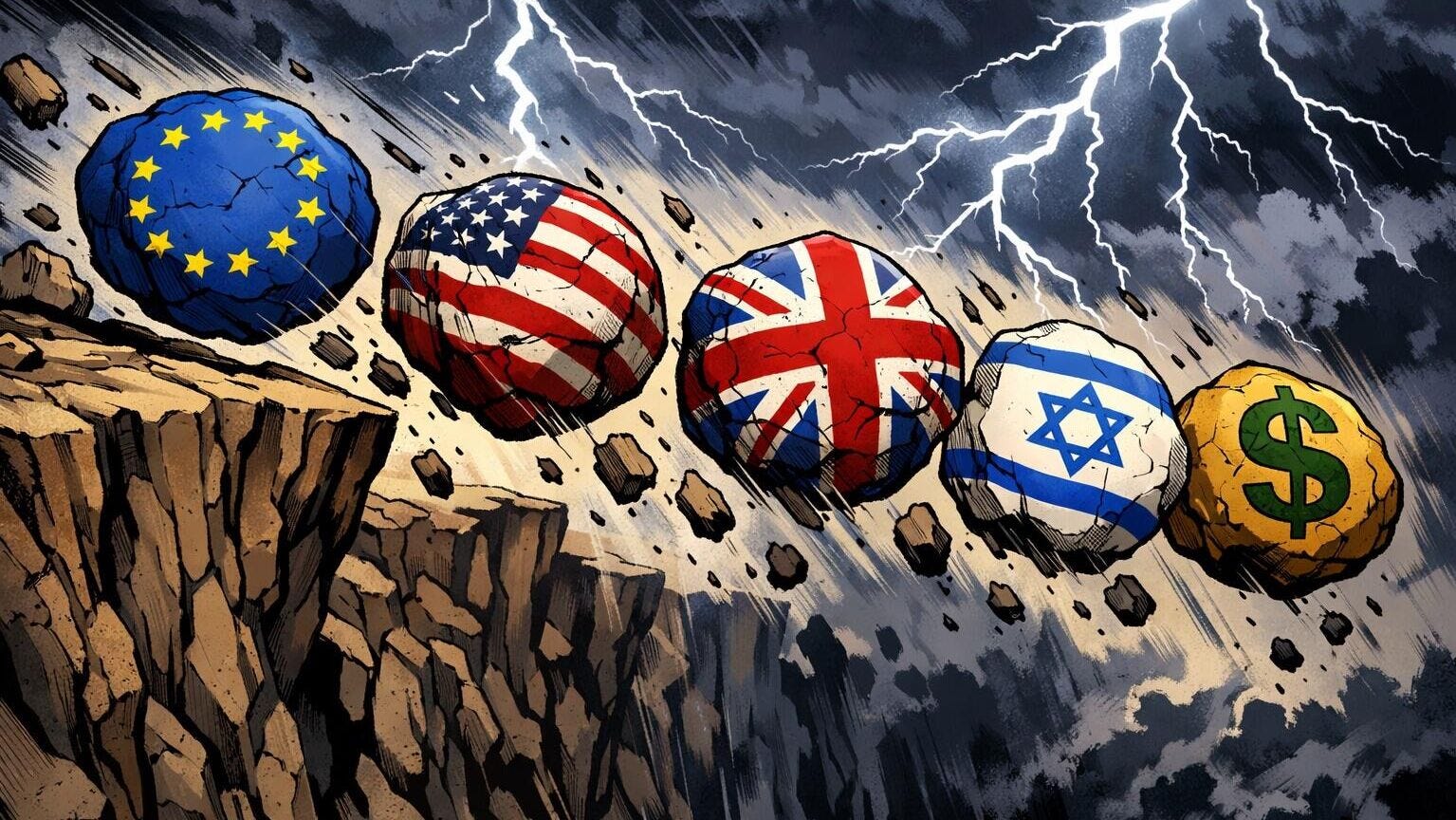
Global politics is undergoing very rapid and dynamic processes. In many ways, this is due to the policies of Trump, who has brought a high level of turbulence, unpredictability, and radicalism to the system of international relations, with events developing at an increasing pace.
Before our very eyes, the idea of a collective West — that is, the united and fairly predictable policies of the major Western powers and those countries that fully follow in the West’s wake — is falling apart. Such a consensus no longer exists. Globalist projects are falling apart at the seams, and even Euro-Atlantic unity and the fate of NATO and the UN are in question.
Trump has stated outright that international law does not apply to him and that he is acting on the basis of his own ideas about what is moral and what is not. Trump’s demand that Greenland join the US and his threats to annex Canada, his attitude towards Ukraine and Israel (lack of unconditional support for the Zelensky regime and, to the contrary, full support for Netanyahu and his Middle East policy) further exacerbate the emerging and almost complete split.
In such a situation, when the collective West as a single political, ideological, and geopolitical entity no longer exists, a new map is gradually emerging, where in its place several separate and sometimes conflicting entities are beginning to appear. This is not yet a finished model, but an open-ended process. Nevertheless, it is already possible to assume that five separate geopolitical entities will emerge in place of the unified West. Let’s try to describe them.
The Trump 2.0 US as West No. 1
Trump’s geopolitical views differ sharply from the globalist strategy adopted by previous administrations, not only under Democratic rule, but also under Republicans (as under George W. Bush). Trump openly proclaims direct American hegemony, and this hegemony has several levels.
First of all, he wants to establish US dominance in the Americas. This is precisely what is reflected in the latest edition of the National Security Strategy, where Trump directly refers to the Monroe Doctrine, adding his own vision to it.
The Monroe Doctrine was formulated by President James Monroe on December 2, 1823, in his annual address to Congress. The main idea was to achieve the New World’s complete independence from the Old World (i.e., from European metropolises), and the US was seen as the main political and economic force for liberating the states of both Americas from European control. It was not explicitly stated that one form of colonialism (European) was being replaced by another (the US), but a certain hegemony of the US in the region was implied.
In its modern interpretation, taking into account Trump’s innovations, the Monroe Doctrine implies the following:
- complete and absolute sovereignty of the US;
- independence from any transnational institutions;
- the rejection of globalism;
- the suppression of other major powers’ significant geopolitical influence in all countries of the Americas (this refers to China, Russia, and European countries);
- the establishment of direct US military, political, and economic hegemony over both Americas and the adjacent oceanic spaces.
This doctrine includes the promotion of US vassal regimes in Latin America, the removal of politicians unwelcome to Washington, and interference in the internal affairs of any state in this area — sometimes under the pretext of combating drug trafficking, illegal immigration or even communism (Venezuela, Cuba, Nicaragua). Overall, this does not differ greatly from the policy that the US adhered to in the 20th century.
The novelty of Trump’s doctrine lies in his claims to annex Greenland and Canada, as well as in his dismissive attitude towards Europe and NATO partners. In essence, the US is proclaiming itself to be an empire surrounded by limitorphs which must be in vassal-dependence on the metropolis. This is reflected in the main slogan of Trump’s policy: “Make America Great Again”, or its synonym, “America First.” During his second presidency, Trump is pursuing this line much more aggressively than during his first term, which is dramatically changing the balance of power on a global scale.
Such a Trumpist America-centric West can be considered the West number 1.
The EU as West No. 2
The European Union is becoming the West number two, which finds itself in a very difficult situation. For many decades, EU countries have oriented their politics, security, and even their economies toward the US within the framework of the Atlantic partnership. Between European sovereignty and submission to Washington, they’ve chosen the latter. At the same time, previous American leaders pretended to consider Europeans as almost equal partners and listened to their opinions, which created the illusion of consensus in the collective West.
Trump has destroyed this model and brutally forced the European Union to acknowledge its vassal status. Hence, in January 2026, at the World Economic Forum in Davos, Belgian Prime Minister Bart De Wever directly spoke of a “happy vassal” and an “unhappy slave” in the context of Europe’s dependence on the US. Previously, European elites were “happy vassals.” Trump looked at this situation from a different perspective, and they felt like “unhappy slaves.” Previously, European elites were “happy vassals.” Trump has looked at this situation from a different angle, while they feel like “unhappy slaves.” He emphasized the choice between self-respect and loss of dignity in the face of pressure from Washington over the annexation of Greenland, but the European Union is clearly not ready for such a choice.
In this new situation, the EU has become, against its will, something independent. Macron and Merz have spoken about the need for a European security system in a situation where the US represents not so much a guarantee of this security as a new serious threat. So far, the EU has not taken decisive action, but the contours of a second West are becoming increasingly clear. The EU’s position on Ukraine differs significantly from Trump’s: the US president wants to end this war with Russia, which he considers unnecessary (at least, that is what he says), while the EU, on the contrary, wants to see it through to the end and is leaning towards direct involvement.
The positions of the West No. 1 and the West No. 2 also differ with regard to Netanyahu and the genocide of Palestinians in Gaza. Trump fully supports this, while the EU largely condemns it.
The UK as West No. 3
Against the backdrop of this Atlantic rift, another pole is emerging — the West number three — in the form of the post-Brexit UK. On the one hand, Starmer’s left-liberal government is close to the EU on key issues, but on the other hand, London has traditionally maintained close relations with the US, acting as Washington’s overseer of European processes. At the same time, however, Britain is not part of the EU, nor does it support Trump’s line, which would assign it the unenviable role of slave-vassal mentioned by the Belgian prime minister.
Having become an interested party in a number of situations, Britain can no longer play the role of an international broker. First and foremost, Britain is enmeshed in the Ukrainian conflict, where it has fully taken Kiev’s side has moreover initiated an escalation in relations with Russia, going as far as direct military involvement on the side of the Zelensky regime. It was the visit of British Prime Minister Boris Johnson to Ukraine that disrupted the 2022 Istanbul agreements.
But the British West — West No. 3 — cannot return to its former imperial policy. Modern England’s resources, its economic decline and the collapse of its migration policy — and indeed its overall diminished scale — do not allow it to play a truly leading role within the British Commonwealth of Nations or to become the hegemon of Europe.
The Globalists as West No. 4
If we take the ideology, organizational networks, and institutions of the globalists, such as George Soros, the World Economic Forum, and other international organizations professing the idea of world government and a united world, then we get the West number four. It was this West that set the tone at the previous stage as the main and unifying force, thanks to which it was possible to speak of a “collective West.”
These circles were represented by the globalist elite in the United States, in the form of the very “Deep State” that Trump began to fight against. This is primarily the top echelons of the Democratic Party, as well as some of the Republican neocons, who occupy an intermediate position between Trump with his America First and classic globalism. Most EU leaders and Starmer himself belong to this globalist project, whose positions have weakened significantly under Trump, leading to the West’s split into several distinctly different poles.
One typical example of the West No. 4, which until recently was the main and only West, was Canada’s position. At the recent Davos Forum, Canadian Prime Minister Mark Carney stated that the existing world order is collapsing and the world is in a state of rupture, not transition. Great powers are using the economy — tariffs, supply chains, and infrastructure — as a weapon to exert pressure, which, in his opinion, is leading to deglobalization. At the same time, he rejected Trump’s claims about Canada’s dependence on the US, calling on mid-range powers to unite against the hegemony of Trumpism, diversify ties (including rapprochement with China), and resist populism.
This is a marker of how the West No. 4 is gradually emerging as a distinct community based on ideological and geopolitical principles — above all, in direct and increasingly harsh opposition to Trumpism as the West No. 1.
Israel as West No. 5
Finally, in recent years — and this is particularly clear since the start of Trump’s second term — another West has been making itself felt: the West number five. This is Benjamin Netanyahu’s Israel. This small country, vitally dependent on the US and Europe, with limited demographic resources and a local economy, is increasingly claiming to be an independent civilization and playing an important and — from the point of view of the Israelis themselves — exceptional role in the fate of the West as a whole, of which it is supposed to be an outpost in the Middle East.
Up to a certain point, Israel could be considered a proxy of the US, that is, another vassal, albeit an especially privileged and beloved one. However, the policies of Netanyahu and the radical right-wing Zionist wing on which he relies, as well as the now exposed extent of the Israeli Zionist lobby’s influence on the US politics, have forced us to look at things in a different light.
First, the scale of the destruction of the civilian population of Gaza by Netanyahu and the rise to prominence of radical political and religious figures who openly proclaim their orientation toward building Greater Israel (Itamar Ben-Gvir, Bezalel Smotrich, Dov Lior, and others) have been met with rejection in the West, namely, in West No. 2, West No. 3, and West No. 4. Neither the EU, Starmer’s Britain, nor the Soros-type globalists support Netanyahu in his harshest actions, including on the issue of war with Iran.
Second, Trump’s complete and unconditional support for Netanyahu has divided the Trumpists themselves, who have raised a huge wave of opposition on social media against Israeli influence and its networks in American politics. In public speeches and on social media, any given Republican or representative of the Trump administration is bombarded with demands to answer the question: America First or Israel First? Which is more important to you: America or Israel? This has put many in a quandary and ruined careers. Admitting either one or the other is fraught with ostracism either by the masses or by the incredibly influential Israeli lobby.
The publication of the Epstein files has only reinforced the fears of those who believed that Israel’s influence on American politics is excessive and disproportionate. The impression is now had that Tel Aviv and its network of influence represent an independent and extremely important authority capable of dictating its will to the powerful first-order powers.
Thus, a fifth West has emerged — with its own agenda, its own ideology, and its own geopolitics.
Conclusion
Let us conclude our brief analysis of the divided West by comparing the attitudes of these poles towards the war in Ukraine. For us Russians, this is perhaps the most important criterion.
The least interested in this conflict is the West No. 5. For Netanyahu, Putin’s Russia is not the main enemy, and the Kiev regime does not enjoy the unconditional support of right-wing Zionist networks. To the extent that Russia strategically, politically, economically, and, most importantly, militarily supports anti-Israeli forces in the Middle East — especially Iran — the West No. 5 objectively finds itself on the opposing side to Russia in a series of local conflicts. But this does not translate into direct support for the Zelensky regime. That being said, Israel is definitely not on our side.
On the whole, the West No. 1 — Trump — also does not consider Russia to be the main enemy and target. From time to time, Trump puts forward anti-Russian arguments (in particular, justifying the need to annex Greenland on the grounds of American security in the face of a possible nuclear strike by Russia), he continues to exert multilateral pressure on Moscow, and he is supplying Kiev with weapons. We cannot call Trump’s policy friendly, but compared to other forces in the divided West, which has been divided by Trump himself, his anti-Russian position is not extreme.
The situation is completely different with the West No. 2, West No. 3, and West No. 4. The European Union, Starmer’s Britain, and globalist networks (including the US Democratic Party and Carney’s government in Canada) hold radically anti-Russian positions, unconditionally support the Zelensky regime, and are ready to continue providing all kinds of support, including direct military support, to Ukraine. Here, the globalist view dominates, namely that Putin’s Russia, which has turned to traditionalism and conservatism and firmly intends to build a multipolar world and assert its civilizational sovereignty, is ideologically and geopolitically opposed to the globalists’ plans to create a world government and a unified world. An example of such a globalist state is the European Union, whose model, according to globalists, should be gradually extended to all of humanity — without nation-states, religions, nations, or ethnic groups.
But for the West No. 2, and especially for the West No. 4, not only Putin but Trump himself is the real enemy. Hence the political myth that Trump is working for Russia. The US president has divided the collective West and has in fact displaced the previously dominant globalists from their central position. But he has done so not in the interests of Putin and Russia, but based on his own ideas and convictions.
If we extend the trend of the divide between the West No. 1 and West No. 2 into the future, it can be assumed that the contradictions between Brussels and Washington will grow to such an extent that European leaders will begin to consider that in such a situation it would be a good idea to turn to Russia in order to counterbalance Trump’s growing appetite and general aggressiveness. Weak hints at this possibility can be seen in certain statements by Macron and Merz against the backdrop of the escalating situation around Greenland. While this is highly unlikely at present, the deepening division of the West into five entities could make such a possibility more realistic.
Finally, the West No. 3, represented by Britain, is one of the main poles of hostility and hatred towards Russia. It is difficult to explain this rationally, because Britain has no real chance of restoring its hegemony. If earlier the Great Game between England and Russia was one of the main, if not the most important, power lines in world politics, then in the second half of the 20th century, England completely lost its status as a world power, handing it over it to the US, its former colony. But even the simple phantom pain of long-gone dominance cannot explain the incredibly high level of Russophobia among the modern English elites.
Thus, the collective West is split into five fairly independent centers of power. It is difficult to predict how this mosaic will develop in the future, but it is clear that we must take these circumstances into account in our analysis of the international situation — especially when it comes to clarifying the geopolitical and ideological context in which Russia’s Special Military Operation in Ukraine is unfolding.
https://www.arktosjournal.com/p/the-5-poles-of-the-trumped-west