
The Canceling of Cesar Chavez
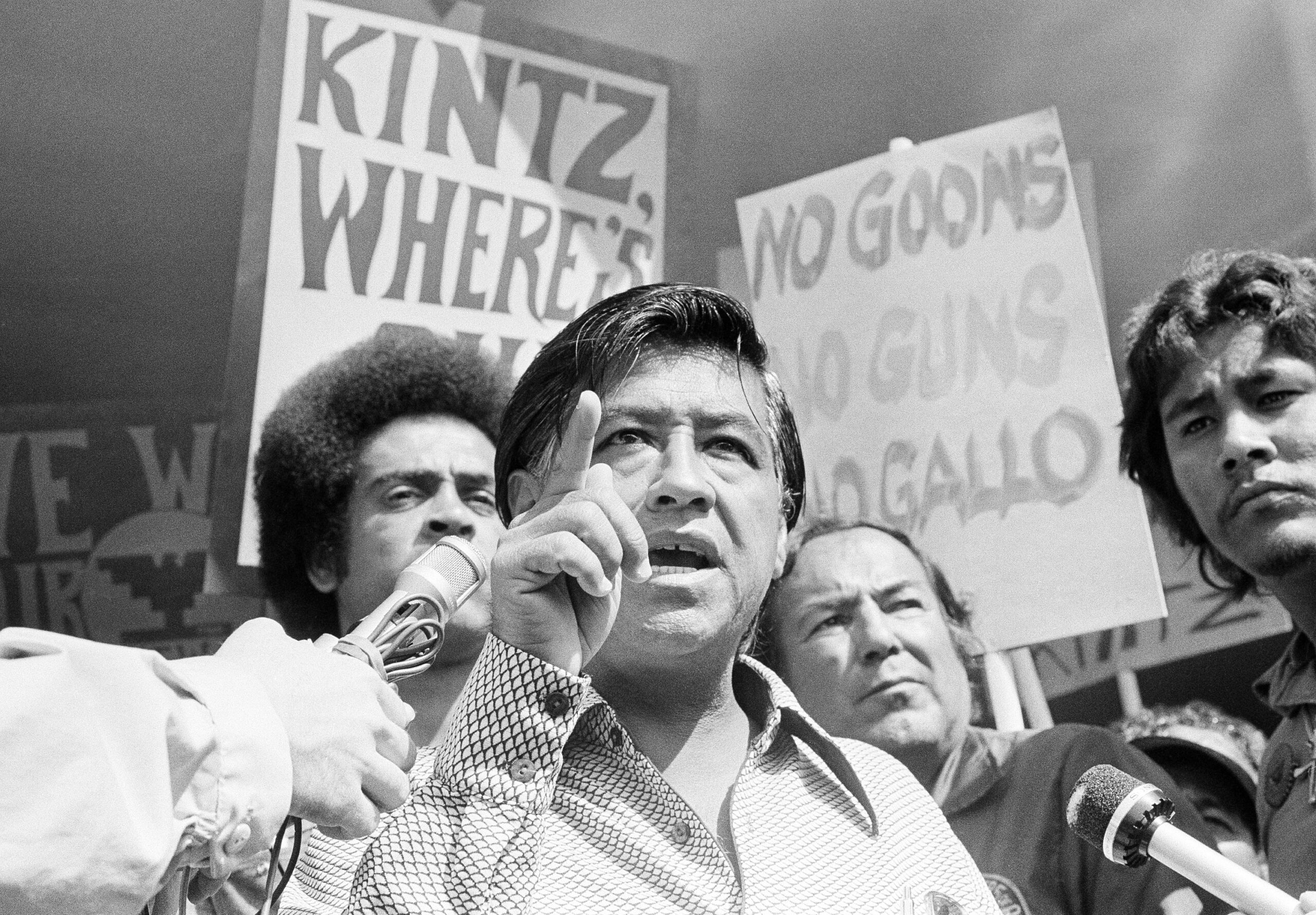
How a one-time labor icon went from farmworker hero to non-person by deviating from the Judeo-Left’s migration consensus.
Icons in this country are not built to last; they are built to be liquidated the moment they become a liability to the current power structure. The sudden, systemic erasure of Cesar Chavez proves that even the most celebrated heroes of the left are only one “investigation” away from total annihilation.
In March 2026, a New York Times investigation revealed what may be the final blow to the legacy of Cesar Chavez. Based on interviews with over 60 individuals and supported by hundreds of pages of union documents, confidential emails, photographs, and recordings, the report alleged that Chavez sexually abused at least two underage girls in the 1970s, sexually assaulted his longtime collaborator Dolores Huerta, and sexually harassed other women throughout his decades leading the United Farm Workers.
The United Farm Workers announced it would not participate in Cesar Chavez Day celebrations on March 31, 2026, describing the allegations as “profoundly shocking” and “incompatible with our organization’s values.” Events honoring Chavez were canceled in Tucson, Houston, Corpus Christi, San Antonio, San Bernardino, and Austin. California Governor Gavin Newsom stated “none of us knew” and planned to discuss renaming Cesar Chavez Day with lawmakers. Two of California’s top lawmakers announced they want to rename sites bearing his name.
These sweeping acts of historical erasure aim to turn Chavez into a non-person, but they ignore the gritty, complicated reality of a man who rose from the absolute bottom of the American social hierarchy. The trajectory of that rise—from the dispossession of his family farm to the grueling life of a migrant laborer—is where the real story begins.
The Making of an Organizer
Cesario Estrada Chavez was born on March 31, 1927, near Yuma, Arizona, to a Mexican American family that owned a small farm and grocery store. The Great Depression shattered this stability. The family farmstead was auctioned for back taxes in 1939, a formative injustice that Chavez would carry for the rest of his life. The Chavez family migrated to California and became itinerant agricultural laborers, picking avocados, peas, and grapes while living in a garage near San Jose.
Young Cesar attended segregated schools, faced poverty, and left after eighth grade to work the fields full time. He served in the U.S. Navy from 1944 to 1946, encountering discrimination there as well. After the war he married Helen Fabela in 1948 and continued farm work while seeking ways to challenge the conditions he and other laborers faced.
In 1952, Chavez was recruited into the Community Service Organization, a Mexican American civil rights group linked to Saul Alinsky’s Industrial Areas Foundation. He became a skilled organizer focused on voter registration and fighting police abuse. By 1958 he was the CSO’s general director in California. But when the organization refused to prioritize creating a farmworkers’ union, Chavez resigned in 1962.
That same year, he moved to Delano, California, with his family and fellow organizer Dolores Huerta. Together they founded the National Farm Workers Association, positioning it as a broad “movement” for dignity rather than just a trade union. The organization adopted the motto “Viva La Causa” and a black eagle flag that would become iconic.
The Delano Grape Strike and National Triumph
The defining chapter of Chavez’s career began on September 8, 1965, when Filipino grape workers in Delano, organized under the Agricultural Workers Organizing Committee and led by Larry Itliong, walked off the fields and launched a strike against local growers. The NFWA faced a choice — join the strike or break it. Despite reservations about readiness, on September 16, Mexican Independence Day, NFWA members voted overwhelmingly to stand with the Filipino workers. The resulting coalition turned a wage dispute into a multiracial labor struggle that would run five years.
In August 1966, the NFWA and AWOC merged to form what became the United Farm Workers, with Chavez as its central leader. The UFW launched a nationwide consumer boycott of California table grapes in 1968, connecting the farmworkers’ cause to the wider civil rights and anti-poverty movements of the era. Organizers fanned out across the country, and liberal consumers stopped buying grapes in solidarity, with union workers in California dockyards letting non-union grapes rot in port rather than loading them.
Deeply influenced by Catholic social teaching and Gandhi, Chavez insisted on nonviolence and used public fasts to dramatize the cause. In February 1968, he began a 25-day fast framed explicitly as penance — a reaffirmation of the movement’s commitment to peaceful protest after some members had turned to violence. On March 10, Senator Robert F. Kennedy flew to Delano to participate in the outdoor Mass that ended the fast, and the two men broke bread together in one of the most photographed moments of the American labor movement.
On July 29, 1970, Delano grape growers finally capitulated, signing contracts that included wage increases, health plans, and collective bargaining rights for tens of thousands of workers. The UFW’s organizing helped produce California’s 1975 Agricultural Labor Relations Act — the first law in United States history granting farmworkers the right to organize and bargain collectively, enacted forty years after the National Labor Relations Act had deliberately excluded them from its protections.
Chavez became one of the most visible Latino leaders of the 20th century. After his death in 1993, he received the Presidential Medal of Freedom posthumously. Schools, streets, parks, and a naval vessel were named in his honor. President Obama designated the UFW’s Keene, California compound as the Cesar E. Chavez National Monument. President Biden placed a bust of Chavez in the Oval Office.
The official story ended there. The actual story was far more complicated.
The Immigration Hardliner
From the founding of the NFWA in 1962 through the mid-1970s, Chavez held views on illegal immigration that would be unrecognizable to most of his contemporary admirers. His opposition was rooted in labor economics: illegal workers were routinely used by growers to break strikes and depress wages, and their desperate circumstances made them willing to accept conditions that directly undermined the UFW’s bargaining position. Chavez used the slur “wetbacks” — common parlance in that era — and was relentless in pursuing the deportation of illegal workers already in the fields.
The UFW took concrete enforcement actions that would be unthinkable from a progressive labor leader today. In testimony before the House Education and Labor Committee on October 1, 1969, Chavez stated plainly: “A year ago we assigned many of our organizers to do nothing but to check on the law violators coming from Mexico to break our strikes. We gave the Immigration and Naturalization Services and the Border Patrol stacks and stacks of information.” Chavez and the union actively demanded that the workers they identified be deported.
Most controversially, by 1974 Chavez had dispatched his cousin Manuel Chavez to organize what the union called “wet lines” — a private border patrol operation along the stretch of border between Yuma, Arizona and San Luis, Mexico. As Miriam Pawel, Pulitzer-winning journalist and author of The Crusades of Cesar Chavez, documented, the operation employed roughly 300 UFW members and cost $80,000 a week at its peak. It was intended to intercept unauthorized crossers and force them to turn back, pressuring lemon growers who were resisting a UFW strike. The patrols turned violent quickly. Reports surfaced in papers on both sides of the border of crossers being beaten and robbed.
Chavez himself summarized the logic bluntly: “If we can get the illegals out of California, we will win the strike overnight.”This stance put Chavez in direct conflict with other Chicano leaders. Bert Corona, a prominent labor organizer and founder of the Hermandad Mexicana Nacional, argued that illegal alien workers should be organized and protected rather than scapegoated. Corona and others cautioned Chavez that alienating illegal aliens was “a disastrous mistake” — that he was making enemies of people who were natural allies in the broader struggle for class and social justice
The Evolution
By the mid-1970s, Chavez’s stance was increasingly out of step with the broader Mexican American civil rights movement. In 1974, when Attorney General William Saxbe announced a plan to deport one million illegal immigrants and claimed the UFW supported the proposal, Chicano activists erupted. Chavez publicly denied backing the deportation plan — and in a November 1974 letter to the San Francisco Examiner, later recovered and published by Latino Rebels, he wrote that illegal workers “are our brothers and sisters” and called for amnesty and legal residency. The letter revealed a more complicated picture than the hardline rhetoric of the Illegals Campaign suggested, even as that campaign continued.
A formal institutional shift came in 1975, when the UFW insisted that illegal alien workers enjoy the same protections and rights as other farmworkers under California’s newly passed Agricultural Labor Relations Act. By the 1980s, Chavez’s position had substantially evolved. He supported the Immigration Reform and Control Act of 1986, which granted amnesty to roughly three million illegal immigrants nationwide. The UFW, as the union’s own account documents, played a central role in fashioning the law’s amnesty provisions, which allowed approximately one million illegal alien farmworkers specifically to become legal residents.
Gaspar Rivera-Salgado, project director at the UCLA Labor Center and a leading scholar of farmworker and immigrant labor movements described the arc this way: “Chavez’s position on undocumented immigrants evolved from being opposed and aligning with the immigration authorities to deport undocumented workers to eventually coming around and defending immigrants and amnesty. It’s important to be aware that even our heroes sometimes evolve and have a change of heart, a change of mind and strategy.”
The more critical view, advanced by researchers drawing on archival work at the Duke University Human Rights Center, holds that Chavez was “rigid and unwilling to consider that the issue was more complicated” and that “by alienating immigrants, by focusing on the wrong ‘enemy,’ and by refusing to consider the advice of knowledgeable and forward-thinking people, Chavez and his union contributed to a toxic and troubling trend of immigrants scapegoating and internal fracturing” — a legacy the UFW has struggled to overcome even as it has moved toward a posture more amenable to the Judeo-Left.
None of it — not the amnesty advocacy, not the posthumous monuments, not the Oval Office bust — inoculated Chavez against what the Judeo-Left’s own reckoning would eventually produce. In March 2026, the New York Times published a five-year investigation by reporters Manny Fernandez and Sarah Hurtes, based on interviews with more than 60 people and a review of hundreds of pages of union records, confidential emails, and audio recordings, that upended Chavez’s legacy entirely.
Ana Murguia, now 66, told the Times she was allegedly groomed by Chavez beginning at ages 8 or 9. Her first sexual encounter with him occurred when she was 13, in his office at La Paz. He locked the door, told her how lonely he had been, guided her onto the yoga mat he used for meditation, kissed her, and pulled down her pants. “Don’t tell anyone,” he said afterward. “They’d get jealous.” She was summoned dozens of times over the following four years. By 15, as the Arizona Mirror reported, she had developed a heroin addiction and made multiple suicide attempts.
Debra Rojas, also 66, told the Times Chavez first touched her inappropriately at 12. At 15, during the UFW’s 1975 1,000-Mile March, he arranged for her to stay at a motel in Stockton, picked her up, and raped her — rape under California law, given her age. He placed a gun on the nightstand, which frightened her each time she glanced at it.
Some of the most explosive allegations came from Dolores Huerta herself. In a statement released after the investigation’s publication, Huerta said she had experienced two sexual encounters with Chavez in the 1960s. “The first time I was manipulated and pressured into having sex with him, and I didn’t feel I could say no because he was someone that I admired, my boss and the leader of the movement I had already devoted years of my life to,” she wrote. “The second time I was forced, against my will, and in an environment where I felt trapped.” The second assault occurred in 1966. Both encounters resulted in pregnancies, which Huerta concealed by wearing baggy clothing, giving birth to two girls and arranging for them to be raised by other families — secrets she kept for nearly 60 years.
Victims remained silent for decades out of shame and fear of damaging Chavez’s stature. More than a decade ago, Rojas posted in a private Facebook group for longtime UFW organizers and supporters, warning of his alleged misconduct. She was accused of tarnishing the movement and deleted the post days later.
It is telling that even as Chavez pivoted late in life to align himself with the cultural Left’s agenda, he could not shield himself from the character assassination campaigns launched by those very same institutions. The latest allegations against Cesar Chavez smack of a coordinated cancel culture effort designed to erase his image. It remains to be seen if these allegations carry legal weight, but Chavez is no longer alive to mount a defense in a proper legal setting. Ultimately, in this Jewish-dominated polity, any individual who deviates from the mass migration consensus—even a non-White activist like Chavez—will eventually be burnt in effigy. If the Judeo-Left cannot destroy you while you are alive, they will certainly tarnish your reputation in death.