
The Civil War Within Britain’s Conservative Party
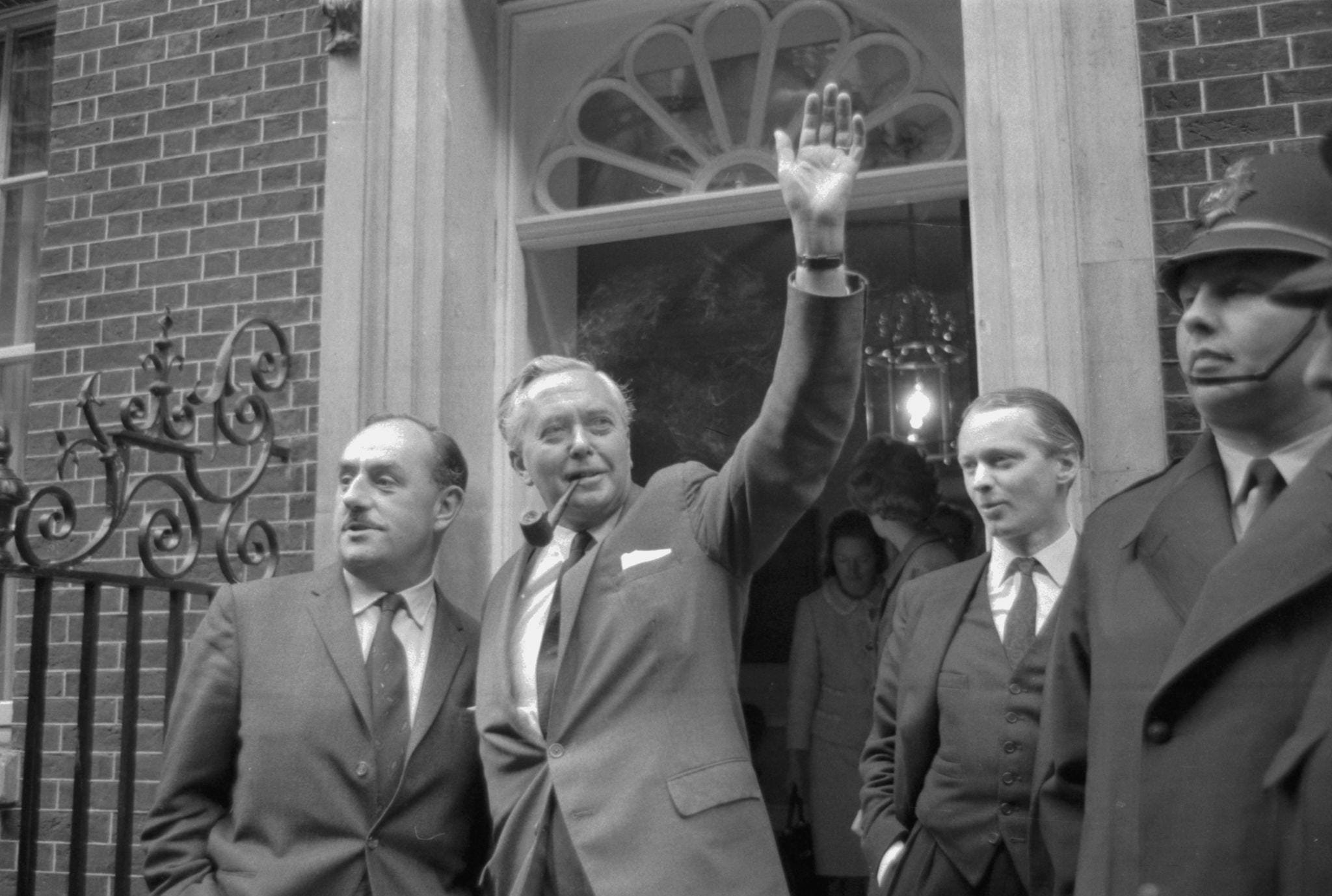
“I will not rest until the rivers of Zimbabwe run red with the blood of every white man, woman and child and every African who supports them.”
At precisely 11:00 GMT on 11 November 1965, Prime Minister Ian Douglas Smith, alongside Deputy Prime Minister Clifford Dupont and their ministerial colleagues, formally signed the Unilateral Declaration of Independence (UDI).1 It was the first time a British colony had unilaterally severed its legislative subordination to the United Kingdom since the American Declaration of Independence in 1776.2
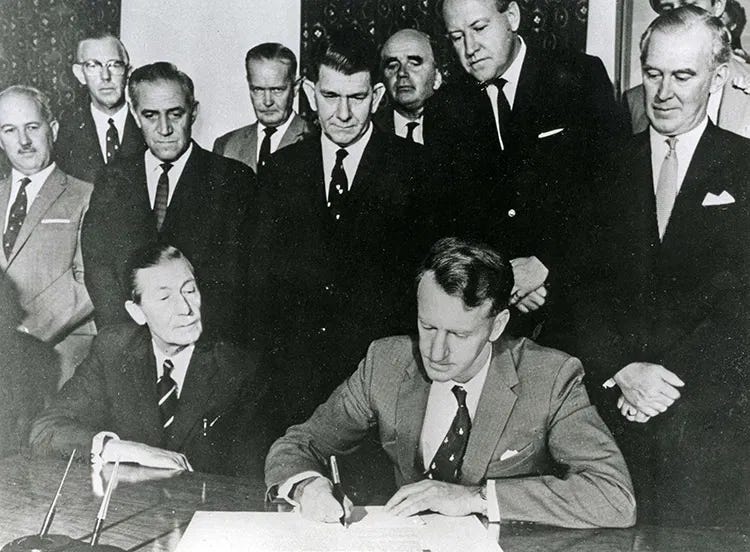
The American precedent was by no means accidental. Drafted by a sub-committee of civil servants led by Cabinet Secretary Gerald Clarke, the Rhodesian proclamation explicitly and provocatively modelled itself upon the 1776 document.3 It appropriated the Jeffersonian invocation of “a respect for the opinions of mankind,” while pointedly and systematically excising any philosophical pretensions that “all men are created equal” or that legitimate governance necessarily relies upon the universal “consent of the governed”.4 In his subsequent radio broadcast to the nation, Ian Smith employed a soaring, anachronistic rhetoric that framed the rebellion not as a rejection of Britishness, but as its ultimate preservation in an age of metropolitan decadence. Asserting that “the mantle of the pioneers has fallen on our shoulders,” Smith declared that Rhodesia was striking “a blow for the preservation of justice, civilisation and Christianity”.5 He explicitly framed the breakaway state as the “first Western nation in the last two decades to say ‘so far and no further’” to the perceived capitulations of the post-war era.6
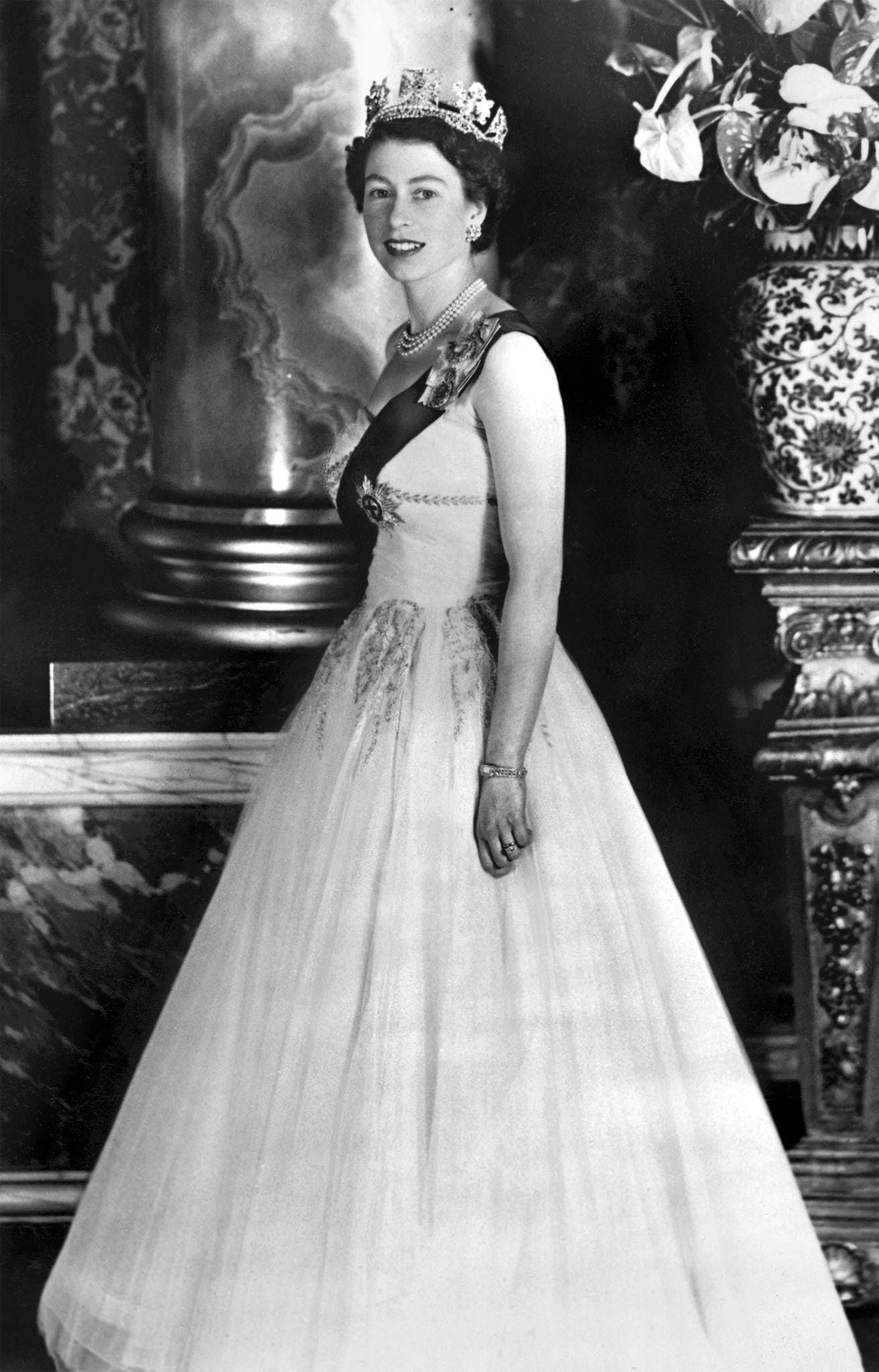
The immediate optical paradox of UDI was its insistence on monarchical loyalty. The proclamation concluded with the traditional “God Save the Queen,” and the amended 1965 Rhodesian constitution audaciously named Elizabeth II the “Queen of Rhodesia”.7 This occurred even as her actual representative on the ground, Governor Sir Humphrey Gibbs, formally dismissed Smith’s entire government for treason, an executive order the Rhodesian Front simply and efficiently ignored, effectively stripping the Governor of all practical power.8 The subsequent day’s edition of the Rhodesia Herald ran the stark headline “UDI, Rhodesia goes it alone,” its front page marred by glaring, conspicuous blank spaces where state censors had frantically excised dissenting copy deemed unfavourable to the newly illegal regime.9
If the declaration was an earthquake in Southern Africa, its seismic waves immediately fractured the political foundations of Westminster. In London, UDI was a significant psychological rupture that laid bare the raw nerves of post-imperial decline. The Labour Prime Minister, Harold Wilson, moved swiftly to condemn the “illegal regime” and, while ruling out direct military coercion, opted instead for punitive economic sanctions and an aggressive oil embargo.10 But for the Conservative Party, then in opposition and led by the technocratic moderniser Edward Heath, the Rhodesian question forced an agonising internal reckoning.11
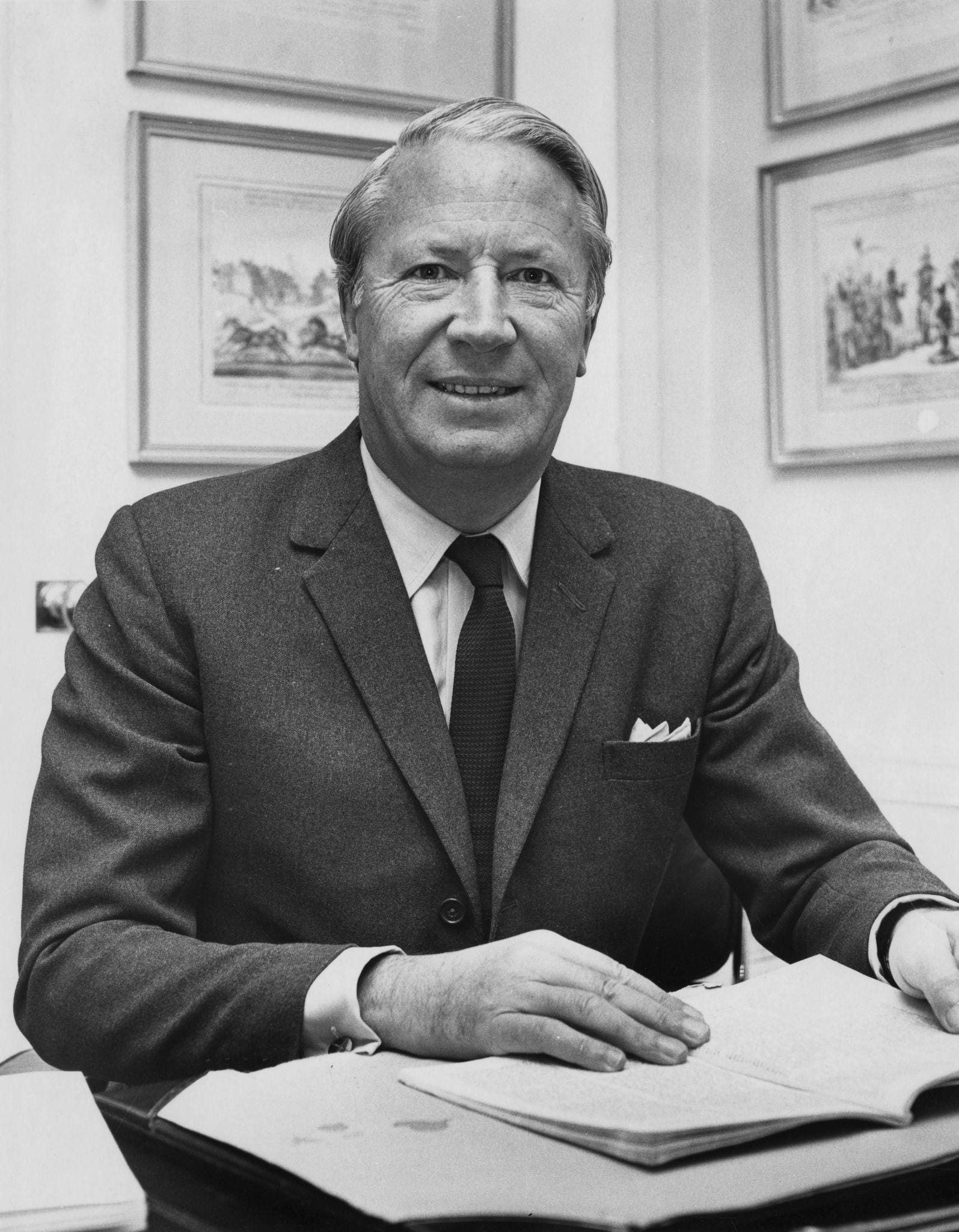
The crisis illuminated the latent divisions within British Conservatism regarding the end of empire and the moral obligations of kinship. When the Labour government introduced the Southern Rhodesia (Petroleum) Order in December 1965, the Conservative Party fractured spectacularly.
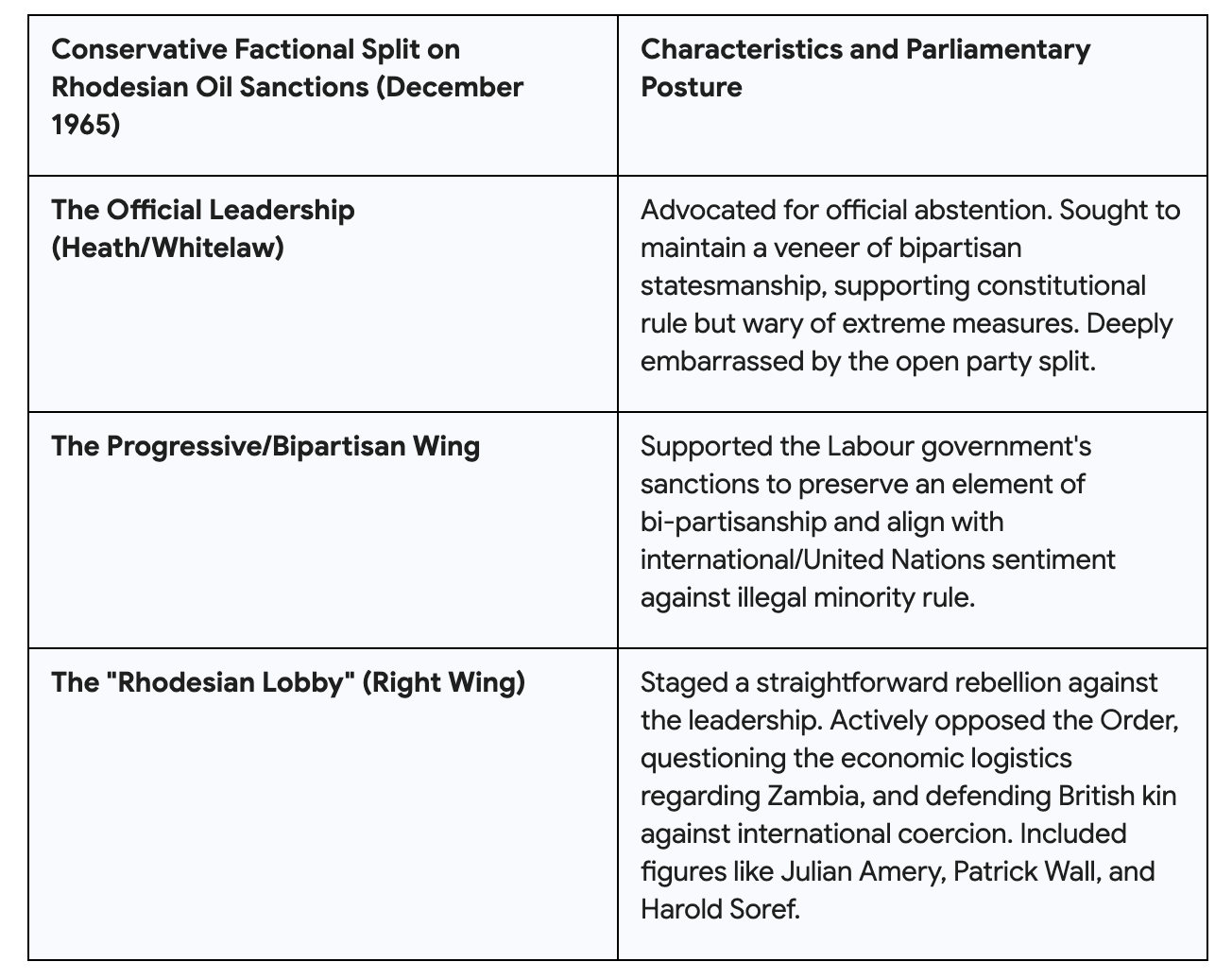
Former Chief Whip William Whitelaw mournfully recalled the December 1965 debates as the moment he presided over a party in “three pieces”.12 During the debates, backbenchers of the “Rhodesian lobby” staged a vociferous rebellion. Figures such as Nigel Birch questioned the logistical sanity of the embargo and its devastating effect on the Zambian economy, while Lieutenant-Commander S. L. C. Maydon argued that sanctions would only harden settler opinion and destroy stable employment for hundreds of thousands of Africans.13 Men like Patrick Wall and John Biggs-Davison expressed open distrust of the Prime Minister and interrogated the jurisdictional overreach of the embargo.14 This factional revolt was the geopolitical vanguard of an ideological insurgency led primarily by the Conservative Monday Club. For this ascendant faction, UDI mattered deeply because Rhodesia had ceased to be only a distant territorial dispute. It had become a highly charged symbolic proxy for a much larger struggle over Britain’s post-imperial identity, the meaning of Western civilisation, and the soul of the Conservative Party itself.
The Founding of the Monday Club
To comprehend the Monday Club’s visceral reaction to UDI, one must trace the organisation’s genesis to the precise moment the British political establishment formally reconciled itself to the loss of empire. On Monday, 3 February 1960, Prime Minister Harold Macmillan stood before the South African parliament in Cape Town and delivered his epochal “Wind of Change” speech.15 By acknowledging the unstoppable force of African nationalism and signalling a rapid acceleration of decolonisation across the continent, Macmillan codified a bipartisan metropolitan consensus that the era of imperial dominion was irrevocably over.16

For a cohort of traditionalist, imperially minded Conservatives, Macmillan’s capitulation was not an act of statesmanlike realism, but a betrayal of the nation’s historical mission. Remembering the date of the speech as “Black Monday,” four young Conservatives, Paul Bristol, Ian Greig, Cedric Gunnery, and Anthony Maclaren, formally established the Conservative Monday Club on 1 January 1961.17 Operating initially from the margins, these self-described “Chelsea Tories” were motivated by a potent blend of upper-class romanticism and an acute, melancholic sense of civilisational decline.18 Jonathan Guinness, who would later emerge as a defining leadership figure within the Club, candidly noted a pervasive feeling that the traditional ruling classes, whom he referred to as “the toffs”, were actively letting down both the Conservative Party and the country.19
Crucially, the Monday Club was founded as a direct intellectual and organisational counterweight to the Bow Group.20 Established in 1951, the Bow Group functioned as the progressive, reformist think tank of the Conservative Party, promoting technocratic modernisation, internationalism, and a pragmatic accommodation with the welfare state and the realities of decolonisation. Conservative Central Office, desperate to present a modernised, post-imperial face to the electorate, heavily favoured the Bow Group and the similarly progressive Pressure for Economic and Social Toryism (PEST).21
The Monday Club explicitly rejected this progressive, managerial consensus. E. S. Adamson, an official at Central Office, noted in a 1961 internal report that requests for information about the Club were coming in “from all over the country,” reflecting a grassroots attempt to set up a right-wing organisation along the intellectual lines of the Bow Group.22 From the outset, the Club sought to act as a ‘party within a party’. It expanded beyond the traditional ad hoc nature of parliamentary factions by building a mass membership, establishing regional and university branches, and disseminating hundreds of ideological pamphlets.23 The organisation was soon lent establishment credibility by its first president, the 5th Marquess of Salisbury (Robert Gascoyne-Cecil), a titan of the Tory right who had previously resigned from Macmillan’s cabinet over its perceived liberal drift and abandonment of imperial obligations.24
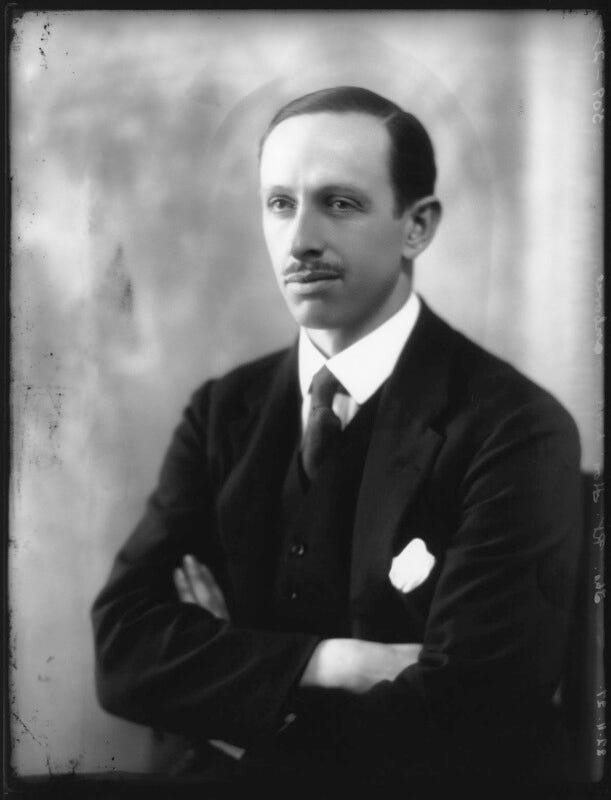
Under the aegis of Lord Salisbury, the Monday Club articulated a worldview in which the hasty dismantling of the British Empire was symptomatic of a deeper domestic malaise. The early intellectual output of the Club sought to bind the retreat from empire directly to the erosion of traditional British institutions. In their pivotal October 1963 pamphlet Conservatism Lost? Conservatism Regained, the Club argued that the government had bribed the electorate into acquiescence with “promises of greater affluence and materialism” while allowing British colonies to fall into chaos.25 The text asserted that a powerful, centralising state was eroding individual liberties at home, while “decadence” ran rife in a society where material wealth uneasily coexisted with declining religious and moral standards.26 Furthermore, it explicitly blamed Macmillan for the government’s African policy, which it claimed was destructive to Britain’s good name.27 Thus, from its inception, the Monday Club did not view colonial policy in isolation; rather, the “Wind of Change” was diagnosed as the external, geopolitical manifestation of a domestic spiritual rot that threatened to sever Britain from its historical destiny.
https://celina101.substack.com/p/the-civil-war-within-the-conservative