I’ve been harping on this theme for a while. In particular, I’ve been arguing that, at this point, the disaster is baked in. The only question is, How bad does it get if Trump continues his crazy war? This is especially pertinent because Iran has made it clear that if Trump attempts to carry out his threatened destruction of Iran’s infrastructure, Iran will respond in kind to the rest of the energy producing region. That would be a world historical catastrophe. The hope is that Trump will clutch at the lifeline that Iran just offered him: ‘End the blockade and we’ll attend negotiations.’ (Per the WSJ)
We’ll start with a fairly detailed explanation of the dynamics that are at work here. Note that only the oil situation is addressed. Not the fertilizer or other angles.
Qasem Al-Ali @AlaliQasem
The oil market just passed its breaking point. And it doesn’t matter if the Strait of Hormuz opens tomorrow. Here’s why the damage is already done. 
Even if a ceasefire is signed TODAY:
Floating tankers need 30–40 days to offload
VLCCs [Very Large Crude Carrier] rerouted to the US need 3+ months to return
Onshore Middle East storage needs to drain ~200M bbls first
The supply gap doesn’t care about peace deals.
Cumulative storage lost from Hormuz closure:
End of April → 1.2 billion bbls
End of May → 1.59 billion bbls
End of June → 1.98 billion bbls
This is 4x larger than any supply outage in history. There is no playbook for this.
The cycle playing out right now:
↑ Crude prices
→ Compressed refining margins
→ Lower refined product output
→ Product storage draws
→ Higher margins again
→ Higher throughput
→ ↑ Crude prices again
Rinse. Repeat. Until something breaks.
By end of July, US commercial crude storage could fall below 400M bbls — near operational minimum. At that point, the Trump administration faces a binary choice: Ban crude exports. Or watch US refineries shut down. Neither option is good for markets.
The only thing that “balances” this market now is demand destruction on the scale of COVID lockdowns. Not lower prices. Not diplomacy. Government mandates forcing people to use less fuel. That’s the math. $95/bbl is not the answer.
The last marginal barrel — the one that keeps a refinery running vs. shutting down — What does it trade for?
Nobody knows. And that’s the most terrifying thing about this crisis. What’s your number? 
Source & credit: @HFI_Research
Full write-up: “The Breaking Point Is Here” — published April 2026.
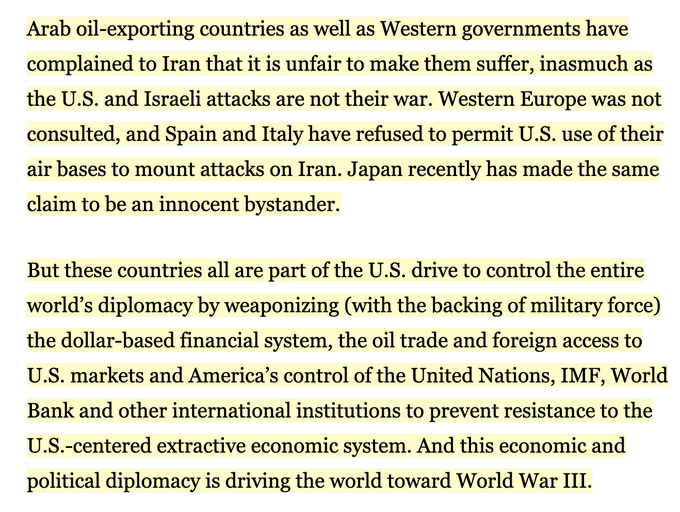
Now, up top we mentioned the Iranian position, which boils down to: Anglo-Zionist war on Iran means Iran will wage war on anyone who supports the Anglo-Zionist Empire against Iran. The logic is clear and straightforward. Please read the excerpt below carefully. It concisely explains what this current crisis is about: The Anglo-Zionist drive to control the entire world by weaponizing the dollar-based financial system—backed up by the US military, whose oversized reach was enabled by that same dollar-based financial system.
Policy Tensor @policytensor
18h
Michael Hudson is not mincing any words.
Doug Macgregor comments on these topics, and more, here:
I think what we need to do is go back to the previous meeting in Islamabad and look at what actually occurred. The first thing which I think is very revealing is that the Iranians showed up with 70 people. They had large numbers of experts in various fields. They were carrying maps, geological surveys. They were loaded for bear frankly to discuss in detail what they would accept in terms of conditions, what they would not, and what they would negotiate. We showed up with VP Vance, Witkoff, and Kushner who had previously been judged as unwanted members of the delegation. The Iranians simply said, “We regard these people as Israeli assets, and frankly that’s what everybody does see them as. We don’t see them as representing American national interests.” So they were prepared to talk with Vice President Vance, but not Witkoff and Kushner. Unfortunately, as far as we know, there was otherwise no supporting staff.
Now, this is not the first time that this has happened. This happened in Anchorage. The Russians showed up and were prepared for very substantive talks. They brought with them all sorts of material pertaining to Ukraine, current state of affairs, troop locations, recommended solutions, and so forth. We showed up with nothing. Trump thought that he was going to charm his way into some sort of agreement. As it turned out, he conveyed the impression that we were prepared in the future to do all sorts of things. And it took some time for the Russians to discover that they were being lied to. Now, I think the Iranians know they’ve been lied to. So, what can we expect from this meeting? You have the same people. Are they walking in with anything of substance? Are they prepared to sit there not for a day or two, but for however long it takes to reach some sort of agreement? I’m very skeptical and I’m sure that the Iranians are very skeptical.
So, that’s the first part. The second part is, as far as I can tell, and I don’t have access to classified information, the Iranians have made it pretty clear that the time for negotiation, as far as they’re concerned, is over. They’re not interested in talking anymore. Frankly, there was a lot of Iranian opposition to signing on for the ceasefire that we wanted. Thanks to Donald Trump and the support from the media that he gets with regard to his public statements, the American people were under the impression that somehow or other, we were in the driver’s seat. We’re not. The strategic initiative firmly rests in Iranian hands. So, at this stage, I have to see tangible evidence from the Iranians that they have agreed to show up. Otherwise my assumption is Vance and the two assets will fly in and meet with themselves. But right now there’s just nothing from the Iranian government that substantiates the willingness to participate in a meeting.
Then finally this point, the Iranians aren’t asking for this meeting. And contrary to what Donald Trump says, they don’t need a deal. That’s a bunch of crap. Donald Trump, I think, is finally beginning to come to terms with the reality that he’s responsible for sending the world into what is likely going to be at best a deep recession and more likely a depression. We’re headed to a recession and the question now is how bad is it going to get? We can talk more about that in the future during the hour. But I think I think the American people have been blindsided and Trump blindsides everybody over and over and over again with nonsense. …
Just a week or two ago, I said that Donald Trump is beginning to realize that he faces national humiliation here at home and international humiliation abroad. He’s walked into a giant bear trap and he’s stuck and there’s no easy way out. One of the things that I think is most important for everybody to understand right now is that Donald Trump has single-handedly reversed the green revolution. Now, a lot of Americans today don’t understand what that was. But the truth is, in the aftermath of World War II, we developed fertilizers, exceptional fertilizers, ways to grow food that we had not had previously. This green revolution allowed hundreds of millions, actually billions of people to live an infinitely better life. And naturally, that also meant they could reproduce.
The global south right now is in terrible shape. Whether it’s Vietnam, the Philippines, Thailand, Indonesia, Malaysia, all of these countries now are suffering. One of the reasons they’re suffering is because 50% of the world’s supply of urea comes from the Middle East. comes through the Persian Gulf. Iran alone is the second largest global supplier. Global urea production is roughly 220 million tons a year. And why is it produced in such large quantities? Well, that’s because other than pneumonia, urea has the largest and highest nitrogen content of all industrial chemicals. The point is that these fertilizers with nitrogen and phosphate combined with urea are coming from major suppliers like Qatar and Saudi Arabia and sulfur. Nearly 50% of the world’s sulfur exports pass through the strait. We talk all the time about oil. Yes, oil is a problem. Roughly 10 million to perhaps 13 million barrels of oil globally are missing. But it’s not just oil. It’s all of these petroleum products and those things connected with it.I think Donald Trump is taking phone calls now and if he isn’t then somebody else at his office is from world leaders telling him, “Look, whatever you think you were going to accomplish, it hasn’t worked. The world is in a lot of trouble. You’ve got to get out of this because if you don’t, we’re going to face famine around the world in many key areas in the global south. We’re probably going to go into a depression.” …, the bottom line is this can’t go on. And Trump doesn’t want to admit the truth that the Navy has lost control of the global sea routes. It’s lost control of the straight of Hormuz, although it really never had it. And Middle East energy infrastructure is being destroyed. And the Iranians have made it abundantly clear. If you attack us this next time around, try to wipe out our oil infrastructure, try to destroy our deselination plants, we will respond in kind to the west coast of the Persian Gulf and that would be devastating to the world. In fact, many of those areas may never come back as they once were. I doubt it. Seriously.
Nobody is thinking about the larger issues. That’s why the commentary at the beginning about the global economy and the danger that is approaching right now around the planet is something that doesn’t even show up in any of the president’s commentary or speeches. You know, the farmers collectively in the United States sent a letter to Trump. I forgot the name of the agricultural organization that that represented them, but it was a very interesting letter. It was very sound and very straightforward and said, “Look, if you keep this up, it’s going to destroy us. We won’t survive it. It’s not just fertilizer. It’s a whole range of things that are important to farming.” You would think that if you’re hearing from farmers collectively in the United States, the people that grow our food, and they were asking you to reconsider, you would do so. But, ultimately, this is not about them. It’s not about anything but Donald Trump. We’ve got to go back to Roy Cohn and Roy Cohn’s systematic brainwashing of Donald Trump as a young man. And Donald Trump has gotten away with lots of things. I mean, the man’s declared bankruptcy six times in his life. He’s turned it into a business model. And what did he do after declaring bankruptcy? Washes his hands and walks away.
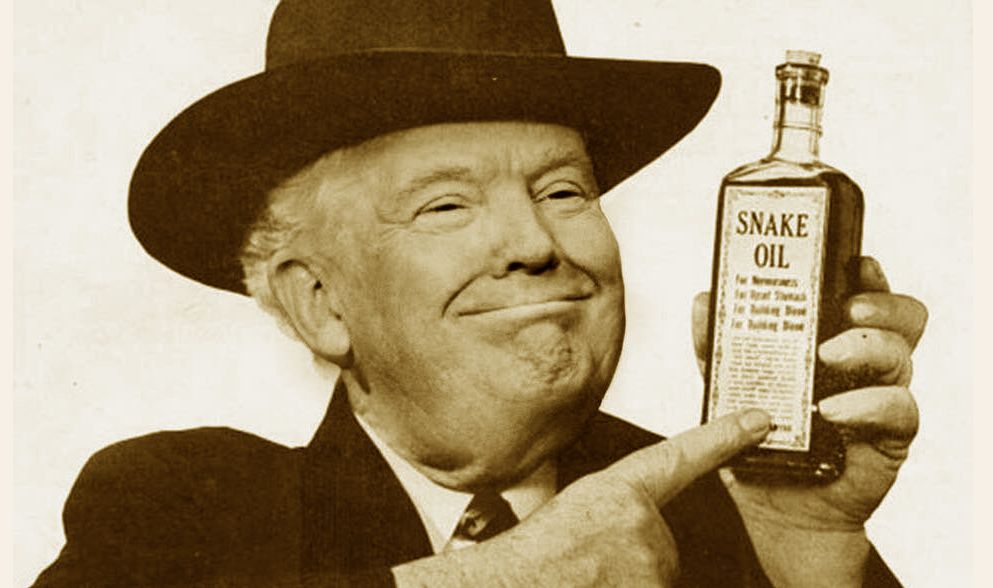
I think Donald Trump is still the marketing genius that he always was. He’s a con man. He sold everybody a bill of goods. Now he’s in a very difficult position and he’s going to ask the US military to rescue him. … Asking him to step down or step away from a bad decision with terrible strategic implications for us and the rest of the world is not something he’s going to even understand. In his mind … he’s the greatest. Just ask him, he’ll tell you.
I’ll wrap up with this. I stand by my claim that what we’re seeing in Trump’s behavior is character based—not dementia based (Robert Barnes’ narrative). Character based flaws like narcissism that—as Mac points out—have been reinforced by a lifetime of experience of getting away with things—no doubt can be reinforced by age and loss of ordinary controls. But they can also be exacerbated by crises, such as finding oneself trapped, in a box, with no available ways out like those that always worked in the past. Trump is in the tightest spot he’s ever been in in his life. And he walked right into it. There is no plausible way out. He owns it, on the world stage.
In that connection, I want to recommend two Max Blumenthal interviews today:
The first of the interviews is with Judge Nap, so it’s short and pithy. In it Max explodes another Barnes narrative—Veep Vance as the good guy in a white hat who’s trying to save the world. Max discusses Vance’s mentorship under David Frum in college and his current fund raising barnstorming with … Paul Singer and Miriam Adelson. Listen to Max. I enjoy Barnes and often find that he has genuine insights. But always exercise critical judgment.