
The Evils of UBI
I was having a recent conversation with a fellow shrew about a friend of theirs who was having difficulty with a very basic employment situation. Most of you—especially the Canucks among you—are aware of the issues regarding our Tim Hortons employment here in Canada.
Tim Hortons is Canada’s iconic coffee and doughnut chain, a cultural staple known for its double-doubles, Timbits, and drive-thru culture. In recent years, the company and many of its franchisees have faced sharp criticism for their heavy reliance on temporary foreign workers (TFW), particularly from India. Tim Hortons has lobbied the federal government to raise the cap on these workers from 20 percent to 30 percent for certain locations. The result has been growing resentment among Canadians who see entry-level service jobs—once filled by local students, young workers, and recent graduates—increasingly going to imported labour. Whether driven by genuine labour shortages or simple cost-cutting, the pattern has created language barriers, cultural cliques, and a widespread feeling that basic Canadian jobs are no longer meant for Canadians.
The issue we were discussing, however, was not primarily about that particular mess. It was about how difficult basic employment has become in general these days, especially in Canada.
When I had my own business in Hollywood many moons ago, we were always getting hassled by the state employment office. Although we worked under union rules with the American Federation of Musicians, the nature of the work made us appear to be independent contractors. The state kept accusing us of being employers whenever our supervised musicians applied for unemployment and listed us as such on the forms. The signatories (film studios) to the union contracts were the employers, not us. It was a bureaucratic nightmare, but I mention it only to highlight a stark contrast with today.
Back then, employment commissions in the U.S. were frantic about enforcing workers’ rights and benefits. This included employer-matched social security contributions, unemployment insurance, proper working conditions, overtime pay, and disability protections. These rules applied across the board—from highly paid professionals to an 18-year-old flipping burgers at McDonald’s for the summer.
I don’t know how vigorously this is still enforced in the United States, but here in Canada the situation feels very different—and much weaker.
In Canada, employers have increasingly turned to classifying workers as independent contractors rather than true employees. This lets businesses avoid many statutory obligations. True employees are protected under provincial employment standards laws, which typically include minimum wage, overtime pay, vacation pay, statutory holidays, termination notice or pay in lieu, and employer contributions to Employment Insurance and the Canada Pension Plan.
Independent contractors, by contrast, are treated as running their own business. They generally receive none of these protections or benefits—no overtime, no vacation pay, no employer-paid EI premiums, and far less job security. Courts and the Canada Revenue Agency are supposed to look at the actual working relationship rather than the label in the contract. In practice, however, misclassification is common, especially in gig work, service industries, and low-wage sectors. Employers save significantly on payroll taxes and benefits, while workers lose protections.
The aggressive enforcement I experienced in the U.S. seems to have eroded here. Basic entry-level jobs that once came with real benefits and oversight now often feel precarious, undervalued, and stripped of the human dignity that stable employment used to provide. Hmmm.
I think I smell a rat.
I seem to smell lots of rats these days, and as most of us probably can agree, we have developed a special skill of seeing the makings of the major movements of the agenda way before they happen. We see that train a’comin’, comin’ ‘round the bend. And guess who is standing in front of it? Us, of course.
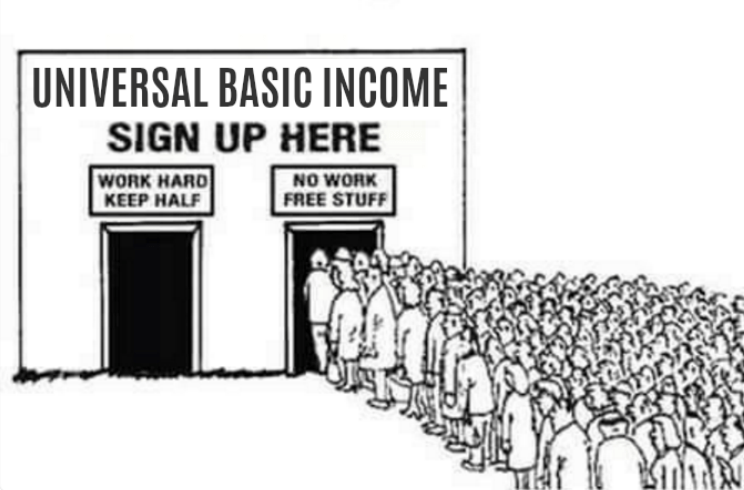
Most of these runaway trains are first disguised as nice, fat, juicy carrots. The stick hits right after the caboose passes our bloody bodies lying on the track. What is the particular carrot I am smelling here? Universal Basic Income.
What better way to set us all up for this? The most obvious scenario we see is AI taking our jobs, but why not immigrants—legal or not—taking them as well? Why not make it impossible to live off the crappy benefits and low pay that employers are now allowed to offer under this “independent contractor” model that is becoming the mainstream work ethic?
In mid-2026, Canada is edging closer than ever to some form of national Universal Basic Income. Proponents pitch it as the compassionate, modern solution to poverty in the age of AI and automation. They claim it will lift people out of poverty, reduce the bureaucratic mess of current welfare programs, give workers freedom to retrain or care for family, and act as a safety net when machines take over jobs. Some even argue it will be cheaper than the cost of poverty itself.
On the surface it sounds almost reasonable. Who wouldn’t want a guaranteed livable income with no strings attached?
But let’s be clear about what UBI really is and why it is a horribly bad idea.
UBI perfectly completes the trap we have been watching unfold. AI is rapidly displacing jobs. Mass immigration—both legal and illegal—is flooding the remaining low-skill positions. At the same time, the explosion of “independent contractor” work strips away the last real employment protections and benefits. Traditional jobs that once offered purpose, dignity, and a paycheck capable of supporting a family are being deliberately eroded from every side.
UBI is the carrot that makes this destruction look like help. When the jobs are gone or degraded beyond recognition, when the pay is unlivable and benefits nonexistent, the government steps in with a monthly check. “Don’t worry,” it whispers, “you don’t need that unstable contractor gig anymore. We’ll take care of you.”
And that is exactly the trap.
Once people become dependent on unconditional government money, they lose both the incentive and the ability to demand better wages, better conditions, or real employment. Work ethic erodes. A sense of purpose erodes. The deep human need for meaningful contribution is replaced by passive consumption and digital distraction.
Economically, a truly livable UBI is unsustainable. Serious studies show it would require massive tax increases, heavy borrowing, or money printing—driving inflation that eats away the very purchasing power the check is supposed to provide. Past pilots, including Ontario’s experiment a few years ago, were quietly cancelled when the numbers simply did not add up.
But the deepest danger is the control it hands to the state. UBI will almost certainly be delivered through digital currencies or central bank digital currencies. Every payment can then be tracked, programmed, and conditioned. Buy the wrong items? Payment paused. Miss a mandated health requirement? Funds frozen. Express the wrong opinion online? Account restricted. It becomes the perfect infrastructure for the biosecurity and behavioural control systems we have warned about for years.
From a psychological perspective, UBI feeds the archetype of the devouring mother—the state as the all-providing, all-controlling parent that keeps its citizens in perpetual childhood. It severs the natural connection between effort and reward, between autonomy and responsibility. A society of dependent individuals is far easier to manage than a society of sovereign adults.
We shrews have seen this playbook before. First, they make the old way impossible or unbearable. Then they offer the shiny new “solution” that looks like compassion but is really a cage with better lighting. The train is coming ‘round the bend, my friend. AI, immigration policy, contractor misclassification, and now UBI are all carriages on the same locomotive.
The only question left is whether enough of us will step off the tracks in time—or whether we will lie there waiting for the next juicy carrot, only to feel the stick when it is far too late.
The rat I smell is getting stronger by the day.