
The Ford is Getting Tired
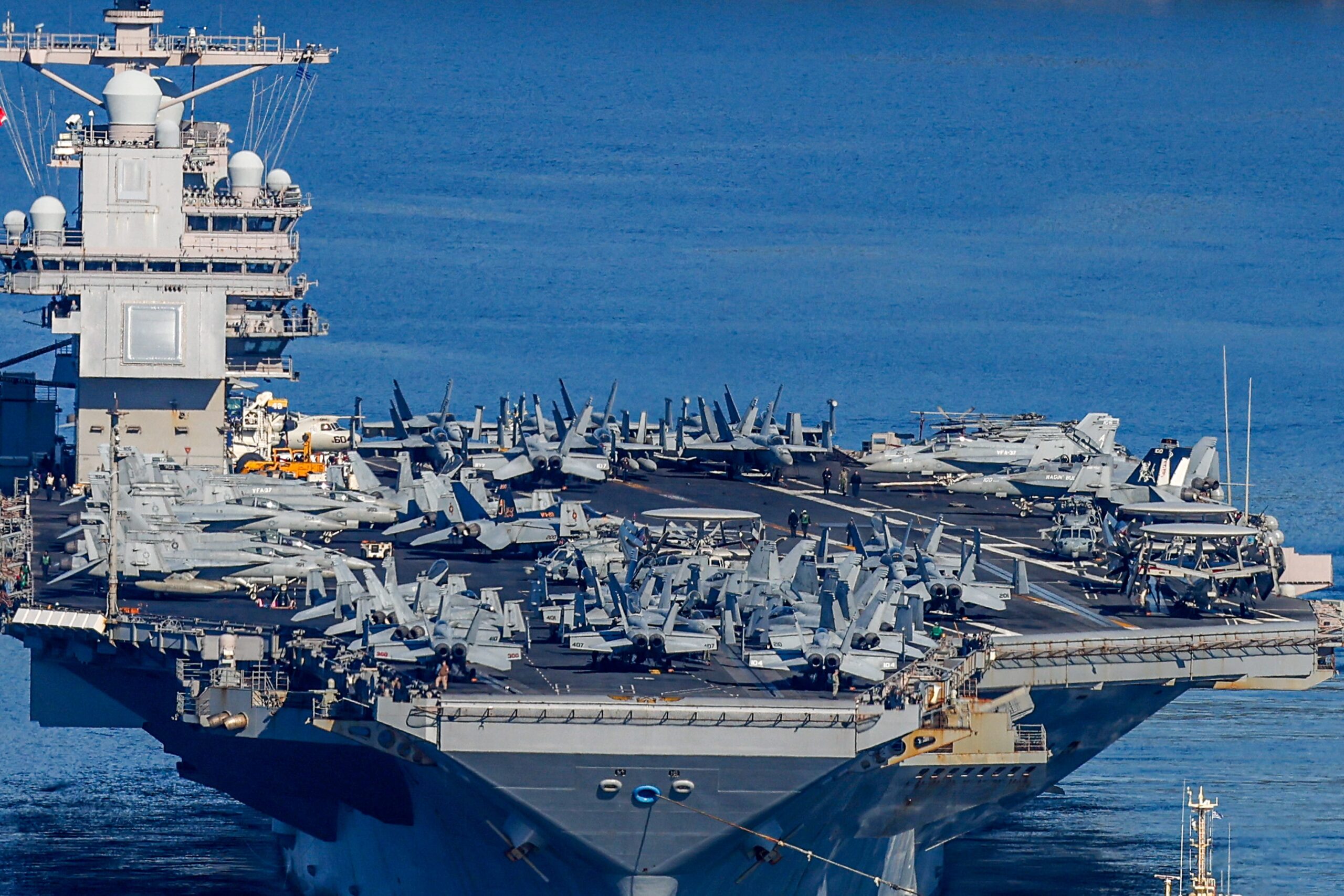
The USS Gerald R. Ford’s record deployment has seen laundry-room fires, clogged toilets, and combat theaters around the globe
The USS Gerald Ford, the world’s largest and most advanced aircraft carrier, broke the record for longest carrier deployment since the Vietnam War on Wednesday. The Ford’s thousands of sailors and crew have in their 296-day journey crossed the Atlantic three times, participated in major NATO exercises, provided cover for the capture of a head of state, and sustained offensive operations in the war against Iran in their historic deployment.
The record comes at a cost: broken promises of homecoming, strained mechanical systems, and an accelerating retention crisis that has rattled the War Department’s top brass.
The Ford, a $12.8 billion behemoth spanning three football fields in length, equipped with nuclear propulsions systems and able to carry up to 90 aircraft, has been a lynchpin of President Donald Trump’s “conquesting” military in his second term. The previous post-Vietnam carrier deployment record was set by the USS Abraham Lincoln in 2020; the Ford may well become the longest deployed carrier in history if it remains at sea for another 37 days, breaking the USS Midway’s 332-day deployment during the Vietnam War.
Where has that meandering 10-month journey taken our sailors? Let’s find out:
NEPTUNE STRIKE
The Ford left Virginia on June 24, 2025, crossing the Atlantic and sailing into the Adriatic to participate in the second phase of NATO’s “Neptune Strike” exercises in late July. The June deployment came two days after the U.S. bombing of Iranian nuclear sites in Midnight Hammer.
Neptune Strike, a NATO campaign spanning four exercise sessions involving over 41,000 personnel and eight carrier groups among 22 allied states, was designed to demonstrate “integrated high-end maritime strike capabilities, executed through a series of dynamic activities and demonstrations across the Alliance’s Joint Operational Areas.” The exercises included long range strike missions, amphibious landings, anti-submarine warfare, surface warfare, and carrier-based operations.
The Ford’s participation in Neptune Strike came as Russian airspace violations and drone sightings in Nordic and Baltic states escalated tension in the region; one such incursion saw drones operating at several Danish defense locations. “NATO has chosen a provocative course by intensifying its member states’ military activities in the High North,” Moscow’s Norwegian Embassy wrote in a statement regarding the Neptune exercises.
The Ford joined Neptune Strike in its second phase, concluding on August 1 exercises including naval, air, and ground assets from 14 partner states. That training included long-range strike missions starting in the Southern Adriatic Sea and covering roughly 1,250 miles, as well as anti-surface and anti-submarine warfare and search and rescue operations.
From Aug. 23 – Sept. 8, the Ford led a naval force alongside Norway, Germany, and France to conduct training in “Operation Overture” in the Norwegian Sea, before rejoining the Neptune Strike exercises for the third wave of training from September 22-26. These exercises saw NATO take operational control of the Ford carrier strike group alongside allied assets.
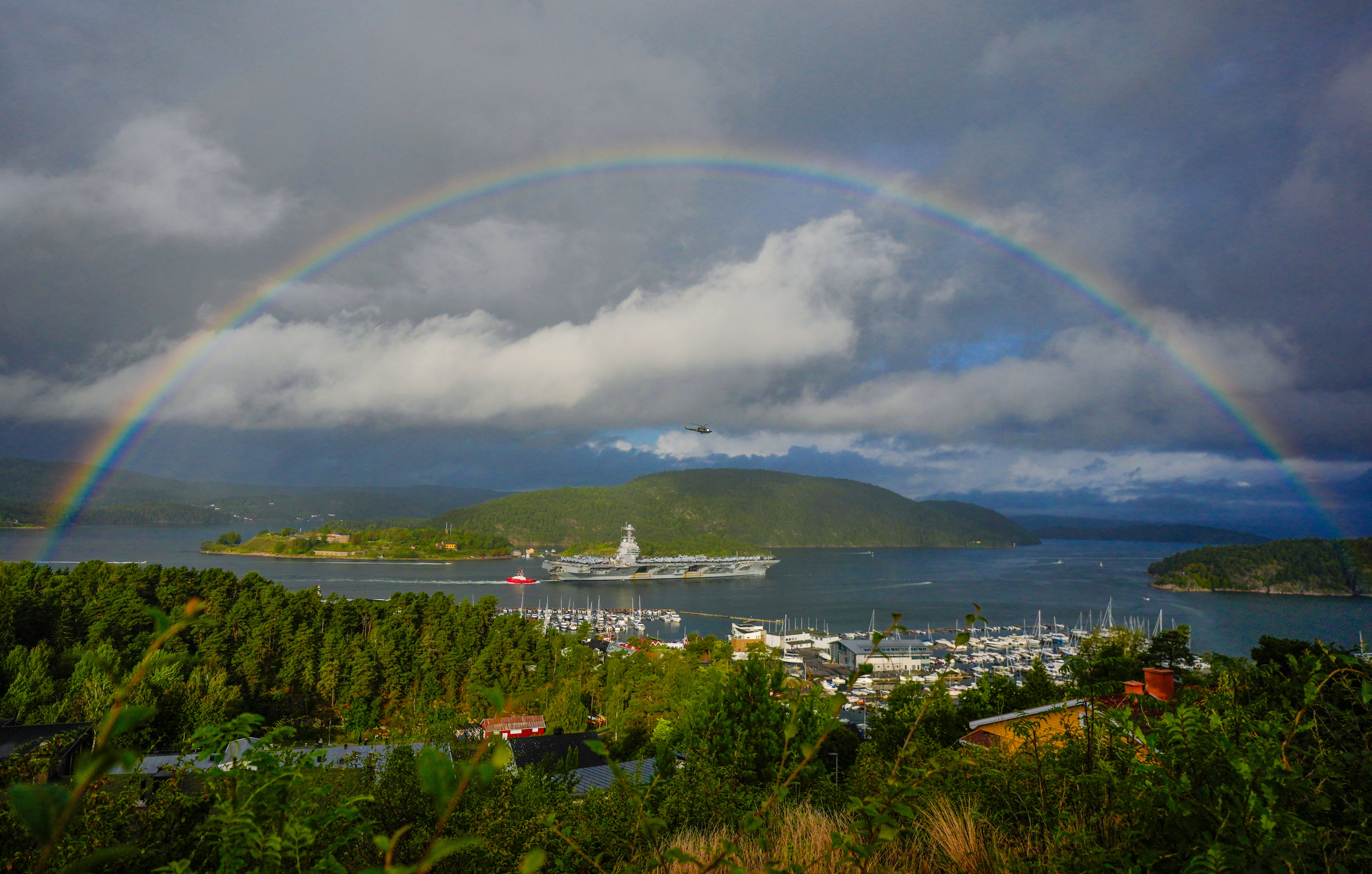
The Ford’s deployment continued on September 12, when the Ford sailed into Oslo, Norway — the first U.S. aircraft carrier to do so in 65 years. “These visits are not merely symbolic,” said Eric Myer, Charge d’Affairs a.i. at the U.S. Mission to Norway. “The presence of this carrier strike group in Norwegian waters training with Allied forces exemplifies our commitment to shared security.”
After the Neptune Strike exercises and the Oslo visit, the Pentagon on October 24 ordered the Ford to deploy to the U.S. Southern Command area of responsibility to “bolster U.S. capacity to detect, monitor, and disrupt illicit actors and activities that compromise the safety and prosperity of the United States” — the Venezuela deployment.
SOUTHERN SPEAR, ABSOLUTE RESOLVE
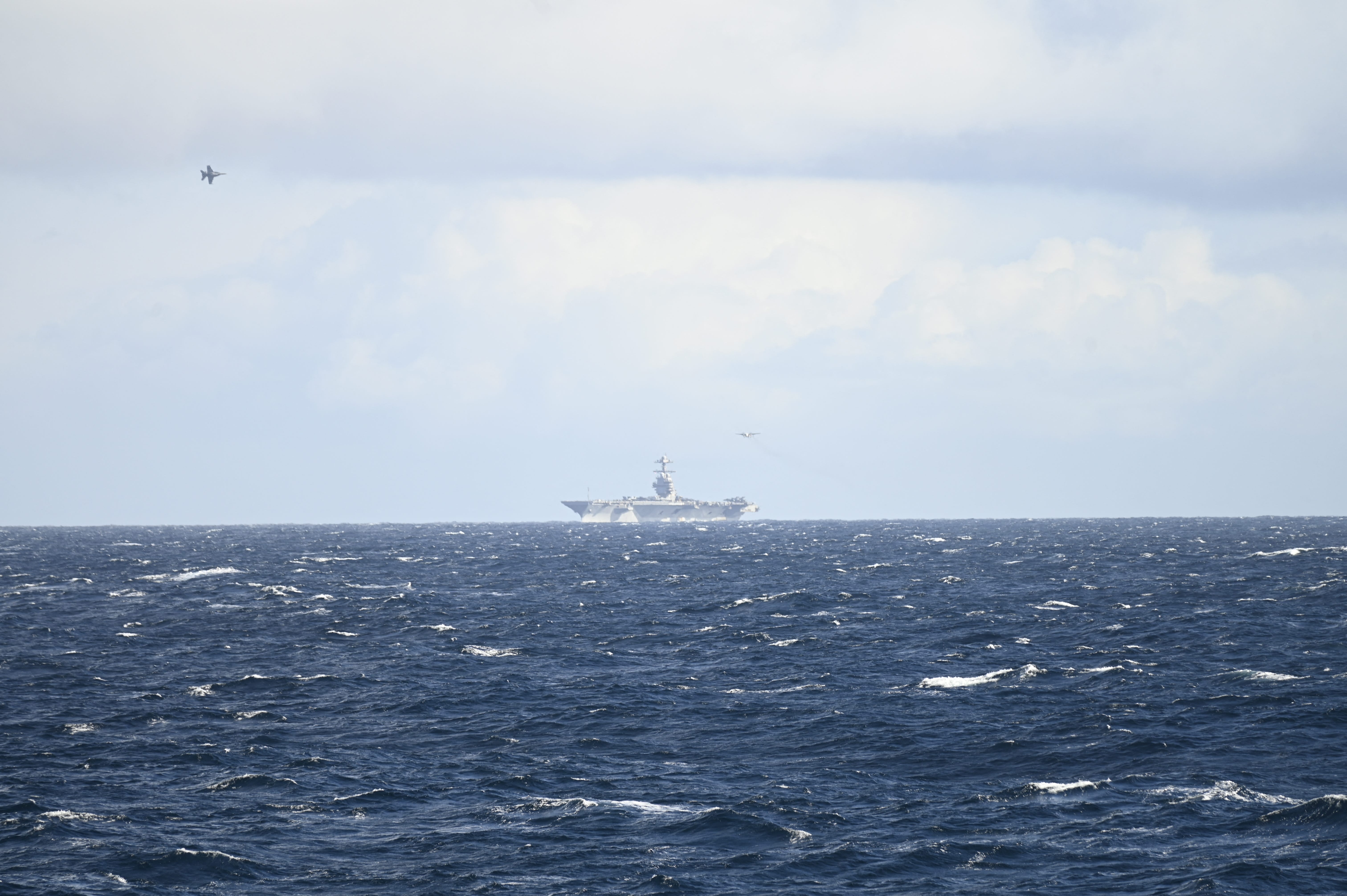
Transiting through the Strait of Gibraltar on November 4, the Ford arrived in the Caribbean on November 16, joining a buildup of troops and assets in the region deemed Operation Southern Spear, including by November some 15,000 troops, an amphibious ready group and Marine expeditionary unit, three destroyers, one cruiser, and fighter and bomber aircraft.
After briefly recuperating with a port visit in the U.S. Virgin Islands, special forces launched from the Ford on December 10 seized an oil tanker off the coast of Venezuela, taking control of the ship’s 1.8 million barrels of crude oil. The mission involved two helicopters, special operations forces, and 10 members each of the Coast Guard and Marines.
Leading up to the capture of Venezuelan President Nicolas Maduro on January 3, aircraft from the Ford flew a “relatively low” number of missions, largely providing command and control support for joint force operations. Following Maduro’s capture, Ford-launched forces again intercepted an oil tanker, the Veronica, on January 15.
By mid-January 2026, the Ford and its crew had been sailing for almost seven months, a deployment that was beginning to take its toll on the crew and machines aboard the Ford.
“I am a big non-fan of extensions … they do have significant impact,” Adm. Daryl Caudle, Chief of Naval Operations (CNO), said in January before the Middle East deployment. “If [the Ford] requires an extension, it’s going to get some push back from the CNO. And I will see if there is something else I can do.”
By January, the Ford’s crew had become all too familiar with one of the ship’s idiosyncrasies — a flawed toilet system that reportedly broke down 205 times in four days. The issues, caused by easily broken valves, debris flushed down the toilets, and calcium buildups, have plagued the ship since its first deployment in 2023. A calcium buildup requires a $400,000 acid flush to fix the system, which has been done at least ten times since 2023.
According to the parent of one Ford crew member, as reported by NPR, the crew was told in early February that they would be home by early March; that same day, the crew was told the ship was being diverted back to the Mediterranean, and that they “probably wouldn’t be home until May.”
“If they are worried about people wanting to reenlist, this doesn’t help retention,” the parent told NPR.
Deployment extension, beyond disrupting the lives of personnel and stoking low morale on board, also risks hardware by postponing maintenance agreements made far in advance of a ship’s coming into port. “When those are tied to a specific time, the yard is expecting it to be there,” Caudle said. “All that is highly disruptive.”
Another extension would indeed come for the Ford on February 12, when the Ford and its escort ships were sent to the Middle East to aid in what would weeks later become a hot war against the Iranian regime.
EPIC FURY
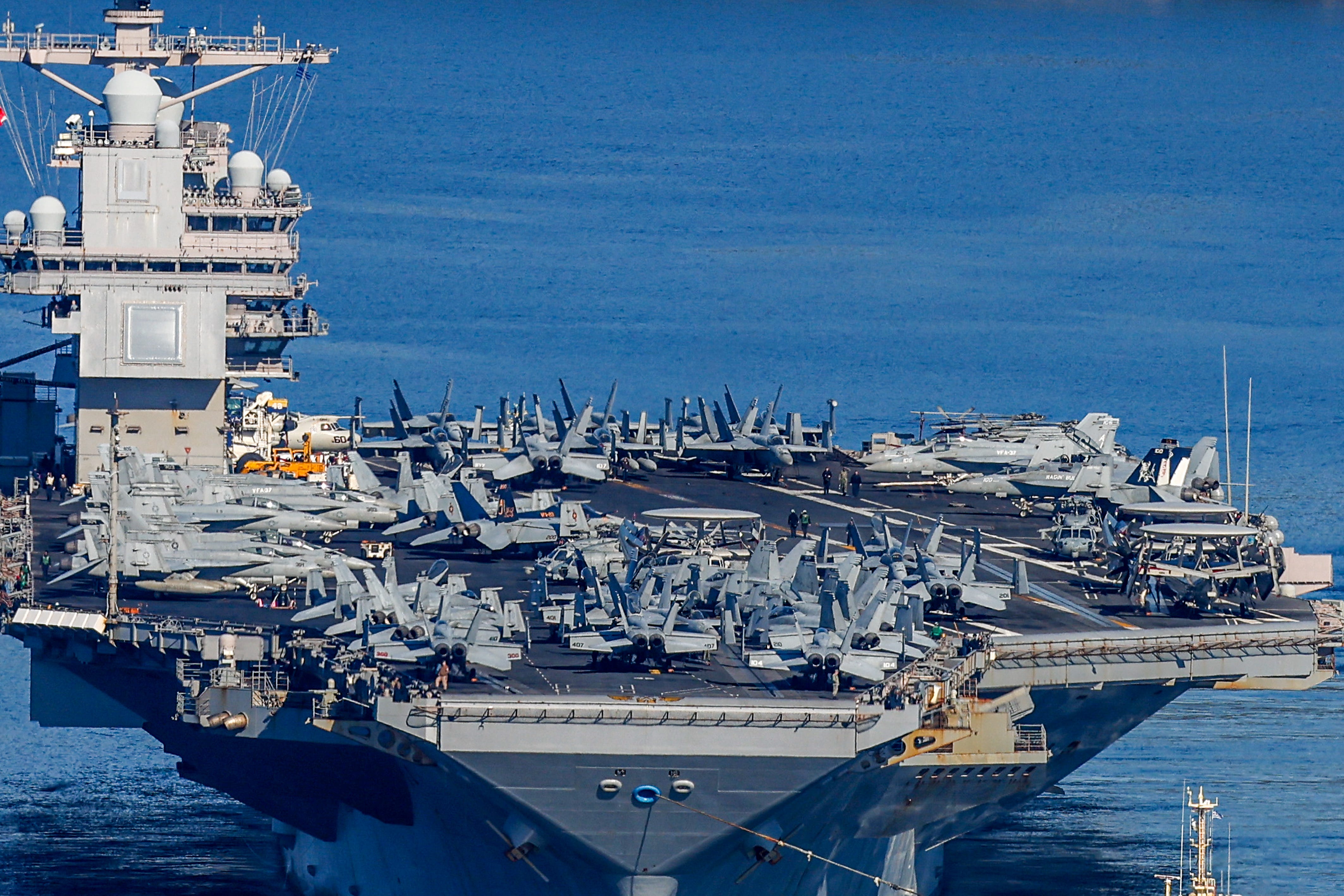
The Ford arrived at the Greek island of Crete on February 24, where it docked at a naval base for four days while taking on supplies and equipment. The 4,500 crew members and accompanying strike group then sailed to the coast of Northern Israel, arriving on February 27, only hours before the United States and Israel began Operation Epic Fury.
The Ford’s involvement in Iran, one report explains, “can be seen as a system that deploys other systems.” Navy aircraft launched from the carrier, including fighter jets and intelligence gathering planes, have supported the Iranian campaign alongside escort destroyers equipped with Tomahawk missiles and air and missile defense systems.
The operational advantage of the Ford, though, lasted only a few weeks. On March 12, a non-combat-related fire in the ship’s laundry room halted flights out of the ship, injuring two crew members, subjecting dozens to smoke inhalation, and forcing some 600 sailors to sleep on floors and tables after “losing their beds” in the incident. It took more than 30 hours to put out the fire.
After the fire, the Ford returned again to the Crete naval base on March 23 for maintenance and repairs, where the Navy described the carrier as “fully mission capable.” The ship then sailed for Croatia, arriving on March 28 for a six day stay during which the ship again underwent maintenance and the crew enjoyed some Croatian R&R.
The Ford is now returning to the CENTCOM area of responsibility. It was in the Mediterranean Sea on Wednesday when it broke the record for longest deployment since the Vietnam War, and, according to Adm. Caudle, likely continuing its deployment for an 11th month of operations.
The beleaguered crew may be relieved by the USS George H.W. Bush, a Nimitz-class carrier sailing from Virginia on March 31 to begin operations for its deployment.
Beyond the mechanical issues related to such a historically long deployment, the Ford’s crew members are being pushed to their limit. Retired Adm. James Stavridis, former supreme allied commander at NATO, described issues with retention and morale accelerating after six months of deployment, a threshold which the Ford crossed more nearly four months ago. War Secretary Pete Hegseth reportedly ordered a review of attrition rates among the Navy’s strike fighter squadrons in March in response to a high rate of sailor burnout and high rates of Navy personnel leaving the service.
After 296 days at sea, participating in anti-Russian exercises in the Adriatic, toppling a South American dictator in the Caribbean, and supporting the war in the Middle East, those brave sailors sure have earned a nice rest back home.