
The Great Swap: How History Gets a Woke Makeover
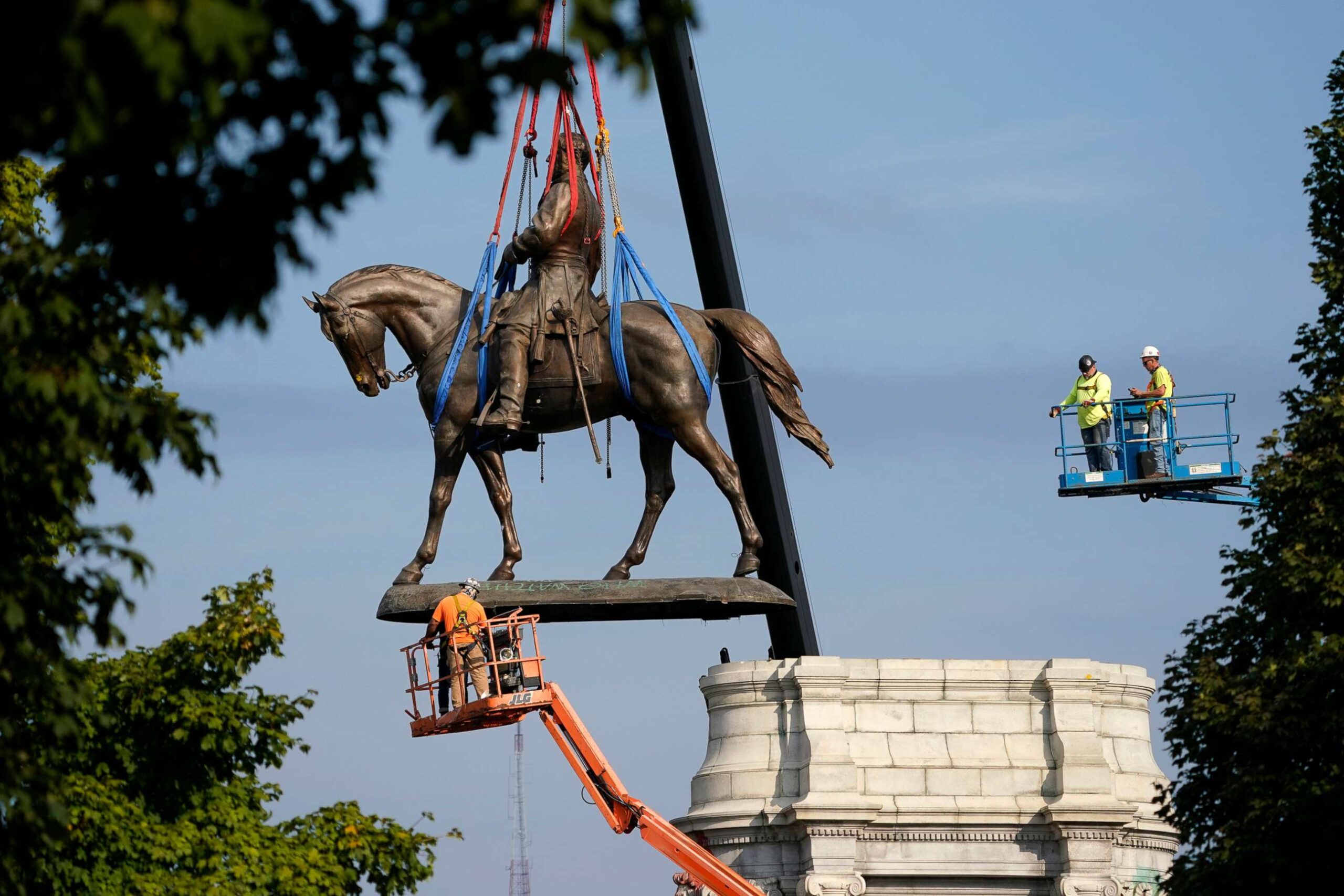
America no longer rewrites its history; it simply swaps it out. Last week, beneath the echoing domes of the United States Capitol, Congress unveiled a statue of Barbara Rose Johns, the 16-year-old Virginia schoolgirl who led a student strike in 1951 against the crumbling, segregated conditions of her high school.
A noble cause. A brave young woman. No quarrel there.
But statues are not awarded for moral hygiene alone. And this one arrived by way of eviction. Johns’ bronze now occupies the spot once held by Robert E. Lee, whose statue had stood in the Capitol since 1909 before being summarily removed in 2020, amid the national nervous breakdown that followed the death of George Floyd.
And there you have it: the great lie of our age—that historical significance is determined not by scale, consequence, or endurance, but by ideological usefulness.
“This is not about honoring the past. It is about disciplining the present.”
Lee shaped the course of American history whether one approves of him or not. He commanded armies, decided battles, altered the fate of a continent, and remains studied in military academies around the world, not unlike Pompey, who fought for a doomed order and lost yet still commands a chapter in every serious history of Rome. You may condemn Lee’s cause—and many do—without pretending he was a footnote. History is not a participation trophy.
Barbara Rose Johns lived a worthy life. So do millions of Americans who never receive statues in the nation’s Rotunda. But the claim that she belongs there while Lee must be purged tells you everything about how history is now curated, not by magnitude, but by moral fashion.
This is not about honoring the past. It is about disciplining the present.
The message is blunt. Power, sacrifice, leadership, and tragedy count for nothing unless they flatter current orthodoxy. Obscurity plus moral signaling now outrank greatness plus complexity. The smaller the footprint, the safer the symbolism.
And the politicians applauding this swap know exactly what they are doing.
The ceremony itself, held on Dec. 16, 2025, was a master class in modern American theater. Emancipation Hall was packed with dignitaries, relatives, and professional clappers. Mike Johnson, the Louisiana Republican allegedly sent to Washington to resist such nonsense, opened proceedings by praising Johns as a “true trailblazer” who “embodied the American spirit.” One could almost hear the speechwriters congratulating themselves.
Virginia governor Glenn Youngkin followed, solemnly intoning that “you can’t tell the story of Virginia without telling the story of Barbara Rose Johns.” This is true, just not in the way he meant it. You also can’t tell the story of Virginia without Jamestown, Jefferson, Washington, Lee, or the Civil War. But those chapters have become…inconvenient.
Youngkin spoke movingly of the “tar shack” classrooms Johns endured at Moton High School under the Jim Crow fraud of “separate but equal.” Quite right. Johns’ strike mobilized 450 students, lasted two weeks, and caught the attention of NAACP lawyers. Her case later became one of five consolidated into Brown v. Board of Education. She was brave, resolute, and morally correct.
Then came Hakeem Jeffries, fresh from explaining that America’s real problem is not inflation, crime, or border chaos, but insufficient enthusiasm for progressive racial catechism. He drew the loudest applause by denouncing Lee as a “traitor who took up arms against the United States to preserve the brutal institution of chattel slavery.” Full stop. No nuance required. History, reduced to a slogan.
But let us not inflate Johns’ role beyond recognition. She was not the architect of Brown. She did not dismantle segregation single-handedly. She did not reshape the Republic. Honoring her does not require pretending she belongs in the same historical tier as Washington, Lincoln, or even Lee.
Lee, after all, remains studied at West Point, where he once served as superintendent. His victory at Chancellorsville, outmaneuvering a force twice his size, remains a case study in operational brilliance. This does not absolve his cause. It simply acknowledges reality.
An 8-to-11-foot bronze of teenage Johns stands at a lectern, hoisting a tattered book faintly evocative of Moses with the tablets. The pedestal bears Isaiah 11:6—“a little child shall lead them”—alongside her famous line: “Are we going to just accept these conditions, or are we going to do something about it?” It is tasteful. Earnest. Unobjectionable.
But the real story is not the statue. It is the swap.
The left understands something that most mainstream conservatives no longer do: that Lee was not “just” a statue. Symbols matter. They carry memory, and memory is dangerous to those who want to rewrite the present. This is why the statue had to go. The Civil War was not a Marvel movie, and Robert E. Lee was not a cartoon villain. He was a man of immense personal honor, who opposed secession, detested slavery, yet could not bring himself to raise arms against his home. His choices were tragic, not evil.
Earlier cultures understood tragedy as the collision of irreconcilable duties, not the triumph of moral purity. A tragic figure is not absolved, but neither is he reduced to a slogan. Our own culture once understood this too, when it was confident enough to acknowledge that history is shaped by flawed men facing impossible choices. We have since lost that confidence. In our current climate, the distinction between tragedy and villainy is unforgivable. Nuance is heresy.
We are told, inevitably, that “it was just a statue.” This from the same people who treat rainbow bunting on lampposts as sacred iconography. The flutter of a Pride flag is defended as inviolable, but a century-old bronze monument to one of the most consequential figures in American history is declared too dangerous for modern eyes. Our culture now reacts to the past not with understanding, but with reflexive revulsion and a demand for ritual cleansing.
Monuments are not built to make you feel “safe.” They are built to remind you of your place in a story larger than yourself, a story of sorrow and sacrifice, of greatness and failure. Lee’s statue was not a celebration of slavery; it was a solemn reflection on the cost of a war that tore a nation apart, when Americans quite literally fought Americans, and victory and defeat alike carried a permanent wound. But we no longer teach people to understand the past. We teach them to judge it, and then to destroy it.
And erasure, once begun, has no limiting principle. If Lee is beyond redemption, why stop there? Close West Point, where he once served. Empty Arlington, which sits on his former land. Rename Washington and Lee University. When purification becomes policy, nothing is ever pure enough. History offers no shortage of warnings. From revolutionary France to the Soviet Union, from Mao’s China to the jihadists dynamiting Palmyra, iconoclasm always proceeds under the same banner: moral renewal through destruction. The targets change; the impulse does not. Memory itself becomes the enemy.
In the end, this exchange tells us far more about 2025 America than about 1865 or 1951. A nation that cannot tolerate its complicated ancestors is a nation that has lost confidence in itself. Statues may come and go, but history keeps score.
And when future Americans look back on this era, they may wonder why a civilization once capable of producing giants became so eager to replace them with saints, provided the saints were suitably small.
https://www.takimag.com/article/the-great-swap-how-history-gets-a-woke-makeover/