
The Grift of Fear
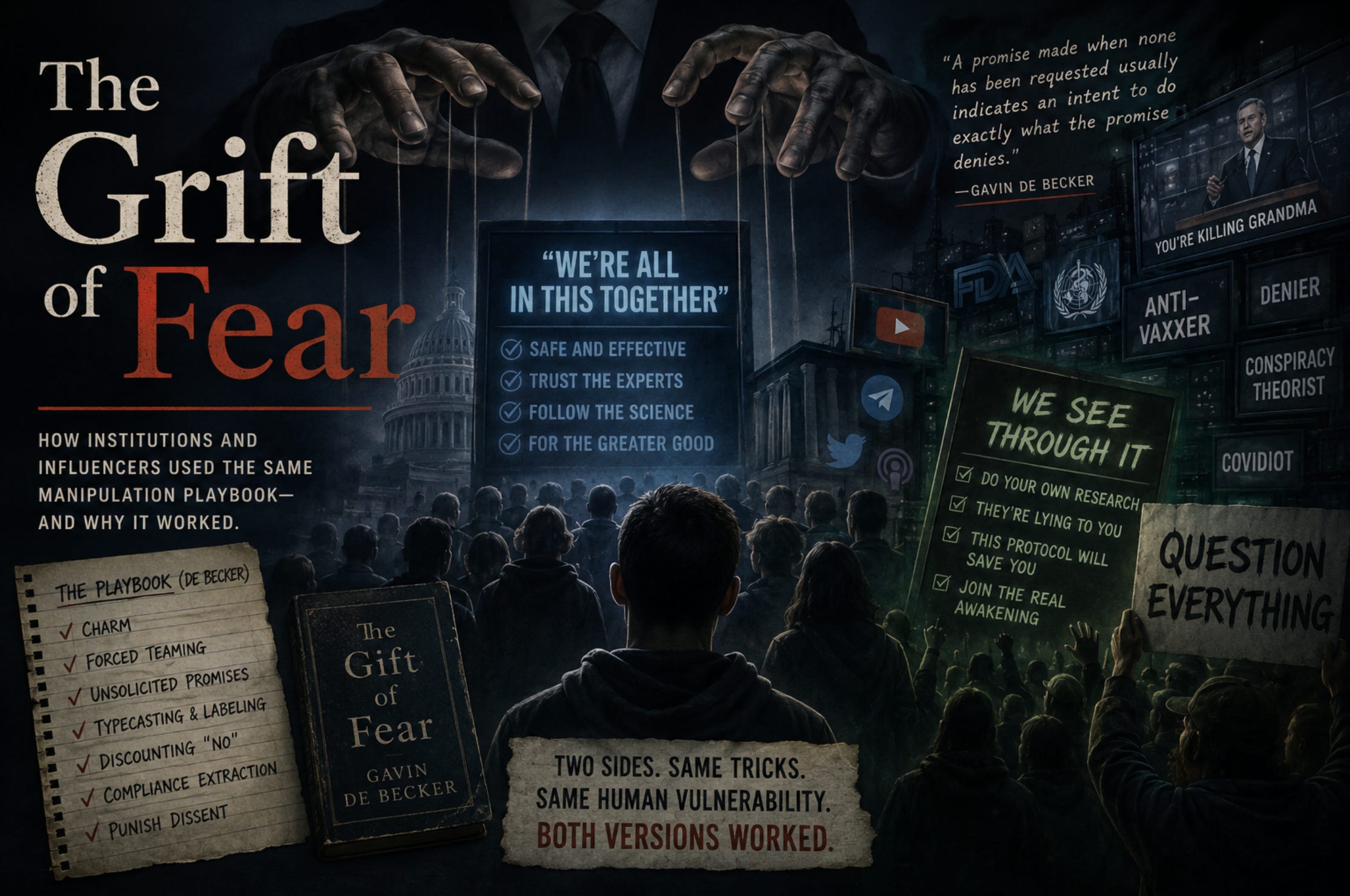
What Gavin de Becker taught us about predators, and how we should have used it.
In 1997 a security specialist named Gavin de Becker published a book called The Gift of Fear. It is a book about predicting interpersonal violence, and it has trained a generation of readers, mostly women, to recognize the behavioral signatures of predators before the violence arrives. Charm. Forced teaming. Too many details. Loan sharking. The unsolicited promise. Discounting the word no. de Becker compiled them by working as a threat-assessment consultant for celebrities, executives, and government officials, and by talking, at length, to people who had survived attempts on their lives and to perpetrators who had been caught before completing them. The patterns are not subtle once you know what to look for. They are also, de Becker argued, recognizable in advance to anyone who has been given the vocabulary.
The title pun was deliberate. Fear, the kind that arrives unbidden when a stranger gets too close on an empty subway platform or when a friendly-seeming offer of help feels off, is not a defect of evolved cognition. It is the gift. It is the brain doing exactly what it evolved to do: reading a small set of cues faster than any conscious deliberation could, and pushing the body away from danger before the mind has caught up. In de Becker’s case studies, the people who get hurt are almost never the ones who failed to notice the signals. They are the people who noticed accurately and overrode the signal. They had been trained to defer. They did not want to seem rude. They felt uneasy and could not articulate why, and so dismissed the feeling as paranoia.
This is the book that should have been on every desk during the COVID years. It was not.
What I want to argue here is something I think the public-health establishment, the contrarian media response to it, and the broader culture that consumed both have collectively missed. The pandemic was not, primarily, a failure of expertise. It was a failure of recognition. The same psychological machinery that de Becker identified, the machinery that protects us against the charming stranger at the door, was being targeted at a population scale by institutional actors whose interests were not aligned with ours. And by some of the loudest dissident actors as well. The targeting was largely successful. The grift, on both sides, worked.
The reason it worked is not that people are stupid. The reason it worked is that the institutions had access to communication channels with effectively unlimited reach, and the techniques they deployed were precisely the techniques de Becker had cataloged in 1997. Charm. Authority cues. Forced teaming (”we’re all in this together”). Unsolicited promises (”safe and effective”). The dismissal of objections as moral failures (”you’re killing grandma”). The refusal to accept no as an answer on any question deemed consequential. And, when those techniques met resistance, the social and economic costs were imposed on those who continued to say no anyway.
The dissident response, when it came, was sometimes calibrated and accurate. It was also, in important respects, the same kind of operation pointed in the opposite direction. The same charm. The same forced teaming (”we’re the ones who see through it”). The same unsolicited promises (”this protocol will save you”). The same refusal to update when subsequent evidence demanded updating. The same compliance extraction, dressed as resistance.
Both versions worked on the same biological substrate. Both versions paid.
Consider the unsolicited promise. De Becker treats this as one of the most reliable signals of a hidden agenda. A promise made when none has been requested usually indicates an intent to do exactly what the promise denies. The trustworthy actor explains. The unreliable actor reassures.
“The vaccines are safe and effective.” This sentence was repeated at intervals that corresponded to no particular challenge requiring rebuttal for roughly three years. It was repeated by senior officials in television appearances, by manufacturers in advertising, by celebrities in scripted PSAs, and by employers in mandate communications. No one had asked for the reassurance. The reassurance arrived anyway. By de Becker’s framework, the question to ask was: what are these people preempting? What is the future criticism that the reassurance is being deployed to head off? Subsequent data answered the question. Internal communications produced in the years since, including the Pfizer and Moderna documents released under court order, the FOIA-ed correspondence among federal officials, and the Twitter Files showing the architecture of platform suppression around vaccine criticism, all indicate that the underlying claim was considerably weaker, at the time it was being asserted, than the public communication suggested. The unsolicited promise was, exactly as de Becker would have predicted, a tell.
Or consider typecasting. de Becker describes it as a minor insult deployed to provoke engagement from someone who would otherwise walk away: “I bet you’re too stuck-up to talk to a guy like me.” The target wants to prove the label wrong by engaging, and the engagement is the predator’s foot in the door. De Becker’s defense is the simplest possible one. You act as if the words were not spoken. Any energy you spend disproving the label is energy you cannot spend evaluating what is actually being asked of you.
“Anti-vaxxer.” “Denier.” “Conspiracy theorist.” “Grandma-killer.” “Covidiot.” Each functioned to make the recipient want to disprove the label by demonstrating compliance, which is exactly what de Becker said the move was intended to do. The recipient who insisted, “I’m not against vaccines, I just have questions about this vaccine,” had already conceded the frame. The recipient who refused to engage with the label, who treated it as the manipulative move it was rather than a description requiring rebuttal, kept the question on its merits.
By de Becker’s framework, this is not difficult to see. It was difficult to see only because the labels were issued by institutions the recipients had been trained to defer to. The pandemic-era equivalent of the predator’s “I bet you’re too stuck-up” was the public-health authority’s “anti-science.” Both work for the same reason. Both are defenses, by people whose intentions are not aligned with ours, against our intuitions about whether to comply.
The same analysis applies to the contrarian side. The dissident communicator who described skeptics of his protocol as “shills,” “captured,” or “still asleep” was running the same operation. The label was meant to do the same work: to convert a question about the underlying evidence into a question about the questioner’s moral or epistemic standing. de Becker’s defense is the same in both directions. The labels are the cost the speaker extracts before you have evaluated the substantive claim.
There is a deeper point in de Becker’s work that I want to bring forward because I think it is the right framework for understanding what the pandemic actually was.
de Becker distinguishes fear from worry. Fear is calibrated. It is a response to a specific present signal that something is wrong, and it is accurate enough often enough that we should treat it as a protective intuition rather than a defect. Worry is something else. Worry is manufactured. It is sustained beyond the duration of any actual signal. It is frequently imposed by one party on another. It often functions as a substitute for action rather than as a guide toward it.
The pandemic era was, primarily, a worry-generation event. The fear, where justified, was justified for narrow, specific groups under narrow, specific conditions. Elderly people with comorbidities in the spring of 2020 had something approximating a real signal. Most other groups did not, most of the time. The worry, however, was universal, undifferentiated, sustained, and continuously reinforced by institutional communication channels that benefited from its continuation.
The institutional channels did this because they were funded, staffed, and incentivized to do it. The contrarian channels did it because they were funded, staffed, and incentivized to do so. Daily case counts were presented without context. Hospitalization graphs without baseline comparison. Modeling outputs whose subsequent revisions received far less attention than the original projections. On the contrarian side: vaccine adverse event reports without denominators. Individual stories of injury without representative sampling. Excess mortality projections whose disconfirmation produced no comparable retraction effort.
Both versions cultivated worry in their respective audiences. Both monetized the cultivated worry. The mechanism is exactly the one de Becker identified, scaled from the predator’s manipulation of an individual mark to institutional manipulation of a population. The reason it scaled was that the underlying psychological machinery is the same. The brain that feels worry in response to a fabricated signal at the door feels the same worry in response to a fabricated signal on television, with the difference that the television signal arrives every day for years, and the friend at the door is gone in twenty minutes.
This is the grift, plain. The gift of fear is the protective intuition that lets us detect signals of danger. The grift of fear is the systematic exploitation of that same intuition by parties whose interests in our worry are different from our own.
Here is what I think de Becker would have said to anyone watching the pandemic communications, on either side, if he had been asked.
He would have said: Notice the unsolicited promises. Ask what they are preempting. Notice the typecasting. Refuse to engage with the labels. Notice the forced teaming, the “we’re all in this together” and its dissident-side equivalent, “we’re the ones who see.” Ask whether the teaming is real or constructed. Notice the volume of detail in communications about uncertain questions. Ask whether the detail is proportional to what is actually known. Notice the refusal to accept no as an answer on questions deemed consequential. Treat that refusal as the most reliable available signal that the actor is not engaged in good-faith communication.
And above all, he would have said: trust the unease. The people who got hurt in his case studies were not the people who missed the signal. They were the people who picked up the signal accurately and dismissed it because they could not yet articulate what they had picked up, or because the cost of acting on it was higher than the cost of overriding it. That cost, in the context of the pandemic, was a designed feature of the environment. The social and economic price of saying no was deliberately raised, on both sides, to deter the rational actor from doing it.
The people who suffered, at population scale, were not the credulous. They were the ones who knew something was off and could not, socially, afford to say so.
The question now is whether we are going to be a harder mark next time.
The institutions that ran the last operation are still here. So are the contrarian operations that ran the parallel grift on the other side. They are funded, staffed, and ready. The next event will not look identical to the last one. The techniques, however, will. The unsolicited promises. The typecasting. The forced teaming. The discounting of no. The compliance extraction dressed as either authority or resistance.
The defense is the same in both directions. It is the calibrated skepticism that de Becker was trying to teach. Not paranoia. Not cynicism. Just the recognition that warmth and confidence are tools, and that the tools have signatures, and that the signatures are visible to anyone who has been given the vocabulary.
The gift of fear is the protective intuition. The grift of fear occurs when intuition is hijacked. The recognition of the hijack is the main defense. de Becker has been telling us, since 1997, how to see it. We did not listen the last time. There is no reason, this time, that we cannot.