
The Lovecraftian Iran Deal
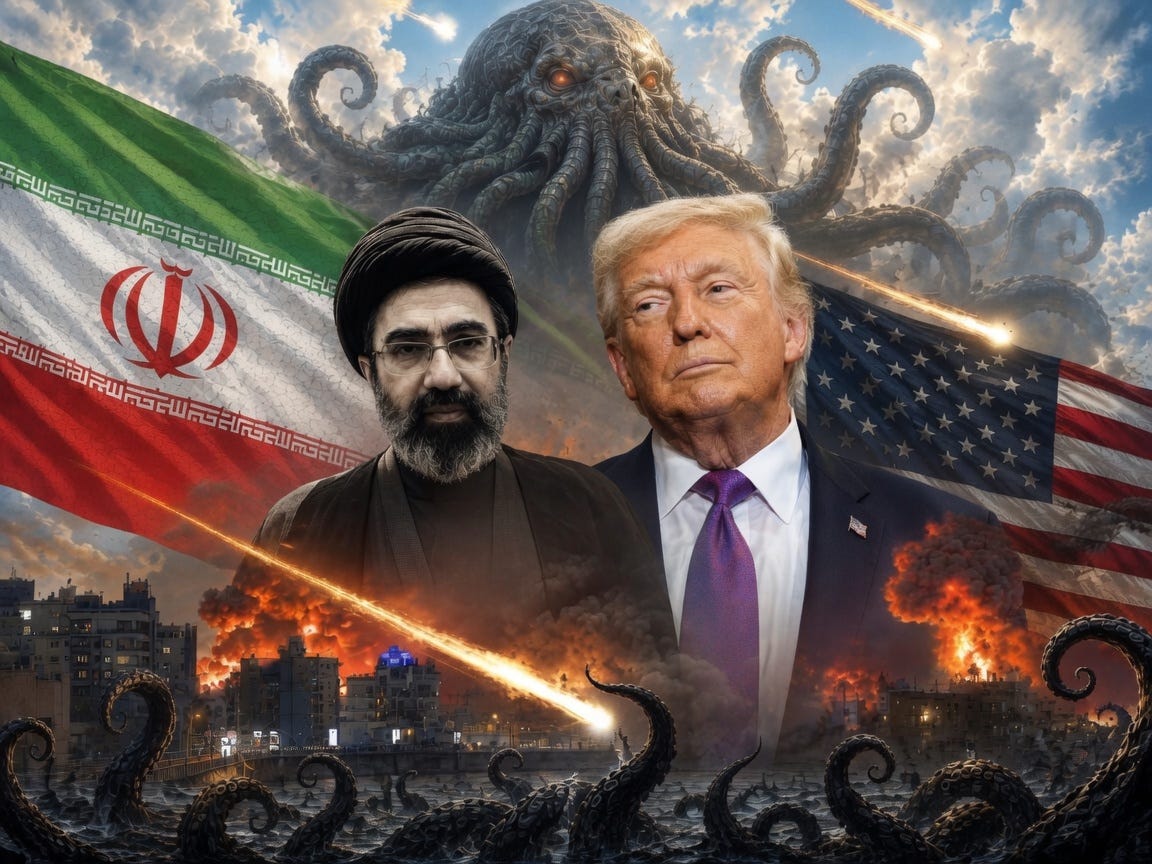
How empire found the abyss.
A strange spectacle unfolded beneath the electric glare of twenty-first-century empire. President Trump, surrounded by advisors, generals, financiers, media apparitions, and the immense machinery of a civilization that once imagined itself master of every horizon, arrived at a point where the pathways ahead narrowed into a grim corridor. The grand strategy that promised pressure, intimidation, and unilateral direction encountered a force that resisted absorption into familiar formulas. At that moment, amid the vast labyrinth of geopolitical calculations, only two doors remained visible: a descent into a far greater military confrontation or a movement towards substantial accommodation with Tehran. This reality deserves remembrance whenever voices celebrate the episode as a demonstration of unambiguous strength.
The deeper significance reaches beyond immediate events. Lovecraft often described solitary scholars who wandered through forgotten archives only to discover that the map they trusted concealed older and more immense structures beneath the earth. So too did the architects of American policy appear to confront a hidden geometry. Years of sanctions, threats, covert operations, diplomatic maneuvering, and regional pressure created the impression of overwhelming control. Yet beneath the visible architecture lurked a different reality, vast and ancient in its own way: a civilizational state rooted in memories, symbols, and institutions that stretched far beyond the lifespan of any administration. The confident equations of power encountered variables drawn from deeper strata, like those buried cyclopean cities whose angles violated ordinary perception in At the Mountains of Madness.
Within this unfolding drama, Trump resembled one of Lovecraft’s protagonists who enters a chamber expecting mastery over mysterious forces and instead discovers himself enclosed within their design. Each escalation generated new pressures. Each demonstration of resolve invited corresponding displays of endurance. The machinery of deterrence began to resemble an elaborate ritual whose participants gradually realized that the forces summoned possessed their own momentum. Across deserts, mountains, shipping lanes, diplomatic corridors, intelligence networks, and financial systems, invisible currents converged into a configuration that constrained every actor involved. What appeared from afar as freedom of action increasingly revealed itself as movement through narrowing passages carved by the accumulated weight of history itself.
The mythology of strength often depends on images. Photographs, speeches, aircraft carriers, missiles, flags, and declarations create impressions that travel swiftly across the modern information sphere. Lovecraft understood the deceptive character of appearances. His narrators frequently gazed upon ordinary landscapes only to glimpse, through a fleeting shift of perspective, colossal forms lurking beyond human comprehension. In similar fashion, the surface imagery surrounding the confrontation suggested dominance and initiative. Yet the deeper structure pointed towards something else entirely. A leader whose strategy culminates in a choice between major war and significant concessions occupies a position shaped as much by limitation as by command. The image projected outward may radiate confidence, while the underlying reality speaks of constriction, pressure, and strategic inferiority.
One might even compare the situation to the explorers who encountered the ancient entities of Lovecraft’s cosmos. Those travelers carried advanced tools, scientific knowledge, and immense faith in their own capabilities. Then came the revelation that greater forces already inhabited the landscape. In geopolitical terms, the lesson remains similar. Technological superiority, economic reach, and military power retain tremendous significance, yet they exist alongside civilizational resilience, ideological commitment, demographic endurance, geographic depth, and historical memory. These elements rarely appear in triumphant headlines, though they often determine outcomes across decades. Tehran’s position drew strength from precisely such subterranean foundations, creating a strategic environment where coercion alone could achieve only limited results.
The final irony carries a distinctly Lovecraftian flavor. Many tales end with a protagonist confronting a revelation that transforms the meaning of everything that preceded it. The apparent hunter discovers himself inside a larger pattern. The investigator becomes part of the mystery he sought to unravel. The conqueror finds boundaries where limitless expansion seemed certain. Thus the narrative of demonstrated strength deserves careful scrutiny. Strength exists most clearly where options multiply and initiative expands. Trump, however, is a figure standing before vast shadowed gates beneath alien stars, surrounded by powers and circumstances that have quietly reduced the realm of possible action. Thus are revealed the true contours of strategic reality, far more clearly than by any triumphant proclamation.