
The Man Who Said No
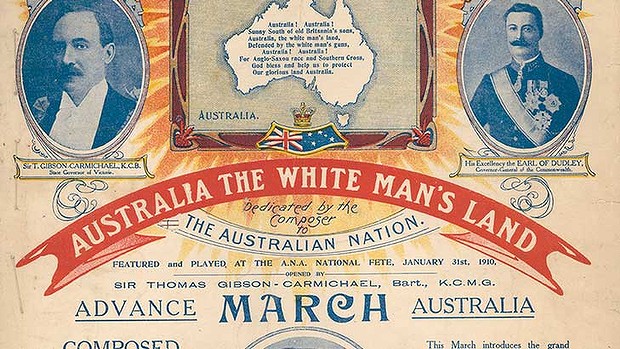
Billy Hughes and the Defense of White Australia.
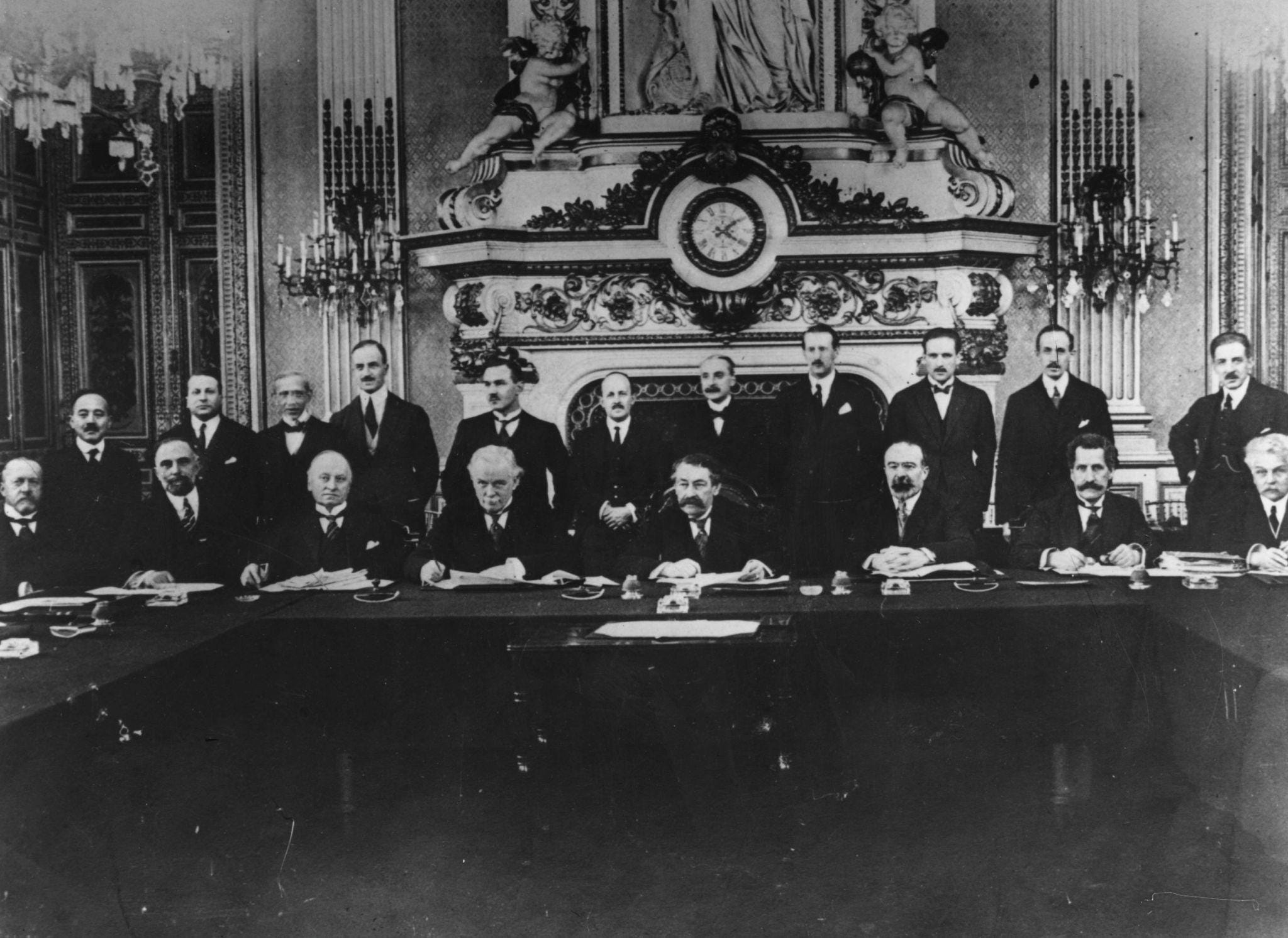
In the early months of 1919, the city of Paris was transformed into the undisputed capital of the world. As the lingering winter snows melted into a cold, wet spring, the grand boulevards and opulent hotels of the French capital filled with diplomats, military officers, intellectuals, and journalists from across the globe. The First World War had shattered four empires, redrawn the map of Europe, and left millions dead in the mud of the Western Front.1 The victorious Allied powers gathered at the Paris Peace Conference to dictate the terms of peace, operating under the assumption that they possessed both the moral authority and the raw power to forge a new international order. Proceedings centered on the Quai d’Orsay, specifically the magnificent Salon de l’Horloge, where beneath the ornate ceiling cove painted with gold-embellished arabesques and sculptures of children symbolising the seasons, the leaders of the world’s greatest powers sought to banish the spectre of war forever.2
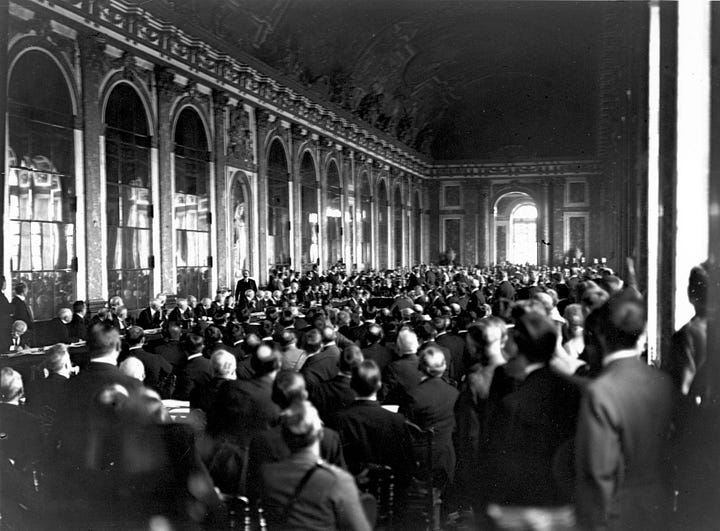
Presiding over this exotic atmosphere was United States President Woodrow Wilson, who arrived in Europe wielding his Fourteen Points like stone tablets brought down from a progressive Sinai.3 Wilson represented a profound shift in geopolitical thinking: the dawn of an ascendant internationalism that sought to replace the hard calculations of balance-of-power realpolitik with abstract, universalist ideals governed by a proposed League of Nations.4 For the cosmopolitan elites gathering in Paris, the conference was an opportunity to transcend the parochial attachments of the nation-state.5
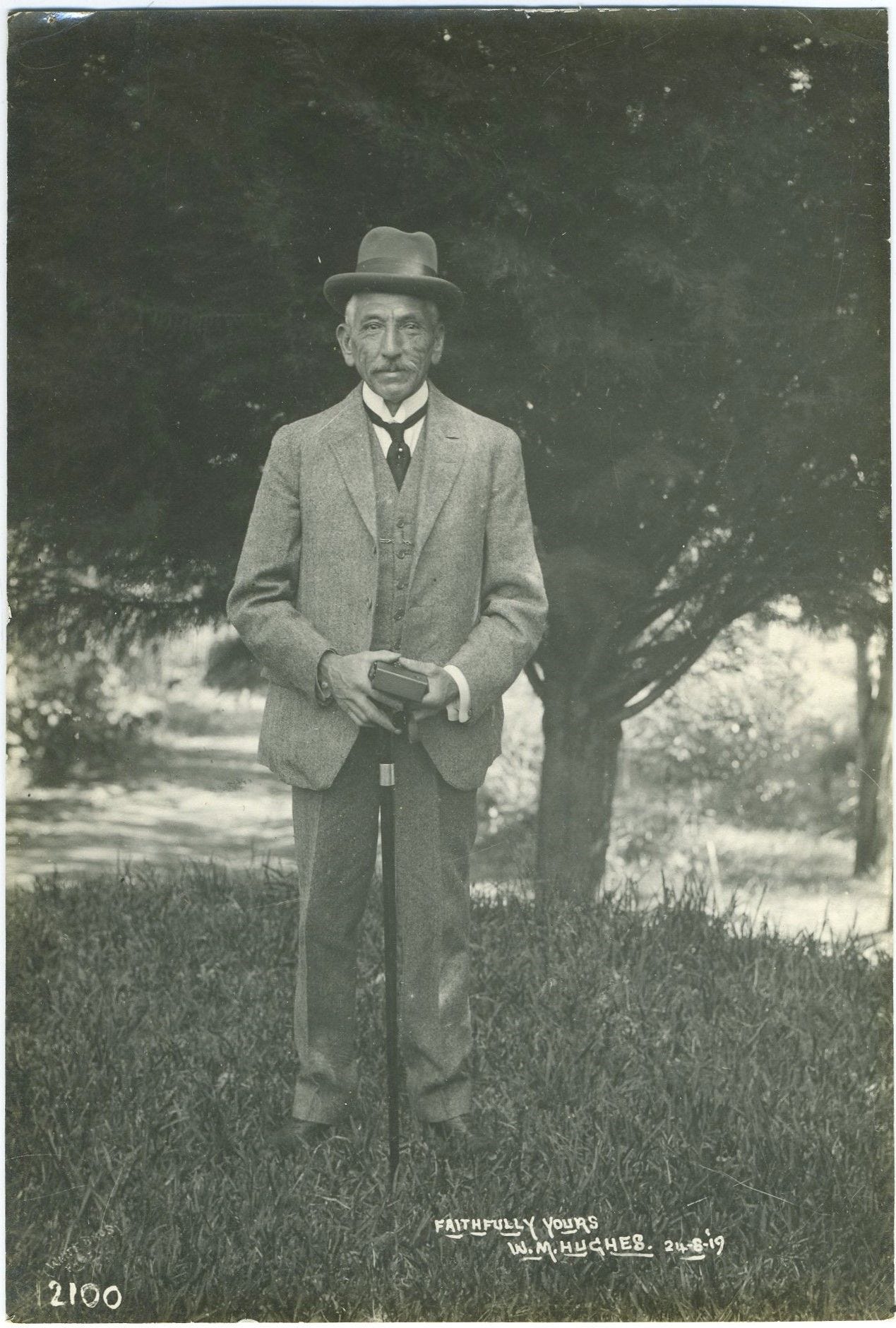
Yet, amid this sea of high-minded universalism, an unlikely and signficantly combative figure emerged to champion the uncompromising realities of national sovereignty. William Morris “Billy” Hughes, the Prime Minister of Australia, was a small, frail, dyspeptic Welshman with a raspy voice and a notoriously vicious temper.6 Hughes navigated the grand halls of Paris clutching a bulky, battery-operated “acousticon” hearing aid, a device he would famously turn off when he simply no longer wished to listen to the moral lecturing of foreign dignitaries.7
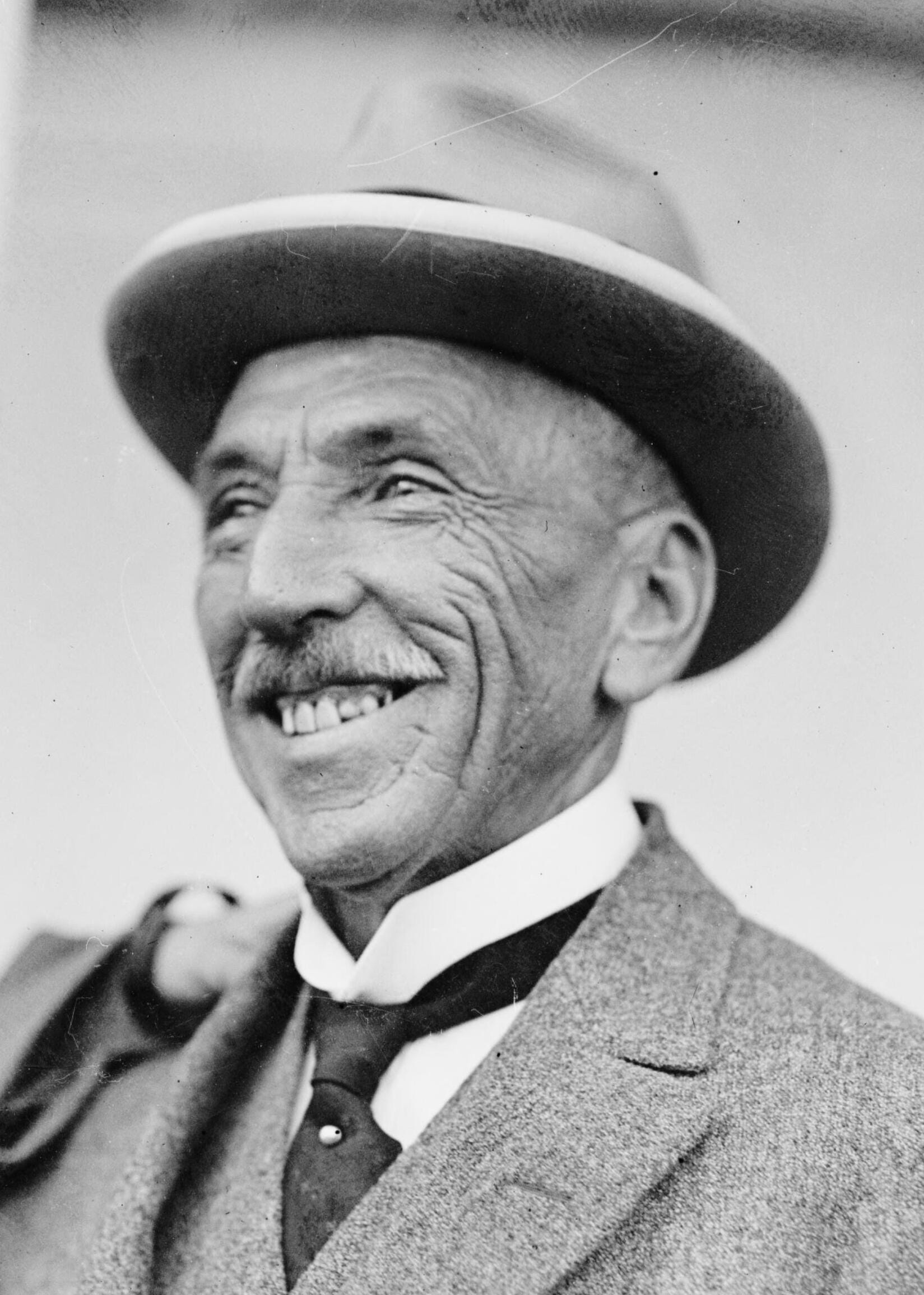
Hughes did not travel to Paris to build a utopian world order. He went to defend the vital, existential interests of a young, vulnerable dominion situated on the edge of the British Empire, isolated in the Pacific, and intimately aware of its demographic fragility.8 While European statesmen spoke of abstract brotherhood, Hughes recognised that for Australia, the negotiations in Paris were a matter of civilisational survival. Central to this survival, in Hughes’s estimation, was the defence of the White Australia Policy and the absolute, sovereign right of the Australian nation to determine who could cross its borders.9 When the Empire of Japan moved to insert a racial equality clause into the covenant of the new League of Nations, it set the stage for one of the most dramatic political clashes of the twentieth century. It was a confrontation between the emerging apparatus of global governance and the stubborn, unyielding will of a single nation determined to preserve its historical identity.
The Blood Sacrifice and the Assertion of Nationhood
To understand Billy Hughes’s behaviour in Paris, one must first comprehend the sheer scale of the blood sacrifice that brought Australia to the negotiating table. When Great Britain declared war on Germany in 1914, Australia, a federated nation barely thirteen years old, unhesitatingly pledged to support the Empire to “the last man and the last shilling”.10 The cost of this loyalty was catastrophic.
From a total population of merely five million, an extraordinary proportion of the nation’s young men volunteered for service, crossing the globe to fight in Gallipoli, the Middle East, and the relentless meat-grinder of the Western Front.11 The human toll fundamentally altered the character of the country.
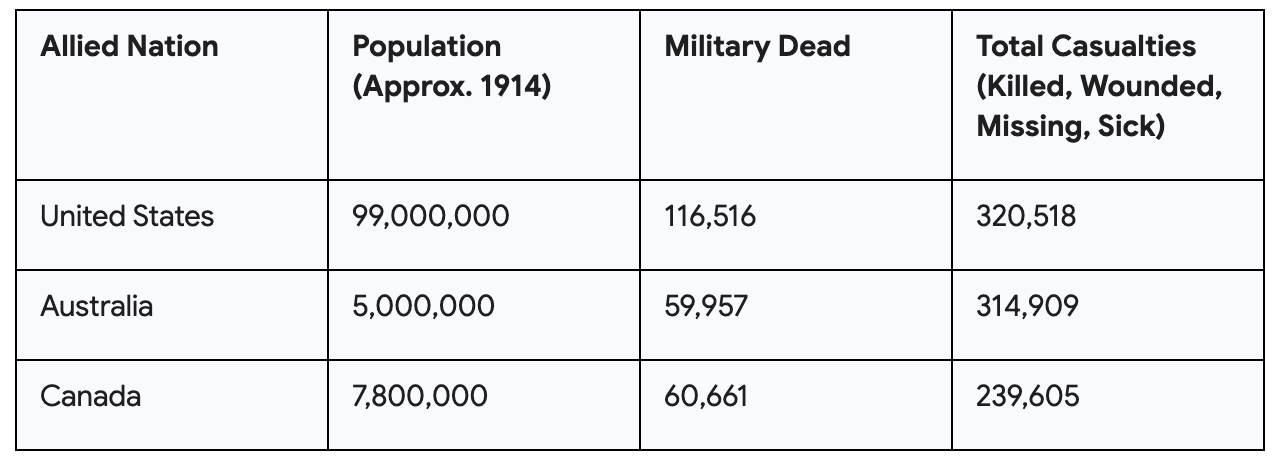
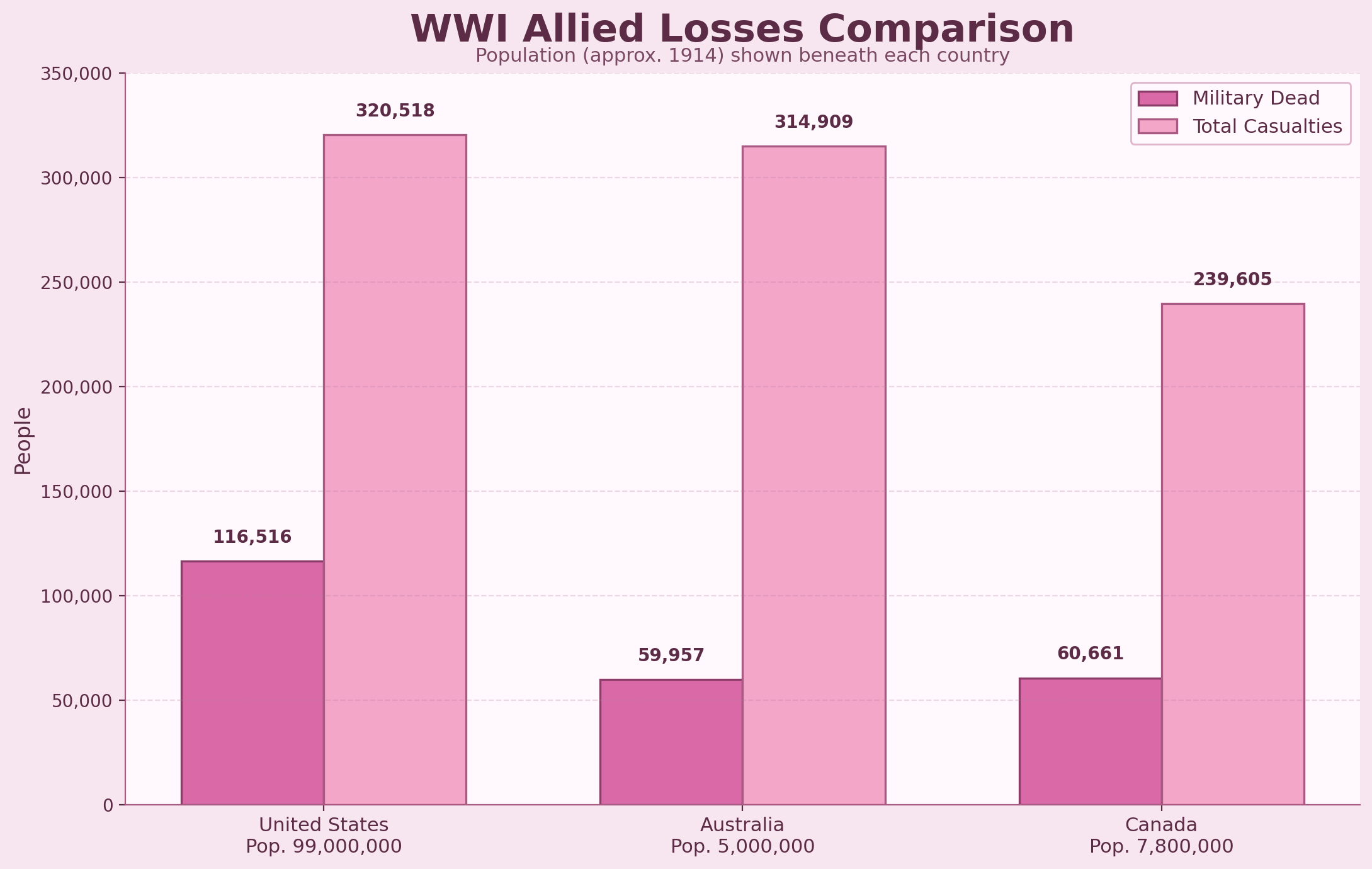
Data reflecting the disproportionate burden borne by dominion forces relative to their population size during the First World War.12 Australia’s casualty figures represented a demographic catastrophe for the young nation.
Australia suffered the highest casualty rate proportionate to its forces of any army in the British Empire.13 Hughes, intensely emotional about the fate of “his boys,” became beloved by the troops, who affectionately dubbed him “The Little Digger”.14 For Hughes, this staggering sacrifice of nearly 60,000 dead fundamentally transformed Australia’s status.15 The dominion had paid for its independence in blood.
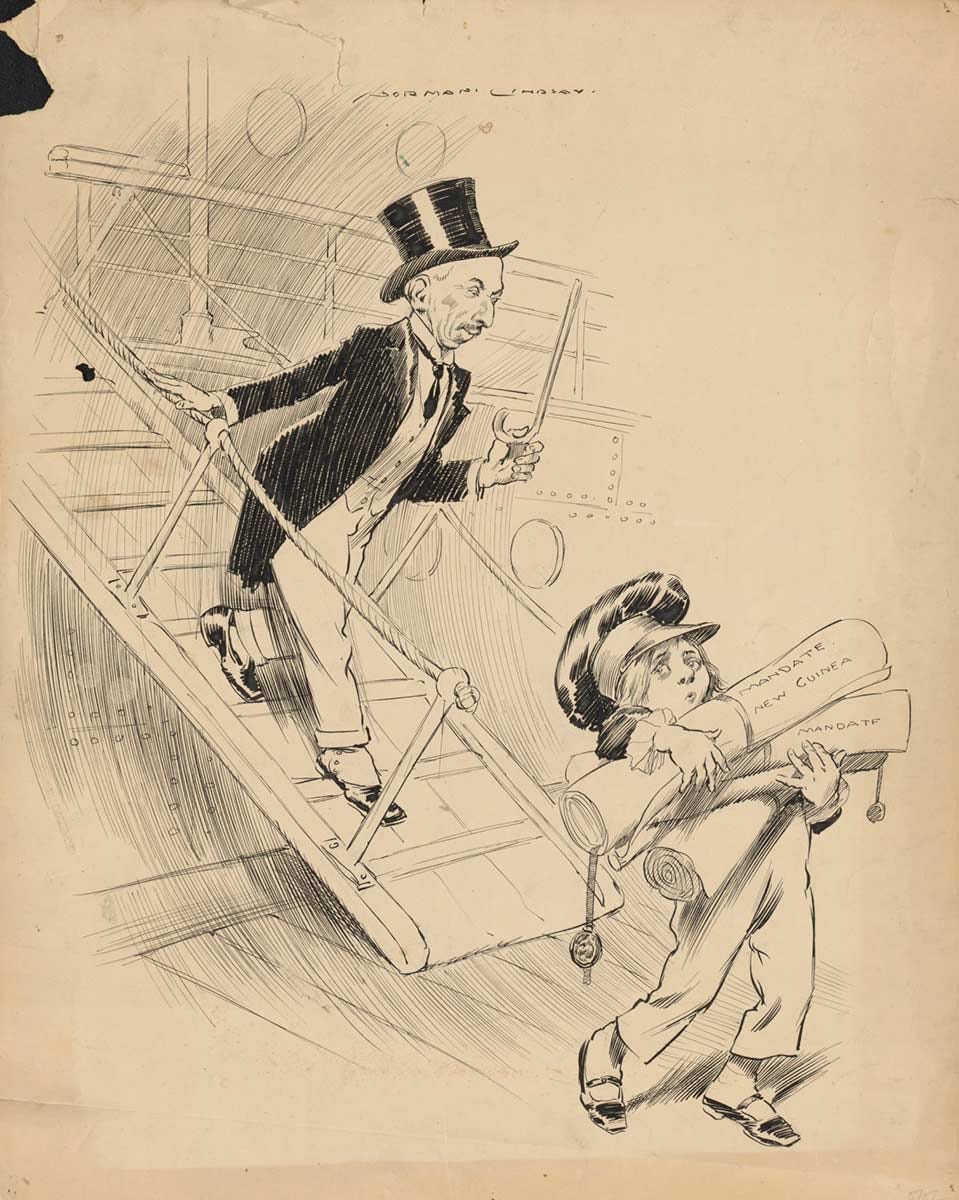
Consequently, when the British War Cabinet initially assumed that the dominions would simply tag along as subordinate members of a unified British Empire Delegation, headquartered at the luxurious Hotel Majestic near the Arc de Triomphe, Hughes was incensed.16 The Hotel Majestic, a former favourite of wealthy Brazilian tourists, had been requisitioned by the British and cleared of its French staff to prevent espionage, becoming the social and political hub for hundreds of British and dominion officials.17 Here, alongside Canadian Prime Minister Sir Robert Borden, Hughes fiercely rejected any compromise that would relegate Australia to a rotating or secondary role. Through sheer belligerence, Hughes extracted from British Prime Minister David Lloyd George the right for the dominions to have full, independent participation at the conference.18
This victory of protocol possessed significant geopolitical implications. Australia was no longer an anonymous voice in an imperial chorus; it had stepped onto the centre-front of the international stage.19 Hughes, supported by his Deputy Prime Minister and Minister for the Navy, Sir Joseph Cook, recognised that Australia’s primary strategic threat lay not in the defeated states of Europe, but in the rising power of Japan to the north.20 Cook’s own conference notebooks reflected the dual anxiety of the Australian delegation: while they wished to save the world from autocracy, they were equally terrified of the ensuing anarchy.21
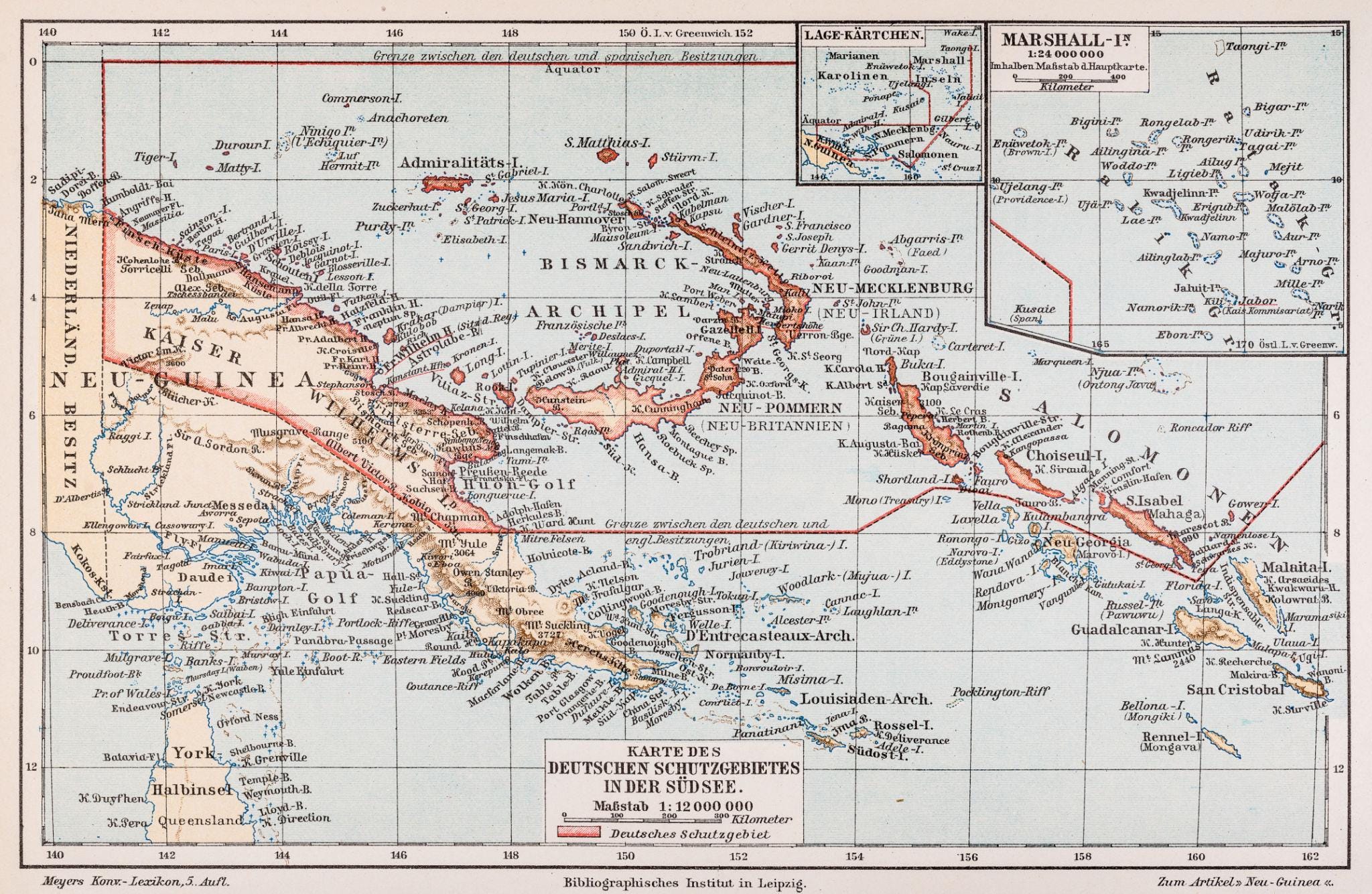
Hughes’s immediate aims were unapologetically self-interested: to secure crippling financial reparations from Germany to cover Australia’s massive war debt of £364,000,000, to annex the captured German territories in New Guinea to form a strategic buffer against Asian expansion, and above all, to defend Australia’s domestic immigration controls from international interference.22 In asserting what he termed a “Monroe Doctrine for the Pacific,” Hughes established the foundations of an independent Australian foreign policy, demanding that the geopolitics of the South Pacific remain the exclusive purview of the nations that resided there.6
The Logic of the White Australia Policy
Modern historical narratives, often clouded by the anachronistic moral judgments of the twenty-first century, tend to reduce the White Australia Policy to a crude manifestation of blind bigotry. To dismiss it as such is to fail to understand the political, economic, and social realities of the early twentieth century. In 1919, the policy was not a fringe, right-wing obsession, it was the foundational cornerstone of the Australian national project, enjoying absolute, unshakeable consensus across the entire political spectrum.23
The origins of the policy were deeply rooted in the economic anxieties of the labor movement.24 Beginning in the 1850s, the influx of Chinese labourers to the Australian goldfields triggered intense social conflict.25 This was compounded in the later nineteenth century when wealthy Queensland sugar plantation owners began importing indentured labourers from the Pacific Islands, known as Kanakas, to work for starvation wages.26 For the burgeoning Australian trade union movement, which was fighting brutal, bloody battles against employers for the right to an eight-hour workday and a basic living wage, the mass importation of cheap, non-European labor was viewed as an existential threat to the working class.27
The Australian Labor Party (ALP) and the broader union movement championed immigration restriction as a necessary shield against the wage-depressing tactics of the capitalist class.28 Early socialist and labor leaders argued that a free-for-all labour market would inevitably drive working conditions down to the lowest common denominator, effectively destroying the utopian vision of Australia as a “workingman’s paradise”.29 As one prominent labour leader, W.G. Spence, articulated, closing the door to cheap labour was essential to prevent the degradation of the national character and the lowering of the standard of living.30
Furthermore, the policy was inextricably linked to the nascent sense of Australian nationalism. When the six separate colonies federated to form the Commonwealth of Australia in 1901, the Immigration Restriction Act was among the very first pieces of legislation passed.31 To appease the British government, which was wary of offending its non-white subjects in India and its strategic allies in Japan, the Australian parliament devised the “Dictation Test”.32 Rather than explicitly banning specific races, the law allowed immigration officials to administer a 50-word dictation test in any European language, providing a legally colour-blind mechanism to achieve a racially exclusive outcome.33
Prime Minister Alfred Deakin, the intellectual architect of early Australian liberalism, explicitly tied the policy to social cohesion and democratic equality. He argued that the success of a highly progressive, egalitarian democracy relied upon a homogeneous population that shared common civic values and political traditions.34 Deakin noted that “unity of race is an absolute to the unity of Australia,” arguing that the presence of an exploited underclass of foreign labourers would corrupt the nation’s democratic institutions.35
In the eyes of early twentieth-century Australians, a cohesive demographic identity was a prerequisite for maintaining their unique social contract. It was fundamentally a defensive posture, a sovereign boundary drawn by a small European outpost situated awkwardly on the periphery of an overwhelmingly populous Asia. For Billy Hughes, who had spent his early career as an organiser for the Sydney Wharf Labourers’ Union, defending this policy was not a matter of debate; it was the sacred duty of any Australian statesman.36 “No government could live for a day in Australia if it tampered with a White Australia,” Hughes was warned by his Deputy Prime Minister, William Watt, in a telegram from Melbourne, a sentiment Hughes entirely shared.37


The Japanese Litmus Test
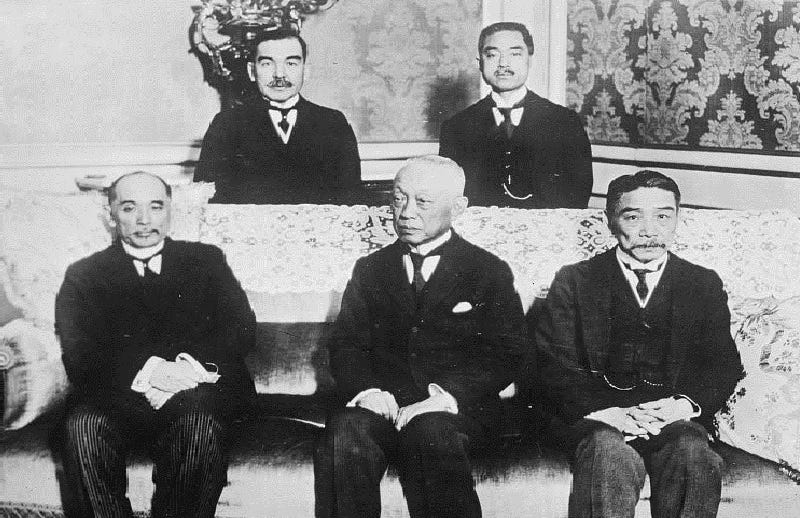
Japan arrived at the Paris Peace Conference in a unique position. It was the sole non-Western nation among the five Great Powers, alongside Britain, France, the United States, and Italy, that dominated the proceedings.38 Since the Meiji Restoration, Japan had undergone a half-century of rapid industrialisation and military modernisation, shocking the globe by defeating the Russian Empire in 1905 and loyally serving the Allied cause during the First World War.39 Japan’s delegates, led formally by Marquis Saionji Kinmochi but practically driven by the astute career diplomat Baron Makino Nobuaki and Viscount Chinda Sutemi, sought international recognition that reflected their new status.40
While Japan had territorial ambitions regarding former German concessions in the Shandong Peninsula of China and various Pacific islands north of the equator, a primary objective driven by intense domestic pressure was the inclusion of a racial equality clause in the Covenant of the newly proposed League of Nations.41 The Japanese public and political elite had long been humiliated by discriminatory immigration policies enacted by the United States (particularly the Alien Land Laws in California) and the British Dominions, including Canada, South Africa, and Australia.42
Within Japan, the issue had become a major domestic flashpoint. The League to Abolish Racial Discrimination held mass public meetings throughout early 1919, exposing the government of Prime Minister Hara Takashi to immense pressure from public opinion.43 For the Japanese, securing the clause was a litmus test to prove whether the Anglo-American world would truly embrace Japan as a fully legitimate, equal partner in the international system.44
On February 13, 1919, Baron Makino formally submitted an amendment to the League of Nations Commission. The proposed text read:
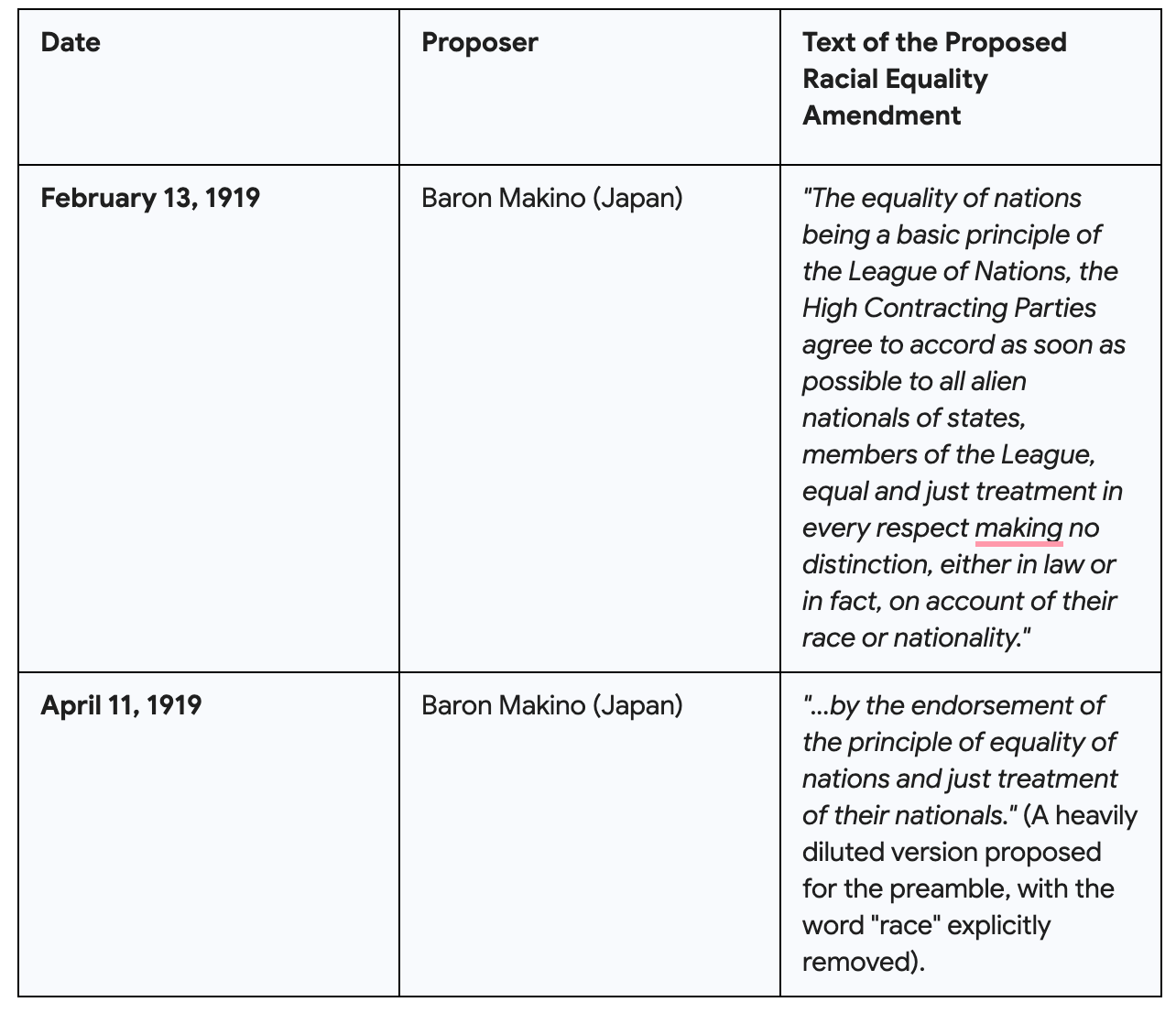
Makino presented the amendment with immense diplomatic tact. He argued that if citizens of member states were expected to fight and potentially die to defend the territorial integrity of other League members under the banner of collective security, they must logically be afforded equal dignity and rights.45 French delegates, viewing their own imperial mission through the lens of a universal civilising culture, strongly supported the Japanese.46 Italian Prime Minister Vittorio Orlando similarly voiced his backing for what he termed an “indisputable principle of justice”.47
However, the proposal sent a wave of panic through the English-speaking delegations. While the Japanese diplomats quietly assured their Western counterparts that the clause was only a statement of abstract principle and would not compel any nation to alter its internal immigration laws, Western leaders remained deeply skeptical. In the prevailing spirit of internationalism that permeated Paris, words mattered. To inscribe such a clause into the foundational charter of a new supranational legal body was to create a mechanism for endless interference in the domestic affairs of sovereign states.
If all nations were legally bound to make no distinction based on race or nationality in law or in fact, the legal architecture underpinning the White Australia Policy, the anti-Asian land laws of California, and the restrictive immigration quotas of Canada and South Africa would inevitably be subjected to challenge and dismantlement. Hughes feared that the cosmopolitan atmosphere of the “Hot Conference” might persuade a majority to support an approach that would leave Australia isolated, “a tiny patch of white in a great sea of colour”.48
Little David and the American Goliath
When news of the proposed racial equality clause reached the British Empire Delegation at the Hotel Majestic, Billy Hughes immediately recognised the threat. Hughes was already locked in a bitter dispute with President Wilson over the fate of German New Guinea. Wilson, driven by his doctrine of “no annexations,” wished to place the territory under the direct control of the League of Nations.49 Hughes, terrified at the prospect of a potentially hostile power acquiring naval bases on Australia’s immediate northern doorstep, demanded outright annexation.50
The tension between the two leaders was palpable. Wilson viewed Hughes as a crude, obstructionist provincial, a “pestiferous varmint” who stubbornly refused to embrace the new dawn of liberal internationalism.51 Hughes, conversely, viewed the American President as a dangerously naive academic whose lofty utopianism threatened the practical security of real nations.52
The animosity erupted during a tense session of the Supreme Council. When Wilson, exasperated by Hughes’s intransigence over New Guinea, slowly and solemnly asked if Australia was prepared to defy the appeal of the “whole civilised world,” Hughes adjusted his acousticon, smiled thinly, and replied, “That’s about the size of it, President Wilson”.53 In another exchange, Wilson attempted to shame the Australian Prime Minister by reminding him that he represented a population of merely five million people, questioning his right to dictate terms to a conference representing over a billion. Hughes levelled his gaze at the President and delivered a line that would immortalise him in Australian political folklore: “I speak for 60,000 dead. How many do you speak for?”54
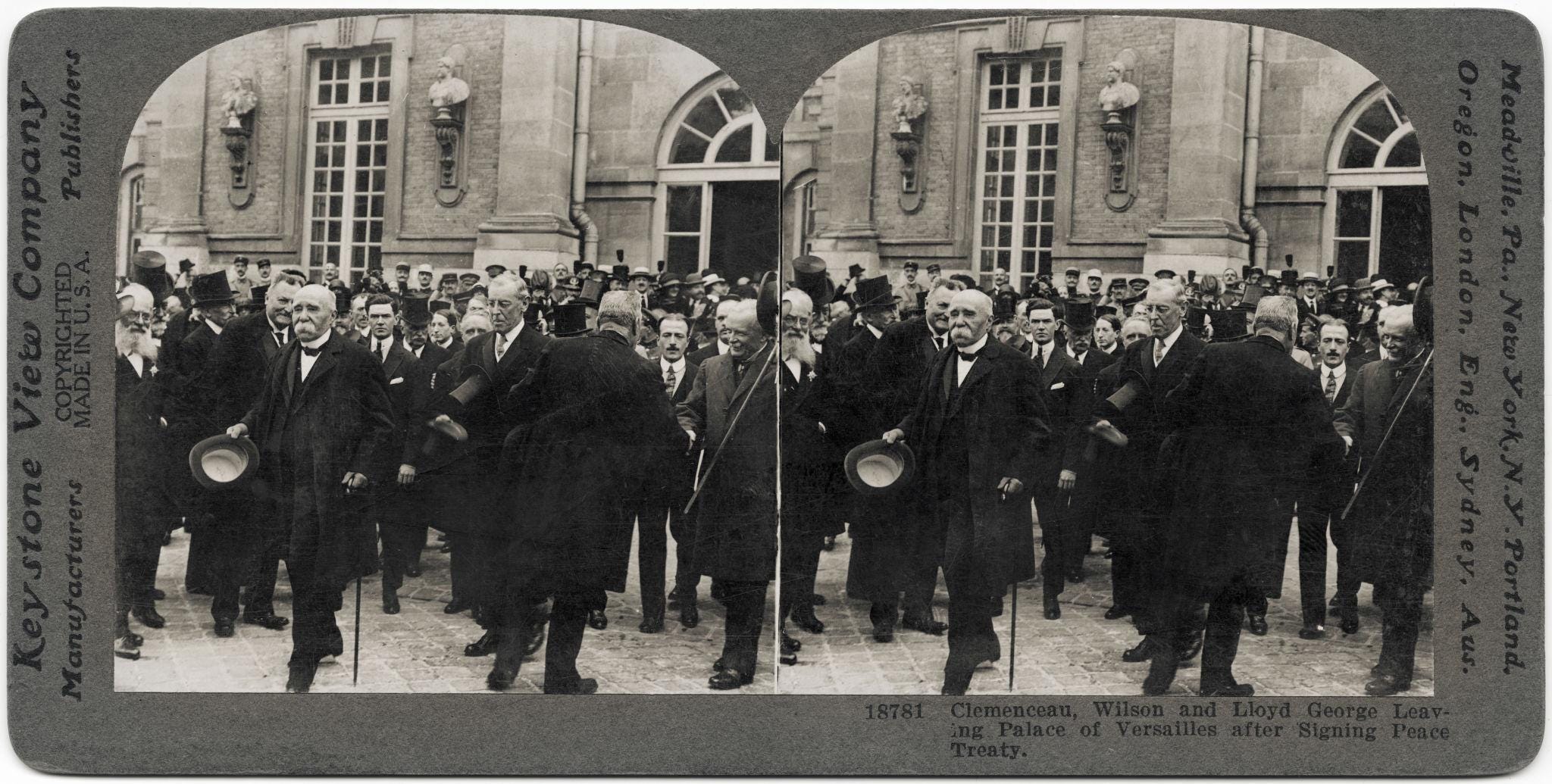
British Prime Minister David Lloyd George, attempting to defuse the escalating hostility, intervened to ask Hughes if he would at least allow Christian missionaries free access to New Guinea if Australia were granted control. Hughes, never one to miss an opportunity for dark humour, replied: “Of course. I understand that these poor people are very short of food, and for some time past they have not had enough missionaries”.55 While Clemenceau and Lloyd George were amused, Wilson was enraged.56
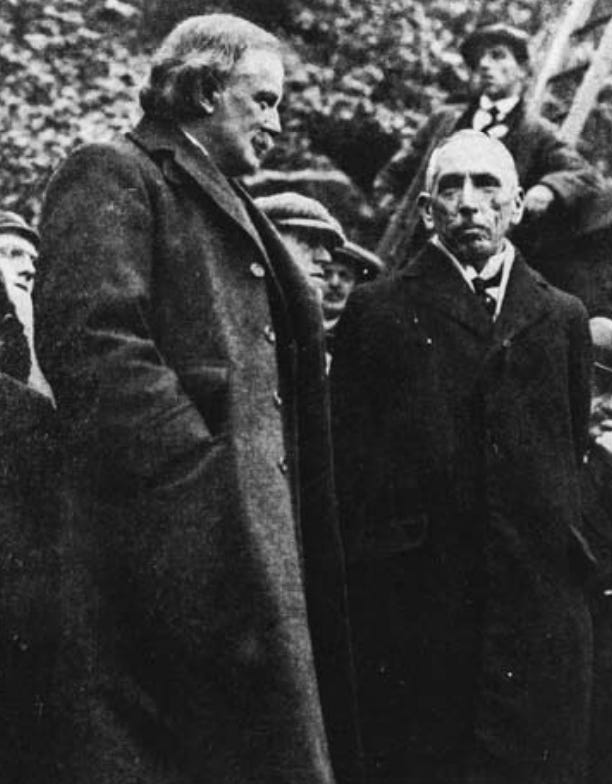
While Hughes eventually accepted a compromise brokered by British diplomats, the creation of a “Class C” mandate that allowed Australia to administer New Guinea under its own laws, effectively securing the strategic buffer while saving Wilson’s face, he refused to yield a single inch on the racial equality clause.57
As the Japanese delegation pressed the issue, the pressure on Hughes mounted. General Jan Smuts of South Africa and Prime Minister Robert Borden of Canada attempted to mediate, visiting Hughes to negotiate a watered-down formula that might satisfy Japanese pride without threatening dominion immigration laws.58 The meetings ended badly. The Japanese diplomats found Hughes to be a vulgar and obnoxious “peasant,” while Hughes complained that the Japanese were trying to manipulate him with “obsequious deference”.59 Hughes was immovable. He stated plainly: “The position is this, either the Japanese proposal means something or it means nothing: if the former, out with it; if the latter, why have it?”.60
When Colonel Edward M. House, Wilson’s closest advisor, urged Hughes to accept a mild compromise to preserve the harmony of the conference, Hughes scrawled a blunt note in reply. He warned that if the clause were adopted, his government would fall.61 He added a characteristic flourish of theatrical defiance, declaring: “But sooner than agree to it I would walk into the Seine or the Folies Bergeres with my clothes off”.62
Hughes weaponised his lack of diplomatic grace. He actively leaked details of the negotiations to the American press, deliberately stirring up a hornet’s nest of opposition among politicians on the U.S. West Coast.63 Senator James Duval Phelan of California immediately launched a propaganda campaign, bombarding the American delegation with telegrams warning that the clause was a loophole that would destroy American demographic security.64 Hughes effectively boxed Wilson in, manoeuvring the American President into a position where endorsing the Japanese proposal would trigger a domestic political revolt in the United States and fracture the British Empire Delegation.
The Collapse of the Clause and the Unanimity Veto
The climax of the racial equality dispute occurred on the evening of April 11, 1919, during a final session of the Commission on the League of Nations. Having seen their previous drafts rejected, Baron Makino introduced a heavily diluted version of the amendment, seeking only to insert a reference into the preamble of the Covenant endorsing “the principle of the equality of Nations and the just treatment of their nationals”.65 The word “race” had been entirely stripped from the text in a desperate bid to secure its passage.66
Makino delivered an impassioned plea, warning that ignoring the deep-seated resentments caused by racial prejudice would eventually undermine the very foundations of the League.67 The British representative, Lord Robert Cecil, acting as the designated mouthpiece for the anxieties of the dominions, expressed his regret but firmly opposed the amendment, arguing that such matters would inevitably infringe upon internal state policies.68
When the matter was forced to a vote, the result was a clear victory for the Japanese.
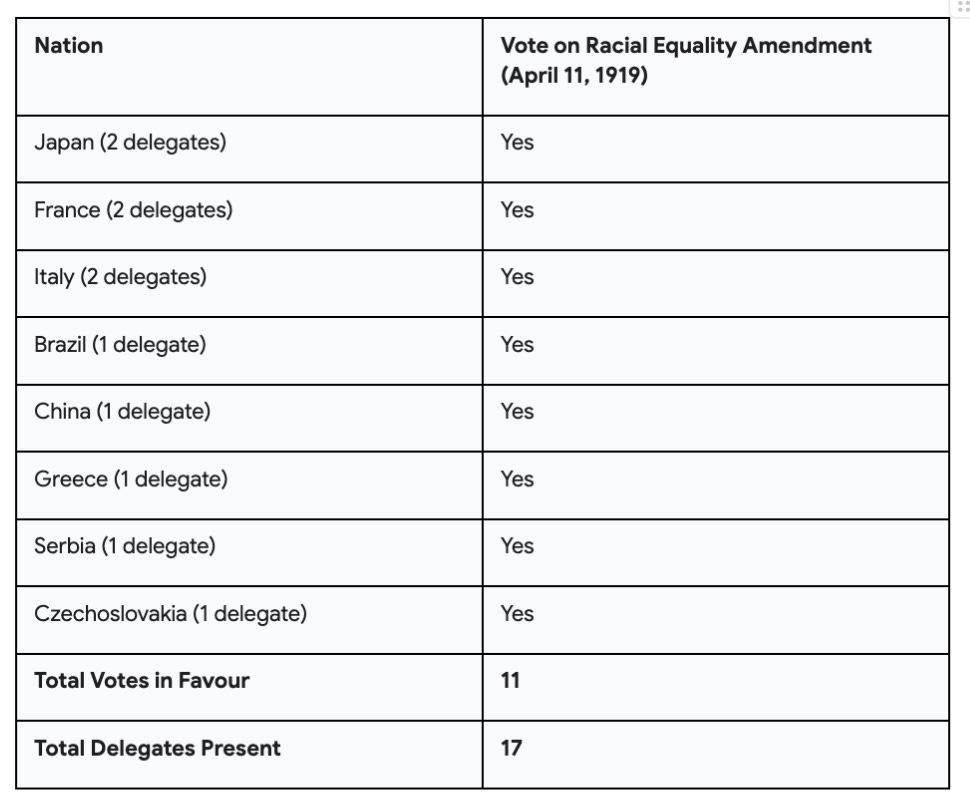
The voting record demonstrates that the amendment secured a definitive majority among the Commission delegates.69 The United States, Great Britain, Portugal, Poland, and Romania did not vote in favour.70
With 11 of the 17 delegates voting in the affirmative, the amendment appeared to have succeeded. Yet Woodrow Wilson, sitting as the chairman of the Commission, found himself trapped. He was desperate to secure the creation of the League of Nations, which required the continued support of the British Empire and the ratification of a skeptical U.S. Senate.71 Knowing that Billy Hughes was prepared to deliver a highly inflammatory, wrecking speech at the upcoming Plenary Session if the clause passed, Wilson made a drastic, unprecedented parliamentary manoeuvre.72
Ignoring standard democratic procedure, Wilson unilaterally declared that because the amendment had failed to achieve unanimous approval, it was defeated.73 When the Japanese delegates politely protested that previous amendments had been carried by simple majorities, Wilson stone-walled them, stating that on matters of such grave international consequence, only absolute unanimity would suffice.74
Billy Hughes had won. By standing as the immoveable object against the irresistible force of globalist sentiment, he had single-handedly orchestrated the collapse of the racial equality clause. To placate the furious Japanese, Wilson subsequently agreed to support their territorial claims over the Shandong Peninsula and the mandate over the Pacific islands north of the equator, islands that Japan would illegally militarise in the 1920s, setting the stage for the bloody Pacific theatre of World War II.75 Hughes returned to Australia to a hero’s welcome, greeted by crowds “unsurpassed in the history of Australia,” and triumphantly reported to the federal parliament that he had brought the great principle of a White Australia back from Paris “as safe as it was on the day when it was first adopted”.76