
The Monroe Doctrine, Reimagined by Trump
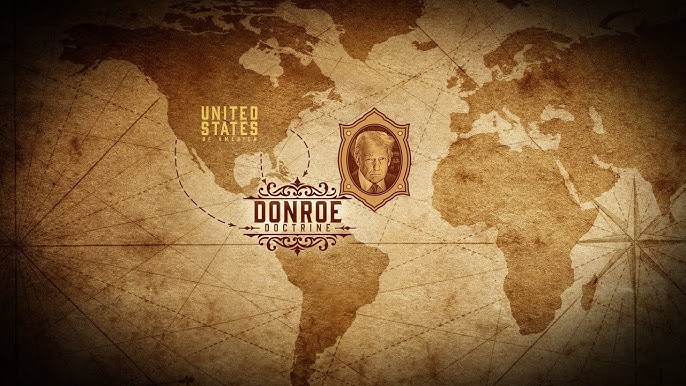
The US capture and transfer to New York of Venezuelan President Nicolas Maduro has sent shockwaves throughout the world as international leaders are compelled to consider the real-world application of the geopolitical theory outlined by the White House in its November 2025 National Security Strategy (NSS) document. The world must now wake up to the reality of what President Donald Trump is calling the “Trump Corollary” to the Monroe Doctrine and all this entails — US domination of the Western Hemisphere, to the exclusion of all nonhemispheric competitors and any regional actors who do not toe the line when it comes to the dictate of US dominance set forth by the White House.
The military raid that captured Maduro and his wife, Cilia Flores, was not an action that came out of the blue. Indeed, its inevitability was predicted in these very pages, where not only was a US-backed regime change predicted, but the context of this action spelled out starkly: “The looming conflict between the US and Venezuela looks to be the initial act in a larger drama of regional power consolidation by a Trump administration keen on building a ‘fortress America’ capable of withstanding the global challenges of a new multipolar world.”
Such speculation has now entered the realm of reality. “We want a hemisphere whose governments cooperate with us against narco-terrorists, cartels, and other transnational criminal organizations,” Trump stated in the 2025 NSS, published in November. The removal of Maduro has put on notice the leadership of Mexico, Colombia and any other nation in the Western Hemisphere that could be painted with the brush of “narco-terrorism” that they may be vulnerable to similar US military intervention and should act accordingly.
“We want a hemisphere,” Trump noted, “that remains free of hostile foreign incursion or ownership of key assets, and that supports critical supply chains; and we want to ensure our continued access to key strategic locations. In other words, we will assert and enforce a ‘Trump Corollary’ to the Monroe Doctrine.” This passage is meant as a direct threat to Russia, China and Iran, all of which had established interests in Venezuela and elsewhere in the Western Hemisphere, that they are not welcome to operate in the backyard of the US and that the US reserves the option of direct action to remove them, by force if necessary.
Cuba is very much in the sights of the Trump administration, something the Russian government must now consider. How far Russia would be willing or able to go in responding remains unclear.
China Put on Notice
China, too, has been put on notice. The embarrassment of having the US detain Maduro shortly after the Venezuelan leader had engaged with a senior Chinese delegation is manifest. Maduro had publicly emphasized China-Venezuela ties in a social media post prior to his detention, writing that Caracas remained committed to a “strategic relationship … for the construction of a multipolar world.”
Trump has effectively vetoed this trajectory, underscoring Washington’s intent to block expanded Chinese strategic influence in the Western Hemisphere.
“The United States,” Trump declared in the 2025 NSS, “must never be dependent on any outside power for core components — from raw materials to parts to finished products — necessary to the nation’s defense or economy. We must re-secure our own independent and reliable access to the goods we need to defend ourselves and preserve our way of life. This will require expanding American access to critical minerals and materials while countering predatory economic practices.”
China must now adjust to the reality that any effort undertaken to expand its Belts and Road Initiative into the Western Hemisphere will face active resistance from a US that is now actively engaged in a policy not of containment but rollback. The US, under Trump’s leadership, is now committed to securing access to critical supply chains and materials.
The interest in these materials is not new. Gen. Laura Richardson, the former Commander of US Southern Command, responsible for overseeing military operations in Central and South America, in 2023 highlighted the existence of what she called “the lithium triangle” in Argentina, Bolivia and Chile — often cited as holding roughly half or more of global lithium resources — and warned that the US would not sit by idly while these resources fell under the control of outside powers, such as China.
The Trump administration has previously made known its dissatisfaction over Chinese influence involving the strategic Panama Canal. China has largely obviated the canal’s importance by building a massive $1.3 billion port facility in Chancay, Peru, that will have rail connectivity with Brazil and other South American nations lacking Pacific coast access. One could anticipate that the US might soon put the Peruvian leadership on notice that Chancay must be placed under US control.
The Trump Corollary to the Monroe Doctrine
In 1823, when then-President James Monroe announced to Congress that it was the policy of the US that the New World and the Old World were to remain distinctly separate spheres of influence, little did he realize the degree to which that pronouncement would grow to shape global affairs. Although his name was not formally attached to the doctrine until 1850, the policy itself was implemented in haphazard fashion, holding the Spanish and British at bay while turning a blind eye to the imperial incursions of France. By the close of the 19th century, however, the Monroe Doctrine had been repurposed with vigor. In a case involving Venezuela and Great Britain, then-US Secretary of State Richard Olney declared, in what has become known as the “Olney Corollary” to the Monroe Doctrine, that the US “is practically sovereign on this continent, and its fiat is law upon the subjects to which it confines its interposition.”
This bold interpretation was enhanced in 1904 by then-President Theodore Roosevelt, who set forth what has been called “the Roosevelt Corollary” to the Monroe Doctrine, namely that the US had the right to intervene in Latin America in cases of “flagrant and chronic wrongdoing by a Latin American Nation” in order to preempt intervention by European creditors.
The Monroe Doctrine has been at the center of US policy in the Western Hemisphere for more than two centuries. The limits of US hegemony, however, have in the past few decades been reached, with the US floundering in Europe, the Middle East and Asia as it confronts the reality of a multipolar world. The essence of the newly invigorated Trump Corollary to the Monroe Doctrine is that there is no room for multipolarity in the Western Hemisphere. Trump has declared that the US “will reassert and enforce the Monroe Doctrine to restore American preeminence in the Western Hemisphere, and to protect our homeland and our access to key geographies throughout the region. We will deny non-Hemispheric competitors the ability to position forces or other threatening capabilities, or to own or control strategically vital assets, in our Hemisphere.”
According to the 2025 NSS, the US “must be preeminent in the Western Hemisphere as a condition of our security and prosperity.” Yet, the document also concedes that Washington seeks to be seen as a “partner of first choice” — while simultaneously discouraging regional collaboration with rival powers.
The days of US passivity in the face of foreign involvement in the Western Hemisphere are over. Trump is committed to a policy designed to create a “fortress America” in the Western Hemisphere. Venezuela is just the opening act. Greenland has been put on notice that it may be next. The bottom line is that, over the course of the next three years, the US will be actively moving to make the Western Hemisphere an exclusive geopolitical playground of the US. That, in its essence, is the Trump Corollary to the Monroe Doctrine.
https://thealtworld.com/scott_ritter/the-monroe-doctrine-reimagined-by-trump