
The New Atlanticism of Marco Rubio
Alexander Dugin on the West’s strategic recalibration in Munich.
U.S. Secretary of State Marco Rubio’s speech at the Munich Security Conference on February 14, 2026, differed significantly from the analogous address delivered by Vice President JD Vance at the same conference a year earlier.
Last year’s speech by Vance was, in essence, a triumph of MAGA—the ideology under whose banner Donald Trump came to power after winning the presidential election for a second time. The U.S. vice president laid out before the Europeans (most of whom were globalists) Washington’s new course towards strengthening the United States as a fully sovereign pole within the context of a multipolar world, as well as the end of the era of globalism. Vance did not conceal his disdain for the Europeans and sharply criticized their left-liberal ideology. The absence of hysterical Russophobic incantations and curses in his speech was perceived by the Euro-globalist elite almost as a “pro-Russian position.” The overall impression was that Atlanticism had collapsed and that the collective West had split into two independent systems: American nationalism (America First) and a fragment of failed globalism represented by the EU.
This time, Secretary of State Marco Rubio spoke in Munich. His address reflected the transformations that U.S. policy has undergone over the intervening period. Importantly, Rubio himself is a neocon; he is oriented towards strengthening Atlantic solidarity, continuing and even intensifying hegemonic policy in Latin America (it was Rubio who promoted the invasion of Venezuela, the overthrow of Maduro, as well as intervention and regime change in Cuba), and escalating tensions with Russia. At the same time, Marco Rubio seeks to fit into Trump’s conservative rhetoric and criticizes the left-liberal agenda (albeit far more mildly than MAGA—and Vance in particular).
First and foremost, Rubio reassured EU leaders regarding the preservation of Atlanticist solidarity. According to him, “in a time of headlines heralding the end of the transatlantic era, let it be known and clear to all that this is neither our goal nor our wish, because for us Americans, our home may be in the Western Hemisphere, but we will always be a child of Europe.” And further: “For the United States and Europe, we belong together.”
The transatlantic era, therefore, continues. At the same time, in the spirit of classical neoconservatism, Rubio emphasized Europe’s strategic dimension. He stated: “We want Europe to be strong. …our destiny is and will always be intertwined with yours, because we know that the fate of Europe will never be irrelevant to our own.” The Secretary of State also assured that nothing threatens NATO: “We do not seek to separate, but to revitalize an old friendship and renew the greatest civilization in human history. What we want is a reinvigorated alliance…”
Rubio spoke critically of the left-liberal system of values; however, he mainly explained the fallacy of liberal democrats’ false hopes—their complacency and confidence in guaranteed global dominance after the collapse of the USSR. Rubio said: “But the euphoria of this triumph led us to a dangerous delusion: that we had entered, quote, ‘the end of history’; that every nation would now be a liberal democracy; that the ties formed by trade and by commerce alone would now replace nationhood; that the rules-based global order—an overused term—would now replace the national interest; and that we would now live in a world without borders where everyone became a citizen of the world. This was a foolish idea that ignored both human nature and it ignored the lessons of over 5,000 years of recorded human history.”
Although Rubio did not mention Russia directly in his speech, on the sidelines of his visit he lamented the “horrors of war,” stating that “we don’t know the Russians are serious about ending the war” and that “we’re going to continue to test it,” while also assuring that the United States would continue to pressure Russia through economic sanctions and via arms supplies to Europe, which would ultimately go to Ukraine. On this issue, Rubio appeared to side more with the Old World, arguing that together with Europe, the US would continue to take measures to pressure Russia so that it would come to the negotiating table.
However, Rubio skipped a meeting of European leaders with Zelensky on Ukraine, held on the margins of the forum, and instead went to meet with Orbán—and this alone provoked criticism from the Euro-globalists, who regarded such behavior as a “challenge.”
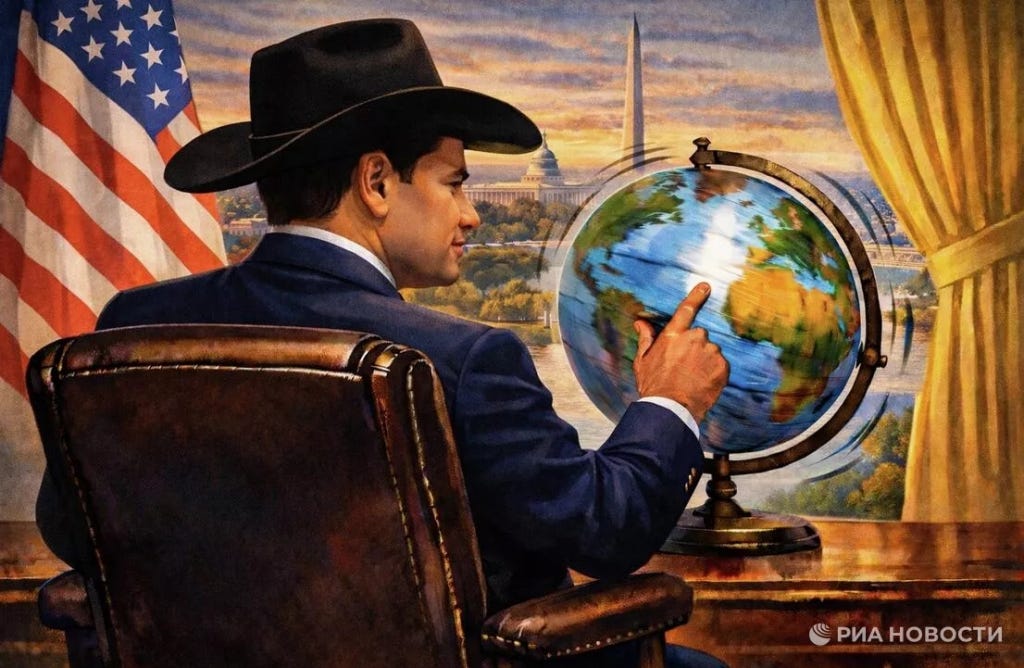
Rubio concluded his conference speech on an optimistic note, hinting that the “new sheriff” in the person of Donald Trump is far less terrible than many believe, and that in reality his international agenda does not differ greatly from the plans of the globalists, albeit presented in a distinctive, extravagant packaging. The very figure of Rubio—a neocon and globalist—was meant to confirm this thesis. He ended with the words: “America is charting the path for a new century of prosperity, and that once again we want to do it together with you, our cherished allies and our oldest friends.”
If one steps back from the emotions, Secretary of State Marco Rubio’s visit to Europe for the Munich Conference records a significant shift in the policy of the U.S. administration compared with last year. The new national security strategy declared that from now on the United States would focus on the Western Hemisphere, which was interpreted as a return to the Monroe Doctrine (America for the Americans) and a break with the Old World. Rubio clarified that this is not the case and that all Atlanticist structures remain in place.
Thus, with a certain degree of confidence, one can conclude that over the past year U.S. policy has moved far away from the revolutionary project of MAGA and is drawing closer to a radical version of neoconservatism and Atlanticist realism.
From the positions with which Trump began his second presidential term, Russia and the United States had prospects for reaching an agreement on new foundations for the world order. Especially since we, Vance, Trump himself, and Rubio all agree that the old liberal-globalist world order, “rules-based,” no longer exists. We would not have particularly objected to a strengthening of the United States in the Western Hemisphere, and Vladimir Putin had the opportunity in Anchorage to discuss his global vision with the U.S. president. The problem of Ukraine would hardly have been resolved, but Washington could well have withdrawn from this war and focused on its own problems. A deterioration in relations between the United States and the EU would also have been rather to our advantage, while a return to traditional values fully coincided with our own patriotic and conservative ideology. With MAGA, we had every chance of finding common ground.
Yet at a certain point Trump himself began, in his policies, to retreat from MAGA and draw closer to the neocons. Parallel to this, Marco Rubio’s role within the political system grew. Negotiations on Ukraine, already problematic and even ambiguous from the outset, gradually approached a near deadlock.
Most importantly, this has affected more than just Russian-American relations. The U.S. administration has turned to neoconservative strategies (in essence, an attempt to save Western hegemony and the unipolar world) in all other areas as well: pressure on BRICS, strikes against Iran, the abduction of Maduro, and intensified sanctions pressure on Russia. And now Marco Rubio, at the Munich Conference, has articulated a program of new Atlanticism—less liberal and more realist, yet still the same. It remains a unipolar world, and in no way a new world order of great powers.
The paths of Russian civilization and Western civilization are diverging ever further (although this process began many centuries ago). We must be prepared for this
(Translated from the Russian)
https://www.multipolarpress.com/p/the-new-atlanticism-of-marco-rubio