
The No Kings Rallies are Not Fighting the System — They ARE the System
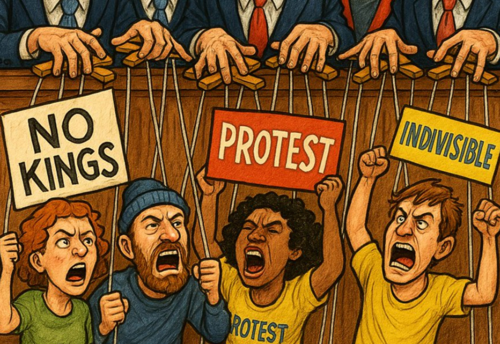
The Machine is not broken.
In a few days, millions of Americans will gather across the country to participate in the third iteration of “No Kings” rallies. These protests will be a visible repudiation of an administration that has made the cruelty of empire unusually legible. There will be signs (but no demands). There will be chants (though none against war). There will be a Chuck Schumer post about being ”so proud of Americans who stand up peacefully.” And, for a few hours, a sense of solidarity will take hold. It will feel like hope.
Then everyone will go home. The sense of solidarity will dissolve in the return to atomized life, and any residual energy will be siphoned with practiced efficiency back into the same system that produced every single condition protestors marched against. It will become donations to a party that will not fight for them. It will become votes for candidates filtered to ensure nothing fundamentally changes. It will become faith that the next election, the next candidate, the next ruling, will be the one that finally changes things.
That hope is a cage. It must be destroyed before anything real can begin.
The Wrong Diagnosis
Perhaps the only point of consensus across the American polity is that something is wrong, although Americans differ on what is wrong. A modest plurality of 29% identify “government and poor leadership” as the country’s most important problem — and they are closer to the truth than their diagnosis allows.
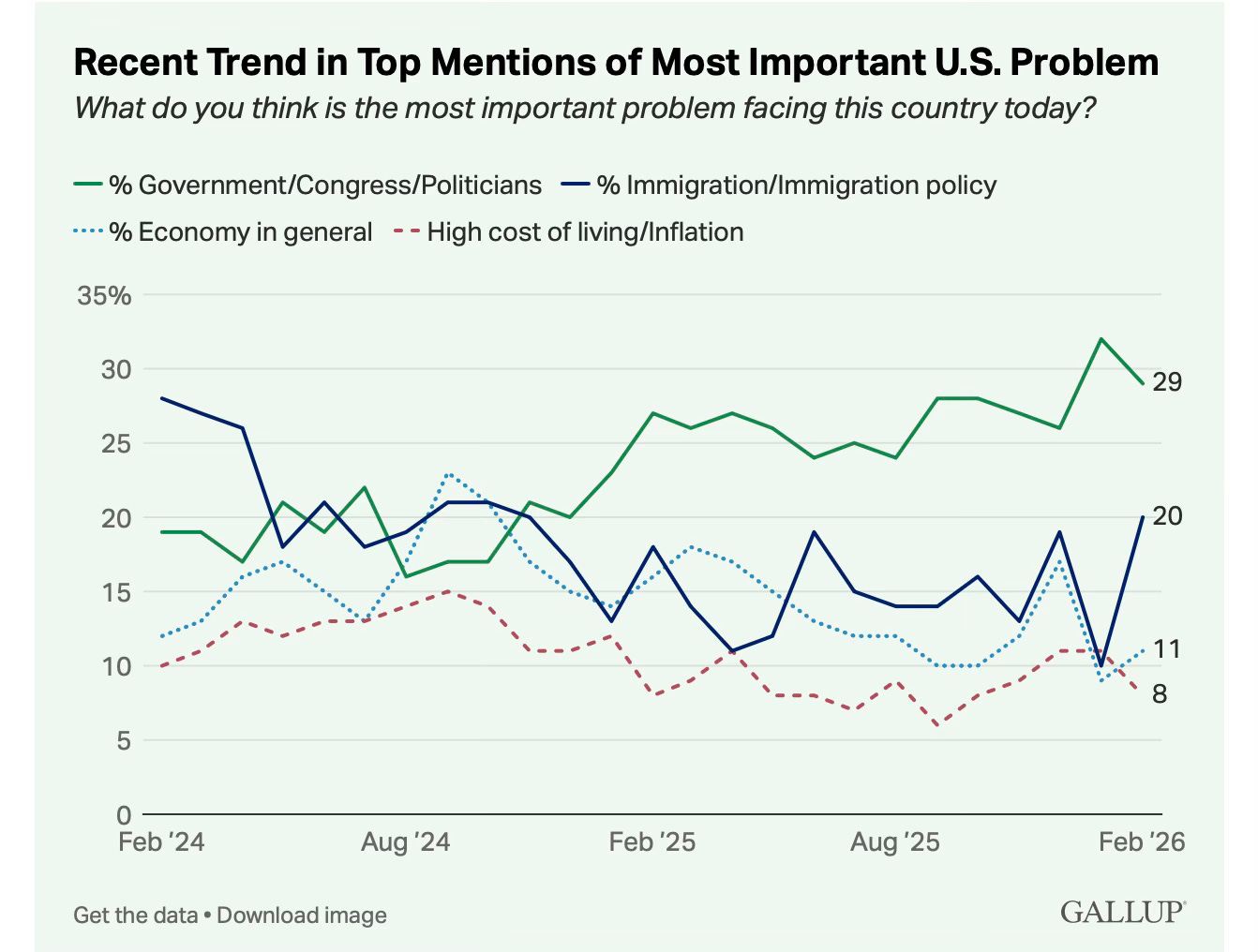
These results are hardly surprising: the machinery of empire is producing suffering on a global and industrial scale. From that recognition, a predictable error follows: a misdiagnosis that persists not by mistake, but because it is the only conclusion compatible with the interests of those who benefit from the system’s operation — the belief that the system is broken, and that the right fix can make it produce different results.
This is not merely a misdiagnosis. It is the misdiagnosis — the load-bearing delusion that converts outrage into system maintenance. This is the deeper trap of the No Kings rallies: recognition without structural analysis is not solidarity, but a shared misdiagnosis that leaves power undisturbed. Real solidarity begins not when people gather to acknowledge the wound, but when they stop believing the knife can be used to heal the wound it inflicted.
The Purpose of a System Is What It Does
The cyberneticist Stafford Beer gave us one of the most quietly devastating analytical tools of the twentieth century when he observed that the purpose of a system is what it does. Not what it was designed to do. Not what its operators say it does. Not what its foundational documents promise. What it does.
Once internalized, this principle makes a great deal of American political discourse simply evaporate. The debate over what the system was meant to do becomes irrelevant — the material output is the argument.
So what does this system produce?
It produces a healthcare apparatus in which a parasitic intermediary extracts hundreds of billions annually for the service of standing between human beings and medical care, contributing nothing, denying claims and delaying treatment, and being compensated handsomely for it — an arrangement so lucrative that medical debt has become a leading driver of bankruptcy in the wealthiest society in human history.
It produces rising prices that never recede and a workforce whose real wages have not risen in half a century while productivity has doubled. It produces an educational system that functions as a debt-indenture pipeline — you may access the credential required for a living wage, but only by mortgaging your future labor to do so.
It produces a mass surveillance system of breathtaking scale. It produces a prison system that has the highest incarceration rate in the world, one that disproportionately warehouses the poor and the Black, and then, with characteristic American efficiency, leases them back out as labor.
It produces war as industry. Genocide as real estate strategy. Ecocide as quarterly earnings. The future of the species reduced to a tradeable — even speculative — commodity.
You can spend a lifetime arguing about whether this is what the system was meant to do. Indeed, the system even commodifies its own critique — an entire industry of constitutional scholarship, Oscar-nominated documentaries, and bestselling books with one-word titles, all dedicated to the question of whether the machine was meant to do what it does, all profitable, none consequential. But the child-feeding machine either feeds children or it eats them, and if it has been eating them reliably for two and a half centuries, with only modest pauses to renegotiate exactly which children and how quickly, we do not need a panel of experts to ascertain its designer’s intent. Its purpose is what it does.
We have our answer: the system is not broken. It is working exactly as it is meant to work. And what it is meant to do is concentrate wealth and power in the hands of those who own the system. The suffering such concentration causes is not a design flaw — it is system exhaust.
The people who run this system are not cartoonish sadists; they are something worse: they are utterly indifferent. Your immiseration — the hollowing out of your communities, the slow death of your retirement, the poisoning of your water — these are not things they want, not usually. They only require that your suffering remain profitable or ignorable, which is a colder, more durable cruelty than malice could ever sustain. Malice burns out. Indifference is structural.
The Architecture of Belief
Everything that supports the system — the vast ideological and institutional superstructure, the legal doctrines, cultural mythologies, its bureaucratic machinery — exists to ensure the system keeps producing the same results. This is not conspiracy. It is function. The superstructure does not need to be coordinated by shadowy elites in a room. It needs only to be selected for — the way any organism selects for the traits that keep it alive.
Its most important support is not the courthouse, the newsroom, or the corporate office. It is your continued belief that the mechanism can be made humane without being replaced. That belief allows the system to absorb protest the way a factory absorbs waste and calls it output.
This is not a call for abstention; it is a warning against mistaking participation for power. After all, there is a critical difference between strategic engagement and faith. The organizer who runs for office to build infrastructure, not to win salvation through the ballot, is operating strategically. The voter who believes the next election will be the one that changes everything is providing maintenance for the machine.
The System Dialectic
The same mechanism that concentrates wealth upward necessarily produces the immiserated class with both the motive and the structural position to supersede it. The machine does not merely produce suffering — it produces its own gravediggers: people pushed not only to reject it, but to form new structures that will replace it. This is not optimism. It is the internal logic of the system, and it is the only output its operators cannot suppress without dismantling the machine itself.
This has happened before, and every time it has, the machine’s response has confirmed the thesis. The Black Panther Party did not petition the child-feeding machine to feed children. They built breakfast programs that fed more than twenty thousand children, free health clinics that screened for sickle cell anemia, and schools that taught liberation as curriculum. The FBI did not classify the Black Panther Party as the greatest threat to internal security because of its guns, but because the Party’s programs demonstrated that the machine was unnecessary — and nothing threatens a system more than proof of its dispensability.
In New York the Young Lords commandeered the city’s own mobile X-ray truck — which had never reached East Harlem — and ran it themselves to conduct tuberculosis testing, because the city would not. The Zapatistas built and maintained autonomous schools, clinics, and governance in Chiapas for more than three decades, not by seizing state power, but by making it irrelevant in the territory they hold.
The pattern is consistent: every consequential attempt to build outside the system has been met not with indifference but with the full coercive apparatus of the state. This is clarifying. Power does not mobilize against what it considers ineffective. The No Kings rallies, whatever the intentions of their participants, have drawn no such response. The machine does not mobilize against its own maintenance crew.
So what comes after the death of faith is not passivity — it is a redirection of enormous energy toward the only work that has ever produced results: building the institutions that outlast the regimes that failed them. Not within the system’s logic, but against it — the way every durable movement in history has done, by constructing a different social order within the shell of the existing one and forcing the question of which one deserves to survive.
The child-feeding machine was not built to feed children. We know this because it does not feed children. Every minute spent hoping it will is a minute not spent building what actually can.
Clarity begins where that poisoned hope is finally buried. Only then can the real work begin.
https://realdialectical.substack.com/p/hope-will-not-stop-the-child-feeding